Unit 3: Land-Based Empires 1450-1750
Contextualization
- Bubonic Plague
- Silk Road, Yuan Dynasty Pax Mongolia
- Feudalism
- landed elites, aristocracy →most power/influcne
- decentralized system
- Song invent gunpowder!
- countries begin to unify under centralized rule
https://www.youtube.com/watch?v=2a9qWnAUn2A
https://quizlet.com/439018590/ap-world-history-unit-3-land-based-empires-flash-cards/
Historical Development
==GUNPOWDER EMPIRES==
- large states that relied of firearms to control/expand territory
- bureaucracy →consolidate power
Major European Developments
- After 300 years of development, Europe became the dominant world power
- Revolutions in European Thought and Expression:
- crusades (religious wars of the 11th century against Muslims, that exposed Christians to advanced Islamic civilizations)
- As countries began to unify and connect more, especially with countries who had preserved their history, Europe expanded its worldview and explored its past and 4 cultural movements happened
- greater emphasis on classical past
The Renaissance (14th-17th)
- As trade increased, people moved to cities and an influx of money was experienced - a lot of money went to studying the past
- Humanism: focus on personal accomplishment, happiness, and life on earth instead of living for the goal of salvation
- Afterlife remained dominant in the Catholic Church
- Arts have a comeback
- People could afford art again - Medici family patrons of Michelangelo and Brunelleschi
- Artists focused on realism - Leonardo da Vinci and Donatello
- Western writers have an audience
- mid-1400s: Johannes Gutenberg invents the printing press - made books easy to produce and affordable, and accessible to everyone
- led to more literate people
The Protestant Reformation (16th-17th)
Define: It resulted in the creation of a branch of Christianity called Protestantism, a name used collectively to refer to the many religious groups that separated from the Roman Catholic Church due to differences in doctrine.
The Reformation was a split between the Catholic Church and what became known as the Protestant Church. The Protestants wanted to be able to read and interpret the Bible for themselves rather than follow the Catholic interpretation.
- Catholic Church was one of the most powerful organizations in the Middle Ages - power in politics and society - undisputed authority
- Church capitalized off its many followers with ==indulgences==: paper faithful could purchase to reduce time in purgatory
- Nobles and peasants began getting increasingly frustrated by the church’s exploitation and noticed its corrupt nature
- ==Martin Luther:== German monk who published his list of complaints against the church - most significantly proposed salvation was given directly through God, not through the church, which significantly reduced the church’s influence
- Pope Leo X: excommunicated Luther when he refused to recount his idea
- Christianity split - Luther’s ideas led to many others to come forward
- Lutherans: Luther’s followers - separated from Catholic Church
- Catholic Reformation (16th century)
- Catholic church attempts to remedy some of their controversies and regains some of its credibility - still wanted authority and control
Scientific Revolution
- Scientific method
- reason needs to be backed up with mathematical precision
Important figures
- Copernicus →came up with the idea of a heliocentric universe
- Galileo →backed up findings with telescope
- theories did not align with the model sanctioned by the Catholic Church
- Deism (popular in the 17th) →God set up world, giving it natural laws, but did not interfere with his creation
Evidence:
The development of the Manchu, Mughal, Ottoman, and Safavid empires
- Manchu (Qing dynasty) 1644-1912
- Ming (previous dynasty last native chinese dynasty) expanded the great wall →isolationism
1. used gunpowder! to expand territory 2. reinstate civil service exam →legitimize rule in eyes of Han people
- Ottoman empire (1300-1922)
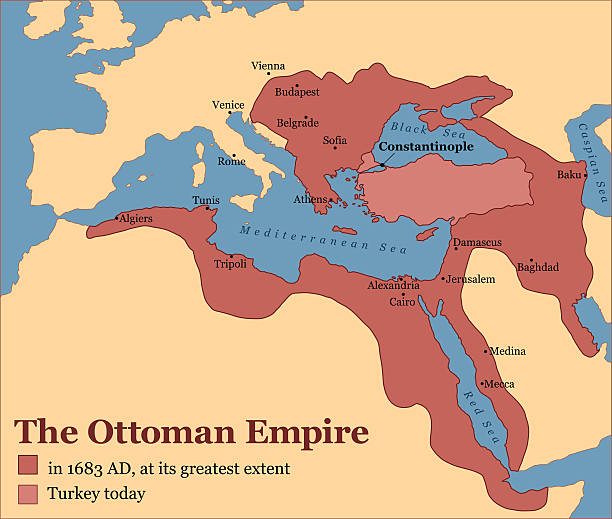
Define: A Muslim empire that ruled over a large territory that included parts of Europe, Asia, and Africa from the late 13th to the early 20th century. It was known for its use of artillery and its sophisticated system of government and administration.
→==Devshirme== system
enslaved poor Christian boys in Southern Europe and the Balkans →to serve in military and bureaucracy
- received a thorough education and some joined the Janissaries (elite force in the army)
seized constantinople (jewel of Byzantine Christianty) through gunpowder! (1453)
- Constantinople renamed Istanbul
Safavid Empire
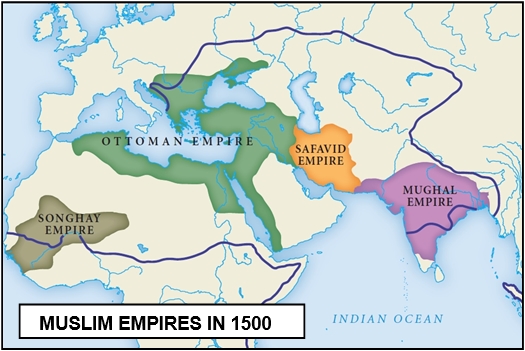
Define: A Persian empire that ruled over parts of modern-day Iran and Iraq from the early 16th to the mid-18th century. It was known for its use of artillery and its cultural achievements, including the development of a distinct Safavid style of art and architecture.
==Shia Islam== official religion
- denied legitimacy to Sunnis
- conflict with Sunni Ottomans
Mughal Empire (16th-18th century)
Define: A Muslim dynasty that ruled over a large territory that included parts of modern-day India, Pakistan, and Bangladesh from the early 16th to the mid-19th century. It was known for its use of artillery and its cultural achievements, including the construction of the Taj Mahal and the development of a distinct Mughal style of art and architecture.
- gunpowder!
- Akbar →unify India by governing under policy of religious tolerance
- prosperous, well-led
- attempt eliminate sati
Qing, Mughal, Ottoman, Safavid 1450-1750
- centralized bureaucracy and military complex and religion and art (legitimize power)
manchu→reintroduce civil service exam, legitimize rule
devshimre (ottoman consolidate power) →poor christian boys →military and bureaucracy →janissaries (loyal to the sultan)
Songhai →control trade, alliances, put power on display
Aztecs consolidate power through tribute system, remote rule
land based empires →collected taxes!
Ottoman →tax farming
Aztec →list of goods, human sacrifices
taxes build giant military complexes →intimidation and gunpowder
Europe: divine right of kings
Islamic empires: caliph
Songhai →convert to islam
Christianity split( protestant reformation) →contribute to growth of Christianity
Ottoman (sunni) empire vs Safavid (safavid)
art and monumental architecture →MUGHAL →TAJ MAHAL (tomb for wife)