Saturn (Part 3)
Structure of Saturn's Rings
General Composition: Fragments of ice and ice-coated rock.
Ring Orientation:
Tilted at 27° from the plane of Saturn's orbit.
Creates visibility issues for observers on Earth.
Photographic Visibility: Rings seem to disappear every 15 years during specific orbital alignments.
Saturn's Ring Structure
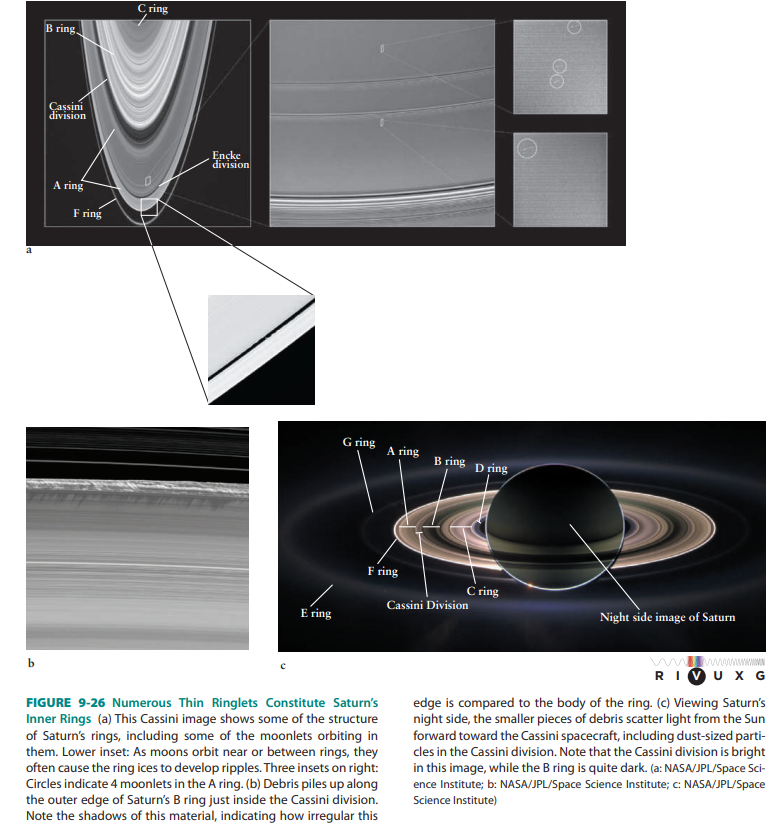
Cassini Division:
A 5000-km-wide gap in Saturn's rings.
Separates two main rings:
A ring: Dimmer, lies outside.
B ring: Brighter, lies closer to the planet.
Discovery: Mid-1800s, astronomers detected a faint C ring just inside the B ring.
Reason for Cassini Division:
Caused by gravitational interaction between Saturn’s moon Mimas and the planet.
Mimas pulls in debris, maintaining a clear area through a process called resonance:
Analogy: Like pushing a swing at the right time to make it go higher.
While larger debris is cleared, the division contains dust-sized particles.
Light scattering behavior: Dust scatters light forward, creating visible effects when viewed from certain angles.
Dynamics of the Rings
Dust Particles:
Observations from the Cassini spacecraft found evidence of tiny debris particles in the rings.
Encke Division:
A narrow gap within the A ring, named after astronomer Johann Franz Encke (1838).
Keeler Gap: Found near the outer edge of A ring, named after astronomer James Keeler (1880s).
Ripples in Rings:
Caused by gravitational pull from Saturn's moons such as Pan, Daphnis, and Prometheus.
Observations from Voyager and Cassini provide insights into ring dynamics and physical structures.
F Ring:
A thin set of ringlets preserved by the orbits of Prometheus and Pandora.
Thicker Edges: Debris buildup causes parts of the ring (specifically the B ring) to rise above and below the plane, forming irregularities.
F Ring Dynamics and Origin Theory
Shepherd Satellites:
Outer satellite (e.g., Pandora) orbits slower than F ring particles, exerting a backward gravitational tug.
This tug slows particles, causing them to fall into orbits closer to Saturn.
Inner satellite (e.g., Prometheus) orbits faster than F ring particles, pulling them forward.
This nudges particles into higher orbits.
The combined effect of these two satellites (Prometheus and Pandora) focuses icy particles into a well-defined, narrow band (about 100 km wide).
Prometheus and Pandora are called shepherd satellites or shepherd moons due to their confining influence.
F Ring Features:
In 2010, Cassini observed snowballs as large as 20 km (12 mi) in diameter forming in the F ring.
These snowballs form as debris, swirls and collides under Prometheus's gravitational tug.
The F ringlets are sometimes braided or intertwined and sometimes separate.
The F ring, though stabilized by shepherd moons, ripples and shows varying brightness, possibly due to collisions between clumps of matter.
Origin Theory of Ice-Rich Rings:
Saturn's largest moons (Rhea, Titan, Iapetus) are believed to have formed in a disk of gas and dust around young Saturn.
A hypothesized innermost moon, formed close to Saturn, lost energy and spiraled inward.
It eventually crossed the Roche limit, where Saturn's tidal forces ripped its ice-rich surface apart.
The stripped ice formed the major rings, while denser rocky debris sank into the planet.
This theory is supported by the fact that all major rings are located inside Saturn's Roche limit.
Meteor Impacts and Ring Matter:
Saturn's rings are struck daily by meteors ranging from centimeter to several meters across.
These impacts create temporary streaks or ripples across the rings.
Many meteors are broken up by impacts with ring debris and become new ring matter.
Saturn's Outer Rings and Dust Rings
Beyond the main rings lie dust particle rings, unstable and dispersed.
Supporting Moons:
Moons like Janus, Epimetheus, and Pallene help stabilize and recycle debris in the outer regions.
Phoebe Ring: Observed in orbit around the moon Phoebe, consisting of particles ejected due to meteorite impacts
Ring Dimensions and Composition
Ring Thickness:
The bulk of Saturn's rings forms a remarkably thin disk, only about 10 m (33 ft) thick.
The total ring system spans over 380,000 km (236,000 mi) in width.
Small amounts of ring material can extend up to 18,000 km above and below the plane, influenced by moon gravity and Saturn's magnetic field.
Moonlets in Rings:
Cassini spacecraft discovered a new class of small moons called moonlets orbiting within Saturn's rings.
Up to 10 million moonlets may exist, theorized to be fragments of a larger body that broke apart to form the rings.
Ring Reflectivity and Composition:
Rings are highly reflective with an albedo of 0.80, indicating brightness.
Primarily composed of water ice and ice-coated rocks, confirmed by spectra.
Ring temperatures range from 93 K (–90°F) in sunlight to less than 73 K (–330°F) in Saturn's shadow.
Ultraviolet radiation from the Sun frees water particles, which are then guided by Saturn's magnetic field to combine with atmospheric particles.
The slight salmon color suggests traces of organic molecules, likely from bombardment by debris from the outer solar system.
Particle Sizes and Ringlets
Particle Size Determination:
Scientists determined particle sizes by measuring ring brightness from various angles and changes in radio signals from Voyager and Cassini.
Different rings contain debris ranging from wood smoke-sized particles to those a few centimeters across, up to 10 m in diameter.
The outermost A ring comprises larger clumps of rubble that frequently collide, analogous to planet-formation processes.
Centimeter-sized particles are the most common among those visible to the naked eye.
Ringlet Structure and Dynamics:
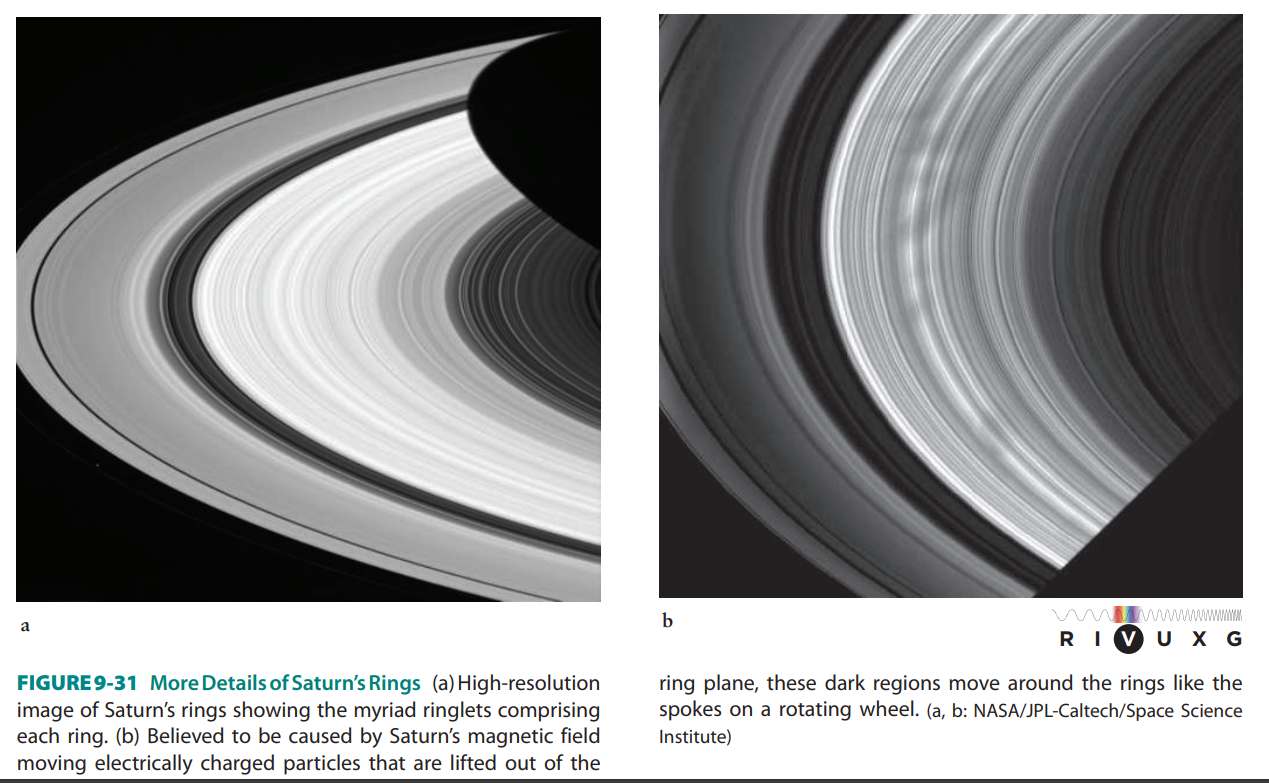
High-resolution images reveal thousands of closely spaced ringlets.
In 2014, Cassini observed a clumping event on the outer edge of the A ring, forming a larger body.
This indicates that the rings are an ever-changing ensemble of particles.
Saturn's Magnetic Field and Ring Interaction
Magnetic Field Production:
Saturn's internal liquid metallic hydrogen layer generates a planet-wide magnetic field affecting its rings.
The magnetic field at Saturn's surface is about two-thirds as strong as Earth's.
Saturn's magnetosphere includes radiation belts similar to Earth's Van Allen belts.
Dark Spokes:
Dark spokes observed moving across Saturn's rings are believed to be caused by electric charges on ring material interacting with the planet's magnetic field.
The magnetic field lifts charged particles out of the orbital plane, decreasing scattered light and making spokelike features appear darker.
As the magnetic field rotates with Saturn, it causes these regions of spread particles to change, making the spokes appear to revolve around the planet.
Titan: Saturn's Largest Moon
Overview:
Largest moon of Saturn, second only to Ganymede in size.
Discovered by Christiaan Huygens in 1655
Larger (though less massive) than Mercury.
Cool enough and massive enough to retain heavy gases.
Is in synchronous rotation around Saturn.
Atmosphere:
Features a dense atmosphere, about 44 times denser than Earth's, but unbreathable.
Pressure on Titan's surface is 1.5 times that of Earth's.
Composed of approximately 90% nitrogen (from ammonia breakdown) and 5% methane, plus other hydrocarbons.
Sunlight interacting with methane produces nearly 20 hydrocarbons (e.g., ethane, acetylene, ethylene, propane).
Thick haze completely blocked views of its surface during Voyager missions.
Atmospheric clouds of methane form and dissipate seasonally near poles and mid-southern latitudes.
Raindrops: Approximately 1 cm in size, falling six times slower due to Titan's low gravity (like slow snowflakes).
Cryovolcanoes: Believed to exist, ejecting water or methane, possibly sourcing atmospheric methane and showing surface brightness changes.
Surface Features & Composition:
Few craters, indicating dynamic surface changes.
Possesses a mountain range with peaks up to 1.5 km (1 mi), covered with organic matter and possible methane snow.
About 20% of the surface has sand dunes (100 m), possibly frozen organic molecules.
Observed to have lakes filled with liquids such as methane and ethane, primarily near its poles.
In 2007, Cassini radar revealed Ligeia Mare, Titan's largest lake, over () and varying from 20 m to over 200 m deep.
Huygens probe photographed rocks, highlands, and channels, confirming subsurface methane reservoirs.
Potential for Life:
Unlikely as,
Surface temperature of 95 K(−288∘F) is prohibitively cold for surface life.
Scientists speculate about life possibilities due to a salty liquid water ocean 100 km beneath its surface.
This subsurface ocean acts as a lubricant, causing surface features like lakes, canyons, and mountains to drift (15 km per year).
The combination of liquid water and organic compounds (like methane) may enable life to have evolved inside Titan.
Titan's atmospheric chemistry is thought to be similar to that of early Earth, forming polymers (long chains of atoms).
Saturn's Other Moons
Diversity: Saturn has 62 known moons in total.
Only 7 are spherical.
The other 55 moons are oblong, often suggesting they are captured asteroids.
Examples of oblong moons include Phoebe and Hyperion.
Twelve oblong moons discovered in 2001move in clumps, suggesting they are pieces of a larger body broken up by impacts.
Rhea: Second-largest moon, primarily composed of ice and rocky debris.
Voyager and Cassini Observations: Provided detailed imagery and data about the moons' craters and surface characteristics, indicative of geological processes.