Angular Motion


With Center of Mass of a system of particles is when

    The total mass is concentrated at that point, and

    the net force on the system is acting through that point.


Center of Mass: Def/Formula


r→cm⁡=∑imi(r→i)∑imi\overrightarrow{r}_{\operatorname{cm}}=\frac{\sum_{i}m_{i}\left(\overrightarrow{r}_{i}\right)}{\sum_{i}m_{i}} | For overall center, with m standing for mass, and r standing for position.

xcm⁡=∑imixi∑imix_{\operatorname{cm}}=\frac{\sum_{i}m_{i}x_{i}}{\sum_{i}m_{i}} | For X direction

ycm⁡=∑imiyi∑imiy_{\operatorname{cm}}=\frac{\sum_{i}m_{i}y_{i}}{\sum_{i}m_{i}} | For Y direction


z_{\operatorname{cm}}=\frac{\sum_{i}m_{i}z_{i}}{\sum_{i}m_{i}}$| For Z direction


Basically, like the lab, to solve for this, you would consecutively add the (mass times the position of an object i, like object 1, object 2, up to i times)


Divided by the sum of all of the masses.


When it comes to different positions, when it comes to finding x, y, or z, you would only use the position for the x, y, or z, coordinates, respecitvely, instead of the general one.


For Two masses


x_{COM}=\frac{m_1x_1+m_2x_2}{m_1+m_2}∣Theearlierformula,butjustdefinedfortwomasses,withmformass,andxbeingthexpositionrelativetothexdirection.</p><divdata−type="horizontalRule"><hr></div><p>Canoetripproblem</p><imgsrc="https://assets.knowt.com/user−attachments/08619e2e−353a−4100−b329−7678b9c40536.png"data−width="75| The earlier formula, but just defined for two masses, with m for mass, and x being the x position relative to the x direction.</p><div data-type="horizontalRule"><hr></div><p>Canoe trip problem</p><img src="https://assets.knowt.com/user-attachments/08619e2e-353a-4100-b329-7678b9c40536.png" data-width="75%" data-align="left" style="display: block; width: 75%; margin-right: auto;"><p>Using the formula for Xcm, you would find the masses of the women, dog, and boat: 70, 30, and 40kg, respectively. Then, plug in the positions, with it being 1, 1, and 2.5, respectively.</p><p></p><p>The reason why the boat is 2.5 is that it’s the position for the entire boat.</p><p></p><p>All of this is dividied by again their combined masses, which is 140 kg.</p><p></p><p>So the answer would be 1.4m, which is 200/140.</p><p></p><div data-type="horizontalRule"><hr></div><p></p><h3 id="30fb818c-6134-4898-b7b1-f6020c357518" data-toc-id="30fb818c-6134-4898-b7b1-f6020c357518" collapsed="false" seolevelmigrated="true">Rotational Kinematics, Statics, and Dynamics</h3><p></p><p>Fixed Axis Rotational Motion: The physcis behind an object rotating about a fixed axis(which is the line which the object the rotating around).</p><p></p><p>Rotational variables all have tangential “partner”</p><ul><li><p>Arc length → displacement</p></li><li><p>Angular velocity→velocity</p></li><li><p>Angular acceleration→acceleration</p></li></ul><p></p><p>Arc Length</p><p></p><p>Def: Distance between two points along a section of a curve</p><p></p><p>Var: s</p><p>Unit: m</p><p>Equation: s=R\theta∣withRforradius,andthetaforangle</p><p></p><p>AngularVelocity</p><p></p><p>Def:Rateofchangeofangleinrad/sec</p><p>Var:| with R for radius, and theta for angle</p><p></p><p>Angular Velocity</p><p></p><p>Def: Rate of change of angle in rad/sec</p><p>Var:\overrightarrow{w}</p><p>Unit:rad/sorjusts−1</p><p>Radisnotarealunit</p><p>Equation:</p><p>Unit: rad/s or just s^-1</p><p>Rad is not a real unit</p><p>Equation:w=\frac{\Delta\theta}{\Delta t}∣withthetaforangle,andtforsecond</p><p></p><p>Connectionbetweenlinearvelocityandangularvelocity</p><imgsrc="https://assets.knowt.com/user−attachments/69187fa8−500d−4b07−bd80−cf33eb1993cb.png"data−width="75| with theta for angle, and t for second</p><p></p><p>Connection between linear velocity and angular velocity</p><img src="https://assets.knowt.com/user-attachments/69187fa8-500d-4b07-bd80-cf33eb1993cb.png" data-width="75%" data-align="left" style="display: block; width: 75%; margin-right: auto;"><p></p><div data-type="horizontalRule"><hr></div><p>Overall recallof Circular motion</p><img src="https://assets.knowt.com/user-attachments/c8c8c325-1c3d-46d9-8233-11fc282787cd.png" data-width="50%" data-align="center" style="display: block; width: 50%; margin-left: auto; margin-right: auto;"><div data-type="horizontalRule"><hr></div><p>Angular Acceleration</p><p></p><p>Def: rate of change of angular velocity</p><p>Var:\overrightarrow{a}</p><p>Unit:rad/s2ors<sup>−2</sup></p><p>Equation:</p><p>Unit: rad/s²or s<sup>-2</sup></p><p>Equation:a=\frac{dw}{\differentialD t}=\frac{d^2\theta}{d^2t}$$ | W for angular speed, theta for angle, t for time in seconds, or change in time, time would be the same to divide by, the same for veloocity would be the same in seconds.


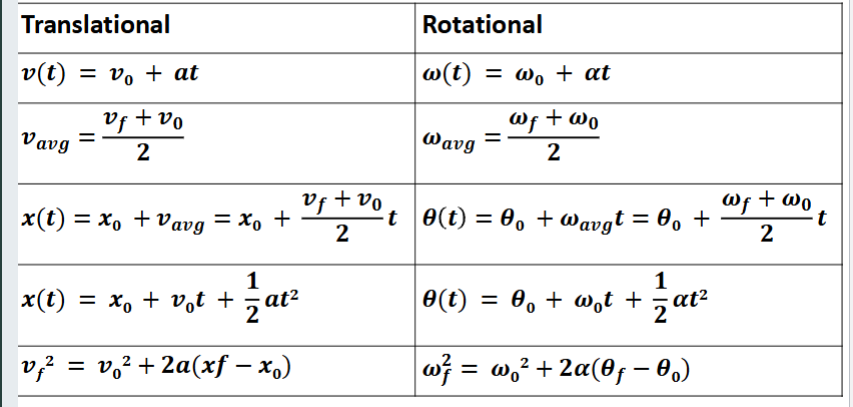
Swapping out kinematics equations for angular motion


With this, the theta is in radians here.


Angular velocity depends on angular distance, not regular distance from center.


Inertia