Sensorimotor 2
Motor System
Control of Movement by the Spinal Cord
- Spinal cord efferents from both alpha and gamma motor neurons arise from the ventral root of the spinal cord
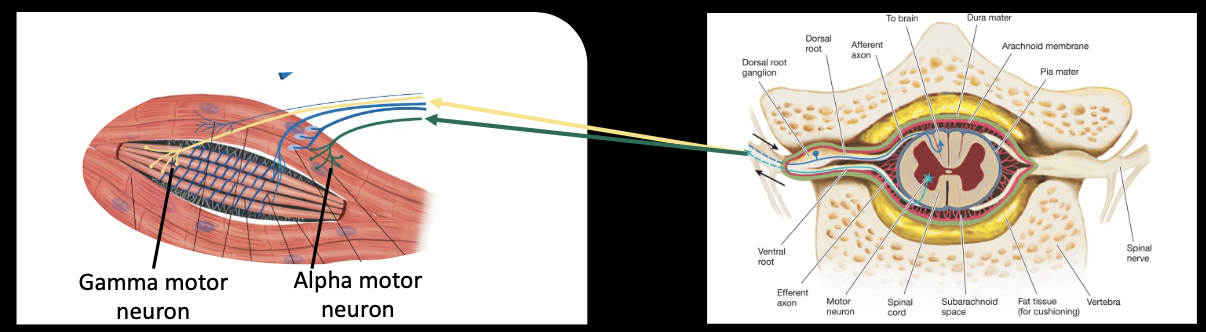
- Afferents from muscle spindles. enter via the dorsal root of the spinal cord
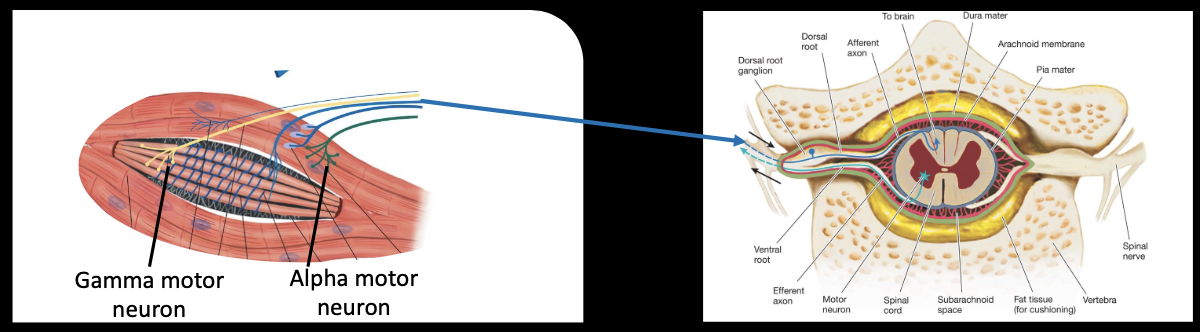
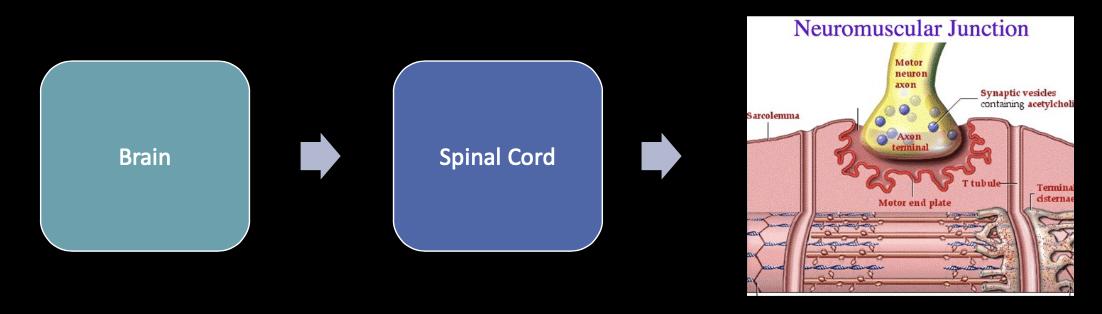
- spinal cord can control movement in 2 ways: enacting commands from the motor regions of the brain, reflexes
- reflexes: automatic movements controlled solely. by the spinal cord and peripheral nervous system (monosynaptic stretch reflex, polysynaptic reflexes)
- monosynaptic stretch reflex: sensory and motor neurons located at the same muscle, only one synapse in the spinal cord is necessary to initiate reflex
1. muscle spindle (intrafusal muscle fibers) detect lengthening of muscle fiber
2. Afferent axon→gray matter in spinal cord
3. Synapse on alpha motor neuron
4. Efferent. axon of alpha motor neuron synapses on the extrafusal muscle fibers of the same muscle 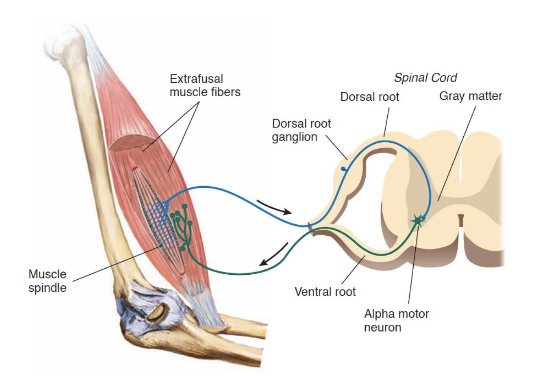 * Examples: patellar reflex, dropping a weight, maintaining posture
* polysynaptic reflexes: all other reflexes require more than one synapse, some synapses excite/acttivate alpha motor neurons, some inhibit alpha motor neurons→prevent damage to the muscles and tendons
* inhibitory sequence
* Examples: patellar reflex, dropping a weight, maintaining posture
* polysynaptic reflexes: all other reflexes require more than one synapse, some synapses excite/acttivate alpha motor neurons, some inhibit alpha motor neurons→prevent damage to the muscles and tendons
* inhibitory sequence
1. Golgi tendons detect extreme muscle strettch
2. afferents axons enter gray matter of the SC
3. synapse on interneurons in gray matter
4. interneurons release glycine at synapses with alpha motor neurons (IPSP)
5. inhibit alpha motor neurons 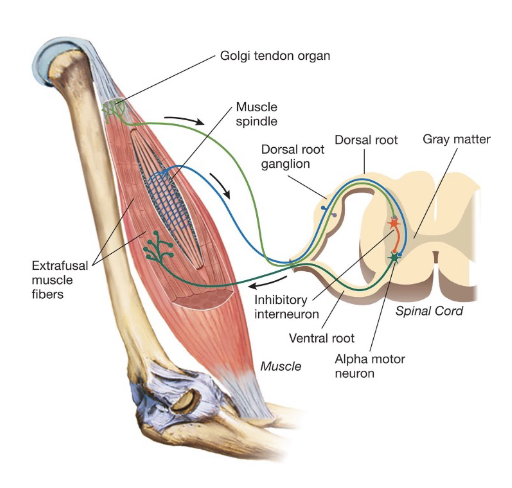 * all other reflexes require more than one synapse
* EX. withdrawl from noxious stimuli, startle reflex
* all other reflexes require more than one synapse
* EX. withdrawl from noxious stimuli, startle reflex
Control of Movement by the brain-Cortical Regions
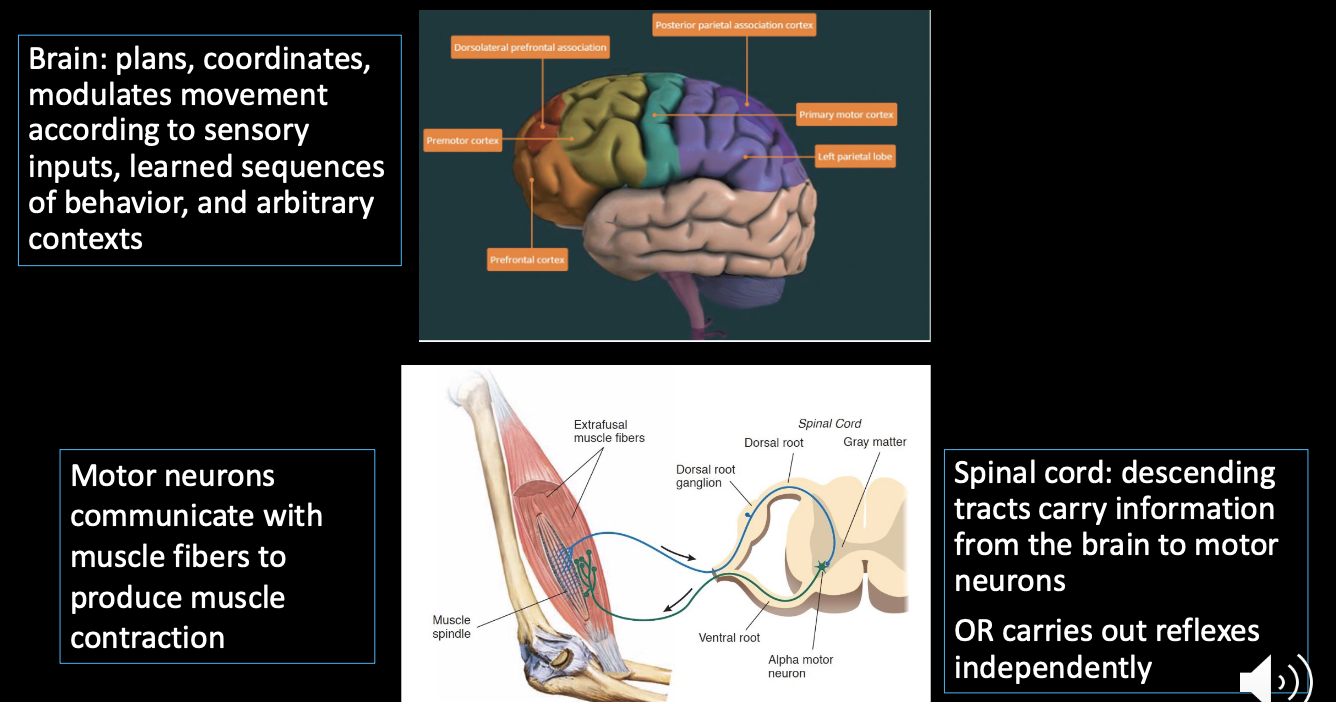
- Cortical areas involved in movement are all located in the frontal lobe
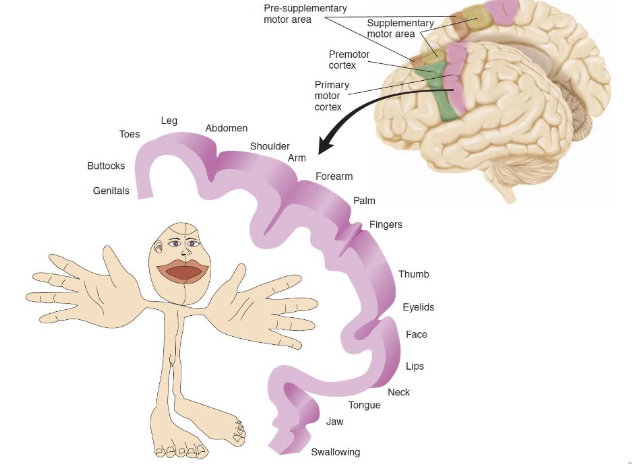
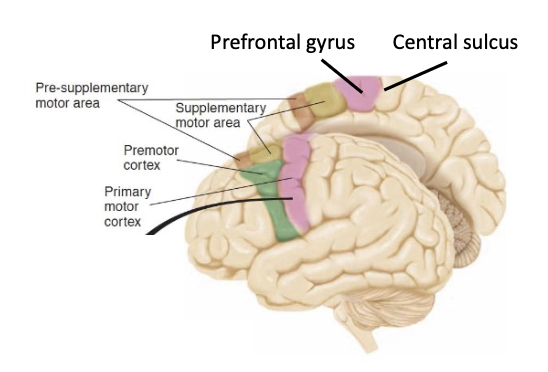
- primary motor cortex: located in the precentral gyrus, functionally controls movement, it consists of maps that produce specific movement in specific body parts
- somatotropin organization: organized into body parts and movements, maps fingers, mouth→fine movements and speech, map organization consists of the production of movements that require more than 1 muscle as well as categories of movements
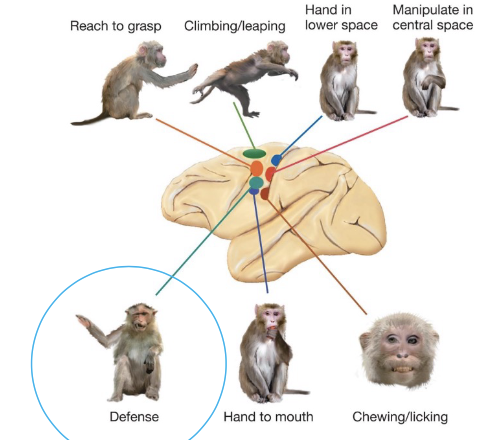
- monkey primary motor cortex: brief stimulation causes brief movements, prolonged stimulation of one area produces complex movements
- controls the movement via two descending tracts to/through the white matter of the spinal cord
1. lateral group: independent limb movements, hands, fingers, face, cell bodies originate in the cerebral cortex 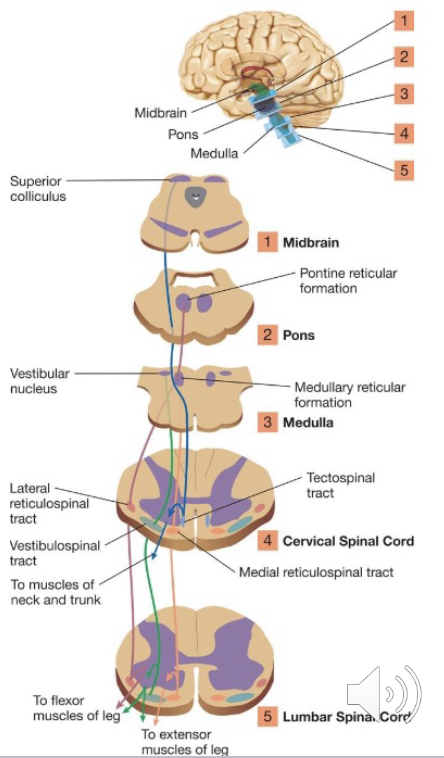 2. ventromedial group: automatic movements in the trunk, coordinated trunk and limb movements (posture/locomotion), cell bodies receive input from primary motor cortex originating in the midbrain or brain stem
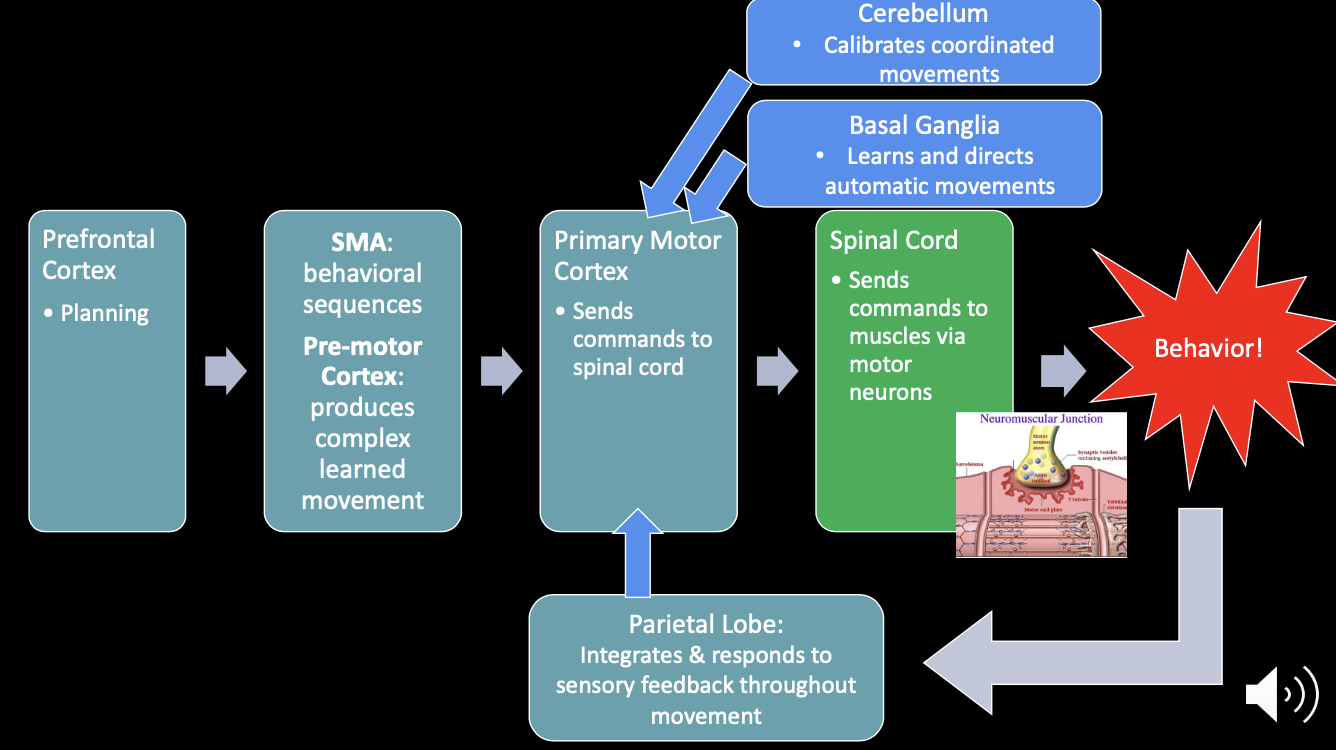
- prefrontal cortex: at rostral region of the frontal lobe, functionally planning behaviors and making decisions, inputs are auditory and visual information, outputs to motor association cortex
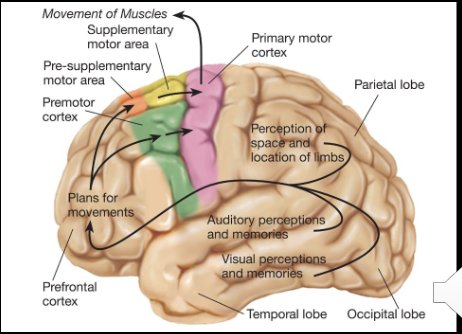
- motor association cortex
- supplementary motor cortex: part of the motor association cortex, located adjacent and rostral to the primary motor cortex, medial, receives input from the prefrontal cortex and sensory inputs from the parietal and temporal lobe, sends efferent axons to the primary motor cortes, function is the production of learned behavioral sequences and it coordinates bilateral movements
- premotor cortex: part of the motor association cortex, located adjacent and rostral to the primary motor cortex, lateral, receives input from prefrontal cortex and sensory inputs from parietal and temporal lobe, sense efferent axons to the primary motor cortex, finctionally is responsible for learning and executing complexmovements, guidedby sesnory information (drives movement based on arbitrary information where the relevance must be learned
- when the premotor cortex is damaged: iimpairs the ability to produce movement in. response to learned auditory and visual (NOT SPATIAL) cues
Control of Movement by the brain-Subcortical regions
- subcortical regions involved ion movement: reticular formation (gamma motor system, specific movement), cerebellum, basal ganglia
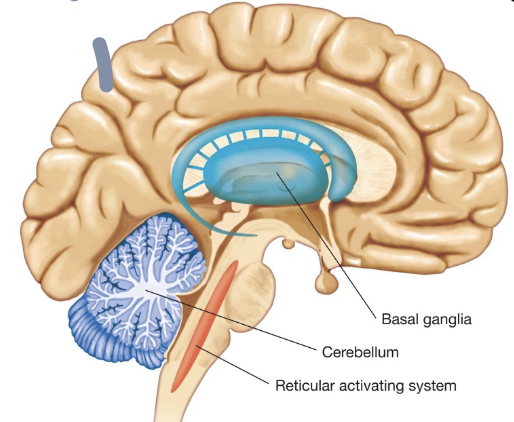
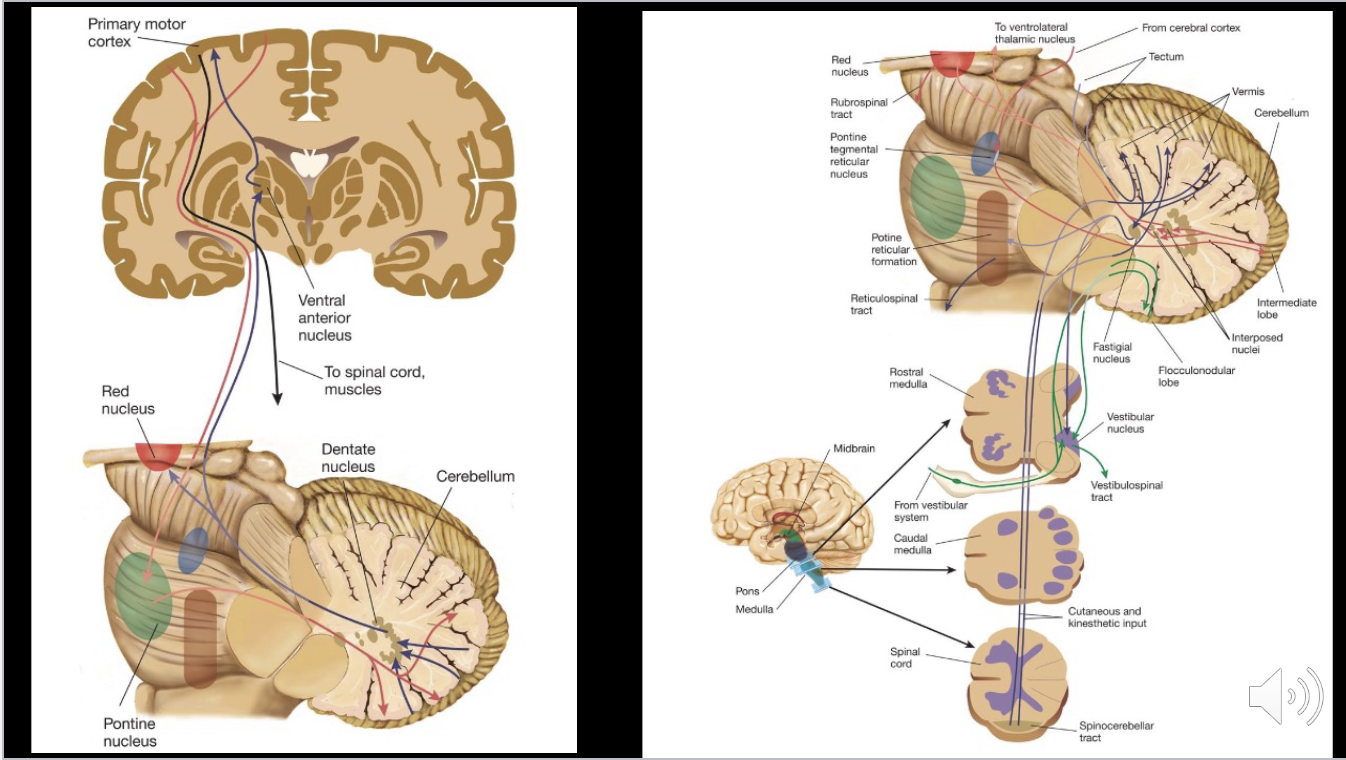
- Cerebellum: structurally 2 hemispheres surrounded by the cerebellar cortex, dorsal to the pons and midbrain, functionally it smooths and coordinates movements by computing complex and closely timed sequences of muscle contractions
- when damaged→jerky, erratic, uncoordinated movements, slurred speech
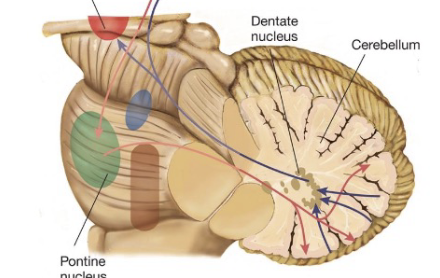
- Circutry inputs
- Mossy fibers: axons from cerebral cortex, carry information bout the frontal cortex(movement plans), vision, audition kinesthesia and proprioception, vestibular senses, cortical motor regions
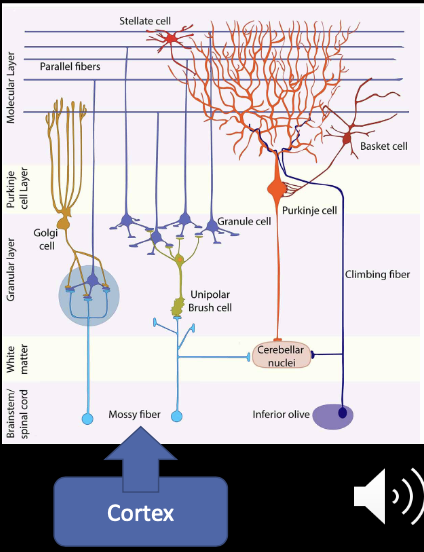
- Circuitry outputs: deep cerebellar nuclei send outputs to cortex motor areas, forebrain, brainstem, spinal cord
- when damaged→jerky, erratic, uncoordinated movements, slurred speech
- basal ganglia: subcortical nuclei located in the cerebrum consisting of the caudate nucleus, putamen, and globus pallidus
- cortico-basal ganglia loop: allows the basal ganglia to monitor and modulate primary motor cortex, a direct pathway through facilitation, an indirect pathway through inhibition,hyperdirect pathway bypassses the caudate and putamen to inhibit by quickly preventing movement
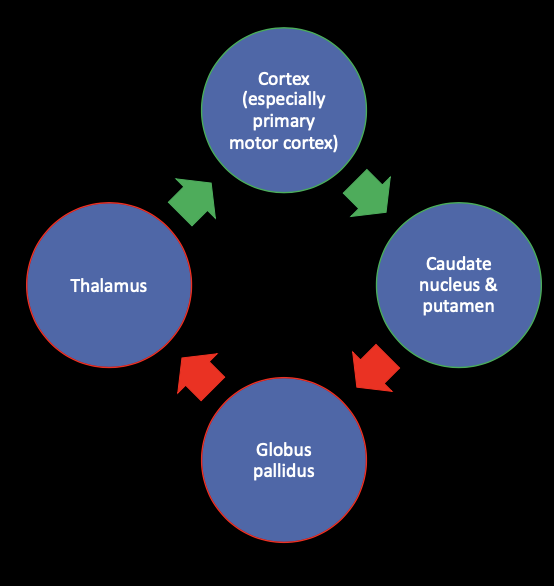
- cortico-basal ganglia loop: allows the basal ganglia to monitor and modulate primary motor cortex, a direct pathway through facilitation, an indirect pathway through inhibition,hyperdirect pathway bypassses the caudate and putamen to inhibit by quickly preventing movement
Complex movements and the role of the parietal lobe
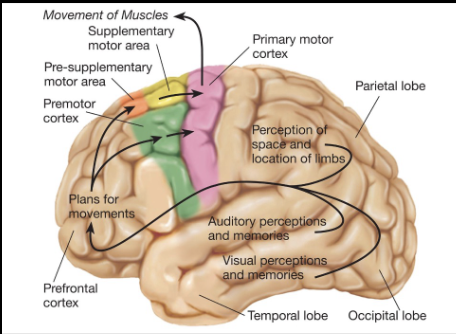
- mirror neurons: neurons in motor regions that respond both when executing a movement or when viewing someone else execute a movement (located in the posterior parietal area
- fMRI studies show that mirror neuron circuits fire in response to: viewing someone else performing behavior, hearing sounds typically produced by a behavior, viewing a clip with different presumed intentions
- parietal reach region: integrates visual-spatial and motor info into accurate reaching
- grasping: visual dorsal stream and motor info control hand and finger movements
- disruption results in the failure to adjust grasp pose when object changes orientation
- motor deficits
- apraxia: movement deficits caused by frontal or parietal cortex damage
1. oral apraxia: speech
2. apraxic agraphia: writing deficit
3. limb apraxia: arms, hands, fingers, incorrect part of limb or type of movement, incorrect sequence of movement
4. constructional apraxia: drawing or constructing objects, impaired perception and imagination of geometrical relation