Biological Reactions II: Comprehensive Study Guide on Carbohydrates and Metabolism
General Definition and Classification of Carbohydrates
Definition and Etymology:
Carbohydrates are organic compounds composed of carbon, hydrogen, and oxygen.
General Chemical Formula: .
The name "Carbohydrate" originated from this formula ( for carbon and for water), though this name is not chemically meaningful in a structural sense.
Chemical Classification:
More accurate descriptions are polyhydroxy ketones or polyhydroxy aldehydes.
Functional Groups: These groups facilitate a wide range of reactions essential for structural rearrangement and energy metabolism within living cells.
D-Glucose Characteristics:
Classification: Aldohexose (contains an aldehyde group and 6 carbons).
Fischer Projection: In the D-form, the hydroxyl () group on the chiral center furthest from the carbonyl group is positioned on the right.
Cyclisation and Structural Equilibrium
The Process of Cyclisation:
linear and cyclic form of monosaccharides are in equilibrium but the cyclic form is heavily favoured.
furanose form - pentose structure (<1%)
linear (0.02%0 → 7 membered ring
pyranose form (99%)
Ring Types:
Pyranose: A 6-membered ring sugar (e.g., derived from glucose).
Furanose: A 5-membered ring sugar (often associated with fructose).
fructose = ketose, in solution fructose assumes mix of two different ring forms plus a small amount of linear form (more than glucose)
chemical reactions require the open form - fructose more reactive than glucose
fruit containing more fructose than glucose oxidise faster
Chemical Intermediates in Cyclisation:
Hemiacetal: Formed when an aldehyde reacts with an alcohol (Aldehyde + Alcohol Hemiacetal + Water).

Hemiketal: Formed when a ketone reacts with an alcohol (Ketone + Alcohol Hemiketal + Water).
Acetal/Ketal: Formed from the reaction of hemiacetals or hemiketals with another alcohol.
Geminal diol: A compound with two hydroxyl groups on the same carbon atom.
Glucose and Fructose Cyclisation Specifics:
Glucose (Aldose): Carbon #1 is achiral in the linear form but becomes chiral upon cyclisation. This carbon is known as the anomeric carbon.
Fructose (Ketose): Fructose assumes a mix of different ring forms. Because it maintains a higher proportion of the linear form in solution compared to glucose, fructose is more reactive.
Practical Consequence: Fruits containing more fructose than glucose undergo oxidation ("go off") faster.
Anomers and Stereochemistry
Anomeric Forms ( and ):
Definition: The two cyclic forms of a sugar resulting from the chirality of the anomeric carbon.
Stability of Glucose: In solution, glucose exists as approximately and . The form is more stable because it avoids steric clashes between hydroxyl groups at positions 1 and 2.
Fructose Anomers:
Pyranose form: and .
Furanose form: and .
Taste Property: -fructopyranose is significantly sweeter than -fructofuranose.
Enzymatic Specificity:
While sugars in bulk solution exist as a racemic mixture of enantiomers/stereoisomers, enzymes are usually specific to one form ( or ). Because the forms are in equilibrium, one can replace another
Oligo- and Polysaccharides
sugars combine into larger units made from similar monosaccharides similar to RNA/DNA proteins
can be lined as there are so many functional reactive groups in a sugar - OH
longer chains can assemble to form oligo or polysaccharides such as cellulose (linear B1-4) linked glucose units or amylose, one of the two components of starch which is glucose (a 1-4)
Linkages:
Monosaccharides combine using hydroxyl () groups to form larger units, similar to how nucleotides form DNA/RNA or amino acids form proteins.
Reactivity Change: If the anomeric carbon is involved in a glycosidic linkage, the sugar cannot revert to the linear form and loses certain chemical reactivities.
Major Disaccharides:
Sucrose (Table Sugar): Glucose + Fructose (linked via anomeric carbons of both, rendering it non-reducing).
Lactose: Galactose + Glucose.
Maltose: Glucose + Glucose (linked 1-4).
Specific Glucose Linkages:
Isomaltose: 1-6 linkage.
Sophorose: 1-2 linkage.
Gentobiose: 1-6 linkage.
Polysaccharides:
Cellulose: A linear chain of 1-4 linked glucose units.
Amylose (Starch component): A chain of 1-4 linked glucose units.
Sugar Chemistry in the Test Tube
Lobry-de Bruyn-van Ekenstein Transformation:
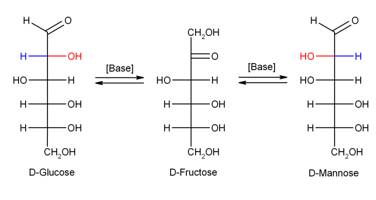
A base-catalyzed isomerisation occurring via an enediol intermediate. used at two points in glycolysis (G6P → F6P, DP → G3P)
This reaction allows for the interconversion between an aldose (like glucose) and a ketose (like fructose).
In bulk solution, this is not stereospecific; starting from D-glucose both D-fructose as well as D-mannose will be produced. reverse reaction can create D-mannose instead of D-glucose by inversion of the asymmetric centre at C2.

Oxidation and Reducing Sugars:
Oxidation requires an aldehyde group. While keto groups are not easily reduced directly, ketoses like fructose can be oxidized after isomerising into an aldose.
Reducing Sugars: detected by simply chemical reactions that reduce a metal to its elemental form (e.g. silver)
Non-reducing Sugars: have structures that prevent the isomerisation. Mainly disaccharides where the glycosidic link if formed by both anomeric carbons
The Silver Mirror Experiment:
A classical test where a reducing sugar is oxidized to its corresponding acid (e.g., glucose to gluconic acid).
Simultaneously, ions are reduced to elemental silver (), which deposits on the container surface.
Oxidation states of organic molecules follow the progression: Alkane Alcohol Aldehyde Acid.
Cellular Metabolism of Sugars
Types of Chemical Reactions in Metabolism:
Oxidation-reduction: Transfer of electrons.
Ligation: Formation of covalent bonds (e.g., C-C bonds) requiring ATP cleavage.
Isomerization: Rearrangement of atoms within a molecule to form isomers.
Group Transfer: Transfer of a functional group from one molecule to another.
Hydrolytic: Cleavage of bonds through the addition of water.
Addition/Removal of Functional Groups: Adding to or forming double bonds.
mechanism: nucleophilic substitution, attach of sugar OH on phosphate
Detailed Steps of Glycolysis
Step 1: Group Transfer (Glucose to G-6P):
Enzyme: Hexokinase.
Reaction: Glucose + ATP Glucose 6-phosphate (G-6P) + ADP + H+
enzyme encourages nucleophilic attack by removing proton (enzyme acts as base) and by withdrawing electron density for the terminal phosphorus via the magnesium ion
the precision position of the reactive sites is determined by the structure of the ensure which positions the magnesium and the base precisely to activate the correct parts of the molecule
in bulk solution = all Oh groups could perform the same reaction, all three phosphates could be attacked.

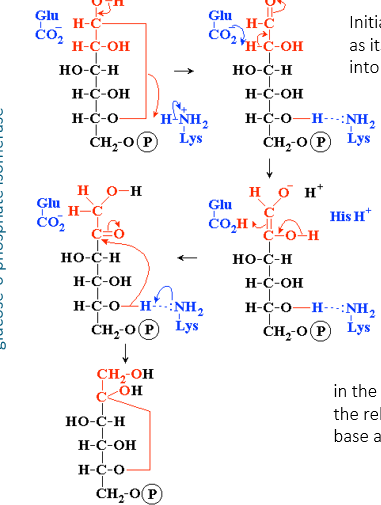
Step 2: isomerisation - glucose 6-phosphate → fructose 6-phosphate
g6p transformed into open chain to form f6p open chain form which transforms into regular f-6p
initial acid (lysine acts as conjugate acid) catalysed step converts cyclic into linear sugar
enolate formed in another base catalysed step (glutamate picks proton here - base)
formation of keton helped along by removal of proton by histidine reside which acts as a base
cyclic sugar rebuilt by the release of lysine which now acts as a base and reclaims its lost proton
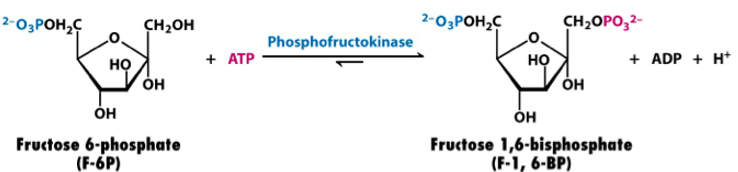
Step 3: group transfer - fructose 6 phosphate → fructose 1,6 phosphate
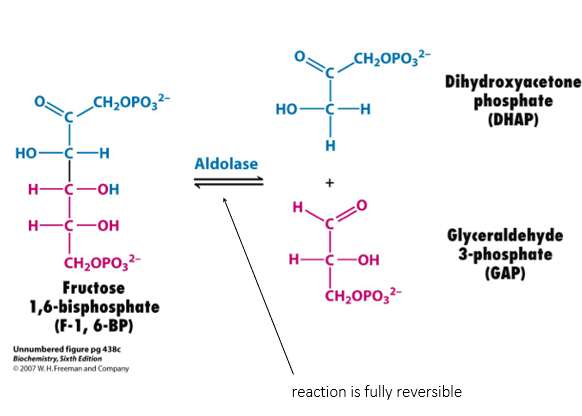
Step 4: Carbon-Carbon Bond Breakage:
Enzyme: Aldolase.
Reaction: F-1,6-BP Dihydroxyacetone phosphate (DHAP) + Glyceraldehyde 3-phosphate (GAP).
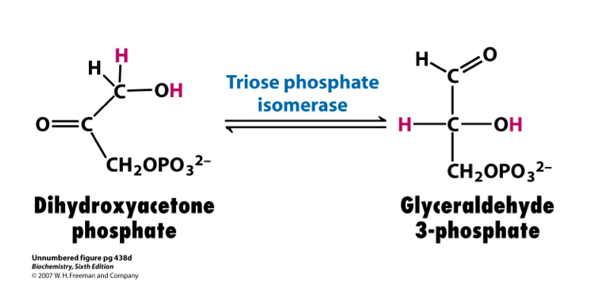
Step 5: Isomerisation (DHAP to GAP):
Enzyme: Triose phosphate isomerase.
Mechanism: Involves Glu 165 and His 95 via an enediol intermediate.
diydroxyacetone phosphate → enediol intermediate → glyceraldeyde 3-phosphate
Step 6: Redox Reaction (GAP to 1,3-BPG):
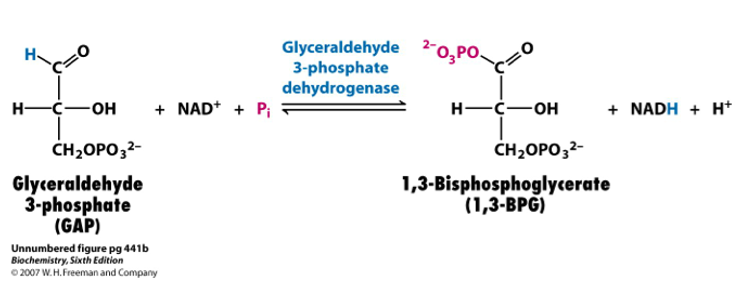
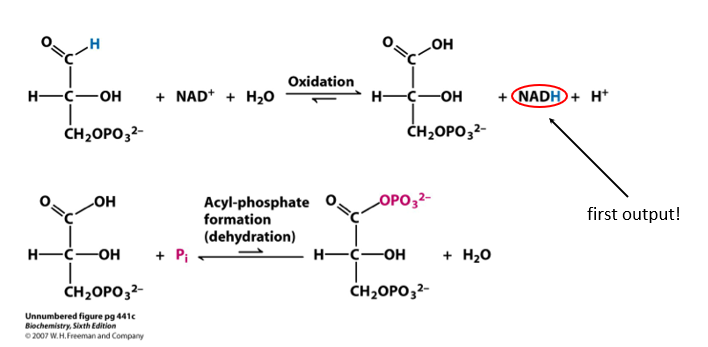
Enzyme: Glyceraldehyde 3-phosphate dehydrogenase.
Reaction: GAP + + 1,3-Bisphosphoglycerate (1,3-BPG) + NADH + H+
oxidation (hydride transfer) reaction then phosphorylation
Step 7: group transfer - 1,3 bisphosphoglycerate + ADP +H+ → 3 phosphoglycerate + ATP
nucleophilic substitution
attack of ADP O- on phosphate of 1,3 BPG
reaction is running backwards compared to example
General Principles of Enzymatic Action
Workbench Function: Enzymes hold substrates in precise orientations to ensure correct atoms react. This provides a level of specificity impossible in bulk solution where any hydroxyl group could theoretically react.
Catalytic Activity: Enzymes frequently initiate reactions by acting as acids or bases to protonate or deprotonate substrates.
Intermediate Stabilisation: Enzymes lower activation energy by establishing interactions that stabilize high-energy transition states or intermediates.