Mental status
Chapter 5: Mental Status Assessment
Defining Key Concepts
Consciousness: A fundamental attribute reflecting an individual's awareness of themselves and their environment, crucial for interactions and response to stimuli. It ranges from fully alert to comatose states.
Mental Status: An overall measure of cognitive function, encompassing aspects such as thought processes, language ability, and emotional state, which provides insight into the patient's mental health condition.
Language: Assesses comprehension and the ability to communicate. This can reveal not only clarity of speech but also the organization of thoughts and the ability to follow and participate in conversations.
Mood and Affect:
Mood: Refers to a person's emotional state over time and can indicate underlying mental health issues.
Affect: The observable evidence of mood, which includes facial expressions, tone of voice, and body language that indicate emotional responses.
Orientation: Involves awareness of one’s identity, time, and location. Complete orientation assesses personal, temporal, and situational awareness, critical for cognitive assessments.
Attention: The ability to concentrate and stay focused on tasks. This includes selective attention, the ability to filter out distractions while maintaining focus on relevant information.
Memory: Encompasses both recent memory (recall of information learned shortly ago) and remote memory (past recall), essential for evaluating cognitive decline or disorders.
Cognitions: Refers to thoughts and thought processes, which involve the way information is processed and stored and can reveal cognitive distortions or dysfunctions.
Behavior: Observational indicators of a person's actions and reactions, which provide context to cognitive assessments and potential mental health issues.
Abstract Reasoning: Evaluates the ability to think conceptually, understand complex ideas, and draw conclusions. This is important for problem-solving and decision-making processes.
The Mental Status Exam Components
Framework: A, B, C, T (Appearance, Behavior, Cognition, Thought Processes)
Appearance: Physical presentation, including grooming, dress style, and hygiene, which can indicate a person's mental state.
Behavior: Actions and reactions of the patient observed during the examination as it can suggest mental health issues or neurological impairments.
Cognition: Cognitive functions assessed include orientation, attention span, and memory capabilities during the evaluation.
Thought Processes: Evaluates the logical coherence and relevance of thoughts, including assessment of whether thoughts are organized and logical.
Appearance Assessment
Posture:
Normal: Relaxed and erect posture, indicating confidence and alertness.
Abnormal: Tense, fetal position, pacing, or slumped posture may indicate anxiety, depression, or discomfort.
Body Movements:
Normal: Voluntary, coordinated, smooth movements, suggesting no neurological issues.
Abnormal: Twitching, involuntary movements, or slow movements can signify neurological disorders or psychological stress.
Dress, Grooming, Hygiene:
Normal: Clean and well-groomed attire appropriate for the context, reflecting care for self.
Abnormal: Disheveled appearance or neglect of hygiene may indicate severe distress or a mental health condition.
Pupils:
Abnormal: Irregular dilation or constriction can indicate neurological issues or responses to substances.
Behavior Assessment
Normal Levels: Awake, alert, responsive, demonstrating engagement with their surroundings.
Abnormal Levels:
Lethargic: Appears drowsy, requiring prompting to engage.
Non-responsive: Does not respond to external stimuli.
Obtunded: Reduced alertness necessitating strong stimuli to elicit a response.
Delirium: Confused state, often with fluctuating attention and cognition.
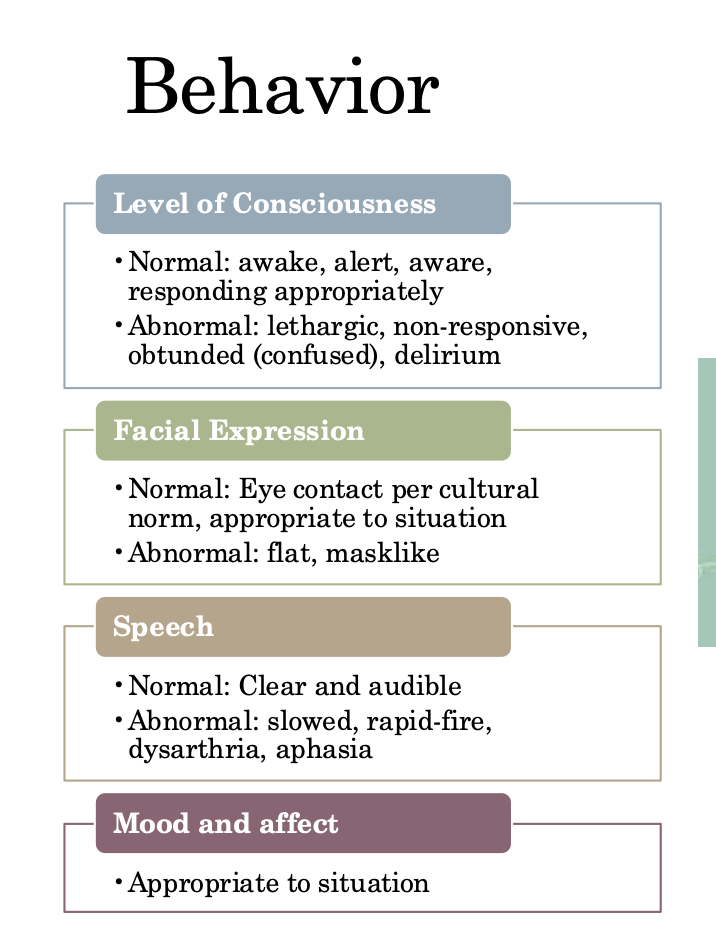
Level of Consciousness
Normal: Suitable eye contact and relevant verbal responses indicate engagement with the situation.
Abnormal: Flat expression or mask like appearance may indicate depression or neurological issues.
Speech
Normal: Clear, audible speech appropriate for the context of communication.
Abnormal: Slow speech, rapid-fire speech, or presence of dysarthria (difficulty speaking) or aphasia (language impairment) signals potential neurological or language disorders.
Levels of Consciousness
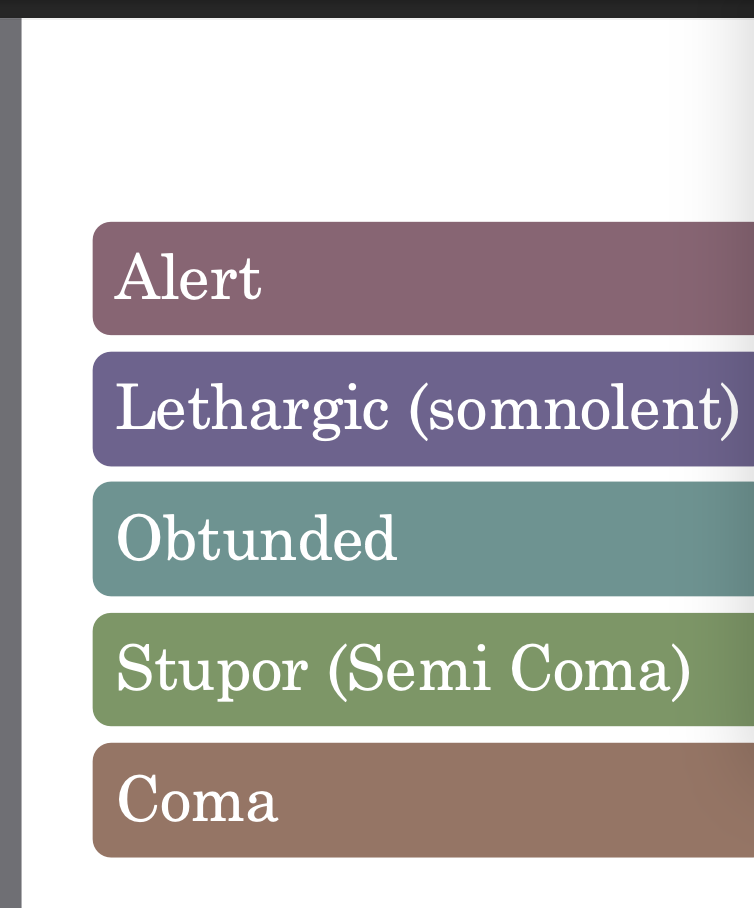
Alert: Fully awake, engaged, and responsive.
Lethargic: Drowsy but can be aroused to respond.
Obtunded: Requires intense stimuli to engage; lacks full consciousness.
Stupor: Near-comatose state with minimal responsive behavior.
Coma: Unresponsive to stimuli, cannot be aroused.
Cognition Assessment
Key Areas
Orientation: Regularly assesses awareness of time, place, and identity, crucial for comprehensive mental evaluations.
Attention Span: Measures an individual's ability to sustain focus over time and amidst distractions.
Recent Memory: Tests recall of events that occurred shortly prior; critical for understanding cognitive function.
Remote Memory: Assesses the recall of past events from long-term memory storage.
New Learning: Evaluates the ability to absorb new information, which reflects cognitive processing and flexibility.
Cognition Screening Tools
Mini-Mental Status Exam (MMSE): A brief assessment tool commonly used to screen for dementia and delirium, assessing orientation, memory, calculation, and language skills.
FACT Test: A tool specifically designed for assessing new memory retention directly after learning.
Four Unrelated Words Test: Involves recalling specific words after a brief distraction, evaluating short-term memory retention.
Thought Processes Assessment
Important Considerations
Thought Process: Coherence and logic in thought patterns are assessed to identify any disturbances.
Thought Content: Explore the actual subject matter of what an individual is thinking, including any delusions or hallucinations.
Perceptions: Awareness of reality versus subjective experiences such as hallucinations or illusions critically shapes the mental assessment.
Screening Tools for Thought Processes
GAD-7: A widely used screening questionnaire for assessing anxiety levels and related disorders.
PHQ-9: A tool that screens for depression severity, informing treatment plans.
ASQ (Ask Suicide Screening Questions): Designed to evaluate suicidal ideation and behavior.
Developmental Considerations
Infants and Children
Emphasizes behavioral, cognitive, and psychosocial development critical for determining proper functioning in younger populations.
Knowledge of developmental milestones (e.g., motor skills, language) is vital for accurate assessment.
Aging Adult
Cognitive assessments must consider slower response times; sensory deficits can alter responses and require adjusted evaluation techniques.
Utilize the same A, B, C, T framework while adapting for the patient's cognitive and developmental state, which may present as less specific orientation (e.g. knowing the city or hospital).
Nurse Check Scenarios
Example of Aging Adult Assessment
Expect difficulties in recalling distant memories; careful attention to immediate recall ability is important.
Normal findings in cognitive assessments may indicate stability in general knowledge despite measurable changes in response times.
Supplemental Mental Status Examination
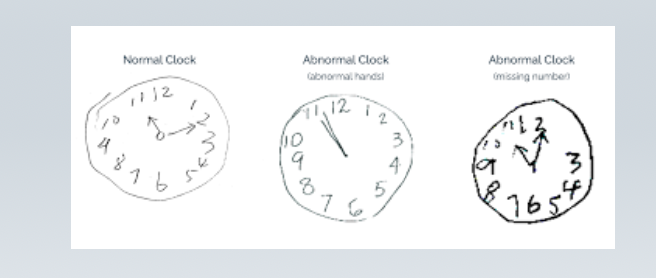
Mini-Cog: A succinct screening tool that engages the patient in clock drawing and recall tasks to effectively evaluate cognitive function, providing a quick overview of cognitive health.