Week 4: Inhibitory and Excitatory Conditioning
Subjects are using a cue to predict something that is not going to happen
Investigating what the association is telling the subject
Excitatory conditioning : a CS predicts that a US will occur
Process: Excitatory conditioning, conditioned exictation
CSs: Conditioned exciters, exciter, excitatory CS
ex. think of this as an open sign
Inhibitory Conditioning: CS predicts that a US will not occur
Process: Inhibitory conditioning, conditioned inhibitions
CSs: Conditioned inhibitors, inhibitors, inhibitory CS
ex. think of this as a closed sign
CS-: not a reliable predictor of anything
CS+: a reliable pavlovian predictor
light is unpaired with the food
bell would have the same reaction when its results are plotted on a graph despite never having being presented to the animal subject prior (novel stimulus)
Conditioned Inhbition & Learning-Performance Distinction
An excitatory CS increases conditioned responding
Conditioned response is produced
An inhibitory CS is expected to reduce conditioned responding
Its hard to detect this decrease, some can’t easily decrease their level of responding beyond the baseline
We don’t have an easy way to test for this!
Special procedures are required to detect this
Salivation Consideration:
A dog can salivate more when expecting food (Excitatory CS)
A dog probably can’t salivate less when not expecting food (Inhibitory CS)
Two tests to Verify Conditioned Inhibition
Summation Test
Impaired Acquisition Test
In order to be considered a conditioned inhibitor the CS must pass both of the tests
Summation Test
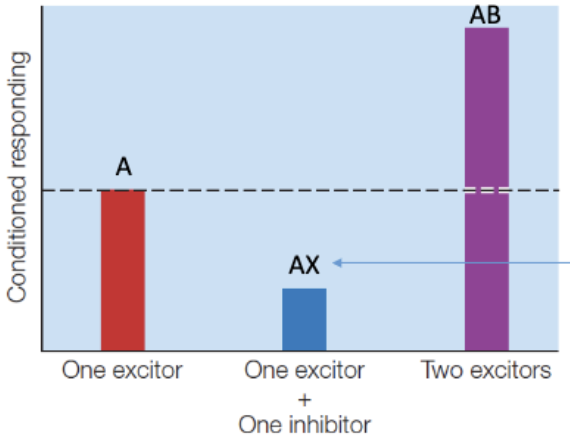
Considers that if we present an inhibitory and excitatory CS at the same time then the responses should cancel each other out
When we present multiple CSs together we are creating a COMPOUND CS
Individual CSs in the compound CS are referred to as elements
We expects the results to grow in a linear fashion
A compound CS has the cues occurring at the same time
We are able to see a cancellation effect happening
Interpreting the results of a summation test
If we see that when we paired an excitatory cs with an inhibitory cs, the response is lower compared to when we have the excitatory cs alone then we can say the CS passes the test and shows evidence of being an inhibitor
As long as there is a decrease in response then we would say that the CS passes the summation test
Impaired Acquisition Test
If we have a Inhibitory CS and we try to pair is with a excititatory CS then it should take longer for the CS to be a predictor of a US compared to a neutral CS
Here would would have different phases of conditioned responding
We would see that the neutral CS would have a learning curve that is the same as pavlovian learning
If we run the experiment for long enough we would see that both of the stimulis would reach the same level of CR
An association can still be learned if we pair the inhibitory with a US
it will take more experience for the animals to overcome the inhibitory stimulus

Creating Conditioned Inhibition
Compound Training
Strongest and most reliable way
Negative Correlation Training
Differential Conditioning
Compound Training
We have three CSs for our experiment
CS1 → present food
Excitatory response
Is going to be used as a sacrificial cue
CS1+CS3 → no food (inhibitory learning is happening here!)
CS1 predicts food but since animals don’t get the food during this trial the animals are attributing the no food to the presentation of CS3
CS3 will eventually become a conditioned inhibitor
Through multiple trials the animal is being presented with evidence that CS3 is preventing food from being presented
CS2 → present food
Shows us how conditioned inhibition work and is not mixed with anything else (our blank)
We could then perform the summation test to see if the training we have done during the compound training produced an inhibitory CS
As long as the US is the same the pairing in the compound can still be GENERALIZED
We can see that the results present a pairing that was not done in the experiment yet we are still able to see the effects of the summation test

Compound training generally causes stronger inhibitory learning than the other available methods
STRONGEST TEST → we are able to see this strength by seeing the amount that is cancelled out
Inhibitory Learning occurs during the training, the meaning that the CS is preventing US from occurring is being built during the training
The test shows whether or not the inhibitory CS is working and does not directly create the inhibitory association
Another example: Conditioned Suppression
Phase 1: The animal is trained to learn the association (lever → food)
Phase 2: Layering of Pavlovian Associations
A+ : Lever is paired with the Shock
Generates strong suppression (we see less lever pressing)
A+B: Lever press isn’t paired with anything
Weak suppression (we don’t see a decrease in the amount of lever pressing)
C+ : Lever press is paired with the shock
Generates strong suppression (we see less lever pressing)
In this example B is acting as our inhibitor which has a higher suppression ratio
B generalized beyond the CS+ that was used to establish it as conditioned inhibitor → we still see the inhibitor increasing the ratio when being paired with C despite the learning being done when B is paired with A
Example of Compound Training and Impaired Acquisition Test:
Conditioning Phase 1:
G1 : Light → Shock
G2: Light → Shock, Tone+Light → No Shock
Conditioning Phase 2:
G1: Tone → Shock
This learning should be done in a normal fashion since it’s a novel stimulus
G2: Tone → Shock (We are pairing the inhibitory and trying to build a excitatory association
We see impaired acquisition with a slower learning rate, takes longer for the inhibitory association to be overcome
Eventually both will reach the same asymptote
Creating a Conditioned Inhibition: Negative Correlation
Procedure creates a conditioned inhibitory using a US but no excitatory CS
We are presenting the CS and the US but we are never presenting them directly with each other, the CS and the US will not co-occur
ex. When the cue is not presented there is a chance that food will be presented
ex. When the cue is presented animal knows that the food will NOT be presented
Inhibition in this procedure is proportional to how likely the US is in the absence of the CS
nothing besides the absence of the CS is predicting the occurrence of the US
Doesn’t produce as strong of an inhibitory CS as compound training
We can manipulate the strength of the inhibitory learning by changing the frequency of the US in the absence of the inhibitory CS
Weaken Learning: We can decrease the amount of times the US is presented when in the absence of the CS
Subject believes that there is a lower probability overall of getting the US
Hard to notice the US is occurring in the absence of the CS
Strengthen learning: We can increase the amount of times the US is presented when in the absence of the CS
Notices that the US is occurring in the absence of the CS
Generates a stronger contrast
Creating a Conditioned Inhibition: Differential Correlation
Standard CS+/CS- Conditioning Scenario
CS- undergoes fairly weak inhibitory learning
Provides us with the weakest inhibitory learning, less reliable
The scenario allows us to test excitatory while also creating an inhibitory learning
Shows us that learning is actually happening during the presentation of the CS-
Difference between negative and differential correlation: Differential correlation also involves the presentation of a CS+ while negative correlation does not
We can convert one procedure to another by adding or removing a CS+
Conditioned Inhibition: Summary
Conditioned Excitation: A CS predicts something occurring
Conditioned Inhibition: A CS predict something not occurring
Conditioned inhibition is created with some expectation of the US
A US is ALWAYS INVOLVED
Inhibition predicts that the US will not occur so the animals must have some knowledge of the existence of the US in the first place
Inhibition is specific to one US
Compound Training usually produce the strongest conditioned inhibition
Strength of Conditioned Inhbition in Negative and Differential Correlation procedures can be altered through changing the frequency of the presentation of the US in the absence of the conditioned inhibitor
Conditioned inhibitors can generalize beyond the excitatory CS used to create them
Conditioned inhibitors must pass BOTH the summation test and the impaired acquisition test
Test Question!!!
Conditioned inhibitors generalize beyond excitation
key feature of inhibitor : we need to conduct the CS in the context of an unconditioned stimulus
need to know that the US exists
compound training is the best and fastest way of making it work
negative and directional suc
Inhibitors generalize regardless of the excitatory CS that is used
Conditional Probabilities
A given B
Probability that A will occur given that condition B is true
Rain Example
Rain given that there is Clouds
Higher probability than if there is sun outsides
Proability of the US to occur in the presence of the CS is higher than the proabibilty of the US occurring in the presence of the inhibitory CS
To create excitatory CS then the probability of the US occurring should be higher in its presence than when its not occurring
For inhibitory learning for conditional probabilities we must have the probability of the US occuring be higher when the inhibiotry CS not be prsent
Why is it important for the inhibitory CS to pass both tests?
We need the US involved at some point to provide evidence that one US is not likely to occur
Need to know that the condition exists in the first place
What if we don’t have the US involved when making the inhibitory CS?
Will have Latent Inhibition (new form of Pavlovian Learning)
Uses Goats
Also referred to as Pre-Exposure Effect
Setup:
Requires two conditioned stimuli (ex. light and tone)
Procedure:
Light undergoes the pre-exposure phase (shown w/o the US in trials)
Subnet doesn’t know foot shock is an option
Light is paired with foot shock, tone is paired with foot shock
Results:
Learning for the pre-exposure phase was slower than learning for the novel stimulus
Pre-exposure learning is harder since it makes it hard for the CS to be a reliable predictor for an event
Impaired Acquisition → eventually both will reach the same asymptote
Graph:
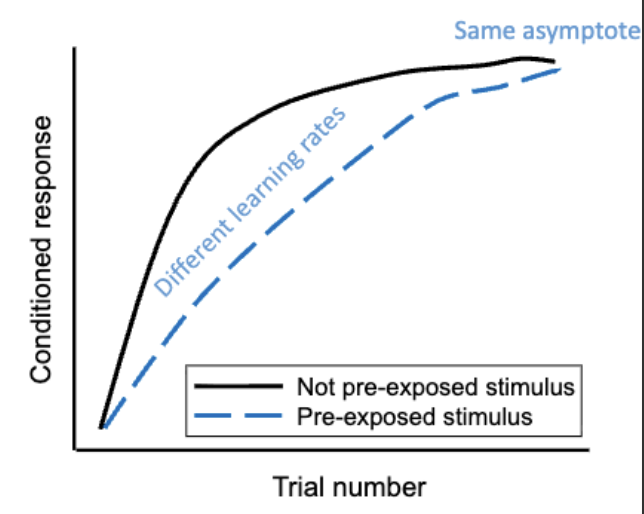
Results are similar to the results of the impaired acquisition test
An inhibitory CS would need to pass both tests since results might coincide with the results of latent inhibition instead
We can’t tell if the results are showing latent inhibition or simply impaired acquisition
When we conduct many trials without presenting anything will produce stronger latent inhibition
good to have both since some cues might pass one but not the other
Conditioned Inhibition and Latent Inhibition are both different processes since the information that is presented during latent inhibition is different from when we conduct the impaired acquisition test
Both latent inhibition and conditioned inhibition causes slower learning in the impaired acquisition test
A cue that undergoes the process of latent inhibition WILL NOT pass the summation test
Shows that there are different processes that are operating between conditioned inhibition and latent inhibition