Spinal Column
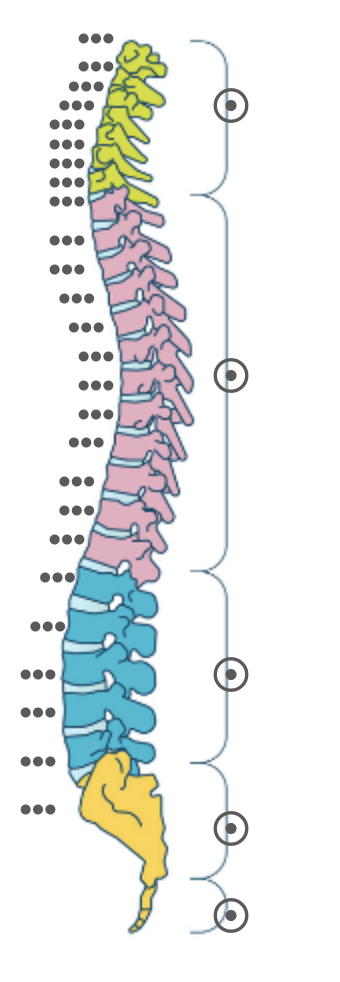
Anatomy
33 bones - 24 moveable, 9 immovable
7 cervical vertebrae
12 thoracic vertebrae
5 lumbar vertebrae
Cervical spine
Convex
C1 atlas, C2 axis
Thoracic spine
Concave
T1-T10
Lumbar spine
Convex
Sacrum
Coccyx
Intervertebral discs
Annulus fibrosus
Nucleus pulposus
Intervertebral articulations
Cartilaginous joints
Gliding, lateral gliding, compression, distraction
Movement at fact joints
Synovial joints
Ligaments
Anterior longitudinal
Posterior longitudinal
Supraspinous
Interspinous
Muscles
Superficial
Erector spinae - longissimus, iliocostalis, spinal
Deep
Interspinal, multifidus, rotators, intertransversarii, semispinalis
Spinal cord
Part of the CNS that is within the vertebral canal
Foramen magnum --> filum terminale
Spinal nerves and peripheral branches
31 pairs of spinal nerves
8 cervical
12 thoracic
5 lumbar
5 sacral
1 coccygeal
Each nerve has the ventral (motor) root and dorsal (sensory) root --> join together to form a single spinal nerve
Dermatome
Five nerve plexuses
Cervical - C1-C4
Brachial - C5-T1 - axillary, radial, musculocutaneous, ulnar, median
Lumbar - L1-L4 - obturator, femoral, tibial
Sacral - L4-S4 - medial/lateral plantar, sural, common/deep/superficial peroneal
Coccygeal - S4-S5 and coccygeal nerve
Injury Prevention and Evaluation
Cervical spine
Muscle strengthening
ROM
45 degrees of lateral flexion and adequate rotation for chin to be even with tip of the shoulder
Correct technique
Lumbar spine
Avoid stress
Correct biomechanical abnormalities
Correct lifting techniques
Core stabilization
Posture
Kyphosis - increased thoracic curve
Forward head posture - cervical spine extension
Flatback posture - decreased lumbar curve
Swayback posture - the anterior shifting of the pelvis
Lordosis - the increased curve of the lumbar spine and anterior pelvic tilt
Scoliosis - lateral curvature of the spine
Cervical spine
Shoulder level and symmetrical
Thoracic spine
Neck motion, trunk motion
Lumbar spine and sacroiliac
Pelvis and shoulders - level
Injuries
Cervical
Cervical fracture
Cervical dislocation
Acute strain
Cervical sprain (Whiplash)
Acute torticollis (Wryneck)
Cervical cord and nerve root injuries
Laceration
Hemorrhage
Contusion
Cervical cord neuropraxia
Spinal cord shock
Cervical spine stenosis
Brachial plexus neuropraxia (burner)
Cervical disc injury
Thoracic
Scheuermann's disease (Dorsolumbar kyphosis)
Lumbar
Lumbar vertebral fractures and dislocations
Low back muscle strain
Myofascial pain syndrome
Lumbar sprain
Back contusions
Sciatica
Herniated lumbar disc
Spondylolysis
Spondylolisthesis
Sacroiliac joint dysfunction
Sacroiliac sprain
Congenital abnormalities
Mechanical defects of the spine
Back trauma
Recurrent and chronic low back pain