gender differences and achievement 30 marker
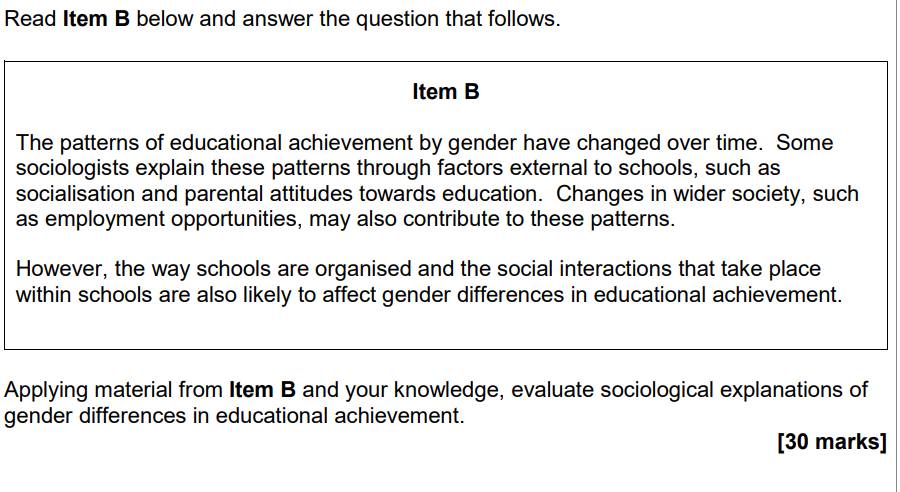
Over the years trends show that girls are achieving higher than boys quite significantly and outperforming boys in many areas within education. item B highlights how factors such as “parental attitudes towards education” contribute to the patterns of educational achievement by gender. parents expectations for their sons compared to their daughters may differ. during primary socialization many kids may feel a pressure to follow their parents expectations for them. For example traditional working class dads may expect boys to not try hard in school and the way parents treat their children's and the expectations they set up for them can later shape their interests in school. ultimately ensuring that some boys don’t have an interest in school as they haven’t been emphasized the importance of hard work therefore girls outperform them as they are seen to be more hard working.
in item B it states that “socialization… explains gender achievement…patterns” this is because some sociologists believe boys and girls are socialized differently which may impact their attitudes towards education. for example boys may be socialized to be more competitive and independent which could lead to a focus on individual achievement rather than collaborative learning. therefore boys may have a negative attitude to working as a collective.
in item b…
changes in wider society include more opportunity’s for girls such as the increase of women in the work force. this works alongside primary socialization as the increase of dual income families have made mothers begin working. this ultimately creates an increase of girls seeking a career outside of being a mother ad they look up to their own mothers and want to follow in their footsteps of achieving a well paid job. many girls therefore want to achieve better grades within school and put in the effort for the outcome they wish to achieve to enable them opportunity’s outside of education.
in item b…
social interactions within schools may include teachers labelling their students. Becker suggests that we constantly label individuals and they often live up to those labels . this applies to educations many teachers may label their students. Gillborn suggests that teachers change their behavior relating to those labels. boys are seen to dominate class discussions as they call out. this leads to discipline and not attention to their education more focused on their behavior. girls are seen to do better in English language and ultimately teachers build a label that girls are more likely to focus on their education and put the effort in. this negatively impacts boys achievement within school as they receive less attention on their education and more on their behavior. labels may influence teachers to label boys talking in class as boisterous behavior whereas girls talking in class may be assumed to be class discussions.
item b…
females take up over 75% of teaching positions effecting boys to ..