Stress
Selye (1983)
Defined stress as the nonspecific response of the body to any demand.
Suggested that not all stress is detrimental to our health and that along with the negative distress, there is also eustress, which is a positive stress response.
DISTRESS
A negative stress response typically accompanied by physiological reactivity and negative emotions.
Physiological changes triggered by distress can lead to significant health risks, particularly when combined with maladaptive coping strategies (coping strategies involving harmful and unhealthy stress management that exacerbates its adverse effects). It is a negative psychological response as indicated by the presence of negative psychological states (anger, anxiety, fear, helplessness, hopelessness).
It is considered negative because it impedes our ability to perform and cope at an optimal level.
Experiences triggering distress could include the death of a loved one, family conflict, or financial difficulties.
EUSTRESS
A positive stress response that improves performance and motivation.
This form of stress is experiences when an individual feels stressed, yet prepared, to complete a task or deal with a situation.
They produce positive psychological states such as excitement, enthusiasm and optimism. They produce the same physiological responses in the body as stressors that result in distress.
Experiences triggering eustress could include graduating from high school, passing your driving test, or starting a new job.
Stressors
Stressors are sources of stress from internal or external factors.
Types of Stressors:
ENVIRONMENTAL
Conditions and physical surroundings of an individual
Noise, heat, pollution, natural disasters.
PSYCHOLOGICAL
Emotional and cognitive factors
Buying a house, relationships, work pressures.
SOCIAL
Relationships and interactions with society.
Pressure to be accepted, conflicts with others.
CULTURAL
Stressors surrounding cultural identity, values and norms.
Discrimination based on beliefs and practices.
Characteristics of Stressors:
SOURCE
Stressors can be categorised as being internal or external.
Internal Stressors: factors that originate within the individual, and can be biological or psychological.
Biological stressors - related to physical wellbeing such as illness, pain, or nutritional health.
Psychological stressors - stress-inducing thoughts or behaviours that come from our own psychological mindset and expectations, could include feelings of worry or anxiety, negative self-talk, and low self-esteem.
External Stressors: factors that originate outside of the body. These can be social, cultural or physical conditions and are often forces that you cannot control.
Examples include - life events (marriage, divorce, death, pregnancy), daily pressures (school, work, traffic), and cultural changes.
DURATION
Stressors can be acute (short-term, under 3 months) or chronic (long-term, 3+ months)
Acute: The body’s immediate, short-term response to stress.
Typically caused by daily demands.
Symptoms can be intense, but then disappear over a short period of time.
Chronic: The body’s response to a persistent, long-term stressor.
Involves ongoing pressures we feel we don’t have control over.
Symptoms are not as intense, but are experiences as a long-term feeling of unease or hopelessness. The long-term nature depletes our body’s natural resources, exhausts us and leaves us vulnerable to physical and mental issues.
INTENSITY
The severity or intensity of stressors can range from being mild to severely distressing.
The ability to cope with the stressor is affected by its severity
Selye’s General Adaption Syndrome (1936, 198)
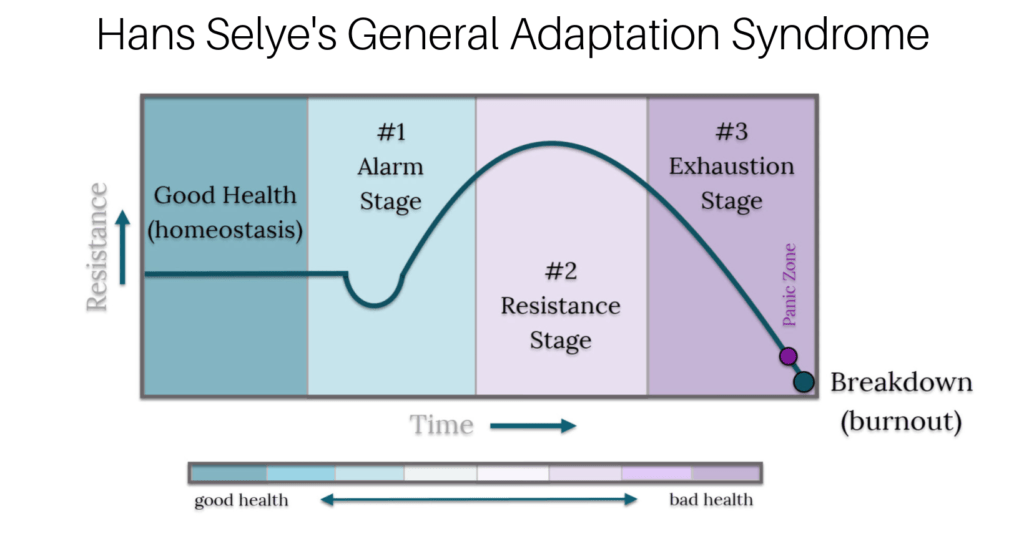
General Adaption Syndrome (GAS) is what Selye named the physical defences that react to harmful physical and psychological stimuli.
His theory was that stress was not simply an environmental stressor, but a set of processes that act as a response.
GAS is a three-stage process that describes the physiological changes our bodies go through under stress.
We begin with normal levels of stress, reach the alarm stage where the sympathetic nervous system is activated, the resistance stage of the parasympathetic nervous system activating, to the exhaustion stage where illness can occur. At the resistance stage, the body is trying to repair itself by activating the parasympathetic nervous system, while the sympathetic nervous system is still working, which it is attempting to reverse. If the stress continues, the exhaustion stage is reached where physical and mental illness can occur.
1) Alarm Stage
Typically occurs 6-48 hours after the initial stressor is detected.
The body’s initial response to a stressor, and is divided into the shock phase and the countershock phase.
SHOCK PHASE - occurs immediately after the stressor is introduces, during which physiological activity temporarily falls below normal levels.
E.g. blood pressure and body temperature may decrease as the body is ‘shocked’ by the stressor and its defences are momentarily lowered. The amygdala can also be alerted to a threat.
COUNTERSHOCK PHASE - immediately follows the shock phase, the body prepares to deal with the stressor.
The amygdala detects the threat and sends a signal to the hypothalamus to initiate the sympathetic nervous system (regulates the glands and internal organ function to physically prepare the body for increased activity during heightened physical or emotional arousal) which activates the fight-or-flight response.
A signal is sent to the adrenal glands via the bloodstream, stimulating the release of stress hormones (chemical substances secreted into the blood stream by endocrine glands to stimulate the function of organs) - including cortisol, adrenaline and noradrenaline (all secreted from the adrenal glands).
CORTISOL - Enables a continual blood sugar supply to provide energy for the body to deal with stressors. It also increases pain tolerance, however prolonged high levels of cortisol can impair immune system performance, and affect cognitive ability by damaging brain areas such as the hippocampus and prefrontal cortex (the front region of the frontal lobes responsible for coordinating executive functions).
ADRENALINE - Increases heart rate and supports the conversion of glycogen (a stored form of energy) into glucose in the liver.
NORADRENALINE - Raises blood pressure by constricting blood vessels.
2) Resistance Stage
The body’s attempt to repair itself following the initial shock of the stressor, or the continued rise of hormones in response to threat persistence.
The parasympathetic nervous system works to restore normal bodily functioning (reverses bodily functioning produced by the sympathetic nervous system, to calm the body and maintain an energy level suitable for normal functioning).
Despite this, hormones such as adrenaline, noradrenaline and cortisol continue to be secreted.
If the stress continues and remains unresolved, the body progresses to the third stage.
3) Exhaustion Stage
This stage is entered if stress persists over a prolonged period.
At this point, physical and mental reserves are depleted, reducing the effectiveness of the adrenal glands, lowering blood sugar levels, and impairing physical health.
Immediate effects include fatigue and reduced motivation, while chronic stress can increase the risk of developing depression or anxiety, and consequent weakening of the immune system raises chances of developing conditions like heart disease and diabetes.
Implications of the Theory
Understanding General Adaption Syndrome helps in recognising and addressing stress early, preventing the negative effects of prolonged stress.
Effective stress management strategies are essential to avoid reaching the exhaustion stage of maintaining overall health and wellbeing.
Practical applications of stress management can improve health, performance, and relationships in both professional and personal contexts.
Holmes + Rahe’s Social Readjustment Rating Scale (1967)
Described stress as a significant change in life that requires a response or adjustment to be made.
There is an assumption that individuals will develop physical or mental illnesses beyond a general limit of adjustment to stressful events (life changes), and that levels of adjustment needed for life changes are similar among people.
According to Holmes and Rahe, personality, life experiences and social support do not effect the impact of stress or the response/adjustments made.
The Social Readjustment Rating Scale (SRRS) is a subjective quantitative measure to assess the amount of stress that has been experienced by an individual in the past year. The assessment tool is used to assess the health and wellbeing of an individual in response to stress.
It is comprised of a list of 43 life events, scored from 10 to 100 Life Change Units (LCU). Respondents indicate which of these events they have experienced over the last year. LCU scores estimate the level of response and adjustment required by an individual.
Holmes and Rahe determined the value of each life event (LCU) by asking 394 subjects to compare each event with marriage, which was given an arbitrary value of 50. For each event, participants were asked to rate how much adjustment or readjustment to their lifestyle the event would require, relative to marriage. The researchers then averaged these ratings across all participants to assign a numerical score to each life event, creating a scale that quantified the potential stress associated with different types of life changes.
Overall scores:
<150: 30% chance of suffering from stress.
150-299: 50% chance of suffering from stress.
>300: 80% chance of developing a stress related illness.
Strengths of measurement tool
Quantitative data is collected, allowing for results to be statistically analysed.
Limitations of measurement tool
Results provided by respondents are based on a subjective measure, allowing for exaggerated responses.
Respondents are only able to select which of the life events they have experienced, and not able to include a reason for their response (a common limitation of quantitative data collection).
Lazarus and Folkman’s Transactional Theory of Stress and Coping (1984)
Suggested that individuals use their perception of a stressful situation and subjective past experiences to help them cope.
The theory differs from stress described as either the stimulus or the response. Instead Lazarus and Folkman suggested that stress is not an event, but a consequence of primary and secondary appraisals of situations and how to deal with it.
They discovered that the level of stress a person experiences is directly related to how confident the individual feels about dealing with a threat.
Interactions between individuals and environment
The Transactional Theory of Stress and Coping (TTSC) is a framework that describes stress as a result of an interaction between an individual and their environment, explaining that stress arises from the continual need to assess their current situation.
It emphasises the relationship between the person (including their unique traits) and the characteristics of the environmental event taken place.
Cognitive Appraisal
Individuals make judgements about environmental events through cognitive appraisal (the mental processes used to assess a situation).
Psychological stress arises from the relationship between the individual and their cognitive appraisal of the environmental event. Whether the person-environment relationship is stressful depends on this appraisal.
Cognitive appraisal involves both primary and secondary appraisal, which occur simultaneously. Primary and secondary appraisals interact with each other, e.g. if a person believes they lack the coping strategies to manage a situation, their stress levels will be higher because they perceive that the potential harm or loss cannot be effectively addressed.
PRIMARY APPRAISAL - the initial assessment of the situation is conducted to determine its significance. Individuals assess whether the event is irrelevant, positive or stressful.
If deemed stressful, it can further be characterised as a:
Harm (damage already done),
Threat (potential future damage), or
Challenge (potential for growth or gain).
SECONDARY APPRAISAL - when identifying a situation as stressful, individuals evaluate their coping resources and options to determine how their situation can be managed. They also assess the likelihood that each coping option will be effective, as well as the potential consequences of using it.
Methods of Coping
Coping strategies are a set of tools that people use to support positive emotions and mental health outcomes. They involve spending mental energy in ways that reduce stress.
EMOTION-FOCUSED COPING:
Aims to manage emotional reactions to stress.
Typically used when individuals perceive they do not have the resources to effectively address the stress.
Cognitive processes - avoidance or positive comparisons (could be worse).
Behavioural strategies - meditation, physical exercise, drinking alcohol, speaking with a counsellor.
PROBLEM-FOCUSED COPING:
Focusses on addressing the root cause of the stress. Typically used when individuals believe they have the resources to deal with the stress effectively.
E.g. conducting research to find solutions, or working on a plan to resolve the issue.
Consequences of Stress
Stress can affect both physical and psychological health, and the way individuals cope plays a key role in determining its impact. Coping strategies can be either maladaptive (which worsen stress) or adaptive (which help manage stress effectively).
Maladaptive Coping Strategies
Coping strategies that involve harmful and unhealthy methods of managing stress that often exacerbates its adverse effects.
These strategies avoid addressing the stressors that are causing the problems.
E.g. negative self-talk, denial, substance abuse. withdrawing from society, rumination, self-blame, procrastination.
Adaptive Coping Strategies
Beneficial and productive methods for managing stress that can decrease the adverse impacts of stress.
Strategies involve facing stressors so that they can be effectively managed.
E.g. meditation, exercise, positive reframing, planning, acceptance, humour, emotional support through others.