Ruminant
Balancing Ration for Ruminants Using Substitution Method
Nutrient requirements of the animals- what nutrient and how much of that nutrient the animals require to perform desired production.
Feedstuffs - National Research Council Feed Composition Tables (reliable references); guide in formulating rations
Considerations in choosing feed ingredients:
Economical, Processing or treatment required, Palatability, and presence of metabolites.
Guidelines and Thumb Rules in Ration Formulation
Simple nurtrients can be met by simple feed formulas
Pearson’s square method (simple rations balancing one nutrient at a time)
Algebraic methods
The more complex the nutrient specifications, the more complex the formula is required to meet specifications
Linear Programming with the least cost formulation
Forage/Pasture and Concentrate Feeding Ruminants
in forages are bulky, high fiber, low total digestible nutrients (TDN)
%CP grasses: 8%; %CP legumes: 20%
some nutrients from forage may come from starch and non-bound proteins from plant cell matrix
concentrates provide leanness and fat gain on performing animals
in concentrates, low fiber, very high TDN, and energy
more digestible than forage
may come in grains, agro-by-products
common feeds for monogastric
practiced in feedlot fattening and dairy production
concentrates cannot fully replace forages because of their availability, costly, negative effects on rumen microbes (Acidosis, bloat)
used as a supplement, not as based diet
Conventional vs. Non-conventional feedstuff
Conventional = Traditional, commonly fed to animals
Monogastric - commonly fed with concentrates as they will have difficulty in digesting high-fiber diets.
Ruminants - commonly fed with forage-based diets, with some concentrates.
Non-conventional = agro-industrial by-products / uncommonly fed leafy plants
eg. vege waste, fruit residues, fermented products, animal by-products
Breeding of Ruminants
A. Breeding - mating of animals to produce their kind
Heritability - hereditary and environmental influences on the development of a trait
Dominant traits - traits that are expressed
Breeding value- animals’ genetic merit for particular trait
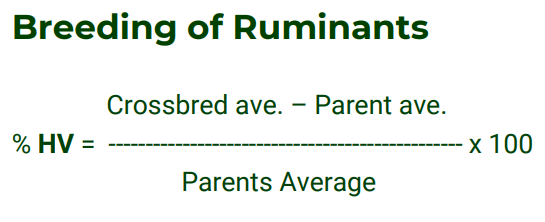
Hybrid vigor- offspring that surpass the performance of the parents
B. Systems of breeding
Inbreeding - to achieve homozygosity
*close breeding (full sib, sire-daughter)
*line breeding (half-sib, cousin-cousin)
Crossbreeding - to achieve heterozygosity of dominant genes and hybrid vigor
C. Crossbreeding Schemes
One-way/single cross
progenies are to be sold as fats
common in dairy cow
5-6% increase in weaning weight; 10% increase in maternal ability and calving percentage
sample: breed A x breed B = crossbred AB (F1)
Three-way/Triple cross/Two-breed crisscross
crossbred mated to another breed
66% of HV (15-20% increase in weaning weight)
sample: breed A x breed B = crossbred AB (F1) - crossbred AB (F1) x breed C = Crossbred ABC (F2)
Terminal Cross
F1 female joined to a bull of a different breed
commonly used in fat-lamb production
Crisscrossing/Three-bred rotational crisscross
mating crossbred progenies to parents
utilizes 80% of HV potential
Backcrossing
progeny to ancestor
breed A x breed B = Crossbred AB (F1)
Crossbred AB x A = Crossbred AB (F2)
Upgrading
mating of purebred male to native female
D. Systems of Selection
Basis for selection
Individuality - based on indivi merit
Pedigree - based on ancestor’s performance
Family selection - between family, with-in family
Production performance - progeny test, production test
Methods of selection
tandem - one trait at a time
independent culling level - minimum standards are set for traits
selection index - assigning traits according to economic importance
E. Breeding Practices
 Control of Calving Difficulty (CD)
causes:
excessive calf size at birth
inadequate size of the birth canal
an additional 20 cm sq. of pelvic area is needed to accommodate each 4.5 kg calf weighing between 23 - 37 kg. (almost no CD below 23 kg, extremely high incidence of CD above 36 kg)
Management of Heifers
other causes of CD/Dystocia:
abnormal calf presentation
obstruction of the birth canal by fat deposits
constriction of the birth canal at the vulva, vagina, cervix
weak labor or poor muscle tone (too thin or too fat)
Calving Difficulty Measures for Control:
Sire breed - heavier bulls should not be mated to heifers of small breeds.
Feeding during pregnancy - heifer should be in medium body condition at calving; full-fed at late pregnancy to prevent retarded pelvic growth and weak labor
Exercise during pregnancy - muscle tone and endurance
Disturbance during calving - birth process may be interrupted.
Rearing of Young Ruminants
first 21 days is critical for milk intake
type of feed: whole milk 4%, milk replacer 16%-18%
caves drink warm milk, not above 45 degrees C
feed calves twice a day, in regular intervals at no greater than 16 hrs and not less than 8 hrs
3-4 weeks old should have access to roughage and concentrates
dehorning is done at 7-21 days
castration at 14 days / avoid double stress
Factors Affecting Forestomach Development
Age differences
ingestion of roughage - increase weight and thickness of reticulorumen
ingestion of concentrate - stimulates the development of papillae
type of feed offered at a younger age - liquid feeding will delay forestomach development
change in the type of feed
Dairy Goat and Kid Management
A. Pre-Parturition
feed 1-2 lbs of 16-18% CP
vaccinate Clostridium perfringens, and with tetanus toxoid 3 weeks prior to kidding
administer vit. E and deworm doe at drying off
B. Parturition
dip navel in tincture of iodine, long navel should be cut to 3-4 inches long
feed colostrum milk soon after birth
Caprine Arthritis Encephalitis can be avoided using colostrum
inject iron dextran and vit A&D after birth
C. Birth to Weaning
3-4 times milk consumption daily at 1-2 weeks
overfeeding can lead to bloating, rapid passage resulting to diarrhea
milk replacer should contain skimmed milk as protein source, should be given to kids older than 2 weeks
the pre-weaning ration should contain 14-18% CP
dehorn kids between 3-24 days of age, using hot electric disbudder held over the area for 15-20 sec.
for meat goats kept until older age, castrate buck kids at 2-4 weeks of age
Clean and disinfect barn/quarters at least once a year (1 lb. lye to 15-20 gal water, or with highly pressurized water sprayer).
Sprinkle superphosphate (0-46-0) on fresh bedding (to control moisture, reduce NH3 fumes, and control foot rot).
Avoid overcrowding; 12-15 sq. ft. space for each mature ewe.
Control foot rot by hoof trimming & foot bathing
Periodically check for mastitis and practice regular teat dipping (for goats only).
Dip the navel of a newborn in a tincture of iodine.
Deworm adult sheep/goat two weeks before turning pasture, at the end of pasture season, deworm again. Use different wormers in rotation.
Spray all sheep with approved insecticide for tick and wool maggot control 10-30 days after shearing.
vaccinate against enterotoxemia, tetanus, and ecthyma or orf.
Administer Se and alpha-tocopherol:
a) to does 60 days before kidding, and
b) to bucks. Repeat several weeks before breeding season.
Sheep and Goat Management Practices
Tail-docking of lambs
•Hot Chisel
•Hot Pincher
Castration of lambs and kids
•Knife
•Burdizzo
•Emasculator
•Elastrator
Creep feeding of lambs and kids
Tagging (sheep)
•Cutting the dung locks of the sheep from around the udders and docks; done before lambing and shearing, and again before breeding season.
Hoof trimming (goat and sheep) and wool shearing (sheep).
Dipping and spraying (sheep) and drenching (Sheep and goat)
•Dipping/spraying after shearing to kill external parasites.
• Drenching for internal parasite (head in level with the nose).
Grafting or fostering (sheep and goat)
• Slime grafting (using placental fluids and membranes from new mother)
• Wet grafting (using salt-water solution and placing in the lambing pen together).
• Skin grafting (tying the pelt of the dead lamb over the lamb to be adopted, and placing in the lambing pen together).
• Fostering pens (same size as lambing pens, but provided with a stanchion that holds the head, making them unable to see or smell suckling lambs/kids, while lambs/kids are free to walk in front of the ewes/does
Marking or Identification (sheep and goat)
• Ear-notching
• Ear Tagging
Condition Scoring
handling area over the short rib (between the last rib and hipbone) and the tail head
Short rib: sharp touch, no tail head fat cover can be felt
Short rib: still felt but rounded rather than sharp, some fat cover around the tail head
Short rib: can be felt with very firm thumb pressure, areas of the tail head show fat cover that can be felt
Short rib: cannot be felt, fat cover around the tail head can be seen as slight mounds
Bine structure is no longer noticeable and the tail head is buried in fat tissue
*if the short rib gives a score of 3 but the tail head is 4, the score to be adopted would be 3.5
BAI Grades for Slaughter Cattle in the Philippines
BAI No. 1 - thickly fleshed and muscled; full in rounds, flanks, and brisket, loin, and lump is rounded with good fat cover
BAI No. 2 - moderately fleshed and muscled; hips and rump slightly prominent, fat cover is thin
BAI No. 3 - thinly fleshed, angular, and rangy; loin, round, and rump are sunken, hip, ribs, and shoulder are prominent, no fat cover with a slightly prominent outline of the body frame
BAI No. 4 - very thin; backbone, shoulder, ribs, hips, and pin bones are exceedingly prominent. the fat cover is almost totally lacking.
Marketing of Ruminant Animals
A. Characteristics of Present Marketing
numerous middlemen
producers unaware of current prices
long transport
no grading of live animals & carcasses; animals sold on a “per head” rather than “per weight” basis
establishment of collection centers
the potential of online markets
Marketing Tips
Using liveweight estimate and current price per kilogram liveweight, sell stocks on “per kilo” rather than “per head” basis.
Native cattle: W=6.3141, H=-706.35
Hariana cattle: W= 4.726, H=-428.37
Native carabao: W= 4.7, H=-466
Phil-Murrah: W=4.93, H=-5222.73
where: W-liveweight estimate (kg)
H-heart girth measurement (cm)
Sell animals ready for market; raising them would continuously raise feed expense
Do not allow middlemen to select from flock/herd
Select direct consumer market
Minimize death losses
*average shrinkage of cattle is 3-6%, and for sheep is 6-10%
Waste Management & Utilization
As fuel
Anaerobic Fermentation of Organic Matter (manure & urine) to produce 60-70% CH4 and 30-40% CO2
Insulated tank with temperature of 35°C; waste is at least 5% solid & treated for 12-15 days
Gas is compressed and stored, remove H2S to prevent corrosion of metals
As feed
OMD (Organic Matter Digestibility) of cattle manure is 43-51% and DMD (Dry Matter Digestibility) of 15- 27% in sheep
Dried cow manure promotes growth in pigs & chickens due to high B12 content.
As fertilizer
available without cost
400-kg beef cattle/carabao can produce 8 tons of fresh manure per year, while a dairy cattle/buffalo can produce 10 tons per year
In one year, 100 cows drop manure equivalent to:
500 kg superphosphate
250 kg muriate of potash
800 kg of sulfate of NH3
One ton of fresh manure contains:
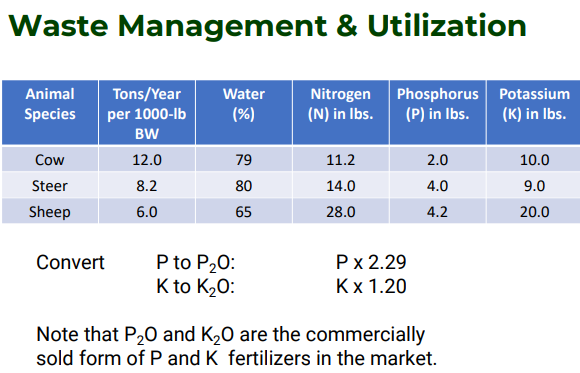
500 lbs. OM
10 lbs. N = 4.8 lbs. in urine, 5.2 lbs. in solids
5 lbs. P2O5 = 0.2 lbs. in urine, 4.8 lbs. in solids
10 lbs. K2O = 5.5 lbs. in urine, 4.5 lbs. in solids
Waste Management & Utilization
Regulations:
15m away from dairy (fly proof) to 45m
Systems of Disposal:
Pumping/Syphoning
Effluent pumped from a sump through polyethylene piping (50 mm diameter) to a suitable disposal area in the farm
Spray irrigation
Running the effluent through polyethylene pipeline from the pump overland to the sprinkler. This gives even distribution of effluent and growth of pasture.
Sump and tanker
Liquid manure is drawn from the sump, carted to paddocks & sprayed onto pasture at least weekly.
Ponding
double-pond interconnected with pipping, and pump is required
allows treatment of raw materials/waste, removal of solids leaving and effluent is easier to handle