Tissues
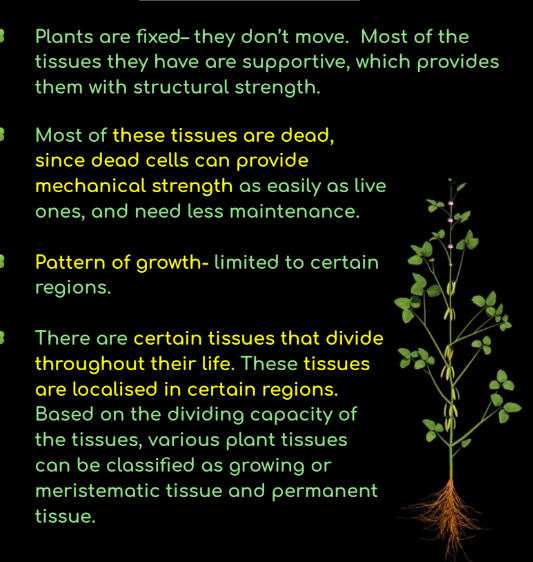
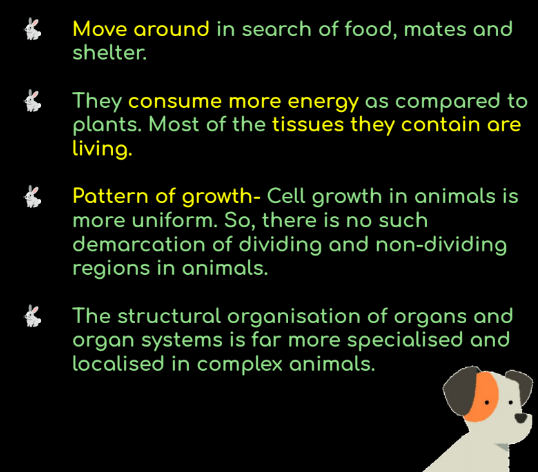
Plant tissue and animal tissue
| Plant tissue | Animal tissue |
|---|---|
| Cells of plant tissue have cell wall. | Cells of animal tissue do not have cell wall. |
| Some tissues are living and some are dead. | All tissues are living. |
| Growth is restricted to the tips of stem and roots. | Growth is uniform all over the body. |
| They are mainly of two types permanent tissue and meristematic tissue. | They are of four types muscle tissue, epithelial tissue, nervous tissue and connective tissue. |
| These tissues require less energy and maintenance as plants do not require movement. | Due to entensive body mobility these tissues require more energy and maintenance. |
| They provide strength and support to the plant. | They control all functions. |
%%Meristematic Tissues :%%
The meristem is a type of tissue found in plants. It consists of undifferentiated cells (meristematic cells) capable of cell division. Cells in the meristem can develop into all the other tissues and organs that occur in plants.
- They lack vacuoles
- They are very active
- They have a thin cell wall made up of cellulose
- They have Dense cytoplasm
@@Apical Meristems@@ - The Apical Meristematic tissue is a tissue found in the plant which is responsible for plant growth and found in the root tips as well as the tips of new shoots and leaves. One of three types of meristems, or tissue that can divide into various cell types, is the Apical Meristem. In plants, the meristem is the tissue where development takes place. Apical growth refers to growth that occurs at the plant's top and bottom tips. Apical Meristems give rise to the primary plant body and are in charge of root and shoot extension. \n @@Lateral Meristems@@ - Some plants, like some people, do not just grow up, but they grow out, as well. This, however, is a much different process in plants and humans. Plants that grow out, like trees and other woody plants, also contain a lateral meristem, from the Latin latus, meaning 'side.' A lateral meristem causes a plant to grow laterally. \n - The meristematic tissues that are present at the base of internodes of stem and petioles of leaves are known as Intercalary meristem. The function of these tissues is to promote the growth of the plants by elongating the nodes and internodes present at the leaves and stems.
Permanent Tissue
Permanent tissues are made of meristematic cells, that has definite form and shape and have lost the power to divide and differentiate and are of three types- simple, complex and special. The simple tissues are parenchyma, sclerenchyma and collenchyma.
Parenchyma
- The cells have an oval or round shape.
- The cell wall is made up of hemicellulose or cellulose.
- The cell is thin-walled.
- The cells have vacuoles and very small nucleus.
- It is found in all parts of the plant.
- The protoplasm is living and dense.
Collenchyma
- Cells are long and thick-walled.
- The cell wall is made up of cellulose and pectin.
- It is the only tissue with the highest refractive index due to the presence of pectin.
- It is found in the epidermis and the vascular bundle of dicot leaf.
- The amount of chloroplast is less in the cells.
- The cells have no intercellular spaces.
Sclerenchyma
- These are dead tissues, very hard and rigid in texture.
- Cells are thick-walled with various size and shapes.
- These provide mechanical support and rigidity to the plant.
Xylem
- It transports water and nutrients from the roots to the leaves of the plant.
- It provides support to the plants.
- It is divided into-tracheids, vessels, xylem fiber, and xylem parenchyma.
Phloem
- It translocates the prepared organic food from the leaves to different parts of the plant.
- It is also known as bast.
- It is composed of sieve tubes, companion cells, phloem parenchyma, and phloem fibres.
ANIMAL TISSUES
Epithelial Tissue
Epithelial tissues form the protective covering and inner lining of the body and organs. These tissues were the first to evolve during evolution and were first formed during embryonic development. They develop from the ectoderm, mesoderm and endoderm of the embryo.
Characteristics of Epithelial Tissues
Following are the important characteristics of epithelial tissues:
- These can be single-layered or multi-layered.
- The tissues have the power to regenerate.
- These are held together by gap junctions, tight junctions, zonula adheren, desmosomes, or interdigitation.
- The plasma membrane of these cells is specialized into flagella, cilia, and microvilli.
Classification of Epithelial Tissues
The epithelial tissues can be classified as:
| Types of Epithelial Tissue | Location | Structure | Function |
|---|---|---|---|
| Simple squamous | Blood vessel lining, air sac lining of lungs | A single layer of flat cells having irregular boundaries | Transport by diffusion and where minimal protection is required |
| Simple Cuboidal Epithelium | The tubular lining of kidneys, glandular ducts | A single layer of short cylindrical cells. It may have microvilli as in proximal convoluted tubules | Absorption and secretion |
| Simple Columnar Epithelium | Digestive tract and upper respiratory tract lining | A single layer of columnar cells (tall and slender) and often ciliated | Protection, absorption, mucus secretion and movement in a specific direction |
| Stratified Squamous Epithelium | The lining of the mouth and vagina | Made up of several layers of cells, continuously sloughed off and regenerated. The older layer of cells is pushed upwards and becomes flat. The lower layer is columnar and metabolically active | Protection |
| Stratified Cuboidal | Mammary glands, sweat gland and salivary glands | The upper layer is cuboid and other layers may be cuboidal or other types | Protection of ducts of various glands |
| Stratified Columnar | Male urethra and lobar ducts of salivary glands | There is a layer of columnar cells present on squamous, columnar or cuboidal epithelial cells | Protection and secretion |
Connective Tissue
Connective tissues develop from the mesodermal cells of the embryo. they support and bind other tissues in the body. These are made up of three components:
- Intercellular Matrix: It is made up of mucopolysaccharide, specifically hyaluronic acid.
- Cells: The major cells include fibroblasts, adipocytes, plasma cells and mast cells.
- Fibres: Connective tissues are made up of three types of fibres, namely, collagen fibre, elastic fibre, reticular fibre.
The connective tissues perform the following functions:
- They attach organs and tissues together.
- They store fat in the form of adipose tissues.
- They help in repairing tissues.
- They prevent the organs from mechanical shocks.
- The organs also help in defence.
Classification of Connective Tissues
The connective tissues are classified as follows:
| Classification | Function |
|---|---|
| Connective Tissue Proper | Provides support and protection to the body |
| Vascular Tissue | Transport of materials in the body |
| Skeletal Tissue | It supports the body and gives it proper shape and form |
Muscular Tissue
The muscular tissue develops from the mesoderm of the embryo. It is classified into three types:
- Cardiac
- Smooth
- Skeletal
Muscular tissue performs the following functions:
- It helps in movement and locomotion.
- It supports the bones and other structures.
- It is responsible for peristalsis and parturition.
Classification of Muscular Tissue
The muscular tissue can be classified as:
| Classification | Function |
|---|---|
| Cardiac | It helps in blood circulation and keeps the heart pumping |
| Smooth | These help in peristalsis and other involuntary functions of the body. |
| Skeletal | Provide support, help in movement and maintain homeostasis |
Nervous Tissue
Nervous tissue makes up the peripheral and the central nervous system. It develops from the ectoderm of the embryo. It possesses the ability to initiate and transmit the nerve impulse. Its main components include: