Chapter 19
19.1:
Evolution: Change in the genetic composition of populations over time
Evolutionary Theory: The understanding and application of the mechanisms of evolutionary change to biological problems
In science, the word "theory" does not mean just a guess or an untested idea. Instead, theory refers to a well-tested body of knowledge that explains the facts that we observe in the natural world.
Before Darwin, many believed that species had been created all at once and were unchanging
Darwin joined HMS Beagle’s global survey voyage, where he observed diverse species, particularly in South America and the Galápagos Islands.
He noted similarities between species in nearby regions and unique species on each of the different Galápagos islands, which suggested adaptations to local atmospheres
Observing living organisms and fossils around the world, Darwin developed a theory of evolution:
Species are not immutable; they change over time.
Descent with modification: divergent species share a common ancestor and have diverged from one another gradually over time
Changes in species over time can be explained by natural selection: the increased survival and reproduction of some individuals compared with others, based on differences in their traits
Natural Selection (Darwin’s concept): the differential survival and reproduction of individuals based on variation in their traits. It is the mechanism that produces change in the natural world
Artificial Selection (Darwin’s concept): selective breeding of organisms, commonly practiced by animal and plant breeders, to increase the frequency of a favored trait (desirable characteristics) from one generation to the next
19.2:
Population: a group of individuals of a single species that live and interbreed in a particular geographic area at the same time
individuals do not evolve; populations do
The 5 Mechanisms of Evolution:
Natural Selection: Three conditions necessary for natural selection to occur:
There must be variation for a trait within a population (due to mutations)
That variation must be heritable.
Individuals with traits more suited to survival and reproduction in their environment leave more offspring (trait affects reproductive success)
Mutation: an alteration of the base-pair sequence of an individual’s DNA
Mutation provides the genetic variation on which all the other evolutionary processes act
Most mutations are either harmful (deleterious mutations) or have no effect (neutral mutations). A few mutations are beneficial (rare)
Mutations are random
Gene flow/Migration: the movement of individuals and the genetic material they carry, from one population to another.
If the arriving individuals survive and reproduce in their new location, they may add new alleles to the population’s gene pool, or they may change the frequencies of alleles present in the original population
Genetic drift: changes in gene frequencies from generation to generation as a result of random (chance) processes (affects smaller populations much more than larger populations)
Population bottleneck: A period/event where only a few individuals of a normally large population survive → result: a change in allele frequencies within the population
Founder’s effect: a small subset of a population forms a new population (colonizes a new location). The new population has allele frequencies matching the founders, rather than the old population (where the founders came from)
Nonrandom mating: a mating system where individuals are more likely to mate with certain individuals (with certain phenotypes)than others
Allele: the alternate form of a genetic character found at a given locus on a chromosome.
Adaptation: a favored trait that spreads through a population by natural selection, making organisms well-suited to the environment
19.3:
Gene pool: all of the different alleles of a population (sum of the genetic variation in the population)
Allele frequency: the proportion of each allele in the gene pool
Genotype frequency: the proportion of each genotype in the population
Change in allele frequency is our measure of evolution
The Hardy-Weinberg equilibrium: in a large, randomly mating population, the frequencies of alleles (gene variants) will remain constant from generation to generation, as long as no evolutionary forces are acting upon it
p = frequency of the dominant (first) allele (A)
q= frequency of the recessive (second) allele (a)
p + q = 1 → we can predict genotype frequencies for genes with two alleles in a diploid population
p2 + 2pq + q2 = 1 → we can predict how common each genotype in the population will be
p2 = frequency of homozygous dominant genotypes (AA)
q2 = frequency of homozygous recessive genotypes (aa)
2pq = frequency of heterozygotes (Aa)
The 5 Hardy-Weinberg equilibrium principles:
Random mating- nonrandom mating will affect genotype frequency
No mutation- mutation introduces new alleles into the population
No natural selection- natural selection removes specific alleles from the population
Infinite (large population size)- allele frequency changes by chance in small populations
No gene flow- gene flow moves alleles in and out of a population
19.4:
Fitness: the likelihood that an individual survives and contributes viable offspring to the next generation
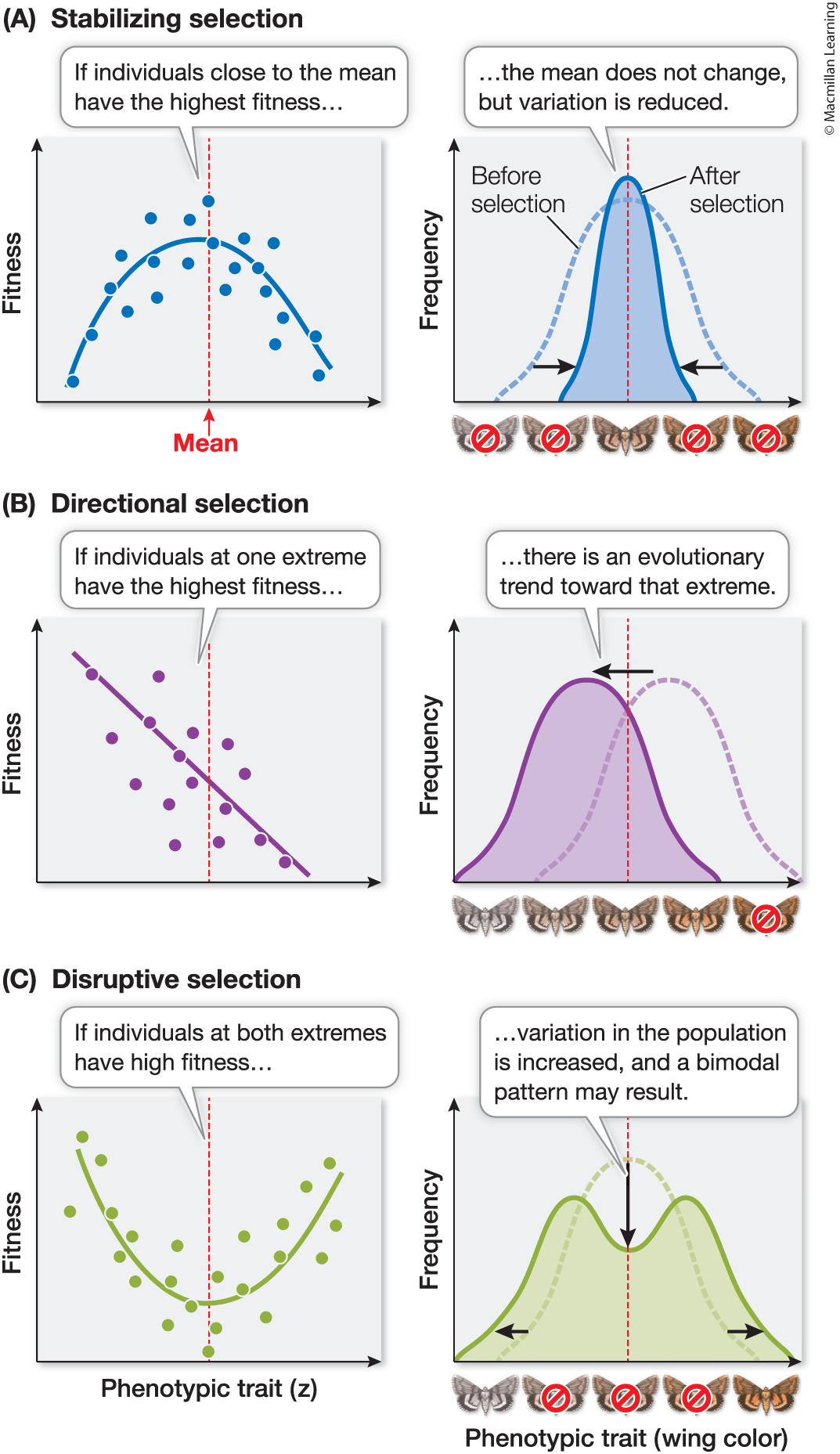
Natural selection can act on quantitative traits in three ways:
Stabilizing Selection: preserves the average phenotype (favors intermediate phenotypes and reduces variation in populations without changing the mean value of a trait)
Ex: birth weight (too light → death ; too heavy → death)
Directional Selection: favors individuals that vary in one direction from the mean (increases in one direction)
Ex: darker moths in the Industrial Revolution (when there was a lot of smoke and pollution, so darker moths survived more)
Disruptive Selection: favors individuals that vary in both directions (favors extremes over the mean)
19.5: Skipped- not covered/not important
19.6:
Macroevolution: large changes, long time. Ex: birds evolving or dinosaurs/tigers/lions evolved from a common ancestor
Microevolution: small changes, short time. Ex: mosquitoes developing resistance to DDT, or bacteria becoming resistant to antibiotics