Chapter 12 - Empires in East Asia
12.1 - Tang and Song China
- The Tang monarchs sought to reestablish China's enormous bureaucracy in order to manage their vast realm.
- They accomplished this by recreating and expanding the Han Dynasty's civil service examination system.
- Tang monarchs imposed crushing levies in the mid-700s to cover mounting government costs.
- These caused hardship for the people, but they were insufficient to fund the expenditures of military expansion and new construction projects.
- During the Tang and Song dynasties, artisans and scholars produced significant technological achievements.
- Movable type and gunpowder were two of the most essential inventions.
- Advances in agriculture contributed to China's rapid expansion. Rice farming was enhanced in particular by farmers.
- China imported a new kind of fast-ripening rice from Vietnam about the year 1000.
- Foreign trade flourished under the Tang and Song rulers. The famous Silk Roads that connected China and the West were defended by Tang imperial soldiers.
12.2 - The Mongol Conquests
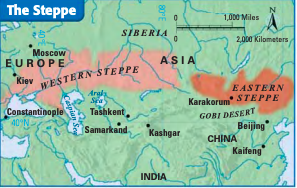
- The Eurasian steppe is divided into two sections.
- From Central Asia to Eastern Europe, the western steppe stretches.
- Some of the ancient invaders you've heard about, such as the Hittites, were born there.
- The Huns, Turks, and Mongols all began their lives in the eastern steppe, which now encompasses modern-day Mongolia.
- The contrasting lifestyles of nomadic and settled peoples resulted in continual interaction.
- They frequently exchanged goods in a peaceful manner.
- Horses, for example, were traded for basic necessities like as food, metal, fabric, and tea.
- Nomads were used to hardship and shortage.
- Following Genghis' death, his sons and grandsons resumed the conquest drive. Armies led by them drove out of Inner Asia from the south, east, and west.
- They invaded Korea after completing their conquest of northern China.
- They razed the Russian city of Kiev and advanced to the Adriatic Sea's shores.
- They had Venice and Vienna under their control.
- Many of the Mongol-invaded areas never recovered. Some cities' populations were wiped away.
- The Mongols also demolished old irrigation systems in places like the Tigris and Euphrates valleys.
12.3 - The Mongol Empire
- The Mongol monarchs and their Chinese subjects had little in common. The Mongols maintained their distinct identity as a result of their distinctions.
- Mongols lived apart from Chinese people and had their own set of laws.
- Under Kublai Khan, foreign trade expanded. The Mongol Peace, which made the caravan routes across Central Asia secure for trade and travel, was largely responsible for this.
- Traders used the Silk Roads and other ways to convey Chinese silk and porcelain, which were highly coveted in Europe and western Asia.
- Marco Polo was caught and imprisoned during a conflict between Venice and its rival city, Genoa.
- He had more time in prison to recount the entire account of his trips and exploits.
- He told his awestruck audience about China's wonderful cities, fantastic wealth, and bizarre things he had seen there.
- In 1294, Kublai Khan died. The Yuan Dynasty began to fade after his death.
- Family members were constantly squabbling about who would rule.
- Four distinct khans ascended to the throne in the space of eight years.
- The whole Mongol Empire had crumbled by the time the Yuan Dynasty fell apart.
- The Ilkhanate of Persia's government fell apart in the 1330s. Until the 1370s, the Chagatai khans governed Central Asia.
- Only the Golden Horde remained in control in Russia.
12.4 - Feudal Powers in Japan
- The first written reference of Japan dates from the first century B.C. in Chinese texts. At the time, Japan was not a unified nation.
- Hundreds of clans, on the other hand, were in charge of their own domains.
- Each clan had its own gods and goddesses who they worshipped.
- The Yamato clan had established itself as the main clan by the 400s A.D.
- The Yamato claimed to be descended from Amaterasu, the sun goddess.
- Buddhism was one of the most major influences brought by Korean travelers.
- The Japanese royal court officially embraced Buddhism in Japan in the mid-700s.
- For the majority of the Heian period, Japan's true authority was held by the wealthy Fujiwara family.
- The Fujiwaras' and the central government's power began to wane about the middle of the 11th century.
- Japan's two most powerful clans struggled for control in the late 1100s.
- The Minamoto family triumphed after nearly 30 years of fighting.
12.5: Kingdoms of Southeast Asia and Korea
- By the first century A.D., Indian commerce ships were arriving in Southeast Asia, taking advantage of the monsoon winds.
- Following that, Hindu and Buddhist missionaries propagated their faiths throughout the region.
- On the islands of Southeast Asia, powerful kingdoms arose. On the island of Java, for example, the Sailendra dynasty controlled an agricultural kingdom.
- The Buddhist temple at Borobudur, built by the Sailendra kings, is another of the world's great architectural marvels.
- The Vietnamese were the people of Southeast Asia who were least influenced by India.
- Vietnam, which is located on the coast directly south of China, fell under Chinese control.
- China conquered northern Vietnam in 100 B.C., under the great Han Dynasty.
- Korea is a peninsula that juts out from Asia's mainland toward Japan. Its size is comparable to that of the state of Utah.
- Summers in Korea are scorching, while winters are bitterly cold.
- Different clans or tribes governed different regions of the country in early Korea, as they did in early Japan.
- The Han empire captured much of Korea in 108 B.C. and created a military government.
- Koreans learned about centralized governance, Confucianism, Buddhism, and writing from the Chinese.