Financial Markets, Banking Systems, and Central Bank Monetary Policy
Alternative Financial Channels: Peer-to-Peer Lending and Crowdfunding
Peer-to-Peer (P2P) Lending Overview:
Definition: Direct lending and borrowing transactions executed between individuals without the intermediary involvement of a traditional commercial bank.
Operational Mechanism: Investors lend capital directly to individual or business debtors via specialized online digital platforms.
Notable Platforms: Zonky, Bondster, and Mintos.
Commercial Case Study: Zonky.cz P2P Consumer Credit Model:
Core Loan Offering: Flexible financing ranging from general-purpose loans to debt consolidation and refinancing (spojení a převedení půjček), home renovations, automotive purchases, health expenses, and business startup funding.
Representative Model Parameters:
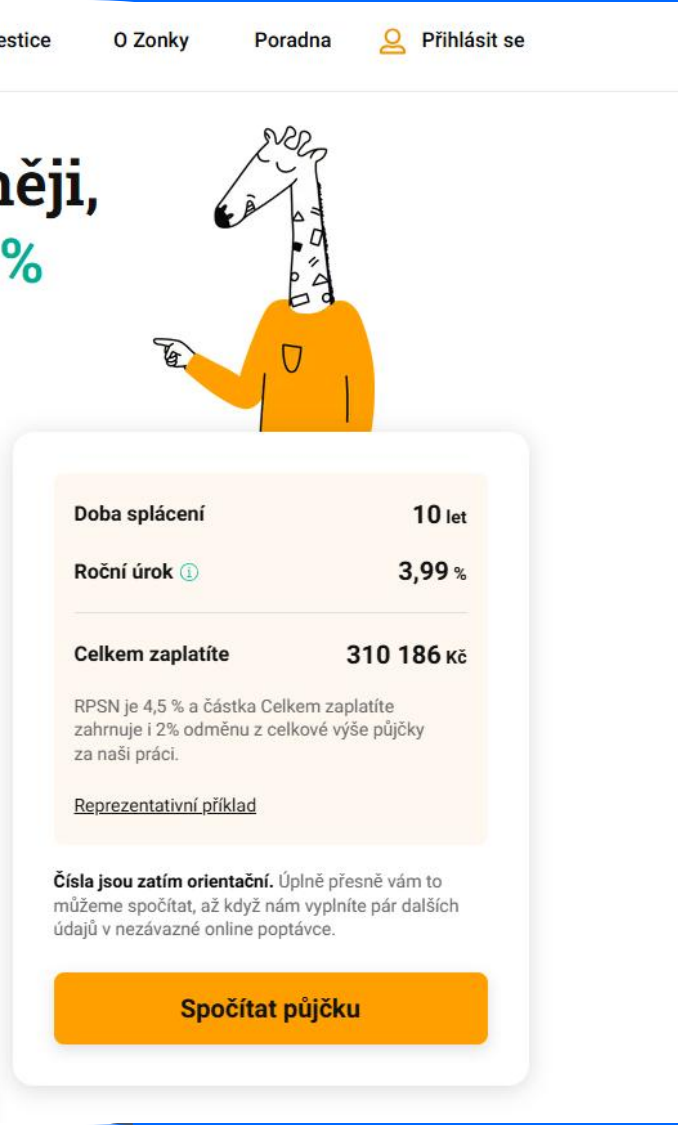
Annual Interest Rate (Roční úrok): Starting from .
Repayment Maturity (Doba splácení): Up to .
Annual Percentage Rate of Charge (APR / RPSN): Approximately .
Platform Fee Structure: Incorporates a origination fee deducted from the total borrowed amount to remunerate platform administration.
Numerical Illustration: A loan principal of amortized over results in a monthly installment of and a cumulative total repayment amount of .
Configurable Ranges: Borrowing limits configurable between and , with monthly repayment obligations scaling between and .
Crowdfunding Architecture:
Definition: Collective, group-based project financing conducted across dedicated online platforms, where individuals, entrepreneurs, or companies secure small monetary contributions from a broad public base.
Prominent Crowdfunding Platforms: Kickstarter, Hithit, and Donio.
Four Primary Models of Crowdfunding:
Reward-Based (Odměnový): Backers receive non-monetary rewards, finished products, or tiered perks in return for their funding pledge.
Donation / Charitable (Darovací / charitativní): Philanthropic funding where backers donate money with no expectation of material or financial return.
Debt / Lending (Půjčkový / dluhový): Collective financing structured as a formal loan repayable with interest.
Equity / Investment (Podílový): Investors receive an ownership share, securities, or equity stake in the funded venture.
Live Platform Funding Metrics (Kickstarter Portfolio):
Volta Thunderbolt 5 3-in-1, 240W Magnetic Adapter (Volta Charger): Achieved of funding goal with remaining.
Cyberpunk Legends: Into the Night (Night Crew Games): Reached fully funded status in , attaining funding with remaining.
Tales and Legends: Fairies, Mermaids and… (COCORRINA): Achieved funding with remaining.
Mr. Floats & The CarnEvil of Souls (PCB Entertainment): Achieved funding with remaining.
Apex Magazine 2026 (Apex Publications): Reached funding progress with remaining.
Financial Market Architecture, Instruments, and Participants
Financial Market Definition:
Systematic marketplace where buyers and sellers trade all physical and digital expressions of money, governed by the macroeconomic interplay of supply (nabídka) and demand (poptávka).
Underlying Assets: Physical cash (hotovost), non-cash bank deposits (bezhotovostní depozita), investment securities (cenné papíry), and cryptocurrencies (kryptoměny).
Structural Segmentation by Asset Maturity:
Money Market (Peněžní trh):
Time Horizon: Short-term financial instruments with maturities up to .
Core Instruments: Physical cash currency, bank checks (šeky), promissory notes and bills of exchange (směnky), short-term bank credits and loans, short-term deposits, and foreign currencies (cizí měny).
Capital Market (Kapitálový trh):
Time Horizon: Medium-term and long-term financial resources.
Core Instruments: Corporate and sovereign bonds (obligace), common and preferred stock (akcie), mortgage bonds (hypotéční listy), mutual fund certificates (podílové listy), long-term bank credits, and long-term time deposits.
Traditional Financial Intermediaries:
Central banks (Centrální banky) and commercial retail/corporate banks (Komerční banky).
Building savings societies (Stavební spořitelny).
Pension management companies (Penzijní společnosti).
Insurance corporations (Pojišťovny).
Asset leasing corporations (Leasingové společnosti).
Installment and consumer credit companies (Splátkové společnosti).
Asset management and collective investment companies (Investiční společnosti).
Licensed securities brokers and investment dealers (Obchodníci s cennými papíry).
Emergent Market Entrants:
Retail public participants operating via decentralized sharing economy frameworks (Sdílená ekonomika).
Peer-to-peer micro-lending platforms enabling horizontal person-to-person credit extension.
Independent digital trading platforms bypassing conventional banking networks using cryptocurrencies supported by mobile and web application architectures.
Core Economic Functions of Financial Markets:
Deposit Function (Depozitní): Provides secure, remunerated repositories for surplus capital.
Credit Function (Kreditní): Reallocates unutilized capital reserves to creditworthy deficit entities.
Store of Value (Uchování hodnoty): Safeguards accumulated wealth and purchasing power against temporal erosion.
Liquidity Function (Funkce likvidity): Facilitates instantaneous, low-friction conversion of financial claims into usable purchasing power.
Payment Function (Platební): Manages national and cross-border settlement infrastructure for goods, services, and transfers.
Risk Mitigation (Ochrana proti riziku): Allocates, hedges, and diversifies systematic and unsystematic operational and market exposures.
Policy Transmission Function (Politická): Functions as the operational medium for government fiscal policy and central bank monetary policy:
Fiscal Policy: Public budget formation, taxation, and government expenditures configured to stabilize employment and foster sustainable gross domestic output.
Monetary Policy: Steering nominal interest rate benchmarks and foreign currency market interventions to protect price stability and optimize domestic currency value.
The Two-Tier Banking Architecture and Institutional Models
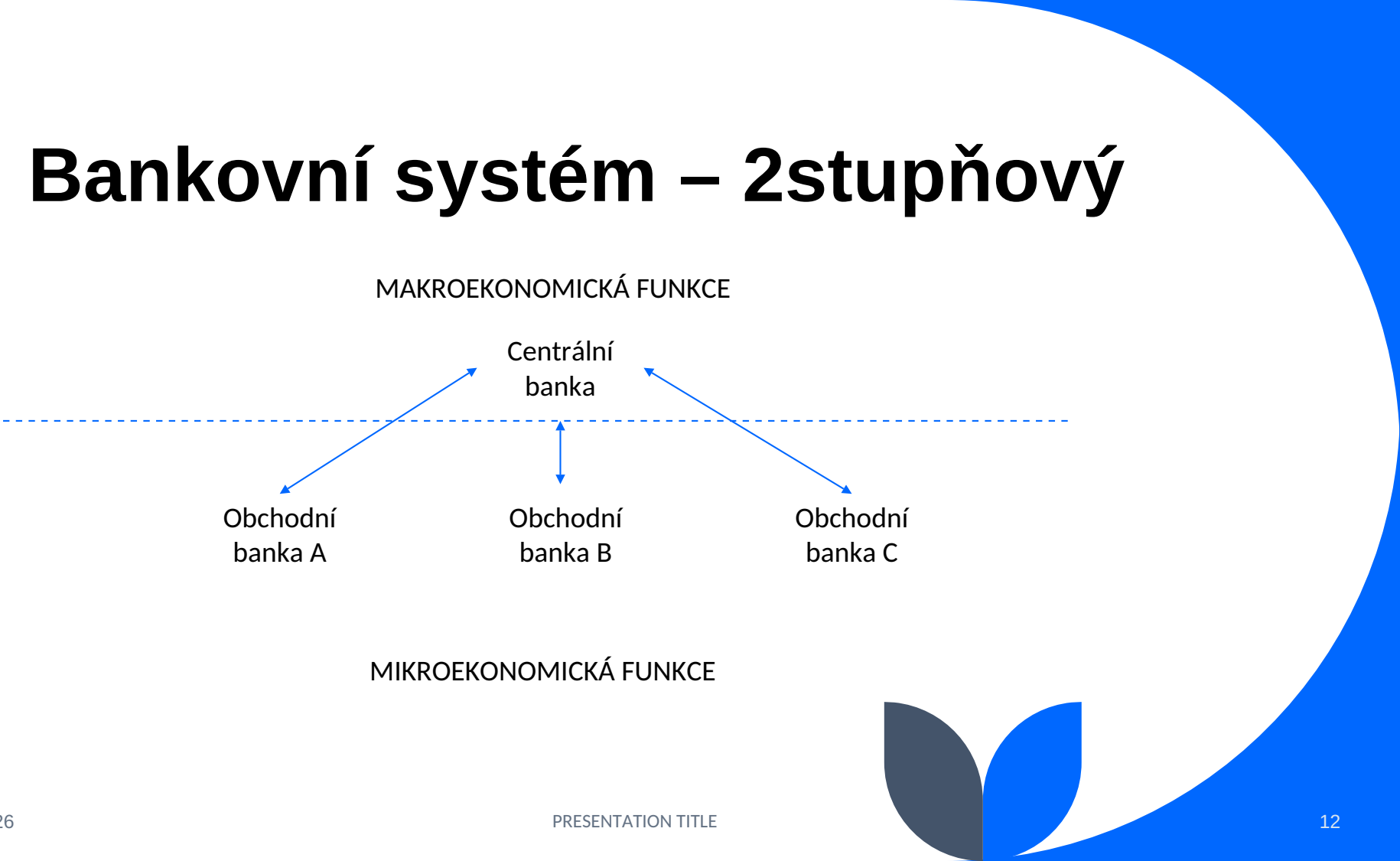
Two-Tier Banking System Overview:
Tier 1 — The Central Bank (Centrální banka):
Functional Scope: Macroeconomic management (makroekonomická funkce).
Primary Objective: Safeguarding monetary integrity and domestic price stability (měnová a cenová stabilita).
Tier 2 — Commercial Banks (Obchodní banky):
Functional Scope: Microeconomic execution (mikroekonomická funkce).
Primary Objective: Generating corporate profit (dosažení zisku) through intermediation spreads and financial fee structures.
Structural Banking Models:
Universal Banking Model (Univerzální bankovnictví): Combines retail commercial banking activities and investment banking operations within a unified corporate entity.
Strategic Advantages:
One-stop service portfolio for clients.
Diversified cross-sector income streams protecting the institution from isolated sector shocks.
Economies of scale and lower operational unit costs.
Inherent Disadvantages:
Potential conflicts of interest and unauthorized internal utilization of confidential client information.
Opacity regarding overhead allocations and fee cross-subsidization.
High concentration of market power resulting in decreased competitive pressure.
Separated / Specialized Banking Model (Oddělené bankovnictví): Enforces a strict legal partition separating deposit-taking commercial entities from underwriting and investment firms.
Commercial vs. Investment Banking Operations:
Commercial Banking Products: Depository savings accounts, commercial and consumer lending facilities, and clearing and payment transactions (platební styk).
Investment Banking Products: Secondary securities market trading, corporate issuance underwriting, securities custody, and merger and acquisition (M&A) advisory.
Underwriting Operations (Emisní obchody): Originating and placing primary debt (bonds) or equity (stocks) on capital markets to pool lending capital or executing public security flotations on behalf of corporate clients.
Custody and Depot Operations (Depotní obchody): Physical and electronic vaulting and asset safeguarding of securities, supplemented by administrative rights management (dividend and coupon collection, proxy voting representation at corporate annual general meetings).
Mergers (Fúze): Contractual consolidation of multiple independent corporate entities into a single enterprise based on mutual agreement.
Acquisitions (Akvizice): Outright purchase, sale, or takeover of a controlling ownership stake in a target business entity.
Central Bank Governance, Mandate, and the Czech National Bank (ČNB)
Institutional Mission:
Fully autonomous statutory financial institution established to safeguard the internal and external purchasing power of the national currency and ensure systemic financial resilience.

Historical Evolution of Czech Banking:
Post-1945 Era: Monobank architecture dominated by the State Bank of Czechoslovakia (Státní banka československá). Autonomous monetary policy did not exist; operations were limited to administrative planning and distribution of currency in circulation.
1990 Landmark Reform: Separation of central banking from commercial banking activities, establishing a modern two-tier structure.
2004 European Union Integration: Implementation of the Single Banking License framework, enabling institutions authorized in their home member state to provide cross-border services across host member nations.
Legal Foundation and Organizational Framework of ČNB:
Constitutional Anchor: Established directly by the Constitution of the Czech Republic (Ústava ČR).
Statutory Charter: Governed by Act No. 6/1993 Coll., on the Czech National Bank (Zákon o ČNB, č. 6/1993 Sb.).
International Integration: Member of the European System of Central Banks (ESCB).
Bank Board of the ČNB (Bankovní rada ČNB):
Highest statutory executive decision-making body, consisting of .
Headed by the Governor (guvernér), Aleš Michl.
Board members are appointed directly by the President of the Republic for a tenure (with presidential power of dismissal).
Service is statutorily limited to a maximum of .
Administrative Infrastructure:
Headquarters located in Prague.
Regional Branch Offices: Prague, Hradec Králové, Brno, and Ostrava.
Regional Territorial Workplaces (Územní pracoviště): Plzeň, České Budějovice, and Ústí nad Labem (with phased institutional closure planned from onward).
Regional Agenda Scope: Account maintenance, localized banking supervisory enforcement, and regional payment clearing.
Four Pillars of Central Bank Independence:
Systemic Rationale: Insulates monetary governance from short-term political pressures. Political administrations often prioritize artificial short-term economic expansion at the expense of long-term price stability. When sovereign governments run fiscal deficits, an independent central bank prevents debt monetization, requiring governments to issue debt to private capital markets at competitive rates.
1. Personal Independence (Personální): The President of the Republic appoints Bank Board members directly without political countersignature or Cabinet nomination.
2. Institutional Independence (Institucionální): The Bank Board is legally prohibited from soliciting or taking directives from the government, Parliament, or the President, maintaining autonomous consultative relationships regarding foreign exchange parity.
3. Functional Independence (Funkční): The ČNB independently defines its operational inflation targeting framework and chooses its monetary policy instruments.
4. Financial Independence (Finanční): ČNB operational expenses are fully defrayed from its own operating revenues and credit operations with banks. It does not draw from the state budget or general tax receipts.
Constitutional Accountability and Inter-Institutional Relations:
Complete immunity from direct governmental orders, balanced by structured mutual consultations regarding macroeconomic and macroprudential policies.
The ČNB Governor retains the legal right to attend Cabinet meetings; the Minister of Finance holds a reciprocal right to attend Bank Board sessions in an advisory capacity.
Mandatory Parliamentary Reporting:
Submits the Monetary Development Report (Zpráva o měnovém vývoji) twice annually () to the Chamber of Deputies (Poslanecká sněmovna) for formal debate.
Submits the Financial Stability Report (Zpráva o finanční stabilitě) once annually () for legislative review.
Macroeconomic Functions: Monetary Policy, Currency Emission, and Reserves
Primary Macroeconomic Responsibilities:
Formulation and execution of monetary policy (Monetární / měnová politika).
Sovereign emission of physical currency (Emise hotovostních peněz).
Management of foreign exchange reserves and exchange market operations (Devizová činnost).
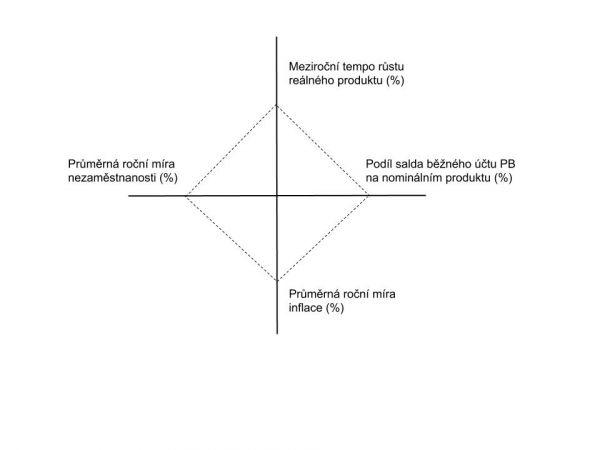
Monetary Policy and the Magic Quadrangle (Magický čtyřúhelník):
Monetary policy coordinates systemic liquidity to maintain macroeconomic equilibrium across four key targets:
Year-on-year real GDP growth rate ().
Average annual unemployment rate ().
Current account balance of the balance of payments as a share of nominal GDP ().
Average annual inflation rate ().
Monetary Policy Orientations:
Expansionary Monetary Policy (Expanzívní měnová politika):
Mechanism: Systematic reduction of policy interest rates.
Economic Objective: Pro-growth stimulus (prorůstová) designed to accelerate real GDP expansion.
Deployment Conditions: Activated during economic downturns, recessions, or prolonged stagnation characterized by low, stable inflation.
Restrictive Monetary Policy (Restriktivní měnová politika):
Mechanism: Progressive increases in benchmark policy rates.
Economic Objective: Anti-inflationary stabilization (protiinflační) designed to cool overheated aggregate demand.
Deployment Conditions: Activated during macroeconomic overheating, high capacity utilization, low unemployment, and rising wage-price inflation spirals.
Monetary Transmission Channels (Rate Hike Analysis):
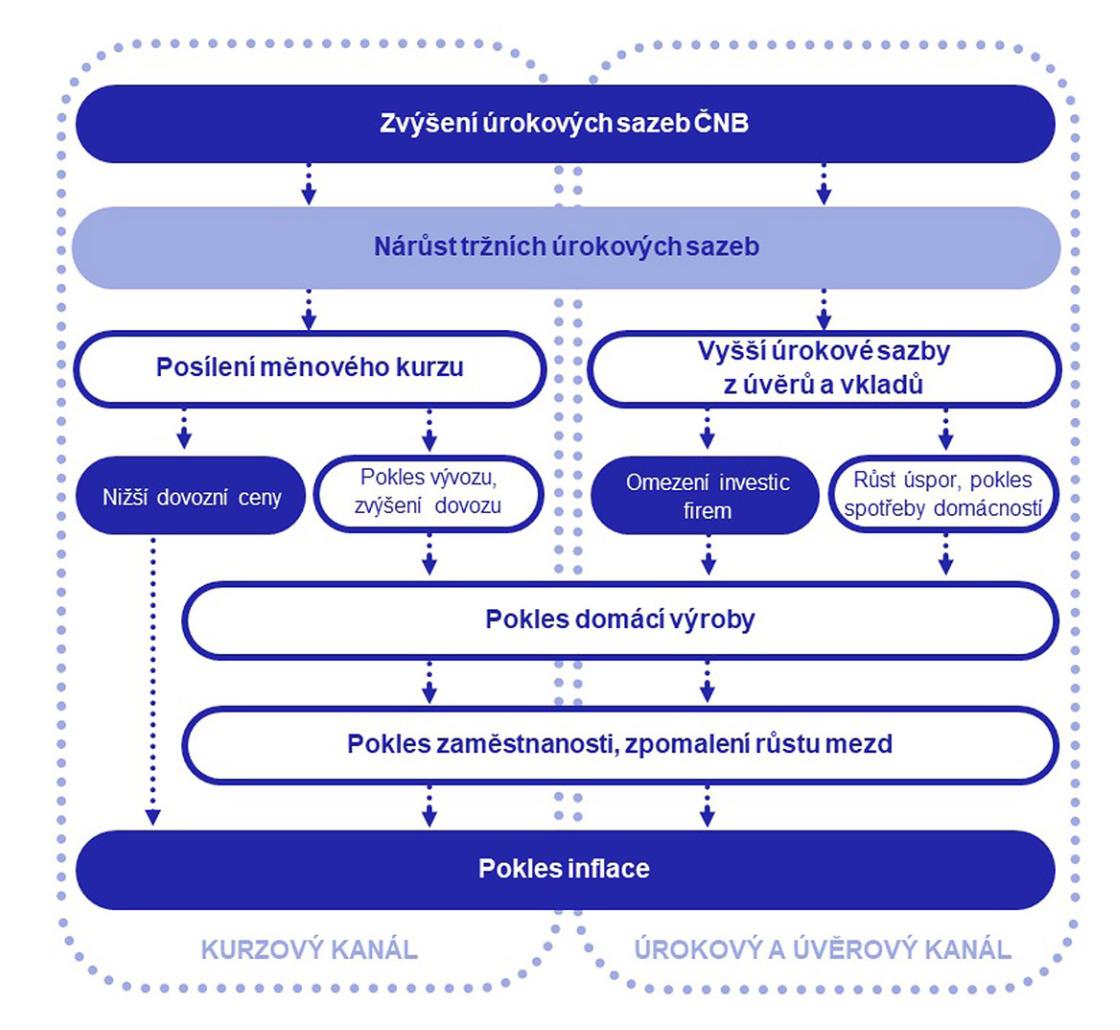
An upward adjustment in ČNB benchmark policy interest rates increases interbank and market yields, propagating through two main channels:
Exchange Rate Channel (Kurzový kanál):
Induces capital inflows, appreciating the domestic currency exchange rate (Posílení měnového kurzu).
Lowers import prices (Nižší dovozní ceny), reducing imported inflation.
Diminishes foreign export competitiveness and raises import volumes (Pokles vývozu, zvýšení dovozu), lowering domestic manufacturing output (Pokles domácí výroby).
Interest Rate and Credit Channel (Úrokový a úvěrový kanál):
Increases retail and commercial borrowing rates while boosting deposit yields (Vyšší úrokové sazby z úvěrů a vkladů).
Increases capital costs, leading to reductions in business investment (Omezení investic firem).
Prompts higher household savings rates and depresses household consumption expenditure (Růst úspor, pokles spotřeby domácností).
Dampens aggregate demand and reduces domestic production volumes (Pokles domácí výroby).
Systemic Output and Inflation Effects:
Reduced domestic production dampens labor demand, lowering overall employment and decelerating wage growth (Pokles zaměstnanosti, zpomalení růstu mezd).
The combination of appreciated import pricing, weakened corporate pricing power, and tempered aggregate demand reduces broad inflation (Pokles inflace).
Currency Emission and Money Supply Dynamics:
Physical Currency Monopoly (Emisní monopol):
The central bank exercises exclusive sovereign authority over the minting, issuance, and permanent withdrawal of physical banknotes and coins.
Manufacturing Partners in the Czech Republic: Banknotes are manufactured by the State Printing Works of Securities (Státní tiskárna cenin Praha, s.p.); coinage is produced by the Czech Mint (Česká Mincovna a.s.).
Non-Cash Money Creation (Bezhotovostní peníze):
Non-cash money is created by commercial retail and merchant banks through fractional-reserve credit extension not backed by physical currency.
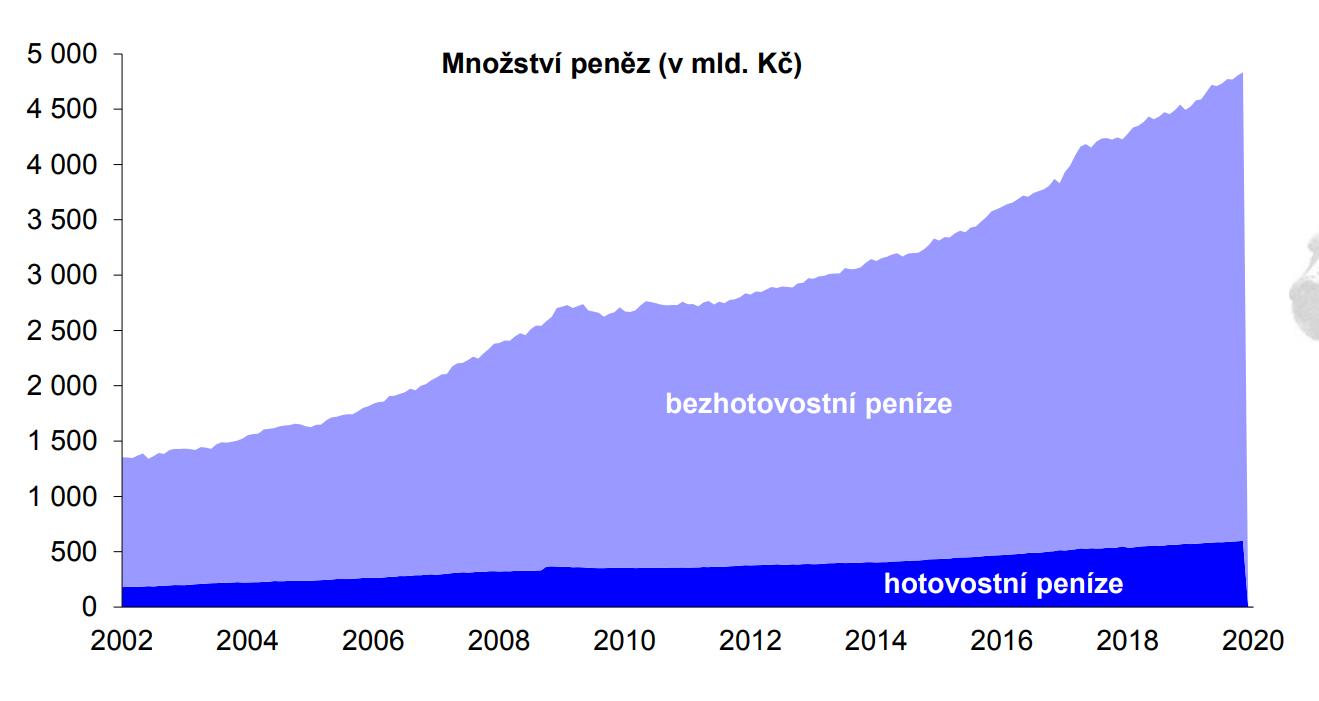
Money Supply Structure in the Czech Economy ():
Broad money supply expanded from under in to over by .
Physical cash accounts for approximately of total systemic liquidity, while non-cash electronic deposits constitute the remaining .
Four Stages of the Cash Emission Lifecycle:
Quantitative projection of physical currency demand (Stanovení množství peněz).
Technical production, engraving, and printing/minting (Tisk peněz).
Controlled logistical distribution into interbank circulation (Distribuce peněz do oběhu).
Withdrawal and destruction of soiled, worn, or obsolete currency (Stahování peněz z oběhu).
Management of Foreign Exchange Reserves (Devizová činnost):
Strategic Purpose: Provides an emergency liquidity backstop to service public external commitments during macroeconomic shocks and funds direct open-market currency operations.
Portfolio Asset Composition of ČNB Reserves (as of ):
Fixed Income and Debt Securities (Cenné papíry):
Cash and Interbank Deposits (Depozita):
Monetary Gold (Zlato):
Other Foreign Assets (Ostatní):
Currency Denomination of Reserves (as of ):
Euro (EUR):
United States Dollar (USD):
Canadian Dollar (CAD):
Australian Dollar (AUD):
British Pound Sterling (GBP):
Physical Gold Holdings:
Foreign Exchange Market Interventions (Devizové intervence):
Discretionary open-market purchases or sales of foreign currencies against the Czech koruna.
Primary Objective: Counteracting speculative currency attacks and curbing excess exchange rate volatility (Snížit volatilitu).
Market Mechanics: Selling foreign assets to absorb koruna reserves shifts market demand from to , clearing the currency market at a higher exchange parity.
Microeconomic Functions and Central Bank Monetary Instruments
Core Microeconomic Responsibilities:
Prudential banking regulation and supervision (Bankovní regulace a dohled).
Interbank payment clearing and fiscal agent services for the sovereign state (Zajišťování platebního styku bankám a státu).
Diplomatic and institutional representation of the state in domestic and international monetary affairs (Zastupování státu v zahraničí na poli monetární politiky).
Prudential Banking Regulation and Supervisory Oversight:
Regulation (Rule Setting): Establishing mandatory structural criteria governing the formation and operation of commercial institutions.
Entry Capital Requirements: Statutory minimum registered capital of .
Professional Qualifications: Fit-and-proper screening of commercial bank executive management.
Operating Standards: Enforcing minimum capital adequacy ratios, liquidity coverage requirements, and counterparty credit exposure limits.
Compliance and Crime Prevention: Implementation of Anti-Money Laundering (AML) standards and insider dealing prohibitions.
Depositor Protection: Mandatory bank membership in statutory deposit guarantee schemes.
Supervision (Ongoing Enforcement): Regular audits, compliance inspections, and enforcement of corrective remedies or license revocations for non-compliant institutions.
Payment Settlement and Fiscal Agency Services:
Bank of Banks (Banka bank): Operates master settlement accounts for commercial institutions, accepts excess reserve deposits, extends emergency discount/lombard liquidity, and clears interbank transfers.
Bank of the State (Banka státu): Administers state treasury accounts, processes revenue and tax collections, and executes payment orders for the national government, regional municipalities, and public bodies.
Sovereign Debt Administration (Správa státního dluhu): Organizes primary debt underwriting auctions, distributes government bonds and bills on capital markets, and services principal amortizations and coupon payments for sovereign debt.
State Representation in Monetary Forums:
Domestic Public Relations: Informs civic and financial markets regarding monetary targets and submits statutory performance reports to Parliament.
International Institutional Relations: Represents the Czech Republic at international monetary institutions, specifically participating in sessions of the International Monetary Fund (IMF / Mezinárodní měnový fond) and the World Bank (Světová banka).
Monetary Policy Implementation Instruments:
Indirect Market Instruments (Nepřímé nástroje): Systemic measures that operate through market incentives across the entire commercial banking sector uniformly.
Monetary Interest Rate Benchmarks:
Diskontní úvěry (Discount Facility): Floor rate facility where banks deposit overnight excess liquidity.
Lombardní úvěry (Lombard Facility): Ceiling rate facility where commercial banks borrow overnight emergency reserves against eligible collateral.
Repo operace (Repurchase Operations): Principal monetary instrument utilized to absorb liquidity over standard durations.
Foreign Exchange Interventions: Direct balance-sheet foreign currency spot operations to control volatility.
Minimum Reserve Requirements (Povinné minimální rezervy - PMR):
Mandatory volume of uninvested liquid funds that commercial institutions must maintain on deposit with the central bank.
Calculated as a percentage of bank liabilities owed to non-bank entities.
ČNB Minimum Reserve Requirement: Fixed at
European Central Bank (ECB) Reserve Requirement: Fixed at
Systemic Function: Fulfills a structural macroprudential and liquidity-buffering role.
Direct Administrative Instruments (Přímé nástroje): Targeted regulatory mandates applied to individual commercial banks.
Credit Quotas (Úvěrové kontingenty): Quantitative ceilings dictating the maximum aggregate volume of loans an institution may originate.
Interest Rate Caps / Limits (Úrokové limity): Mandatory administrative floors or ceilings on loan or deposit interest rates.
Liquidity Directives (Pravidla likvidity): Legally binding structural ratios regulating the composition and maturity matching of bank assets and liabilities.
Academic Presentations and Case Assignments:
The Bank Board of the ČNB: Institutional mandate, executive leadership, and analysis of recent monetary policy decisions (presented by Lukáš and Timur).
The European Central Bank (ECB): Institutional history, core macroeconomic functions, and executive leadership (presented by Arsen).