Assessment Techniques & Communication
Module 34 The Concept of Assessment
Module 14 Table 14.6 Classification of Overweight and Obesity by BMI, Waist Circumference
Clinical Nursing Skills: Chapter 1: Skill 1.2-Height: newborn, infant, child, adult, measuring
Clinical Nursing Skills: Chapter 1: Skill 1.4-Weight: newborn, infant, child, adult, measuring
Clinical Nursing Skills: Chapter 3: Skill 3.1-Pain in newborn, infant, child, adult: assessing
Kaplan-> Content Library-> Nursing School
General Survey and Vital Signs (first 2 min 45 sec)
Subjective data: Symptoms feellings/senstations that cant be measure
Objective: Signs identifed by oberservation or physical examination
Kaplan->Basics Book
Techniques page 6-8
Findings: General Survey page 8ime
Across the lifespan general
Physical appearnace, body structure, mobility, behavior, ht, wt, bmi
BMI
18 and under = underweight
25 -30 overwight
30 and above obese
Underweight can lead to malnutretions, which could be caused by eating disorders
Sound heard over the stomach: tymphany
Bariatric scale is for pts who wt more than 350 lbs
Children under 3 to get a tympanic membrane temperature gently pull the ear down and back
Apical pulse is found at the 5th intercostal
120-180 newborn pulse
60-100 adult pulse
80-140 toddler
Diastolic pressure= pressure in arteries when the heart is at rest
Pulse pressure calculation minues the systolic to the diastolic. Normal range is 30-40.
Types of assessments
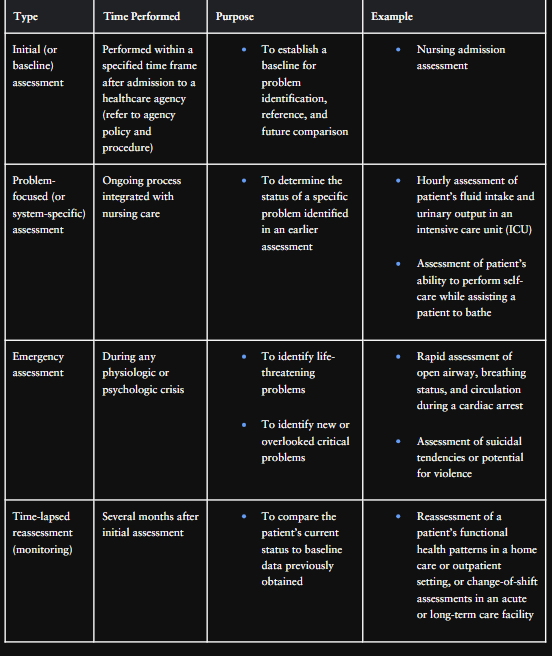
Physical assessments
Palpation: pulses, skin temp, turger
Percussion: normal percussion tones, resonant, hyperresonant, tympany, dull, flat
Ausculation: Bell vs diaphragm
Ausculation: Techniques for lungs, heart, and abdomen
Other systems: Inspection, palpation, percussion, auscultation
Abdomen: Inspection, auscultation, percussion, palpation
Precautions/hygiene
Hand hygiene
Univeral precaustion
Cleaning eqipment
Questions/pain
Histroy Taking
Numeric Rating Scale
Wong-baker FACES pain ratting scale
Visual analogue scale
_____________________________________________