Chapter 4: Atoms Combining
Formation of Ions
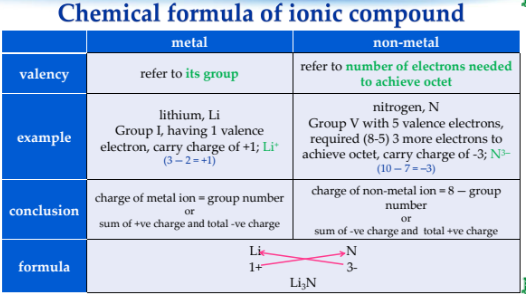
Cations: Positive ions formed from metals.
Anions: Negative ions formed from non-metals.
Ionic Bonds
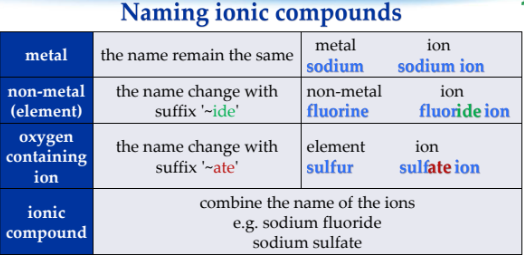
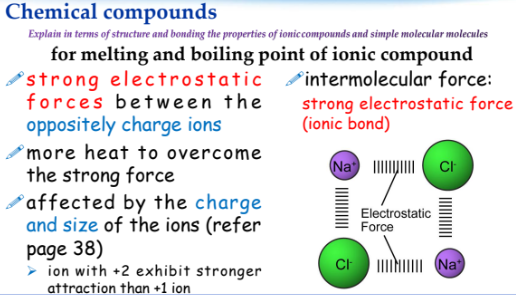
Strong electrostatic attraction between oppositely charged ions.
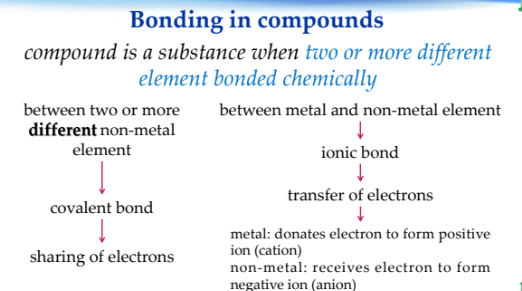
Typically formed between Group I and Group VII elements via electron transfer.
Giant lattice structure: Regular arrangement of alternating positive and negative ions.
Properties of Ionic Compounds
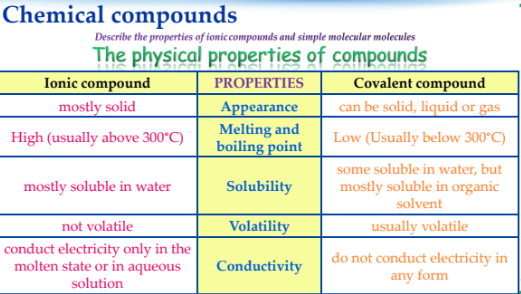
High melting and boiling points due to strong electrostatic forces.
Good electrical conductivity when aqueous or molten, poor when solid due to fixed ion positions in solid state.
Covalent Bonds
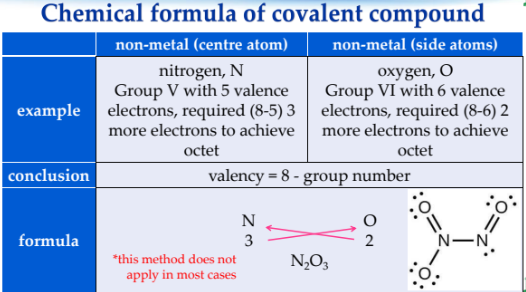
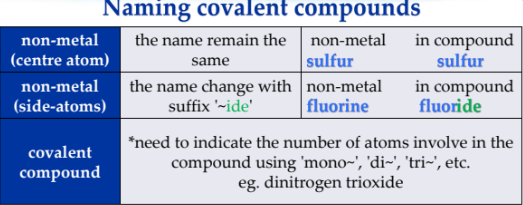
Formed when a pair of electrons is shared between two atoms to achieve noble gas electronic configurations.
Occur in simple molecules like , , , , , and .
Properties of Simple Molecular Compounds
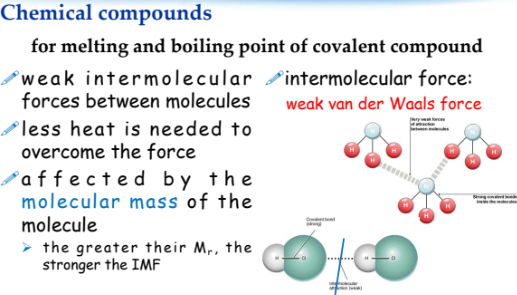
Low melting and boiling points due to weak intermolecular forces.
Poor electrical conductivity as they do not contain ions.
Covalent Bonds in Complex Molecules
Formed in molecules like , , , , and .
Giant Covalent Structures
Graphite:
Used as a lubricant and electrode.
Layers of carbon atoms arranged in hexagonal rings, enabling the free movement of electrons, which contributes to its electrical conductivity and lubricating properties.
Diamond:
Used in cutting tools.
Each carbon atom is covalently bonded to four other carbon atoms in a tetrahedral arrangement
Silicon (IV) oxide ():
Similar properties to diamond due to tetrahedral structure, forming a giant network of silicon and oxygen atoms.
Metallic Bonding
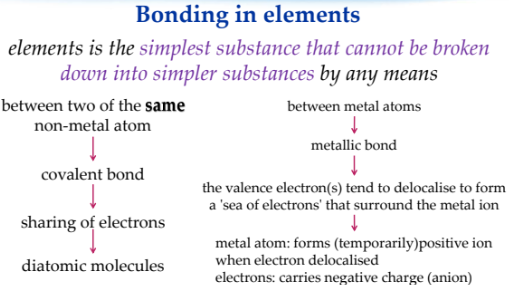
Electrostatic attraction between positive ions in a giant metallic lattice and a 'sea' of delocalized electrons.
High electrical and thermal conductivity.
Valence electrons delocalize, creating a 'sea of electrons' and positively charged metal ions. This results in properties such as malleability and ductility, allowing metals to be shaped without breaking.
Properties of Metals
Good electrical conductivity due to delocalized electrons.
Malleability and ductility.
Chemical Bonds
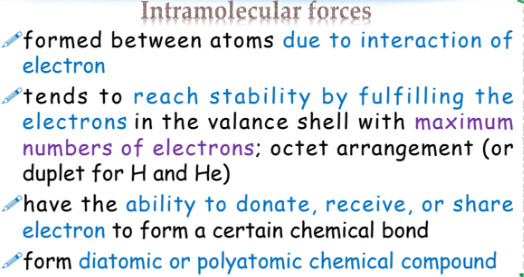
Intramolecular forces (strong): Ionic, covalent, and metallic bonds.
Intermolecular forces (weak): van der Waals forces.
Bonding
Covalent: Sharing of electrons between non-metals.
Metallic: Delocalization of valence electrons forming a 'sea of electrons' around metal ions.
Ionic: Transfer of electrons between metal and non-metal atoms.
Ionic Bonding
Metal atoms lose electrons to form cations.
Non-metal atoms gain electrons to form anions.
Cations and anions attract each other through strong electrostatic forces.
Covalent Bonding
Sharing of one or more electrons from both atoms to form single, double, or triple bonds.
Properties Comparison
Ionic compounds: Mostly solid, high melting/boiling points, conduct electricity when molten or aqueous.
Covalent compounds: Can be solid, liquid, or gas; low melting/boiling points, generally do not conduct electricity.
Structure of Chemical Substances
Simple molecular: Fixed number of atoms, held by weak van der Waals forces.
Giant molecular: Limitless number of atoms, all atoms strongly bonded by covalent bonds.
Allotropes
Two or more distinct forms of the same element in the same physical state (e.g., diamond and graphite).
Alloys
Parent metal with residue/impurity/foreign atoms, which prevents metal atoms from sliding over each other.