taxes test
Federal Unemployment Tax Act (FUTA): A federal program that provides temporary financial assistance to unemployed workers who lose their jobs through no fault of their own.
Income Tax: A tax imposed on the income generated by an individual or business. Income tax is further divided into federal, state, and local income tax.
Medicare Tax: A tax that funds health insurance for citizens 65 years of age and older, and for younger people receiving disability benefits through Social Security.
Progressive Tax System: A tax system where the tax rate increases as the taxpayer's income increases.
Property Tax: A tax imposed on real estate or other forms of property, calculated based on the value of the property.
Sales Tax: A consumption tax paid by the end consumer of goods and services, and collected and remitted by the seller to the appropriate government agency.
Social Security Tax: A tax that funds financial assistance for retirement, disability, and survivors.
State Unemployment Tax Act (SUTA): A state program that provides temporary financial assistance to unemployed workers who lose their jobs through no fault of their own.
Tax Liability: The amount of money that is owed by a person or organization to a taxing authority, like the federal, state, and local governments.
Taxes: Mandatory payments made by individuals and businesses to governments.
April 15th… for some, this day is just another spring day. But for others, this day marks a rush of panic, stress, and perhaps some relief. Why? In the United States, April 15th is Tax Day—the official deadline for individuals and businesses to file their federal tax returns for the previous year. So, what exactly is a tax return, and why and how do we file them?
A tax return is a form or set of forms filed with the government to report (personal or business) income, the taxes already paid during the prior year, and the taxes still owed. Taxpayers can also claim deductions and/or credits, which can reduce the amount of taxes owed, or even provide a refund for a previous overpayment of taxes. Think of it as settling up with the government to make sure everyone pays their required share, based on what they earn.
Filing a tax return is crucial for several reasons:
To calculate the correct tax: Not everyone pays the same amount of taxes. Filing your tax return helps you determine if you've paid too much (and you're due a refund) or too little (and you need to pay more).
To maintain records with the IRS: Filing a tax return keeps your financial records up to date with the IRS, which is important for things like applying for loans and financial aid.
To claim tax benefits: There are many tax benefits, like deductions for students or credits for lower-income workers. Filing your tax return allows you to claim these benefits.
You have several options for filing your tax return:
Paper filing: This is the traditional method where you fill out your tax forms by hand and mail them to the IRS. It’s free to file but can take longer to process.
Electronic filing (e-filing): This method uses tax software or online platforms such as TurboTax, H&R Block, and TaxSlayer, to fill out and submit your tax forms digitally. It’s faster, and you can get your refund quicker if you’re owed one. There is usually a fee associated with these services, depending on the complexity of your return.
Using a tax professional: If you find the tax return process confusing and/or complex, you can always hire a tax professional, like a CPA (Certified Public Accountant). They can ensure that your taxes are prepared and filed accurately, however, this route is usually the most expensive.
Typically, tax returns are due by April 15th of each year. If that day falls on a weekend or a holiday, the due date might be pushed to the next business day (Monday). If you need more time, you can file for an extension, which gives you until October 15th to file your return. However, if you owe taxes, you still need to estimate and pay that amount by April 15th to avoid any penalties and/or interest.
Form W-2
A primary component of a tax return is the summary of income an individual earned throughout the year. There are various types of income, including wages, salaries, and tips, and passive income such as dividends, interest, and capital gains. But for most people, income will come from an employer in the form of a wage or salary. To assist in the reporting and calculation of income and taxes withheld, employers are required to provide each employee a Form W-2.
A Form W-2, also called a Wage and Tax Statement, is a tax form an employer prepares to report an employee’s annual compensation and tax-related withholding amounts.
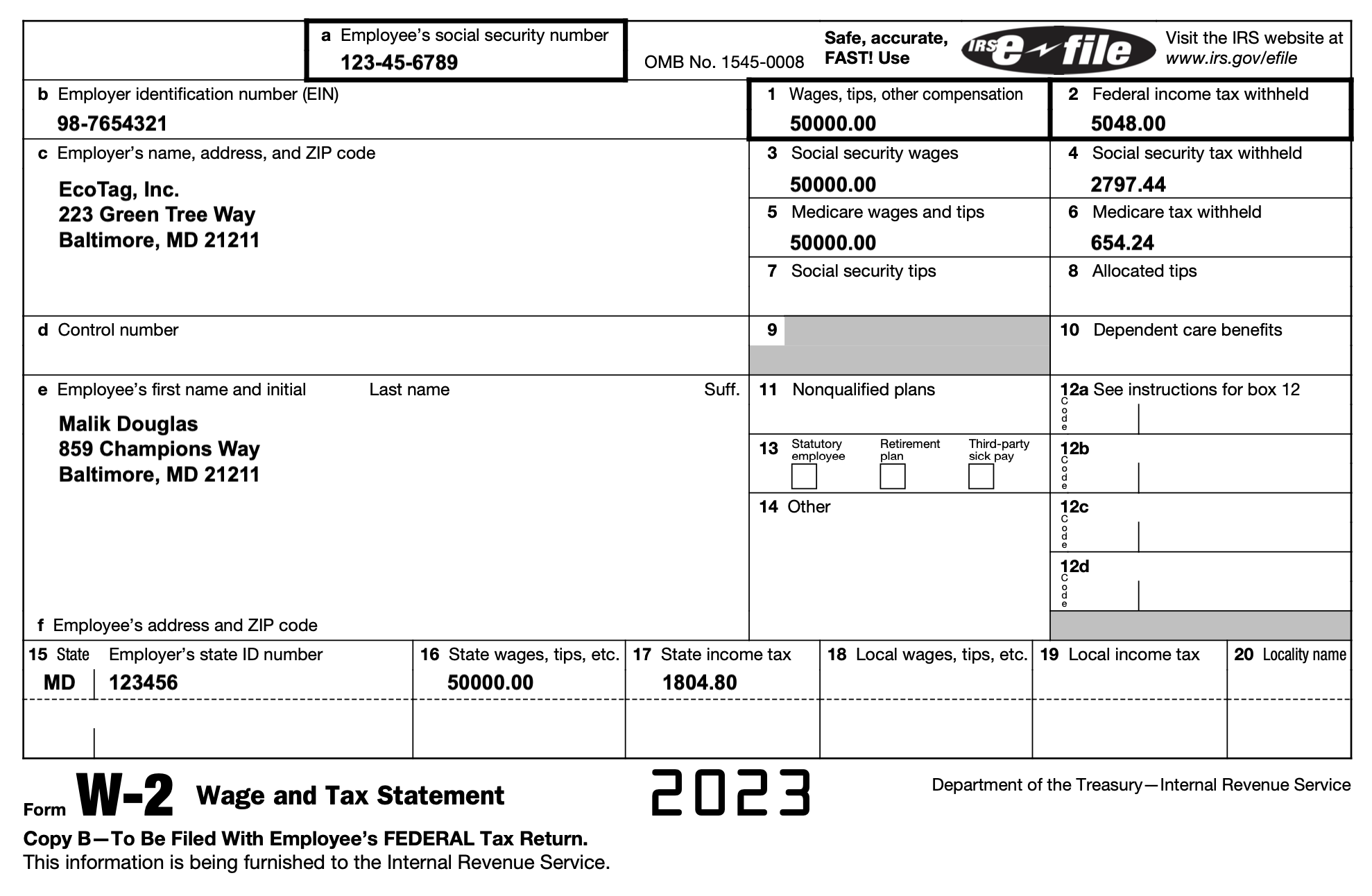
Above is an example of Malik Douglas’s Form W-2 for the year 2023, provided to him by his employer, EcoTag. Let’s break down the primary components of his W-2 in more detail:
Box 1: Wages, tips, and other compensation: This box shows total taxable income for the year. Malik earned $50,000 in 2023.
Box 2: Federal income tax withheld: This is the amount of federal tax withheld. EcoTag withheld and remitted $5,048 in federal income tax in 2023 on behalf of Malik. The withholding amount is based on the withholding allowance Malik claimed on his Form W-4.
Box 3: Social Security wages: This shows the amount of earnings that are subject to Social Security tax. Malik’s full $50,000 of earnings were subject to the Social Security tax.
Box 4: Social Security tax withheld: This is the amount of Social Security tax withheld. EcoTag withheld and remitted $2,797.44 in Social Security tax in 2023 on behalf of Malik.
Box 5: Medicare wages and tips: This shows the amount of earnings that are subject to Medicare tax. Malik’s full $50,000 of earnings were subject to the Medicare tax.
Box 6: Medicare tax withheld: This is the amount of Medicare tax withheld. EcoTag withheld and remitted $654.24 in Medicare tax in 2023 on behalf of Malik.
Box 15-20: State and Local Information: The W-2 also includes boxes for state and local taxes, which vary depending on where the employee lives. Malik lives and works in Maryland, and EcoTag withheld and remitted $1,804.80 in state income taxes on behalf of Malik.
Employers are required to deliver Form W-2’s annually to all employees by January 31st each year. This gives employees enough time to to prepare and file their tax returns, which are due by April 15th. For those working multiple jobs, a W-2 from each employer will be sent. It is important to gather all W-2s before filing your tax return.
The second most common income summary document is called a Form 1099, which has many variations. For example, a Form 1099-NEC is used to report payments made to non-employees for services performed for a business. A Form 1099-DIV is used to report dividends and other distributions from investments. A Form 1099-INT is used to report interest income received from various sources, such as banks. And a Form 1099-R is used to report distributions from pensions, IRAs, or other retirement accounts. Another common form is called a Schedule K-1, which is used to report a partner’s share of partnership income and distributions.
Tax Concepts
Before we dive into filling out a tax return, it’s essential to understand some key tax concepts. These terms will help you make sense of the forms and figures involved in the tax process.
Income
Income is any money an individual or business earns or receives as the result of economic activity. There are many types of income, including: wages and salaries, contractor income, interest, capital gains, dividends, rent, and others.
Tax Deduction
A tax deduction is an expense that a taxpayer is allowed to subtract from their total income to reduce the amount of income that is subject to taxation. Deductions are typically used to account for certain expenditures that are considered beneficial or necessary, such as medical expenses, mortgage interest, and charitable contributions. There are two primary types of deductions:
Standard Deduction: A fixed dollar amount that reduces a taxpayer’s taxable income. The amount varies based on your filing status (single, married filing jointly, etc.). For example, for the 2023 tax year, the standard deduction was $13,850 for single filers and $27,700 for those married filing jointly. Most people use this deduction because it’s higher than their combined itemized deductions.
Itemized Deductions: Specific expenses that taxpayers can claim to reduce their taxable income. These can include medical expenses, mortgage interest, and charitable donations. If the total of these expenses are greater than the standard deduction, then taxpayers would use this amount, in order to reduce their taxable income even more than the standard deduction would provide for.
Tax Credit
A tax credit is a direct reduction in the amount of taxes owed by a taxpayer. Unlike tax deductions, which reduce the amount of taxable income, tax credits reduce the actual tax liability on a dollar-for-dollar basis. Common tax credits include the Earned Income Tax Credit (EITC), Child Tax Credit, and various education credits.
Dependents
A dependent is a person who relies on the taxpayer for financial support and for whom the taxpayer can claim a dependency exemption on their tax return. Claiming a dependent can provide tax benefits, such as eligibility for certain tax credits and deductions.
Withholding
Withholding is the process by which an employer deducts a portion of an employee's wages or salary for taxes, retirement plans, health insurance premiums, and other employee benefits, before the remainder is paid to the employee. Regarding taxes, this system ensures they are paid regularly, and directly to the appropriate government agencies, throughout the year, rather than in a lump sum at the end of the tax year. The amount of tax withheld depends on the information you provide on your W-4 form.
Filing Status
Filing Status refers to a category that defines a taxpayer's marital and family situation, affecting tax rates, standard deductions, and eligibility for certain tax benefits. The primary filing statuses are:
Single: Not married.
Married Filing Jointly: Married couples who combine their income and deductions and file one tax return.
Married Filing Separately: Married couples who file separate tax returns.
Head of Household: Single individuals who support a dependent/s and pay more than half the cost of keeping up a home.
Adjusted Gross Income (AGI)
Adjusted Gross Income (AGI) is a taxpayer’s total income for the year minus specific eligible deductions. AGI is an important number on your tax return because it is used to calculate your eligibility for various deductions, credits, and other tax benefits.
Taxable Income
Taxable income is the portion of income that is subject to income tax. It is calculated by subtracting any deductions (either standard or itemized) from your AGI. This is the amount of income that taxes are based on, so the lower your taxable income, the less tax you owe, and vice versa.
Completing a 1040
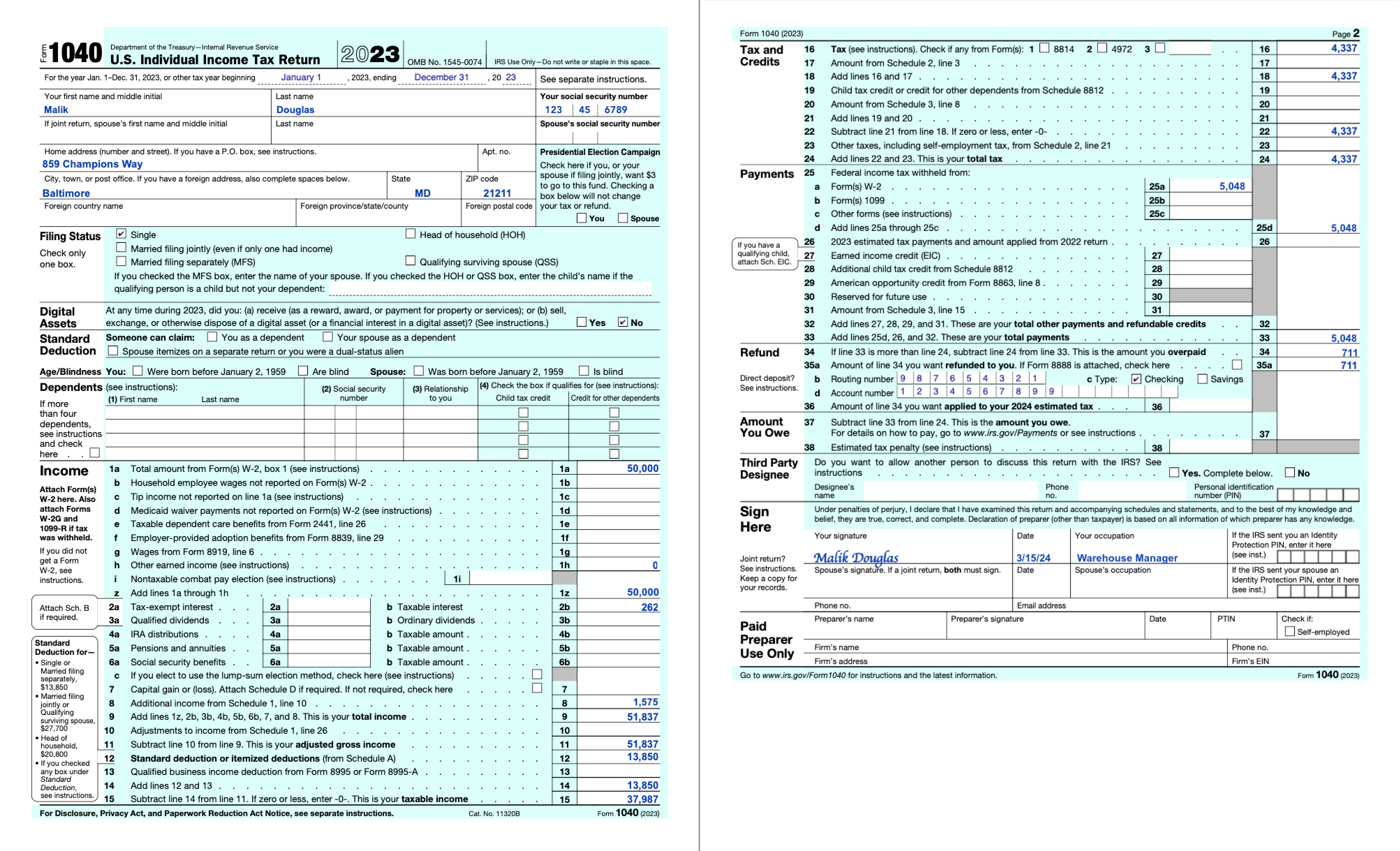
Now that we’ve covered the basics, it’s time to bring it all together and learn how to fill out a Form 1040, which is the standard U.S. Individual Income Tax Return form used by individuals to file their annual income tax returns with the Internal Revenue Service (IRS). To demonstrate, we are going to fill out a Form 1040 for EcoTag employee Malik Douglas. The steps are as follows:
Step 1: Gather Your Documents
To start, make sure you have all the necessary documents. This includes W-2’s, 1099’s, receipts for deductions, and any other tax-related forms received. In Malik’s case, the only tax form he received was his W-2 from EcoTag.
Step 2: Fill Out Your Personal Information
At the top of the Form 1040, Malik entered his personal information including his name, address, social security number, and filing status. Malik is filing “single”.
Step 3: Report Your Income
Form W-2: Malik takes the $50,000 of income shown in Box 1 of his W-2, and enters it in line 1a of Form 1040.
Interest Income: Malik received a Form 1099-INT from his bank for interest earned on his savings account. The interest totaled $262 and is entered on line 2b.
Other Income: To earn additional income, Malik provided landscaping services for multiple clients in 2023. His clients paid him in the form of cash, but did not provide him with 1099s. Still, even when 1099s aren’t provided, the income is required to be reported. His landscaping earnings total $1,575, and are entered in line 8.
Total Income: Next, all income sources are added together and entered on line 9. Malik’s total income equals $51,837.
Step 4: Calculate Adjusted Gross Income (AGI)
Next, we will calculate Malik’s AGI:
Adjustments to Income: Malik does not have any adjustments to his AGI, such as student loan interest or retirement contributions.
Total AGI: So his AGI is equal to his total income, $51,837, which is entered on line 11.
Step 5: Take Deductions
Now, Malik needs to decide whether to take the standard deduction or itemize his deductions. The sum of Malik’s itemized deductions do not exceed the standard deduction, so the standard deduction amount, $13,850, is entered in lines 12 and 14. Note, the standard deduction amounts are listed to the left of this section.
Step 6: Calculate Taxable Income
To calculate taxable income, total deductions $13,850 (line 14) are subtracted from AGI, $51,837 (line 11). Malik’s taxable income, $37,987, is entered in line 15.
Step 7: Determine Tax Owed or Refund Amount
Total Tax: Now that we know Malik’s taxable income, we can calculate the tax owed. Using the tax tables in the 1040 instructions, Malik’s taxable income of $37,987 means taxes are owed in the amount of $4,337. This amount is entered on line 16.
Tax Credits: Malik doesn’t qualify for any tax credits, but if he did, they would be added in this section. Since there are no credits, the total tax, $4,337, is entered in line 24.
Taxes Already Paid: Next, the total federal taxes withheld from Malik’s paychecks throughout the year, which is reported in Box 2 on the W-2, totaled $5,048. This amount is entered on line 25a, and totaled on line 25d.
Refund or Amount Owed: Subtract the taxes Malik already paid, $5,048, from his total taxes owed, $4,337. This equates to a tax refund of $711. A tax refund is the amount of money returned to a taxpayer by the government when the taxpayer has paid more in annual taxes than they owed. If Malik owed more than he had already paid, then he would pay the remaining tax amount to the government.
Step 8: Sign and Submit
Finally, Malik signs and dates the Form 1040 and sends it to the IRS. The 1040 can either be e-filed or a paper copy can be mailed to the IRS.