Steady State Theory and Oscillating Universe Theory
Steady state theory - another theory that tries to explain the origin of the universe. As opposed to the big bang, this theory states that the universe has no beginning and no end
Overview of the Steady State Theory
The steady state theory suggests that the universe has always been here and will always be present
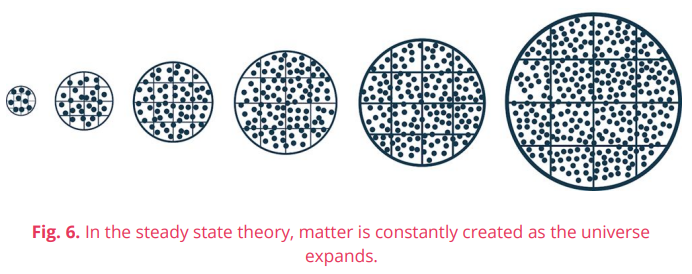
During expansion, the density of the universe remains constant; hence, the name steady state.
steady state shows that the universe maintains a constant density as it expands.
Proponents of the Steady State Theory
Hermann Bondi, Thomas Gold, and Fred Hoyle in 1948
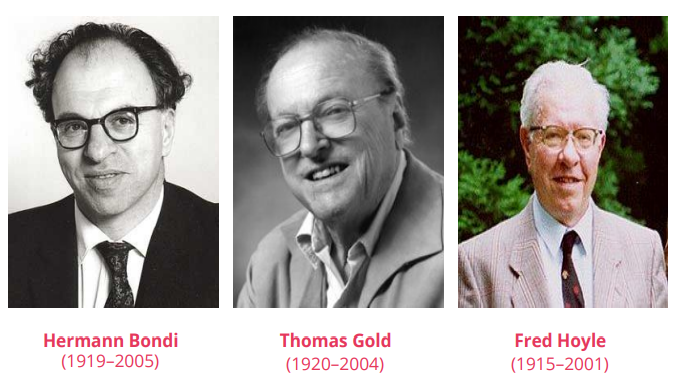
These three physicists from Cambridge, released the idea of the steady state theory by submitting two papers to Monthly Notices of the Royal Astronomical Society, one from Bondi and Gold, and the other one from Hoyle’s
The steady state idea of Bondi and Gold may have started when they watched a movie together late 1940s
the universe is constantly changing yet remains the same
Drawbacks of the Steady State Theory
Other astronomers did not favor this theory since it is not parallel with the law of conservation of energy and mass where energy and matter cannot be created nor destroyed but can only change their form
The steady state theory explained that the cosmic radiation was a result of a supernova. However, after thorough research, it was proven that the radiation is equal in any direction of the universe and could not be a result of many supernovae.
Oscillating Universe Theory - the universe is expanding and will contract once all the energy after the big bang has been used up, only to expand again once it approaches the point of singularity.
Overview of the Oscillating Universe Theory
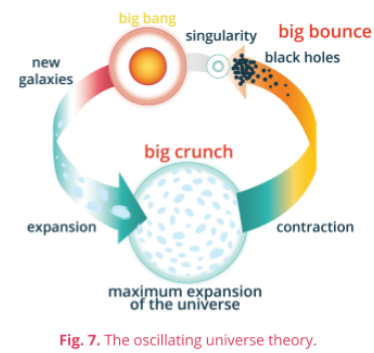
The oscillating universe theory can be described as the combination of the big bang and the big crunch
big crunch occurs when the universe expands and eventually reverses, then collapses causing the formation of a singularity
The oscillating universe theory suggests that once the universe reverses and attains the point of singularity, another universe will be born. This is referred to as the big bounce.
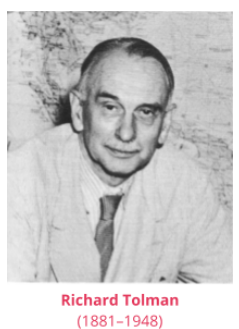
Richard Tolman - an American mathematical physicist and physical chemist, theorized that the universe may be first in the cycle, or it could be a result of a previous big bounce event
Proponent of Oscillating Universe Theory
Tolman made essential contributions on theoretical cosmology. In his monograph entitled, “Relativity, Thermodynamics and Cosmology”, he documented and explained that the universe has zero energy because the positive mass energy and negative gravitational energy cancel each other
Drawbacks of Oscillating Universe Theory
This theory suggested that the universe would collapse on its own after it reached its full expansion, which would violate some current laws of physics, such as the postulated existence of dark energy