Unit 6- Genetic, Biotech, and Decision-making
DNA
DNA is a nucleic acid that contains nucleotides. Nucleotides consist of a phosphate group, a sugar (deoxyribose), and a nitrogenous base. The nitrogenous bases are adenine, guanine, cytosine, and thymine, which are paired based on their charges and lengths. Adenine and guanine are purines that have two rings and cytosine and thymine are pyrimidines that have one ring.
General structure
Nucleic Acid
Nucleotide- building blocks
phosphate
sugar
deoxyribose
nitrogenous base
paired for charges and lengths
purines
adenine
guanine
two rings (longer)
pyrimidines
cytosine
thymine
one ring (shorter)
Role of DNA
Chapter 13, p. 417
Carries instructions to create proteins
Stays in the nucleus to protect instructions
Replication
DNA carries instructions to create proteins and is located in the nucleus for protection. There are two types of cells: eukaryotic and prokaryotic. In eukaryotic cells, DNA replication is semiconservative, which means that each strand of DNA separates and becomes a template for the synthesis of two new complementary strands. In prokaryotic cells, replication starts from a single point and goes in both directions until completed. An enzyme called polymerase joins nucleotides and proofreads the newly synthesized strands to ensure accuracy.
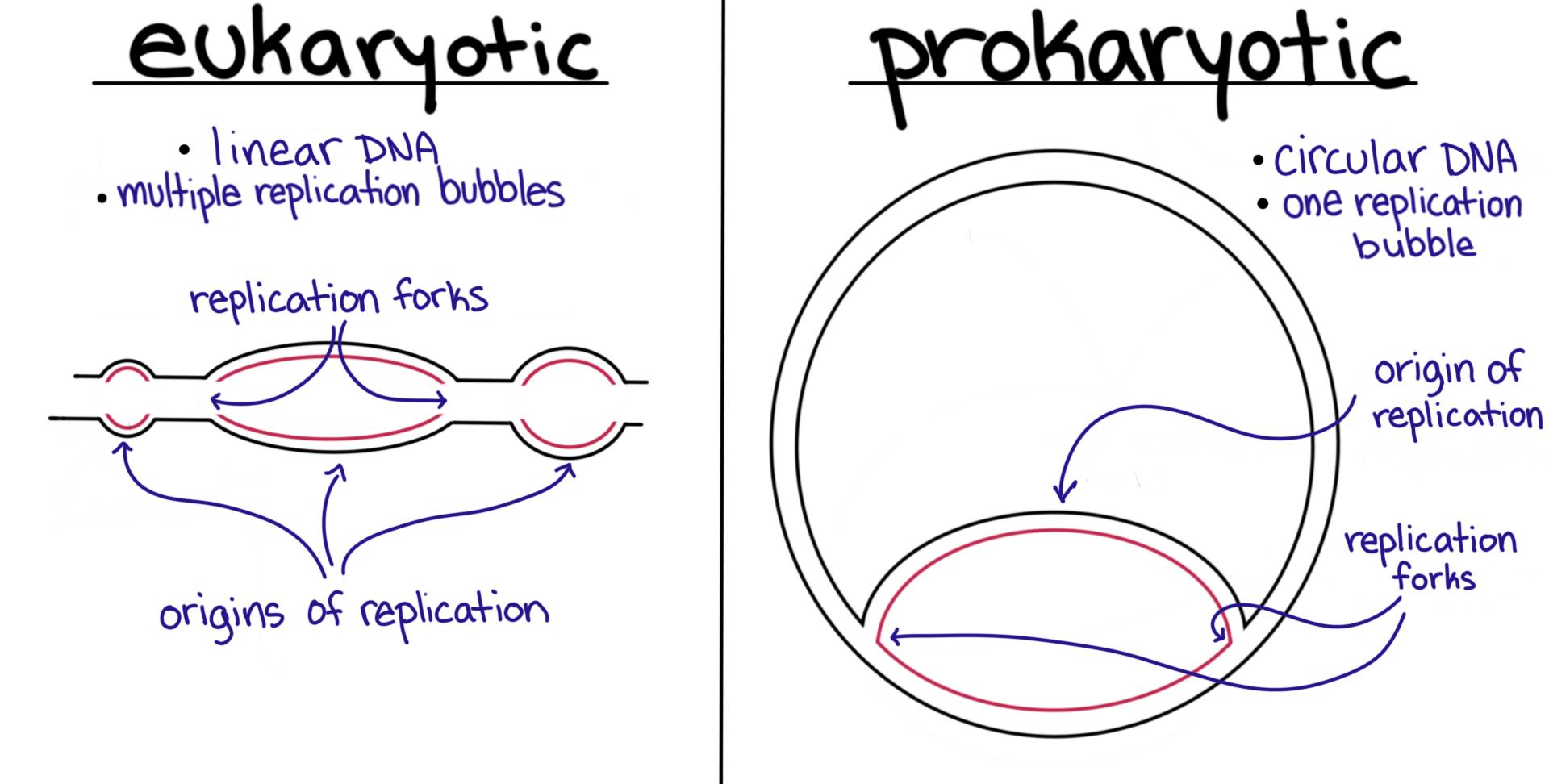
Eukaryotic
Two strands of DNA separate/untwist
each strand becomes a template
two new complementary strands can be synthesized
begins at many places at once
semiconservative
Prokaryotic
Replication starts from a singular point and goes in both directions until finished.
Polymerase
enzyme that joined nucleotides
“proofreads”
Telomeres
the tip of eukaryotic chromosomes
the enzyme telomeres add short, repeated DNA sequences to telomeres as the chromosomes are replicated
RNA
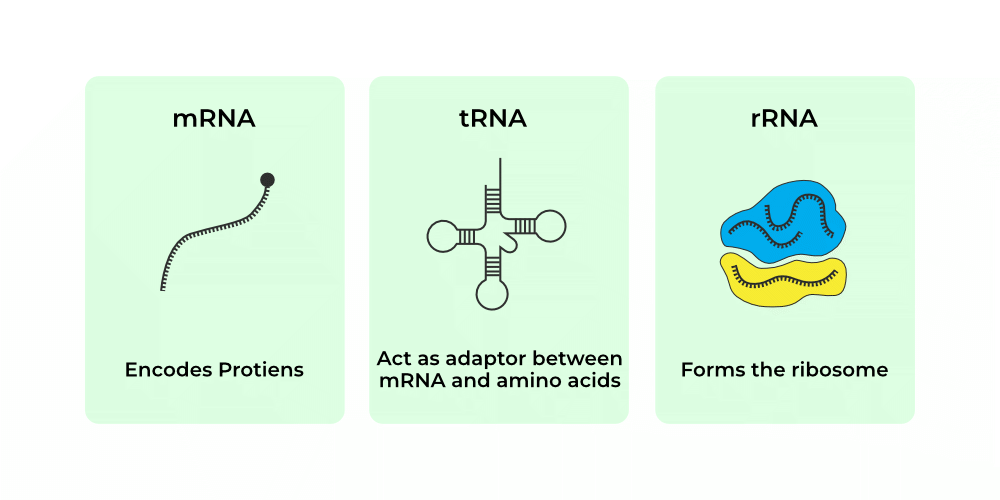
RNA plays a crucial role in protein synthesis and gene expression. All RNA is produced in the nucleus before traveling to the cytoplasm. There are three types of RNA, each with its own function. Messenger RNA (mRNA) is a copy of the portion of DNA that will be used to produce a protein. Transfer RNA (tRNA) carries amino acids from the cytoplasm to the mRNA. Ribosomal RNA (rRNA) is part of ribosomes, which consist of two subunits made of ribosomal proteins and RNA.
General structure
a single-stranded molecule composed of nucleotides. It consists of a sugar-phosphate backbone with four nitrogenous bases: adenine (A), cytosine (C), guanine (G), and uracil (U). RNA plays a crucial role in protein synthesis and gene expression.
Different types and their functions
All RNA is made in the nucleus and then travels to the cytoplasm
Messenger RNA (mRNA)
copy of the portion of DNA that will be used to make a protein.
Transfer RNA (tRNA)
carry amino acids from the cytoplasm to the mRNA
Ribosomal RNA (rRNA)
ribosomes consist of two subunits which are made of ribosomal proteins and RNA.
Transcription
RNA polymerase binds to and separates DNA strands to assemble complementary mRNA nucleotides, binding only to specific base sequences in promoter regions.
RNA synthesis
Segments of DNA serve as templates to produce a complementary mRNA molecule
RNA polymerase
binds to DNA, separates strands
assembles RNA nucleotides
binds only to regions of DNA that have specific base sequences
promoter region
Translation
starts when a ribosome attaches to an mRNA molecule. Then, tRNA molecules, carrying amino acids with them, bind to mRNA codons. The ribosome helps form a peptide bond.
it breaks the bond holding the tRNA molecule to its amino acid.
The ribosome reaches a stop codon releasing the newly synthesized polypeptide and the mRNA molecule.
When a gene is used to build a protein, scientists say that the gene has been expressed.
Codon chart
Three consecutive bases that specify a single amino acid are shown through codon charts.
stop and start codons
there are 20 amino acids
Mutations
Horrible change in genetic information
Gene mutation
formation shift
substitution
insertion
deletion
silent
Point
change in a single nucleotide
Chromosomal
change in the structure of the chromosome or number of chromosome
deletion, duplication, inversion, translocation
Vocabulary
Anticodon
a sequence of three nucleotides in a transfer RNA molecule that is complementary to a codon in messenger RNA during protein synthesis.
Codon
three-letter sequence found in an RNA molecule
codes for amino acids
The genetic relationship
all organisms read code this way
most amino acids are specified more than one codon
Prokaryote vs. eukaryote
Prokaryote DNA:
Found in the nucleoid region, a region within the cytoplasm where genetic material is located.
Prokaryotic DNA is typically circular in shape, unlike the linear structure found in eukaryotic cells.
Prokaryotic DNA lacks introns, which are non-coding segments of DNA that interrupt the protein-coding sequences.
Eukaryote DNA:
Eukaryotic DNA is contained within the nucleus, a membrane-bound organelle that houses the genetic material of the cell.
Unlike prokaryotic DNA, eukaryotic DNA has a linear structure with distinct ends.
One of the key differences is that eukaryotic DNA contains introns, segments of DNA that do not directly code for proteins and must be removed through RNA splicing during gene expression.