Habituation and Sensitization - Comprehensive Study Notes
RECALL: Are these Examples of Learning?
Voice changes at puberty
Phineas Gage’s personality and attitude change
The change in behaviour of lobotomy patients
Increased energy levels after taking a caffeine pill
Mood changes due to hunger
Fatigue after studying for several hours
Why or why not?
RECALL: What is Learning?
A relatively permanent change in behaviour, knowledge, capability, or attitude
Acquired through experience
But cannot be attributed to illness, injury, or maturation
Reflex or instinctive behaviours: inborn and do not require learning
Elicited Behaviour: Effect of Repeated Stimulation
Elicited behaviour refers to reflexive or stimulus-driven responses.
Historical view (Descartes): reflexes are automatic, innate, invariant; energy of eliciting stimulus transferred to motor response via a direct physical connection.
Central question: does repeated stimulation change the strength of a reflex?
Early test idea: elicit a reflex (e.g., salivation) to determine whether repetition changes response size.
Taste Reactivity Experiment (Epstein, Rodefer, Wisniewski & Caggiula, 1992)
Hypothesis: elicited behaviour is invariant across repeated stimulus presentations.
Prediction: strength of elicited response should remain constant across repetitions.
Design:
Group 1: repeated lemon presentations ()
Group 2: repeated lime presentations ()
Dependent measures:
Salivation (g)
Hedonic ratings of taste
Results:
Both salivation and hedonic ratings decreased with repeated presentations of the same flavour.
When flavour was changed, salivation and liking showed recovery.
Conclusions:
Elicited behaviour is not invariant across repeated stimulation.
Observed pattern indicates habituation of elicited responses.
Habituation is stimulus-specific (i.e., transfers poorly across very different stimuli).
Habituation: Definition and Core Concepts
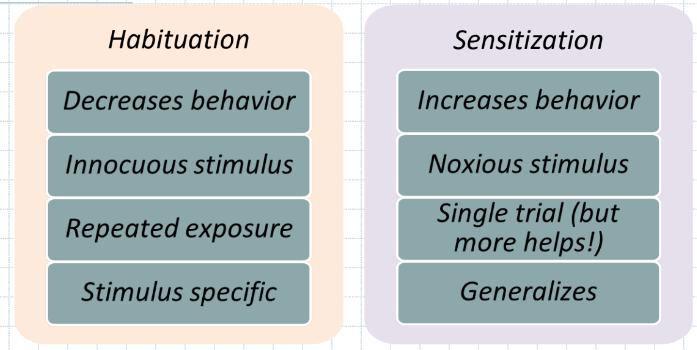
Definition: A progressive decrease in the vigor of elicited behaviour that may occur with repeated presentations of the eliciting stimulus.
Considered the simplest form of memory and a form of nonassociative learning.
Distinguishing notes:
Not the same as learning via association (nonassociative).
Reflexes/innate behaviours can also be affected by habituation.
Habituation: Quantification and Typical Patterns
Early responses are strong; responses decline to a relatively stable asymptote (relatively stable point) after substantial training.
Early strong responses taper to a relatively stable, weaker level (the asymptote).
Examples: fan being in room, or background noise in a restaurant,
Exception: cocktail effect (if you’re talking to someone at a party, you’ll ignore others until you hear your name and you’ll attend to it)
Example study: acoustic startle response, each repeated presentation of the stimuli (a “ding”, acoustic sound) the mice react less and less, they becom habituated to the stimuli
Characteristics of Habituation
Ubiquity: found across the animal kingdom; even some single-celled organisms show habituation.
Core features that recur across species:
Dishabituation: a novel/arousing stimulus can temporarily restore responsiveness to the habituating stimulus.
Stimulus specificity: decline is strongest for the habituating stimulus, with limited generalization to very similar stimuli.
Spontaneous recovery: after a break in stimulation, the response tends to recover toward baseline.
Short- and long-term forms: some habituation is transient, some persists.
Massed vs. spaced training: spacing repetitions influences both the rate and duration of habituation.
Innocuous (weak) stimuli yield stronger habituation than strong stimuli.
Dishabituation
Definition: a novel or arousing stimulus briefly resets the system, temporarily restoring the previously habituated response (e.g., different noise after repeated old noise)
This dishabituation effect fades quickly, though
Example shown graphically as a novel stimulus interrupting ongoing habituation (X indicates new noise).
New sound increases vigilance to environment, because after learning old thing is meaningless (so you stop responding to conserve energy), new stimulus might mean anything so you’re on high alert, and then switching back to old stimulus you’ll still be on high alert for a little bit, but they rehabituate quicker with the old stimulus
Stimulus Specificity
Generally, responses only decrease to the habituating stimulus only.
For very similar stimuli, there can be some generalization (partial habituation or generalization of reduced responding).
Spontaneous Recovery
At its core, it’s forgetting you have learned
When the repeated stimulus is stopped, the behaviour gradually returns toward baseline.
Recovery time varies with factors such as interval, training history, and stimulus characteristics.
1hr break after repeated stimulus there is a little bit of spontaneous recovery - longe rperiod of time passed, the mor elikely it is you’ll forget, the more the spontaneous recovery
Short- vs Long-Term Forms; Temporal Dynamics
More repetition of stimulus generally leads to longer-lasting habituation.
With many repetitions, effects can become relatively permanent.
Short term: create learning very quickly (very many instances of stimulus and very quick, cramming), however more vulnerable to spontaneous recovery
Day-to-day and session-to-session patterns influence persistence.
Massed vs Spaced (Frequency Effects)
Stimulus frequency refers to how often a stimulus is repeated in a given period of time
i.e. how often the stimulus occurs per minute
Higher frequencies means less times between stimulus repetitions
Responding declines rapidly
Results in a larger short-term habituation effect
Massed: stimulus occurs very frequently with little to no gap between presentations.
Rapid decline in responding and a larger short-term habituation effect.
Spaced: breaks between sessions slow initial acquisition but yield longer-lasting effects.
Concept of stimulus frequency: higher frequency means shorter inter-stimulus intervals.
Practical implication: spaced training often yields more durable learning (relevant to study habits).
Taking breaks between sessions of repeated stimuli makes habituation develop more slowly but last much longer (works better for studying, too
Time-Course of Habituation (Illustrative Slides)
Spaced & long-term habituation: e.g., 1 tone per day with blocks of 30 tones; long-term effects observed.
Massed & short-term habituation: rapid decline in startle or reflex with crammed sessions; rapid recovery after breaks.
Weaker Stimulus = More Habituation
The stronger the stimulus, the less habituation develops
This ensures that weak/useless stimuli are ignored, but painful/important stimuli gain more attention
With very strong (noxious) stimuli, sensitization occurs…
Less intense “ding” versus intense “ding”
Habituation vs Sensory Adaptation and Fatigue
Habituation doesn’t = to sensory adaptation or fatigue
Learning has to be in the CNS (brain or spinal cord). If there were modifications outside the interneuron, it isn’t learning.
This means there are tow alternative explanation to rule out, where we get silly:
If the organism isn’t making behavioural responses, we gotta rule out fatigue — so change up the stimulus to ensure that the rat is actually capable of jumping. Motor neurons stop firing if they’re exhausted — that is ruled out (change stimuli, look for different baseline response)
We also gotta rule out sensory adaptation — so you need to look for a differential behaviour to the same stimuli (e.g., if the rats’ ears twitch while the sound is playing, it means it habituated and it isn’t deaf) (keep sitmuli the same, look for differential response)
Habituation is not the same as sensory adaptation (peripheral changes) or fatigue (reduced motor ability).
Distinct sites: sensory adaptation occurs at sensory neurons; fatigue occurs at motor neurons; habituation is proposed to occur at an interneuronal/synaptic level leading to decreased reflex strength.
Diagrammatic distinction shows separate loci for sensory adaptation, fatigue, and habituation.
What is Sensitization?
Definition: an increase in the strength or occurrence of a behaviour due to exposure to an arousing or noxious stimulus, or after an aversive stimulus.
Example: heightened acoustic startle following a prior arousing event, or shocking the rat (making it aroused)
Test 1 is normal jump, sensitization stimulus shocks rat, test 2 makes rat jump even more than first time
Sensitization: Formal Definition and Time Course
Definition (summary): An increase in the vigour of elicited behaviour that may occur with repeated presentations of the eliciting stimulus, or from exposure to a strong extraneous stimulus.
Time course:
Short-term sensitization: decays with time in the absence of the eliciting stimulus.
Long-term sensitization: persists after substantial time without stimulation.
Note: spontaneous recovery concept is typically used for habituation in the literature; for sensitization, the term spontaneous recovery is not always used, but the decay over time is analogous.
Examples and Experimental Quantification of Sensitization
Example: after a noxious event, an organism exhibits an exaggerated response to subsequent stimuli.
Sensitization experiments often quantify changes in reflexive responses to a startle or withdrawal cue.
Characteristics of Sensitization
Sensitization is also ubiquitous
Found throughout the animal kingdom
Also shows a set of common characteristics:
Spontaneous recovery, short- and long-term forms, massed batter than spaced
Noxious (painful) stimuli produce stronger sensitization than weak stimuli (e.g., easier to ignore something that is weak)
More generalization, less stimulus specificity
Can develop with just a single noxious stimulus
A conserved mechanism to increase responses to stimuli that are important
A lot of the time, it’ll be short-term sensitization into habituation
What’s the point of sensitization? Opposite of habituation. Point is to make you pay MORE attention to stimuli in environment.
When we are sensitized to something in our environment,
it means we show an exaggerated response to a normal
stimulus (because of repeated exposure to it like hockey themwe
(Horror movies, bacon and cookie smell can sensitize you)
TWO WAy
Sensitization: Quantification
Sensitization is an increase in responding over baseline
Dishabituation is an increase in responding, not over baseline
Startle Response in Rats (Illustrative Data)
Experiment design example: Startle magnitude with blocks of tones under conditions of baseline and stress.
Typical parameters shown: 60 dB background noise; 80 dB background noise (as contrasting baseline conditions).
Source: Davis (1974).
The same stimulus can induce both habituation or sensitization depending on the intensity (60dB white noise that isn’t problematic, will sensitize to the ding sound — environment changes in which the white noise is at 80dB, which is loud for a rat, that has a sensitization effect [more indicative of potential problems]).
Habituation vs Sensitization: Parallel Processes
Dual Process Theory: Predictions and Interactions
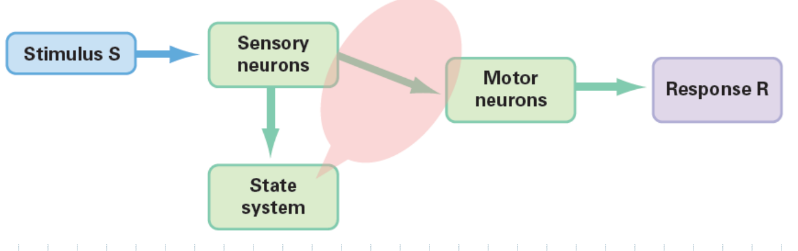
Groves & Thompson (1970) proposed that habituation and sensitization are mediated by distinct neural processes that occur in parallel;
Habituation Process: S-R system – Shortest neural pathway between the sense and the muscles involved in the response (e.g., reflex arc).
Sensitization Process: State system – Parts of the nervous system that determine an organism’s level of responsiveness or arousal
Both processes may be activated at the same time
Behavioural outcome is the net result of both habituation and sensitization process
*One Issue — If behavioural increases, sensitization, if it decreases, it is habituation. The effect is based on how the animal behaviour changes OUTWARDLY. You can only demonstrate one of these effects at a time. Groves & Thompson said that the habituation process and sensitization process are happening at the same time — the processes are what’s happening INTERNALLY. After a stimulus is introduced, both processes are activated, and they battle. Whichever process is strongest, is the effect that actually take place.
*Other problem — students like us got annoyed by the naming. So, the habituation process is also known as the S-R system, whereas the sensitization process is also known as the State process.
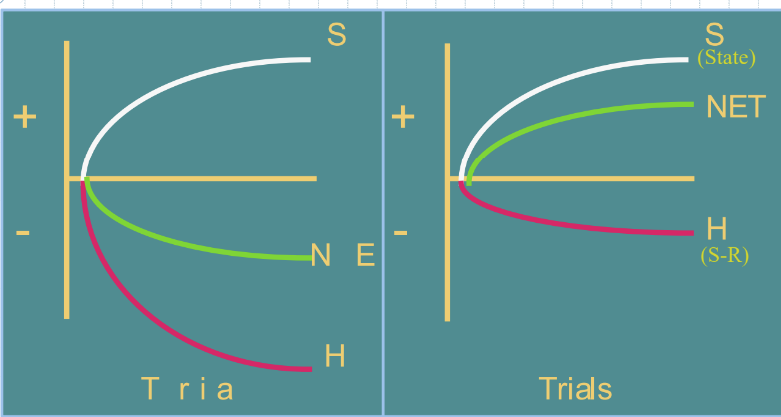
Yellow is baseline
Red is habituation process
White is sensitization process
NET is the net result of their fight
On the left, the habituation process wins
On the right, the sensitization process wins
Groves & Thompson (1970) proposed that habituation and sensitization reflect differential activation of two different systems:
A low-threshold reflex pathway that weakens with repeated use
A high-threshold “state system” that, when activated, increases responses globally
Theory explains several features of habituation and sensitization:
Weak stimulus: primarily reflex pathway activation, stimulus-specific decline in responsiveness
Noxious stimulus: reflex + state system activation, generalize increase in responsiveness
Moderate stimulus: initial reflex + state system causes more responsiveness, but gradually, reflex weakening dominates
Moderate stimuli yield a mix: initial reflex enhancement by the state system with eventual reflex weakening as S-R habituation dominates.
This framework explains: stimulus-specific decline, generalized sensitization, and context-dependent response patterns.
What is Going on There?
Habituation: a decrease in the strength or occurrence of a behaviour due to repeated exposure to the stimulus that produces the behavior
How does the brain of the rat rewire so that the same
stimulus will now produce a different behavior?
It’s difficult to answer with so many billions of neurons
in the brain
The brain can activate S-R and state systems concurrently, producing nuanced behavioural changes.
Habituation is still stimulus-specific because the S-R component is tied to the specific reflex pathway.
The state system can interact with multiple S-R systems, enabling generalized sensitization across stimuli.
Both habituation and sensitization decay over time, consistent with time-dependent forgetting or resetting of neural weights.
Aplysia californica as an Animal Model
Aplysia californica, the “sea hare,” has only 20,000,
very large neurons in its CNS
These features have made Aplysia popular for understanding the neural mechanisms of learning and memory
Rationale: simple nervous system with identifiable neurons and circuits; large neurons suitable for electrophysiology.
Aplysia contains ~20,000 neurons in its CNS, enabling precise mapping of neural pathways involved in learning and memory.
Pioneered by Eric Kandel and colleagues to study the cellular basis of learning.
Aplysia Behavior: Gill-Withdrawal Reflex
Gill-withdrawal reflex:
Touch the tail, siphon, or gill
The gill contract within the mantle
Time to relaxation is measured
Stimulus: touch to the siphon or tail triggers gill withdrawal.
Measuring: the duration or strength of gill withdrawal as an index of the reflex.
Baseline observation: touch to siphon evokes a robust gill withdrawal.
Habituation in Aplysia
Repeatedly touching the siphon results in
a smaller response (gill withdrawal)
The habituated response is not due to muscle fatigue or a change in motor neuron response because touching the head produces a full response
Gentle touch to siphon, produces gill withdrawal response
Repeat same touch every minute for 10-15 mins
Progressively shorter withdrawal durations
Recovers quickly but, with many sessions, becomes long-lasting
How?
Repeated siphon touch leads to progressively shorter gill withdrawal durations.
Control: touching the head still evokes a full response, indicating the reduction is not due to general fatigue of the motor system or muscle fatigue.
Habitual pattern: touch every minute for 10–15 minutes; with repeated sessions, habituation becomes longer-lasting.
Core question: What mechanisms underlie these changes?
Mechanisms of Habituation in Aplysia
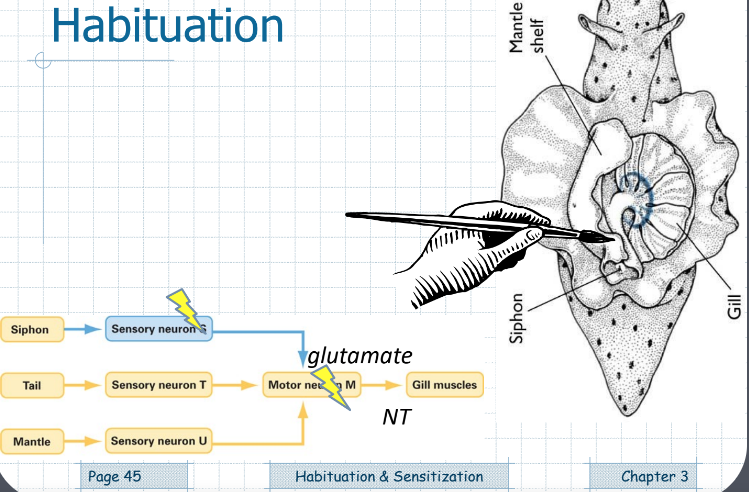
Repeated touch depletes sensory neuron transmitter: synaptic depression
Sensory neuron communicates less with motor neuron, trying to save resources (e.g., glutamate)
stimulate siphon of aphlesia over and over again, itll learn that anything that happens to it wont impact its siphon, so sensory neuron of siphon and gill retraction reflex aren’t as connnected, to the point that someonetes the sensory-motor synapse are actually pruned away (long-term habituation, more resistant to spontaneous recovery)
Synaptic depression at the sensory-motor synapse:
Repeated touch depletes neurotransmitter from the presynaptic sensory neuron, reducing transmitter release on subsequent activations.
Long-term habituation can involve structural changes:
In some cases, long-term habituation is associated with pruning (removal) of certain sensory-motor synapses.
Sensitization in Aplysia
Gentle touch to siphon, produces gill withdrawal
Aversive shock to tail
Next touch, much longer withdrawal duration
Recovers quickly, but becomes long-lasting with multiple sessions
How???
This heightened response tends to recover quickly but can become long-lasting with repeated sensitization sessions.
The question remains: what cellular changes drive this increased responsiveness?
Mechanisms of Sensitization in Aplysia
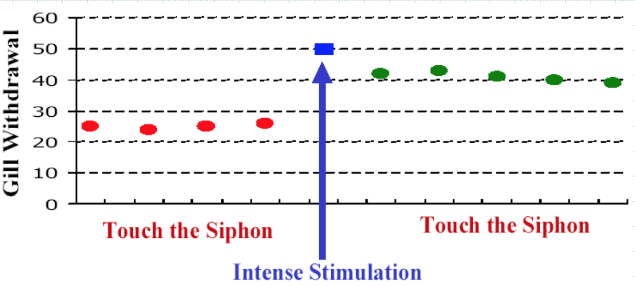
Periodically touching the siphon (no habituation) results in a consistent response.
Provide an intense stimulation
A stronger response is triggered for following stimuli
Suggests the response has undergone sensitization
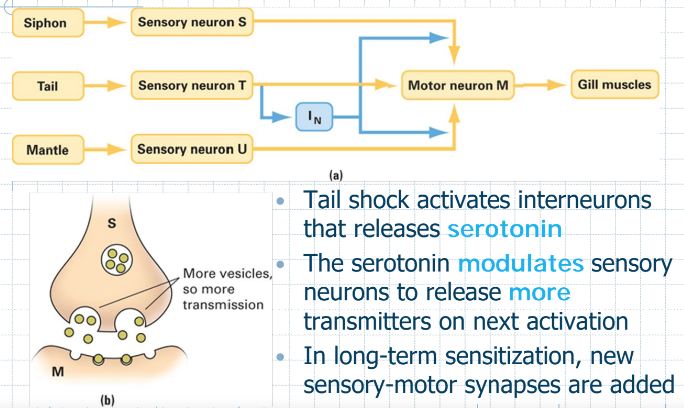
Tail shock activates interneurons that releases seretonin
The seretonin modulates sensory neurons to release more transmitters on next activation
In long-term sensitization, new sensory-motor synapses are added
Serotonin release: Tail shock activates interneurons that release serotonin (5-HT).
Serotonin modulates sensory neurons to enhance transmitter release on subsequent activations, increasing the reflex strength.
Long-term sensitization involves structural changes: formation of new sensory-motor synapses.
Implications and Integrated View
S-R (reflex) and state (arousal) systems interact to shape behaviour on a moment-to-moment basis.
Habituation is largely stimulus-specific due to localized synaptic changes in specific reflex circuits.
Sensitization can generalize across stimuli because of neuromodulatory state changes affecting multiple circuits.
Both habituation and sensitization reflect synaptic mechanisms that can be short-term (transmitter depletion or modulation) or long-term (synapse formation or pruning).
A common theme: learning involves both changes in synaptic strength (depression vs. facilitation) and longer-term rewiring (new or removed synapses) to support memory storage.
Lessons Learned from Habituation, Sensitization, and Aplysia
Habitutation and Sensitization reflect opposing synaptic processes that shape reflex strength:
Depression at certain synapses leads to weakening of reflexes (habituation).
Facilitation and new synapse formation lead to stronger responses (sensitization).
Learning can involve direct synaptic changes and neuromodulatory influences that alter circuit function.
Repeated training can drive neural rewiring, contributing to longer-term memory storage.
Connections to Broader Concepts
Links to foundational learning principles: nonassociative learning (habituation/sensitization) complements associative learning (e.g., Pavlovian conditioning, upcoming in Chapter 4).
Ethical and practical implications: understanding how repeated exposure affects responsiveness can inform educational strategies, exposure therapy, and treatment of hyperarousal or anxiety.
Summary of Key Takeaways
Habituation: decreased reflex strength with repeated non-noxious stimulation; stimulus-specific; can show dishabituation and spontaneous recovery; massed vs spaced influences durability.
Sensitization: increased reflex strength after arousing/noxious stimulation; can be short- or long-term; more generalized across stimuli than habituation.
Dual Process Theory: behaviour reflects the net result of an S-R (habituation) system and a state (sensitization) system operating in parallel.
Aplysia provides concrete cellular and synaptic mechanisms for both habituation (synaptic depression, possible pruning) and sensitization (serotonin-mediated facilitation, new synapses).
Overall implication: learning involves both short-term synaptic changes and longer-term circuit remodeling; both are essential for adaptive behavior.
Next Time: Pavlovian Conditioning: Basic Concepts
Preview: The upcoming chapter will cover classical conditioning, a form of associative learning distinct from nonassociative habituation/sensitization.