DNA structure
What is DNA
The generic material that determines the characteristics of a species and is passed onto offspring for the continuity of life
Basic DNA Structure:
Composed of two helical stranding winding around a central axis
Individual subunits that make the strands are nucleotides, which have a sugar phosphate backbone and a base facing the centre of the double helix
DNA organization:
DNA molecules are very long, wrapping around proteins called histones which organizes them to fit into the microscopic anucleus in eukaryotic cells
Coiled DNA stored as chromatin (in non-dividing cells) which are further coiled into chromosomes(in dividing cells)
Coiling DNA around histones:
First, DNA wraps around proteins called histones grouped together in 8's
DNA loops around histones twice before looping around the next histone
8 histones and DNA wrapped around it is called a nucleosome
Creates thick cord called chromatin
Chromatin then coils further to create chromosomes
Types of chromatin:
Looking at a chromosome, it often appears striped, this banding is because chromatin can be differentiated into two regions:
Heterochromatin:
Very tightly coiled and dense, absorbing more microscopic staining and looking darker
Euchromatin:
Less tightly coiled appearing lighter
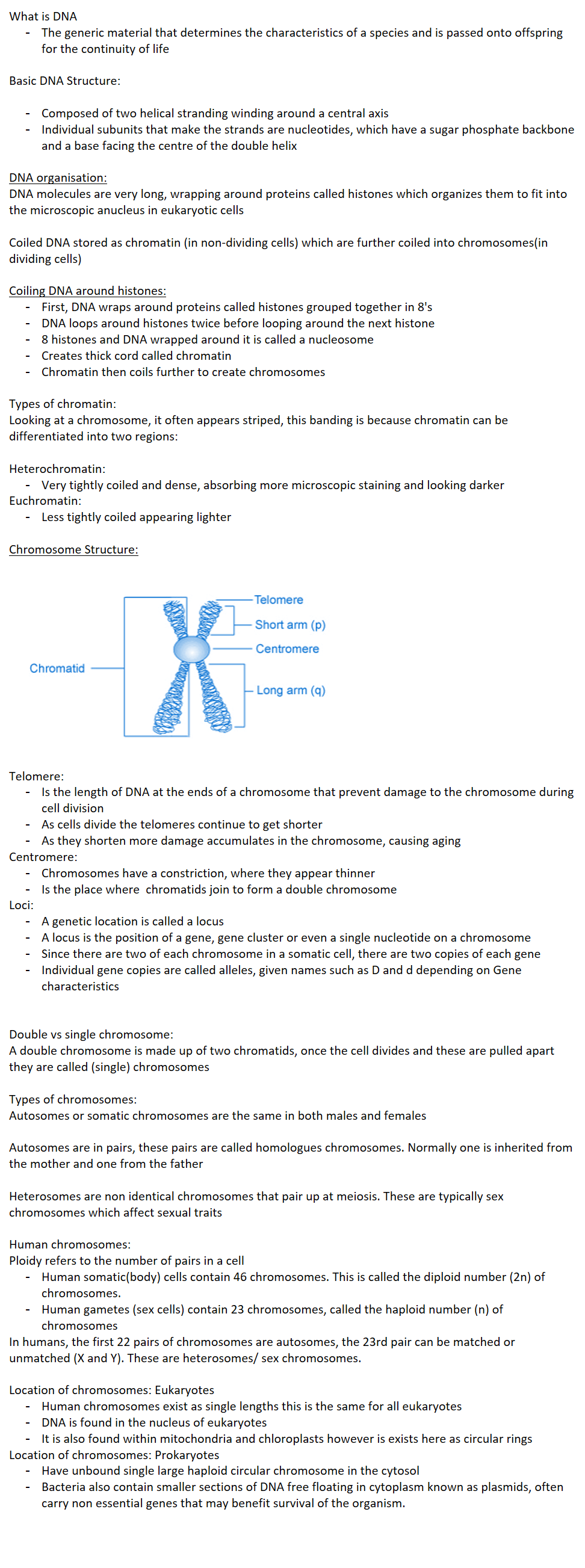
Chromosome Structure:
Telomere:
Is the length of DNA at the ends of a chromosome that prevent damage to the chromosome during cell division
As cells divide the telomeres continue to get shorter
As they shorten more damage accumulates in the chromosome, causing aging
Centromere:
Chromosomes have a constriction, where they appear thinner
Is the place where chromatids join to form a double chromosome
Loci:
A genetic location is called a locus
A locus is the position of a gene, gene cluster or even a single nucleotide on a chromosome
Since there are two of each chromosome in a somatic cell, there are two copies of each gene
Individual gene copies are called alleles, given names such as D and d depending on Gene characteristics
Double vs single chromosome:
A double chromosome is made up of two chromatids, once the cell divides and these are pulled apart they are called (single) chromosomes
Types of chromosomes:
Autosomes or somatic chromosomes are the same in both males and females
Autosomes are in pairs, these pairs are called homologues chromosomes. Normally one is inherited from the mother and one from the father
Heterosomes are non identical chromosomes that pair up at meiosis. These are typically sex chromosomes which affect sexual traits
Human chromosomes:
Ploidy refers to the number of pairs in a cell
Human somatic(body) cells contain 46 chromosomes. This is called the diploid number (2n) of chromosomes.
Human gametes (sex cells) contain 23 chromosomes, called the haploid number (n) of chromosomes
In humans, the first 22 pairs of chromosomes are autosomes, the 23rd pair can be matched or unmatched (X and Y). These are heterosomes/ sex chromosomes.
Location of chromosomes: Eukaryotes
Human chromosomes exist as single lengths this is the same for all eukaryotes
DNA is found in the nucleus of eukaryotes
It is also found within mitochondria and chloroplasts however is exists here as circular rings
Location of chromosomes: Prokaryotes
Have unbound single large haploid circular chromosome in the cytosol
Bacteria also contain smaller sections of DNA free floating in cytoplasm known as plasmids, often carry non essential genes that may benefit survival of the organism.