16: Phase change and IMF
Heating Curves
Phase changes ≠ chemical bonds. phase changes describe change in the forces holding chemical units (atoms, molecules, ions) together, NOT how those units themselves are constructed
different phases: solid, liquid, and gas
as temperature rises, the particles warm up and move more. During the phase change, the temperature plateaus, because the thermal energy is solely being used to change phases, not to raise the temperature of the system. At the plateau points, KE of the compound remains constant. here is a graph of thermal energy to temperature, indicating the points where phase change occurs.
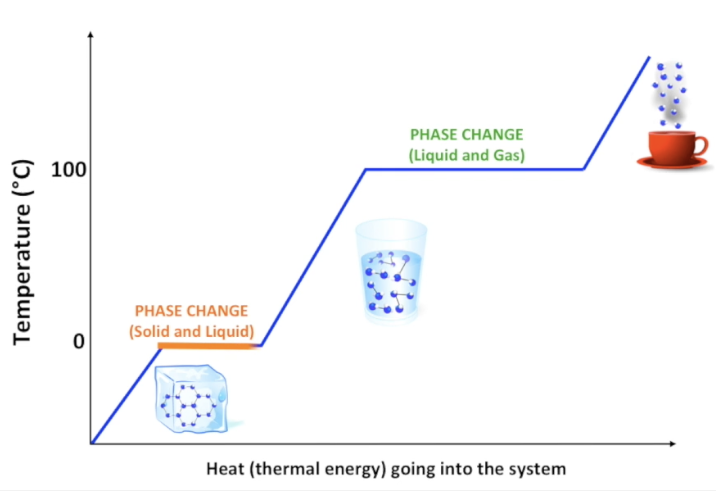
the phase change from solid to liquid requires a certain amount of energy, which is called the latent heat of FUSION, and is represented as ΔHfusion
the phase transition from solid to liquid is endothermic because we have to put energy INTO the system. therefore ΔHfusion > 0
the phase change from liquid to gas also requires a certain amount of energy, which is called the latent heat of VAPORISATION, and is represented as ΔHvap
ΔHvap > 0 as well, because it is endothermic, meaning heat has to be applied to the system for the water to vaporise
NOTE: temperature does NOT change during a phase change
the energy going into the system is used to overcome the forces holding the molecules together
Names of phase changes
solid → liquid: melting (endothermic, + val of ΔHfusion)
liquid → solid: freezing/solidification (exothermic, - val of ΔHfusion)
liquid → gas: vaporisation/boiling/evaporation (endothermic, + val of ΔHvap)
gas → liquid: condensation (exothermic, - val of ΔHvap)
solid → gas: sublimation (endothermic, + val ΔHsub)
gas → solid: deposition (exothermic, - val ΔHsub)
NOTE: combustion is also exothermic
NOTE: both pressure AND temperature affect phase transitions
There are three properties related to phase change:
vapor pressure
boiling point
freezing point
any liquid in a closed system will begin to evaporate and start to form vapor. At some point, the system will reach equilibrium and some molecules of vapor will condense back into liquid and an equal number of molecules of liquid will evaporate
Vapor pressure (units in mmHg): the pressure of the vapor (the gas molecules) that are present at equilibrium
the larger the vapor pressure, the more gas is present in the system at equilibrium → this means it is easier to go to the vapor phase than the liquid phase, so the IMF in the liquid phase are relatively weak
trend: higher vapor pressure = weaker IMF
as temperature increases, vapor pressure increases (this is because more molecules have the energy to evaporate
At the boiling point, vapor pressure = external pressure; Pvap(liquid) = external Pressure
if the IMF in the liquid are strong, more energy (and therefore higher temperature) is needed to reach boiling point
trend: stronger IMF = higher boiling point
to find the boiling point, look at the vapor pressure diagram and identify the TEMPERATURE at which vapor pressure = external pressure
Melting point: at the melting point Pvap(solid) = Pvap(liquid).
the stronger the IMF, the higher the melting point
NOTE about external pressure:
external pressure increases the higher you go above sea level
Intermolecular vs intramolecular forces
Covalent (polar and nonpolar) and ionic bonds are examples of INTRAmolecular forces (or bonds), because they are the electrostatic forces that hold atoms together WITHIN molecules
forces that hold two or more molecules together in condensed phases (liquid and solid) are called INTERmolecular forces
intermolecular forces determine whether something will be a solid, liquid, or gas at room temperature
if a compound has a stronger IMF, then it will be “more solid” at room temperature and standard pressure
eg: H2O is a liquid at room temp, NH3 is a gas at room temp. H2O has stronger IMF than NH3
Strong IMF →
lower vapor pressure
higher enthalpies of vaporization (ΔHvap)
higher boiling point
higher melting point
Phase diagrams
Phase diagrams show us the phase of a substance as a function of both temperature and pressure
This is the phase diagram for water. How do we interpret this diagram ?
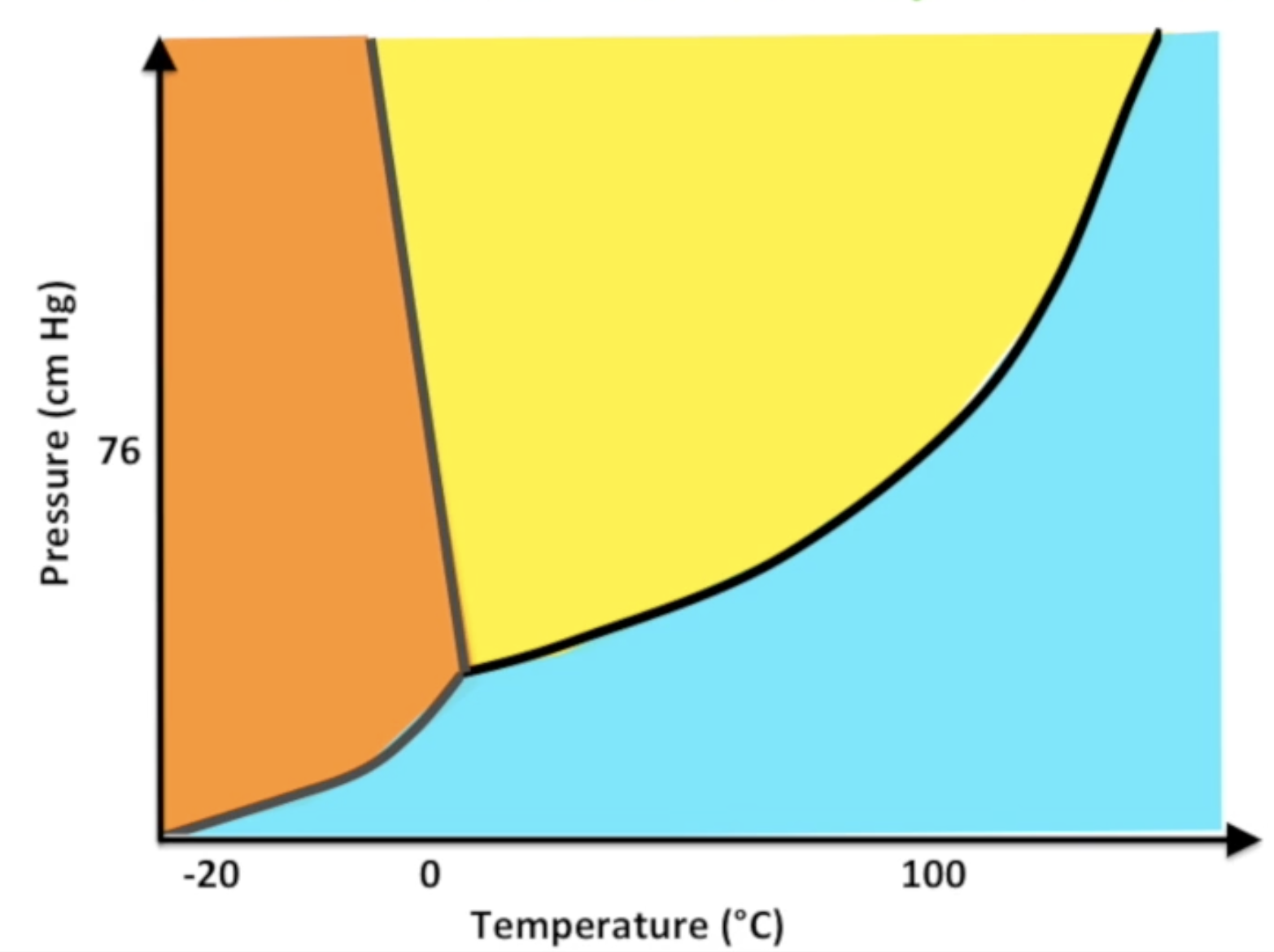
NOTE: 76 cmHg = 1 atm
At higher temps and lower pressures, we expect to find gas. so the BLUE section represents the temperatures and pressures at which water is a GAS
At low temperatures, we expect to find solids, so the ORANGE section represents the temperatures and pressures at which water is a SOLID
The YELLOW region in between represents the temperatures and pressures at which water is a LIQUID
Solid → Liquid
the freezing point of water/melting point of ice where the pressure is = 1atm or 76cmHg is called the NORMAL FREEZING POINT or the NORMAL MELTING POINT
Liquid → Gas
the boiling point of water where the pressure is = 1 atm or 76cmHg is called the NORMAL BOILING POINT
the line of interface between liquid and gas represents vapor pressure
Liquid, Gas, Solid
the point at which all three phases meet is called the TRIPLE POINT
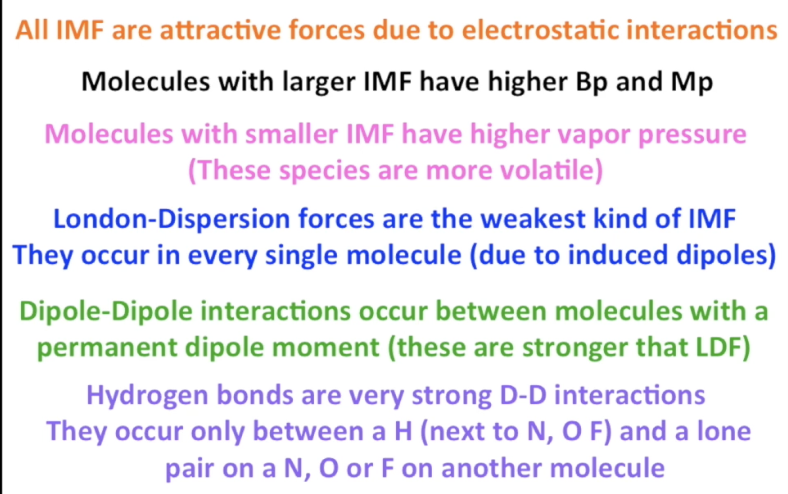
Dipole dipole interactions
dipole dipole interactions, like covalent and ionic bonds, are also based on electrostatic interactions
3 different kinds of species that have electrostatic interactions:
ionic species (cations and anions)
polar molecular species (where one side has a partial positive charge and the other has a partial negative charge)
this molecule has no net charge, but do have dipoles
Nonpolar molecular species (where the molecules have a symmetrical distributions of charges and therefore do not have a more negative/more positive side, and thus have no dipoles)
the electron cloud of one molecule moves in response to the nucleus of the other, and a dipole moment is induced as the two molecules move closer to one another
Strongest → Weakest types of electrostatic charges
ionic species electrostatic attraction (charge - charge)
dipole - dipole electrostatic attraction (partial positive and partial negative)
nonpolar molecular species (induced dipole - dipole)
NOTE: #2 and #3 are IMF.
3 types of IMF, from strongest to weakest:
Hydrogen “bonds”
Dipole - dipole interactions
London dispersion force (induced dipole - induced dipole interactions)
NOTE: hydrogen “bonds” are a type of dipole-dipole IMF that are MUCH stronger than dipole-dipole interactions, but still weaker than covalent bonds
We need to be able to:
look at the chemical formula
think about the polarity of the molecule
for this, draw out the Lewis diagram
predict how it will interact with other molecules
Dipole - dipole interactions
use the chemical formula to predict the molecular geometry
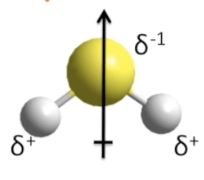
based on the electro-negativities of the atoms that make up the molecule, assign a partial positive charge (𝛿+) or partial negative charge(𝛿-) to each atom in the molecule
use an arrow to represent the dipole moment and where the negative sign is pointing. eg:
NOTE: review how to determine electro-negativities of molecules
Hydrogen “bonds”
A hydrogen bond is a very strong dipole-dipole interaction, and is a strong IMF. they are different from covalent bonds (they are a lot weaker)
Hydrogen bond: bond between lone pair on a very electronegative atom + Hydrogen on another molecule
there are only three electronegative atoms that can form hydrogen bonds: N, O, F
the H to which they hydrogen bond with must also be attached to either an N, O, or F
Eg: water
in one molecule, the Hydrogens are covalently bonded to their oxygen. However the force between molecules is a hydrogen bond. it connects a hydrogen of one molecule to the oxygen of another molecule
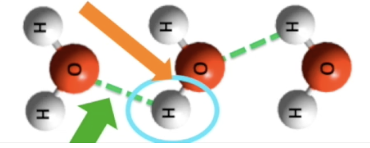
here the orange line indicates the covalently bonded H - O WITHIN the molecule. the green line indicates the attractive force (hydrogen “bond”) between H and O between two separate molecules
Hydrogen bonds are the strongest IMF, so they will raise the boiling point
3 common examples of compounds that can have H “bonds”
H2O → water
NH3 → Ammonia
HF → Hydrogen fluoride
They MUST be compounds that contain Hydrogen covalently bonded with either O, N, or F
Consider CH3F, which has the following molecular geometry:
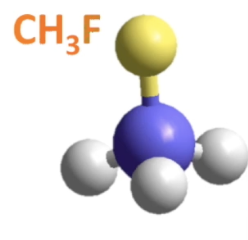
Note that the Hydrogens are covalently bonded with Carbon, not Fluorine, so this compound CANNOT form hydrogen “bonds”
NOTE: not every polar molecule can form H “bonds” but every molecule that can form H “bonds” is polar
In order to determine if a compound can form hydrogen bonds, you have to look at the molecular geometry and see if the hydrogen(s) is covalently bonded DIRECLY to O, N, or F
London dispersion forces
the weakest, most short lived IMF
attractive forces between nonpolar molecules that occur because of shifting in the electron clouds
molecules without permanent dipoles can form temporary instantaneous dipoles, that induces dipoles in the surrounding molecules
the strength of london dispersion forces in a molecule depend on
size
atoms with valence electrons in higher orbitals are bigger, and therefore have stronger london dispersion forces
trend: the more valence electrons, (AKA the more down a group you go) the stronger the london dispersion force
and shape
larger molecules with many atoms are larger, have more points of interaction, and thus can interact with other molecules through MULTIPLE induced dipoles
trend: the more spread out/large the molecule (based on molecular geometry), the stronger the london dispersion force
NOTE: LDF occur between all atoms/molecules (except H) and are directly proportional to size and shape
Overview of IMF: