Equine Repro Notes
Why Study Anatomy?
Importance of anatomy and physiology comprehension:
- Determining when there is a problem
- Horse Selection
- Breeding/Cycling
Function of Reproductive Tract
- Release of ova
- Maintain conceptus through gestation
- Deliver newborn
- Nourish newborn
Organ Groups
Fundamental Structures
- Ovaries
- Oviducts
- Uterus
- Cervix
- Vagina
- Vulvar labia
- Mammary glands
Regulatory Structures
- Pineal gland
- Retina
- Hypothalamus
- Pituitary gland
Vulva
Three Structures
- Labia
- External Opening, Lips of vulva
- Clitoris
- Place where bacteria likes to grow
- Vestibule
- Secretary glands/Mucus glands that help lubricate reproductive tract
Function of labia and vulva
- Protect
Position Important
- Lips: Tight seal, keeps bacteria and manure out of the body
- Angle of vulva: Vertical
- Position: over 50% below pelvic rim from the point of butt
- Caslick procedure: remove a little bit of tissue around labia and suture it back up to try and keep pregnancy a little bit cleaner
Vestibule and Vagina
Vestibule: 4-5”
- Secreting mucus to help with lubrication
Vagina: 6-8”
- Highly elastic
- No secretions
Cervix
When in heat will get soft and loose, will sink lower in body when trying to AI
- Function:
- Secretory: Think mucus
- Shape changes in response to hormones: Changes the feels and consistency of cervix when in and out of heat
Uterus
- Two horns and body
- Suspended via broad ligament
- Attachment = Mesometrium
- Attaches to the dorsal surface
- Attachment = Mesometrium
- 3 barriers of protection
- Endometrium
- Changes throughout cycle
- Creates uterine milk as well as for the fetus and placenta attachment
- Secretions
- Endometrium
- Perimetrium
- Outermost lining, attached through connective tissue to the broad ligament
- Myometrium
- Contains muscle; helps with contractions
Oviducts
Three sections
- Infundibulum
- Where sperms is going to come in
- Ampulla
- Where oocytes will meet sperm cells
- Isthmus
- Going to catch oocyte
- Where sperm cells will remain
- Uterotubal junction
- Muscular sphincter that selectively allows embryos, but not unfertilized oocytes to pass into uterus
- Unfertilized oocyte remain in oviduct - fertilized egg will move into uterus 4 days post ovulation
- Muscular sphincter that selectively allows embryos, but not unfertilized oocytes to pass into uterus
Ovaries
Location: sit in between 3 or 5th lumbar vertebra
- Different sections of the broad ligament will hold this up
- Mare ovary is “inside out”
The Ovary
Functions: produce and house oocytes
- estrogen and progesterone produced
Transient components: CL and follicles
Tissue types: Medulla and cortex
- Medulla provides structural support for the ovaries
- Cortex is where the germinal cells will be houses
- Will not ovulate if there is a CL present
Broad Ligament
Supports and suspends the repro tract
- Also contains blood supply and brings through nutrients
Mesovarium
- Supports the overy
Mesosalpinx
- Supports the uterus
Mesometrium
- Supports the
Mammary Gland
Four quarters
- Each tit have 2 quarters
- Milk produced in alveoli
- Mammary development minimal until late gestation
- They do not hold very much milk in their tit cistern/gland cistern
- 3-4 weeks before due date mare will start to develop an utter
Reproductive Status
- Maiden mare
- Never had foal before/Never been bred
- Barren mare
- Not pregnant this year/having issues getting bred but has had a foal/bred before
- Slipped mare
- Was confirmed in foal but lost the pregnancy early on
- In foal mare
- Is pregnant and carrying foal
- Open mare
- Didn't bred this year
Leptospirosis
- Bacterial infection
- Zoonotic
- Signs: Feber, depression, loss of appetite, abortion, uveitis
- Diagnosis: Blood test
- Prevention: Vaccination, best management practices

Estrous Cycle gestation
- Estrous cycle consist of a series of predictable reproductive events beginning at estrus and ending at the subsequent estrus
- Provide females with opportunity to copulate and become pregnant
- Anestrus = a period without estrous cycles
Seasonal Anestrus
Gestation ~340 days
- Prevent females from conceiving during periods of the year when survival of the developing embryo and neonate would be low
- Transitional period:
- Erratic and unpredictable
- Recommended not to breed mares at this time
- Transitional period:
Estrous Cycle
- 21 days ovulation to ovulations
Estrous Cycle Phase
Follicular Phase:
Anatomical changes:
Functional changes:
| Luteal Phase:
|
|---|
Estrous Cycle Stage
Stages:
Follicular
- Proestrus
- Receptive for 5-7 days to stallion
- Estrus
Luteal
- Meetestrus
- Transition between estrogen to progesterone
- Diestrus
Proestrus
- Begins when progesterone declines as a result of luteolysis
- Follicles are recruited and tract prepares for the onset of estrus
- Endocrine transitions
- Follicles are recruited and tract prepares for the onset of estrus
Estrus
- Estradiol concentrations are high
- Onset of sexual receptivity is gradual, culminating with standing estrus
- Notaceable behavior/anatomical changes
- Relaxed cervix
- Increased locomotion, urinating/winking, general nervousness
- Standing behavior: “breaking down”
Metestrus
- Begins at ovulation ends at fully functional CL
- Transition to a period of progesterone dominance
- Luteinization: follicle undergoes cellular and structural changes to become the CL
- 2-5 days before C: produces high levels of P4
- Luteinization: follicle undergoes cellular and structural changes to become the CL
Diestrus
- CL is fully functional and P4 secretion is high
- Longest stage of the cycle
- P4 purpose:
- Ends when CL is destroyed (luteolysis)
- No sexual receptivity
- Closed, pale cervix located high
- P4 purpose:
- Longest stage of the cycle
Follicles
- Oocytes stored in follicles
- Zona pellcida
- Acellular structure surrounding oocytes
- Protection, encasing membrane
- Acellular structure surrounding oocytes
- Zona pellcida
Types of follicles:
- Primordial
- Growing
- Antral
- Graafian
- Anovulatory
- Regressing
- Microscopic unless selected to grow
Cell Types
- Granulosa Cells → inside
- Respond to the follicle hormone FSH
- Produce estrogen/estradiol
- Theca Cells → outside
- Structural support for follicle → “connective tissue”
- Produce progesterone
- Cumulus
- Helps with cell fertilization
Follicle Size for Ovulation
~40-50mm cell ovulation depending on the mare
- Some smaller and some larger
Corpus Luteum
- Cellular changes
- Granulose cells become large luteal cells producers of progesterone
- Theca cells become small luteal cells
Functions of the Endocrine System
- Collection of Organs that produce hormones
- Regulates
- Metabolism
- Growth and development
- Tissue function
- Sexual function
- Appetite
- Sleeping and waking cycles
- Regulates
Basics of the Endocrine System
- Hormones
- Secreted by glands
- Glands
- Going to produce the hormone
- Ex: Uterus, testes, hypothalamus
- Going to produce the hormone
- Target tissues
- When the hormones have its effect
- Receptors
- Located in the target tissues
- Feedback loops
- A stimulus
Types of Action
- Endocrine
- Secreted by circulation to secrete its response
- Paracrine
- Target near by tissues and or cells
- Autocrine
- Hormones that secrete on its self
Components
- Hypothalamus
- Pituitary gland
- Adrenal gland
- Thyroid
- Pancras
- Gonand
Endocrine Regulatory Structures
- Pineal gland
- Produce melatonin
- Responsive for changes in daylight
- Hypothalamus
- Secretes GnRH (Gonadotropin releasing hormone)
- GnRH stimulates the release of the pituitary glands
- Secretes GnRH (Gonadotropin releasing hormone)
- Pituitary gland
- Anterior pituitary
- Produces oxytocin
- Posterior pituitary
- Produces FSH (follicle stimulating hormone)
- Ovary
- Produces LH (luteinizing hormone)
- Follicnes
- E2
- CL
- P4
- Follicnes
- Produces FSH (follicle stimulating hormone)
- Anterior pituitary
Back up to oxytocin
PGf2a regresses CL
Hormone Classification
- Amine hormones
- Small
- Has nitrogen on them
- Components: Amino acid with a modified group
- Peptide/protein hormones
- Bigger than an amine hormone
- Chain of amino acids
- Components: aminoacids
- Steroid hormones
- Derived from cholesterol
- Components: Testosterone, progesterone, and estradiol
- Derived from cholesterol
Peptide/Protein Hormones
- Water soluble
- Examples: Insulin, growth hormone, ADH, Gastrin, CCK
- Stored in vesicles prior to release
Steroid Hormone
- Made from: Cholesterol
- Fat (lipid) soluble
- Examples: Estrogen, Testosterone, Cortisol, aldosterone
- Made on demand
Amine Hormones
- Made from tryptophan or tyrosine
- Most are water soluble
- Examples: thyroid hormones, (nor) epinephrine, serotonin
- Stores in vesicles prior to release
Fat or Water Soluble?
- Determines travel through the blood and interaction with its receptor on the target cell
- Determines the mechanisms of action in the target cell
Movement through the Blood
- Water soluble: generally “free”
- Fat soluble: bound to a carrier protein
Hormone Receptors
- Bind to hormones and elicit and intracellular response
- Nature of response specific to receptor type
- Tissue specific receptor expression
- Number of receptors on/in cell affects the sensitivity of that cell to the hormone
Hormones secreted in the Brain 
Hormones from Uterus and Ovaries 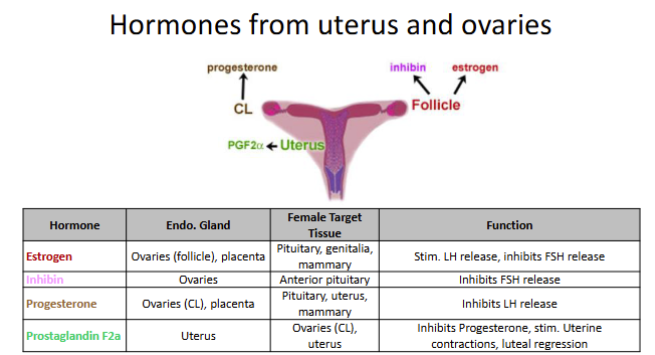
Reproductive Endocrinology
- H - P - G axis
- Hormonal feedbacks
Control of secretion and production
- Positive and negative feedback loops
- Unbalance = reproductive problems
Why do we need to manipulate estrous?
- Try and increase pregnancy rates
- Expensive
- Only have stallion at certain times
- Born earlier for competition
How to manipulate estrus?
- Photoperiod → melatonin being produced
- Melatonin secreted during hours of darkness
- Ambient light - first cycle ~ March/April
- Stimulatory artificial photoperiod - earlier ovulation
- Artificial lighting
- Alters photoperiod
- Begin Dec 1st → ovulate mid Feb
- 60-70 days to get to begin ovulating regularly with manipulation of lights
- 100 - 200 watt bulb in 12 x 12 stall
- Goal: Expose them to 16 hours of light and 8 hours of darkness
- Preferably in the evening
- Timers: off at 11pm
- Light Masks
- LED blue light
- Light Masks
468 nm wavelength
One eye
Hormonal Manipulation of Reproduction
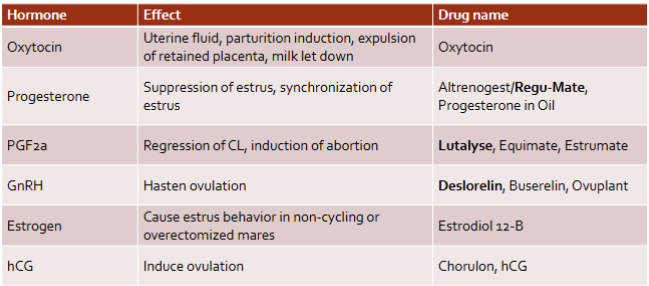
Control of Ovulation
- Why:
- Flush oocytes/embryos
- Breeding
- Timed ovulation
- GnRH and hCG given
- hCG: is going to act similar to LH
- Ovulate 36-48 hours after hCG is given
- hCG: is going to act similar to LH
GnRH
- Peptide hormone - 10 AA
- GnRH agonist - Deslorelin
- Implant: in the mucosa in the vulva will include the LH causing the mare to ovulate
- Injectable: 85-95% of mares with a follicle >35 mm ovulate within 48 hours
hCG - Human Chorionic Gonadotropin
- LH - like activity
- Requirements for hCG to work
- Follicle >35mm
- Uterine edema
- Ovulate ~ 36 hours after treatment in 80-90% of mares
Lutalyse - Prostaglandin
- Prostaglandin secretion is pulsatile
- Administration of exogenous prostaglandin
- Side effects: sweating, abdominal cramping, diarrhea
- Typical use: Short cycling mares
- Minimum of 5 day post ovulation to give luteolyse
- We do this to make sure we have a mature CL to be able to regress
- Minimum of 5 day post ovulation to give luteolyse
- 3 fates of prostaglandin administration:
- 1. If the mare has a follicle she might ovulate before she comes into behavioral estrus
- 2. You can cause the CL to regress and the dominate follicle will ovulate just like predicted (3-4 days before she would have naturally)
- 3. Have a growing follicle however it might start to regress
Short Cycling a Mare
- To be used:
- Syncronization
- Getting multiple pregnancies in a year
- Natural ovulation
- Develops a functional CL
- Give Lutalyse 6-8 days post ovulation
FSH - Follicle Stimulating Hormone
- Used to recruit multiple follicles
- FSH administered twice daily
- 5-7 days after ovulation when largest follicles is 20 mm
Superovulation in Mares
- 5-7 days post ovulation of FSH
- 7-9 days post ovulation of luteolyse
- Continue FSH twice a day for 3-5 days until follicles reach 35 mm
- Administer hCG
- Breed mare
- Collect embryos 7-8 days later, implant into recipient mares
Progesterone - Altrenogest
- Produced by CL and placenta
- Potent negative feedback on LH
- Typical use: performance horses to keep them out of coming into heat
- Maintain pregnancy in pregnant mares
- Typical use: performance horses to keep them out of coming into heat
- Suppressing estrus
Protocol for Early Breeding
- Dec 1: Increase lights to 16 hours a day
- Jan 2: Being teasing with stallion
- Jan 14-25: Palpate for CL or follicles
- Jan 26 - Feb 4: If follicles present, daily regulate
- Feb4: Treat with luteolyse (PGF2a)
- Feb6-10: Breed when follicle >35mm or every other day when in estrus
Stimulating Transitional Mares
- sOne ore mare follicles >20mm
- Administer lowdose GnRH (deslorelin) bidaily, IM
- Discontinue when one or more follicles >35 mm
- No therapy for 24 hours
- Administer hCG
Induction of Times Ovulation
- Uses:
- 2 doses of Semen
- Desolrelin 8 am or hCH at 12pm
- AI evening after dosing
- Ovulation at midnight
- 2 doses of Semen
- Requirements:
- 1 dose of semen
- Deslorelin 8 om
- Ovulation 12pm
- Inseminate post ovulation
- hCG or Deslorelin
- 1 dose of semen
Fertilization
In the ampullar isthmic junction
- Activities in the mare
- Mare needs to ovulate
- Sperm ejaculated directly into the cervix
- Mare needs to ovulate
- Activities in the sperm
- Sperm have to go through capacitation to be able to fertilize the egg
- Happens through the mares repro tract in the isthmus
- 4 hours for sperm to make it to oviduct

Capacitation
Fertilization 
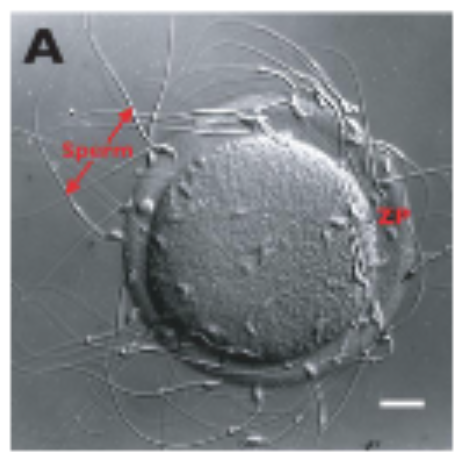
Embryonic Development
Cell division begins within 24 hours of fertilization
- Morula > 32 cells
Blastocysts = differentiation begins (all in the oviduct)
- Trophoblast cells: become the placenta, arranged along the outside
- Inner cell mass: become the fetus/embryonic cells
Enters uterus at around day 5 or 6
- In the estrus cycle the CL isn’t “ready” until day 5 or 6 of her cycle
Early Embryonic Development
Gastrulation occurs by 14 days
- Differentiation
- Form germ layers
- Endoderm: form internal layers
- Lung cells, thyroid cells, digestive cells
- Mesoderm: Middle layer
- Support system
- Ectoderm: External layer
- Nervous system and skin cells
- Endoderm: form internal layers
Movement of Conceptus
Movement in uterus
- Prevents release of PGF2a
- Day 16 or 17 (maternal recognition of pregnancy)
Endometrial Cups
Equine chorionic gonadotropin (eCG) very high in early pregnancy
- Day 28: Endometrial cups form, invade uterine endometrium
- Day 55-70: maximum size
- Function: produce a hormone called eCG that is going to act like LH
- Encourage formation of a secondary CL on the ovaries
- Function: produce a hormone called eCG that is going to act like LH
- Cups destroyed by 100-140 days gestation (regress)
Placental Development
Two membranes
- Chorioallentosis: Chorion + Allantois = the placenta
- Uterus side
- Allantoamnion: Allantosis on outside and amnion inside, very vascularized
- Foal side
Placental Features 

Attachment to Endometrium
Microcotyledons
- Fundamental unit of fetal maternal interface
- Specialized chorionic villi
Types of Placentation
- 6 layers between the maternal and fetal blood
- Maternal circulation is poor, only supports one fetus
- All of the placenta interfaced with endometrium
- Top image: Horse
- Middle: Dog
- Last: Humans
Equine Placenta: Mend
- M - Microcotyledonary
- E - Epitheliochorial
- Multiple layers why it can peels
- N - Nondeciduate
- Do not bleed or lose any tissue from uterus when foals
- D - Diffuse
- Covering the entire placenta
Fetal - Placental Hormone Production
Progestogens
- P4 and P5
- Come from the placenta especially surge when they are in the end of pregnancy
- Helps with shedding
Estrogen
- Encouraging or promoting blood flow to the placenta
- Mares don’t have get blood flow
- In the fetus the gonads are going to produce DHA that will go to the placenta and then the placenta will produce estrogen
Relaxin
- Maintain pregnancy
- Towards the end of pregnancy if helps relax the pelvic ligaments for the mare to be able to foal out
- Produced by the fetal, placental unit
Function of the Placenta
No mining of blood occurs
- Selective transport of nutrients and waste products between mare and fetus
- Gasses: gas exchange with fetus
- Nutrients
- No transfer of immunoglobulins in mares
- Not just a permeable membrane

Middle Pregnancy
Middle pregnancy: through 7 months
- Good quality hay, balancer pellet or light concentrate
- Benefit from moderate riding or exercise
Ultrasound/Pregnancy Check
Day 2 after breeding – see if she has ovulated
- Day 14 - 15
- If conceptus not seen:
- Tease the mare
- Rescan in a couple of days
- If conceptus is seen:
- If conceptus not seen:
- Twins??
- Abort 7-8 months
- Factors:
- Breed
- Repro status
- Age of mare
- Lactation status
- Factors:
- Abort 7-8 months
Presence of twins in opposite horns → the one twin will be pinched
- Regu mate and flunixin (banamine) given twice or three times a day for three days
- Ultrasound on day 4 post pinch
Twins on top of eachother or near eachother
- Scan in one or two days
- Pinch if separated
- If haven't separated will give PGF2a and start over
Pregnancy Check Continued
Day 22 - 28
- Increased uterine tone, tight cervix
- Regu mate if tone is not normal and check blood P4
Day 60 and 90
- Make sure mare is still carrying pregnancy
- Fetal sexing can also happen during this time
- Also can to 120-160 trans abdominal
- Fetal sexing can also happen during this time
Pregnant Mare Urine (PMU) Mare Industry
Production of hormone therapies for menopausal women
- Estrogen
- ~1300 mares, QH, Paints, Appys, Drafts, Thoroughbreds
- Ranches contracted by Pfizer near Brandon, Manitoba, Canada
- North American Equine Ranching Information Council (NAERIC)
- Incentives for showing/racing
- North American Equine Ranching Information Council (NAERIC)
Care of the Pregnant Mare/Neonate
Nutrition
- Maintain BCS of 6-7: Once she reached lactation she will struggle to meet nutritional requirements
- First 8 months:
- Good quality forage and balancer for her food
- Last 3 months:
- Increase mares nutrient intake
- Good protein sources/quality → amino acid
- Soybean meal
- Good protein sources/quality → amino acid
- Increase energy
- Form of hay or concentrate feeds
- Good intake of Calcium and Phosphorus
- Ideally 2:1 ratio
- Increase mares nutrient intake
- First 8 months:
Nutrient Requirements 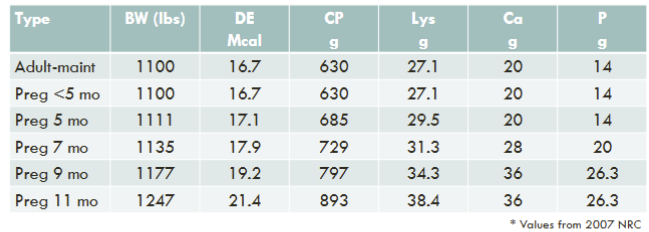
Nutrition Continued
- Forage based diet
- Forage first!
- Alfalfa mixed hay
- Forage first!
- Fortified concentrate feed
- Best option for mare and foal specific feed
- Free choice salt
- Free choice water
Parasite Control Reminders
- Use fecal egg count, treat accordingly
- Storngyloides Westerii (threadworms)
- Deworm within 2 months of foaling
- Pasture management
Housing Considerations During Pregnancy
Ideal: Shelter from the elements
- Fields open areas
Biosecurity
- Avoid having pregnant mares around sick, young, or traveling horses
Changes close to foaling
- Will self isolate
Pasture concerns:
- Tall fescue
- Can cause a golactia and increase risk of dystocia
- Toxin is still active if mowed as well
- Can cause a golactia and increase risk of dystocia
- Get mare accustomed to where she is going to foal
Vaccinations for the Pregnant Mare
Purpose:
- Core Vaccines
- Tetanus
- WWE
- EEE
- Rabies
- WNV
- Timing: 4-6 weeks give other than rabies give that one after she foals
- Not recommended during pregnancy
- Timing: 4-6 weeks give other than rabies give that one after she foals
- Reproductively important
- Equine herpesvirus 1 (EHV -1)
- Equine viral arteritis (EVA)
- Rotavirus
Equine HerpesVirus
- EHV-1
- Neurological form
- Respiratory disease
- Abortion and neonatal health
- EHV-3
- Venereal disease
Affects external genitalia- Causes abortion in pregnant mares
- Venereal disease
- EHV-4
- Nonfatal upper respiratory disease
- Seen in foals
Equine HerpesVirus-1
Signs
- Incubation period typically 4-6 days
- Biphasic: Fever day 1 or 2 and again on day 6 or 7
- Respiratory signs: Nasal and ocular discharge, not much coughing
- Neurologic signs: Rapidly progressing, incoordination, limb weakness, head tilt, inability to rise
- Reproductive signs: Abortion between 7-11 months
Contagious
- Direct horse to horse
- Indirectly through contaminated physical objects
- Survives up to 7 days in the environment
- Easily killed by disinfectants
Protection
- Vaccination: Equine Rhinophounagalis vaccine
- Best management practices:
- Biosecurity practices
- Clean equipment
- Take care of mares before other horses
- 3 dose series for mares: 5,7, and 9 months of gestation
- Best management practices:
EVA
Contagious disease
- Abortions
- Death in young foals
- Stallions can be long term carries → can cause infertility
- Respiratory secretions
- Veneral
- Indirectly
- In utero
Signs
- Fever
- Swelling in legs, scrotum, sheath in stallion
- Breeding stallions should be tested
- Swelling in mammary glands, and around eyes in mares
- Anorexia and depression
- Nasal discharge
- Abortion
- Death in foals
- May show no signs some
Diagnosing:
Vaccine: There is a vaccine that can be given to a mare than is going to be bred to a stallion that is a carrier of this disease
- No proven therapeutic means of eliminating virus form carries
Best management practices
- Biosecurity
- Testing mares and stallions
- Checking sperm/blood
- Vaccinate stallions
- Known carrier isolate them
Rotavirus → Zoonotic disease
Virus damages SI villi
- Highly Contagious
- Environmental contaminations
- Fecal oral route
- Indirect
- Best management practices
- Isolate infected foals
- DO NOT spread manure on pastures
- Disinfect stalls
- Biosecurity: washing your hands and changing your clothes, boot wash, keeping separate equipment
- Signs
- Diarrhea
- Lethargy
- Anorexia
- Distended abdomen
- Infected foals shed virus in feces for up to 10 days
- Protection
- Vaccination: 3 dose series for pregnant mares 8,9,10 months
- Only effective if foal receives an adequate amount of colostrum and absorbs sufficient anti rotavirus antibodies
- Vaccination: 3 dose series for pregnant mares 8,9,10 months
Prep for Parturition
- Herd management
- Move to foaling premise ~ 4 weeks. Prior to expected foaling date
- Prep stalls
- Observation!!!
Gestation Length
- Average 340 days, 320-360
- 305 to 320 days is considered premature
- < 305 days is considered an abortion
- Gestation length > 365
- Foals can get dismature when the mares go longer than 365, foals can get muscle atrophy, and crooked limps, and placenta can start to go “bad”
- Mares usually follow the same pattern every year typically
- Influencing factors
- Seasonal affects: mares that foal early in the year they tend to hold pregnancy about 10 days longer
- Sex of foal: Fillies have about an average 3 days earlier gestation versus colts they will go later
- Body condition: thinner mares will have their baby later in gestation
Physical Changes – Nearing Parturition
- Mammary gland development
- Begins around 4-6 weeks
- Madin mares may be a little less pronounced in the way the bag grows
- Engourged
- Less than 7 days of foaling
- Waxing
- Not all mares develop wax
- Drip milk
- In the days leading up to foaling
- Change in electrolytes of colostrum
- Record daily udder scores!
- Morning and Evening
- Begins around 4-6 weeks
Udder Scores
- Score 1: Little to no udder development
- Score 2: Developing udder, not tight, teats not full
- Score 3: Full, tight udder with filled teats
- Amber or wax
Physical Chances Continued
- Pelvis
- Vulva
- Swelling of vulva
- Vaginal discharge
- Belly drops
- Tailhead
- Reduced feed intake or refusal
- Behavior changes
- Starting First Stages of Labor
- Colicky, frequent urination
- Starting First Stages of Labor
Mammary Secretions
- Electrolyte changes
- pH decreases
- 7.4 plus 12 hours before foaling
- Will drop about 6.4 -6.2 before mare foals
- 7.4 plus 12 hours before foaling
Predicting Foaling via Colostrium
- Using 400mg/dl Calcium cut off:
- If >: 90% certain that mare will foal within 24h
- If <: 98% certain that mare will not foal within 24h
- pH if decreases to 6.4
- 97% certain that mare will foal within 24h
- If >: 99% certain that mare will not foal within 24h
Observing Foaling
- Night watch person
- Cameras
- Foal alert system
- Halter monitors
Initiation of Parturition
- Fetal placental signaling triggers parturition
- Fetal HPA axis
- ↑ Fetal ACTH, ↑ Fetal cortisol
- Effects:
- Starting the beginning stages of labor
- Starting the hormone changes
- Effects:
- Progesterone withdrawal – removes uterine quiescence
- Increased estrogens
- ↑ Myometrial contractility, ↑ Oxytocin receptors, ↑ Prostaglandin production, Cervical softening
- Prostaglandins and oxytocin – Positive Neuro Endocrine Loop
- PGF2a
- Stimulates uterine contractions
- Oxytocin – Posterior Pituitary
- Ferguson reflex
- Key Concept: Parturition initiated by the fetus, not the mare
- PGF2a
Stages of Labor
- Stage 1: Pre Devilery, Positing the foal
- Starting contractions → Ends with water breaking
- Foal getting into position
- Mare might begin to pase, colicky signs, biting at belly
- Be calm and quiet! → wrap top portion of tail
- Stage 2: Delivery
- Feet should appear first
- Check proper delivery position
- Soles of feet facing mares feet
- Nose
- Delivering the chest
- Timeline: 30 minutes
- Rest post delivery
- Umbilical cord breaks
- How to help (if it’s safe):
- Timeline: 30 minutes
- Feet should appear first
Move membrane off of foal if still on there
Check for foal to be breathing
Possibly towel dry foal
Move foal towards front of mare if still laying down
- Stage 3: Passing the Placenta
- <1 hour
- >3 hours = retained placenta
- Save placenta for evaluation
- Never pull placenta out of the uterus
Proper Presentation
- Check for 2 feet and nose position
- Front feet – soles down
- Call the vet if it's any different!
- Can get mare up/down
Placental Examination
- Always exam post foaling
Post Foaling Procedures
- Tire up amnion
- Banamine
- If they are still uncomfortable
- Give after placenta is given
- Wash Udder
- Strip some colostrum to test
- Naval dip as soon as breaks and stops bleeding
- Dilute chlorhexidine solution (0.5%)
- 2x/d for first 48-72 hours
Foaling Emergencies
- Red Bag - CALL VET
- Rupture membranes immediately
- Deliver foal as soon as possible
- Rectovaginal perforation occurs
- Mare foals while standing
- Excessive bleeding from mare or mare gums pale or purple
- Should be no bleeding after foaling
Mare Management Postfoaling
- Maidens - Give banamine
- No concentrate for 12 h
- Check temp
- Excessive vaginal discharge
- Hemorrhage concerns
- Mastitis prevention if foal is sick
- Turn out it is important!
Dystocia
Anything that is not normal foaling
- Long labor
- Mal presentation
- Stage 2 of labor more than 30 minutes
Medical emergency
- 4-14% of all equine births
- Early recognition and early successful intervention is critical for foal survival
- The ultimate goals
- Survival of the mare
- Survival of the foal
- Maintain mares fertility
Dystocia and Foaling Times
- 93% between 9:00pm and 8:00am
Obstetrical Intervention
- For each 10 minute increase in stage 2 of labor beyond 30 minutes
- !0% increased risk of foal born dead
- 16% increased risk of foal not surviving
Causes of Dystocia
Fetal Causes → More Common
| Maternal Causes
|
|---|
“On Farm Obstetrics”
Key Components:
- Experience
- Training
- Preparation
- Equipment, supplies
- Emergency plan
- Relevant factors:
- Proximity to vet clinic and or surgery suite
- Experience of staff
- Limitations of staff
- Understanding the situation
- Call for assistance if in doubt
- Relevant factors:
When to Call for Assistance
- If there has been no progress toward delivery after 15 - 20 minutes
- Progress abruptly stops
- If mare becomes painful or is in shock
- If you detect a significant problem
- If you are unsure of the issue
- If you do not have the knowledge or ability to diagnose or correct the problem
Step 1: Identify the Problem
Initial mare examinations
- Use safety precautions
- Use of stocks
- If the sides can open
- If they dont and mare goes down very hard to get back out
- Free standing in stall
- Restraint
- Determination if fetus is dead or alive may be critical to subsequent decisions
- Often this is not an easy task
Decision Making
- Status of foal
- Duration/severity of dystocia
- Economic value of mare and foal
- Clinician expertise
- Client preference
- Facilities
Step 2: Correct the Problem
- Many dystocias are mild
- More severe dystocias may require significant experience, specialized equipment or facilities and additional assistance
- Example: Front leg retained or flexed at the shoulder
Delivery Options:
- Vaginal delivery
- Cesarean section surgery
- Fetotomy
Obstetrical Procedures
General Principles:
- Pump lubricant into uterus
- Repel fetus into the abdomen
- Correct placement of body part that is out of position
- Assist with delivery
Assisted vaginal delivery:
- Place OB chains or nylon straps
- Apply tension on chains
- Work with mare
- Pull when she is pushing
- Relax when she stops pushing
- Work with mare
Outcomes of Dystocia
- Foal survival rate:
- Early decision made and equipment and facilities available
- Mare survival rate:
- Relatively high
- Mare future reproduction:
- Depends on the dystocia that mare had
Medical Risks of Dystocia
Mare
- Retained placenta
- Peritonitis
- Inflammation of the abdominal wall/lining
- Laminitis
- Inflammation of the feet
- Trauma
- Retinal region
- Uterine tear
- Cervical tear
- Prolapses
- Not very common
Foal
- Oxygen deprivation
- Failure of passive transfer
- Trauma
- Rib fracture
- Ruptured bladder
- Can be corrected surgically
‘On Farm’ Obstetrics: Elbow Lock
Orientation
- Frontwards presentation
- Right side up
- Both front feet and muzzle visible
- One leg protrudes more
Problem
- Elbow ‘caught’ on pelvis
Elbow Lock
- ‘On Farm’ Obstetrics
- Pull between contractions
- Foal usually delivered unassisted with subsequent contractions
- Provide assistance only if needed
‘On Farm’ Obstetrics: Red Bag
Orientation
- Brick red, velvety membrane protrudes through vulva
Problem
- Failure to rupture outer placental membrane
- Premature placental separation
- Foal at high risk of hypoxemia
Emergency situation
- Call for farm assistance
- Rupture membrane immediately which will “break her water” (allantoic fluid exits)
- Assist with delivery
- Use guidelines to assist
Other
- Retained fetal membranes
- Cesarean section
- Hemorrhage from uterine or ovarian artery
- Uterine prolapse
- Uterine laceration
Keys to Successful Foaling Season
- Owner/foaling attendant education
- Communication
- Owner
- Breeding farm staff
- Veterinary staff
- Preparation
- Foaling kit
- Emergency plan
Neonatal Care
- Normal behavior:
- Gets sternum within 5-10 minutes
- 1-2-3 rule: 1 hour be standing, 2 hours want them to nurse, 3 hours pass meconium
- Can give enema of sterile saline if foal is straining to pass meconium
Importance of Colostroum
- Passive transfer of immunity
- Risk in immunoglobins
- Good Quality
- Score: 21 or greater the foal should get enough antibodies, 20 or below not enough antibodies
- Bricks %
- Score: 21 or greater the foal should get enough antibodies, 20 or below not enough antibodies
- Produce 2.5-5 L of colostrum
- Some mares are poor quality colostrum producers or will drip colostrum when they are starting to get close
- Maiden mares will produce less quality colostrum
Immunoglobulin Classes in the Foal → IgG MOST IMPORTANT
Passive Transfer of Immunity
- Foals have enterocytes: cells that line the small intestine
- Have the ability for Nonselective pinocytosis is how macro molecules are absorbed
- Immunoglobulin Absorption
- Rapidly declines after birth
- “Gut Closure” → switching from immature cells to mature cells; 24 hours after birth
- Blood draw
- Plasma greater than 800 mg/dl → Snap test
- Partial failure of passive transfer: if it is between 400-800 mg/dl
- Failure of passive transfer: less than 400 mg/dl
- Check blood about 12 hours
- Risk of pneumonia, septicemia, and septic arthritis
- Treating FPT
- < 12 hours: Oral colostrum/IgG
- > 12 hours: IV hyperimmune plasma
Care of the Neonatal Foal
- Temperature
- Normal 99 - 102
- Umbilicus
- Dip in diluted chlorhexidine
- Colts can urinate out of their umbilical stubs
- Check temperatures
Nutrition
- Nursing
- 110 lb foal drinks ~ 15 L of milk per day
- 8 times an hour
- Size at birth
- About 10% of mature body weight when born
- 60% of the height that they are going to be
- Rapid growth
- 2-3 lbs per day in weight
- 0.3-0.4 cm per day in height
- Smooth steady grow curve
- 8,000 calories per day
- Forage
- 2-3 weeks of age they will get fiber digesters
- Alfalfa mix → foals growing bones and mares lactation
- 2-3 months supplemental feed
- Balance → no oats and grass forage hay
- High quality protein → 2:1 calcium phosphorus
- Proper mineral balance
- Increase concentrate with age
- Don’t offer free choice concentrate
- 2-3 months supplemental feed
Microbial Fermentation
- Important functions
- 1. Break down compounds to make nutrients available
- 2. Protecting the GI tract from pathogens
Neonatal GI Tract
- Foal born with few or no microbes in their gut
- Rapidly colonize after birth

- Feeding the foal and the microbes!
Coprophagy
- Foal eating mares poop
- Probiotic from moms poop and for the mare to get more fiber
Orphan Foals
- Milk replacer
- Mares milk is higher in lactose 6-7%
- Milk fat is lower in mare milk where ruminante % is higher
- All encompassing milk replacer isn't really made for foals
- Train to bucket
- Bottle fed can happen but would have to feed every 2 hours
- Pelleted concentrate
- 1-2 months only can start weaning off of milk replacer
- Social aspects
- Nurse mare option
Care of the neonatal foal
- Feal consistency
- Watch fecal consistency, while normal varies we don’t want diarrhea
- Feces shows microbial/digestive health
- 3-4 days poop 1-2 a day
- Biosecurity
- Handle mares and foals first before other horses stalls
- Keep separate equipment
Parasites
- Main concern: Roundworms/Ascarids (Live in the intestines and can cause a blockage)
- Highly resistant to ivermectin and moxidectin
- Benzimidazoles effective
- Safe Guard
- Panacur
- Anthelcide + EQ
- Administer by weight
Parasite Control
Treat with anthelmintics 4 times in the first year
- 2-3 months to target Ascarids
- Before weaning (4-6 months)
- Fecal egg if still have ascarids
- 9 months (can do fecal egg count)
- 12 months
- Treat with the rest of the heard
- 2x a year spring and fall
- Fecal egg count in fall
- Ivermectin, no combo requited
Vaccinations
Colostral antibodies lasts about 4 weeks
- Core vaccines ( minus rabies)
- 1st dose: 4-6 months
- 2nd dose: 4-5 weeks after 1st
- 3rd dose: 10-12 months
- Rabies
- 1st dose: 6 months
- 2nd dose: 4-6 weeks after 1st
- Coggins
- Not done until about 6 months old
- Equine infections anemia is what is looking for in a coggins test
What to expect from the normal foal
- Nursing and Sleeping
- Close to mom
- Poorly coordinated
Normal Vital Signs 
When things go wrong
- Maturity
- Meconium impaction
- Diarrhea
- Neonatal maladjustment syndrome
- Neonatal isoerythrolysis
- Developmental orthopedic disease
Mucous Membranes
- Salmon pink
- CRT < 2 sec
Maturity
- Premature
- Less than 320
- Placentitis → infection in the placenta → leading causes
- Major issues in their joints, they aren't developed
- Signs of Premature
- Muscle weakness (delayed nursing)
- Weak suckle
- Poor thermoregulation
- Poor glucose regulation
- GI and renal immaturity
- Entropion
- Dysmature
- Normal gestation however they have similar signs/behaviors to a premature foal
- Can get entropion
- Normal gestation however they have similar signs/behaviors to a premature foal
Meconium Impaction
- Signs
- Straining to defecate
- Swishing tail
- Depressed
- Dorsal recumbency
- Abdominal distention and colic
- Treatments
- First step is to give an enemia
- Can give right when foal is born
- Don’t give more than 2 within the first 24 hours
- Banamine if it is serious
- First step is to give an enemia
Diarrhea
- 2 Main categories
- Infectious
- Caused by a particular pathogen
- Bacterial Causes
- Clostrudium difficile, Clostridium perfringens, and Salmonella
- Opportunistic pathogens
- Severe diarrhea, fever, sepsis
- Produce toxins, inflammation in GI tract, and increase intestinal permeability
- Treatment/Protection from Infectious Diarrhea
- IV fluids
- Antibiotice
- Probiotics
- Gastroprotectants
- Prevention
- Good hygiene
- Bacterial Causes
- Caused by a particular pathogen
- Non Infectious
- Foal heat diarrhea – not caused by the first heat in the mare
- Transient, Self resolving (1-3 days)
- Associated with changes in microbial community
- Up to 80% of foals will develop transient diarrhea
- Treatment
- Supportive
- Monitoring hydration status
- Monitor for signs of systemic disease
- Necrotizing Enterocolitis
- Related to prematurity?
- High death rate
- Signs: Fever, depression, severe colic, diarrhea
- Nutritional Causes
- Orphaned or hospitalized foals
- Feed correct milk replacer
- Lactose intolerance
- Rare dont see it all too often
- High milk producing mares
- Foals tend to have more diarrhea
- Orphaned or hospitalized foals
- Foal heat diarrhea – not caused by the first heat in the mare
- Infectious
Neonatal Maladjustment Syndrome
- Hypoxic ischemic encephalopathy, perinatal asphyxia, or “dummy foal”
- Potential Causes
- Placentitis
- Prematurity
- Post maturity
- “Red bag”
- Dystocia
- Wonder around stall, weak suckle, decline in behavior
- Potential Causes
- Treatment
- “Dummy jug” IV cocktail
- IV fluids
- Broad spectrum antibiotics
- Intranasal oxygen
- Madigan squeeze
Neonatal isoerythrolysis
- Foal inherits blood type different from mare
- Signs 6-72 hours after birth
- Dull and lethargic
- Pale yellow mucous membranes
- Tachycardia
- Dark yellow urine
- Fever
- Signs 6-72 hours after birth
- Prevention and Treatment
- Blood type
- Muzzle
- Treat fever and prevent infection
Developmental Orthopedic Disease (DOD)
- Growth disturbances and orthopedic problems
- Osteochondritis dissecans (OCD) → bone chips in the joints
- Physitis
- Flexural deformities
- Angular limb deformities
- Bone chips
- Treatment
- Restricted exercise
- Corrective trimming
- Splints, casts, wrapping
- Medication
- Surgical
- Preventing DOD
- Proper feed formulation
- Minerals
- Cu and Zn
- Mn and Mg
- Ca and P
- Overfeeding
Lactation
- Lactation is the process of secreting milk from the mammary gland
- Mammals are the only class of organisms that produce milk
Importance of Milk
- Provides nourishment for young
- Provides protection for neonates against disease
- Provides human food
- What are the major components of milk?

Milk Composition
- Macro nutrients
- Protein – 1-2$
- Fat – 2%
- Carbs – 6-7%
- Micro Nutrients
- Vitamins
- Minerals
- Water
- Protein
- Carbs
- Vitamins
- Minerals
- Fat
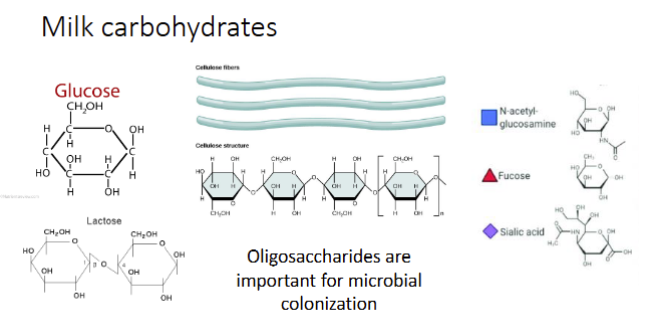
Over 50 different types of oligosaccharides
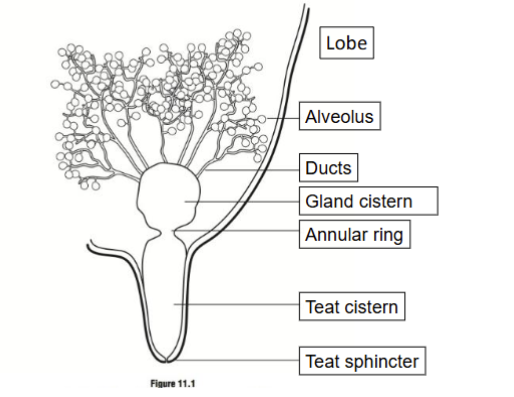
Mares have 4 quarters but only 2 teats
Alveolus
- Functional unit
- Where the milk is produced
- Milk secreting unit of the mammary gland
- Lined in alveoli
Myoepithelial Cells
- Muscle cells that surround the alveoli
- They have a hormone receptor for oxytocin (peptide hormone)
Pregnancy loss timeline
- Day 0 - 14: Pre maternal Recognition
- Day 15 - 40: Early embryonic loss
- Day 28 - 120: Endometrial cups
- Day 40+: Fetal stage
- Day 150: Placental dependence
Terminology
- Conceptus: all of the products of conception
- Fetus, placenta, fluids, etc
- Embryo: portion that will eventually turn into the foal
- Fetus: the offspring is still in utero and can be defined or easily identified as that species
- Generally, < 40 day = embryo
- > 40 days fetus
- Foaling rate = live foal rate = fertility rate
Pregnancy loss: Early Embryonic Loss
- Average foaling rate: 60 - 70%
- 35-40% of mares will lose that pregnancy at some point
- 10 to 15% of all pregnancies end in early embryonic loss
- Sub fertile, older mares → 7-8 times more likely to lose a pregnancy
- After day 75 the frequency of pregnancy loss starts to lower
- Causes
- Maternal
- External
- Embryonic
- Sub fertile, older mares → 7-8 times more likely to lose a pregnancy
Early Embryonic Loss
- Endometrial cups
- eCG production
- Prevents return to estrus
- Twin pregnancies → leading causes of pregnancy loss
- Twin fixation – competition – loss
- Management
Causes of early embryonic death
- Maternal factors:
- Low progesterone
- Failure of maternal recognition
- Primary CL deficiency
- Endomaturitis → inflammation of the uterus
- Oviduct Environment
- Reduced oviduct secretions
- Embryonic toxins
- Incorrect timing
- Scar tissue
- Uterine Environment
- Endometritis
- Fluid in uterus during early pregnancy
- Endometrial cysts
- Lack of required secretions
- Chronic endometrial disease
- Age of Mare:
- Light levels of FSH and LH
- Quality of oocyte decreases
- Cellular division is slower
- External factors
- Stress
- Decreases progesterone production
- Inadequate nutrition
- Ingestion of toxins or infectious agents
- MRLS in KY (2001) → caused by tent caterpillars
- Mare reproductive loss syndrome
- MRLS in KY (2001) → caused by tent caterpillars
- Embryonic Factors
- Small size and defects
- Chromosomal abnormalities
Diagnosis of embryonic death
- Small for age vesicles
- No embryo development in vesicles and/or no heart heat at day 24
- Development next to endometrial cyst
- Uterine edema
- Treatment
- Provention
- Progesterone
- Continue until day 75 or 100
- Can still even fail
- Continue until day 75 or 100
- Treatment
Pregnancy Loss: Late Term
- Abortion vs stillbirth
- Abortion: pregnancy ended at any point however usually used in the beginning of pregnancy
- Stillbirth: foal should still be viable but for some reason that foal is not
- Twisted umbilical
- 10% of pregnancy
- 6 to 11 month: placental dysfunction
- Acute: EHV - 1 or a twisted umbilical cord
- Chronic: do have signs, discharge, thickening of the vulva
- Usually bacterial or fungal causes
Late term abortions
- Viral: Equine Herpevirus 1
- Bacterial
- Streptococcus zooepidemicus
- Leptosprosis
- Fungal: Aspergillus spp.
- Always treat as infections
- Submit fetus and placenta for analysis
- Biosecurity
- Sample types
Uterine Endometrium
- Interior of uterus
- Functions:
- Secretions that support the developing placenta and embryo when it comes it
- Clear any bacteria and debris after that breeding
- Anestrus - atrophied
- Not active during the winter months
- Estrous - edema present but not a lot of fluid
Uterine Health and Pregnancy
- Uterine environment must be infection free to support conceptus and placenta
- Endometritis:
- Major cause of infertility or sub fertility mares
- Hard to diagnose
- Most cases are non infectious
Uterine Clearance in normal mares
- Oxytocin released during breeding
- 2 - 4 hour post breeding: healthy sperm arrive at oviduct
- Inflammation in the uterus
- Release of immune cells: Neutrophils, Antibodies, Complements, Polymorphonuclear cells (PMN)
- PGF2a is produced
- > 4 hour sperm collected from uterus phagocytized
- Lymphatic system in uterus drain fluid
- Inflammatory response lasts 40 to 72 hours post breeding
Classifications of Endometritis
- Sexually transmitted disease
- CEM - contagious equine metritis (bacteria)
- All TB mares bred to imported stallion need to be tested
- All European mares tested prior to breeding
- Persistent mating induced endometritis → Leading Cause
- Contamination in the breeding process
- The cleaning process doesn't happen
- Inflammation is sustained
- Chronic endometritis
- Chronic degenerative endometriosis
- Due to anatomical issues in the mare
Persistent Mating - Induced Endometritis
15% of mares →
- Normal cycle, lose early conceptus or fail to get pregnant
- Incomplete voidance of uterine fluid and seminal products
- Poor uterine contractions
- Anatomical defects
- Cervical malfunction
- Inadequate lymphatic drainage
- Reduced uterine clearance = decreased pregnancy rate
Diagnosis
- Ultrasound the uterus
- Cultural swabs → swab, plate/culture swab
- Should have a clean uterine culture prior to breeding
- Uterine biopsy → take a clip of tissue from uterine lining, only looking at that specific location not looking at the whole uterus
- Uterine lavage → sterile procedure, through vaginal, flush the uterus, collect fluid that was flushed and culture fluid
Treating persistent mating induced endometritis
- Goal: Remove all fluid
- AI preferred over live cover
- Fresh/Cooled preferred over frozen
- Oxytonic: 4 - 6 hours until cleared
- Uterine lavage
- 10% povidone - iodine
- Oxytocin
- Check at 24 hours
Chronic Endometritis
Causes:
- Infections agent
- Contaminantes from fecal
- General microflora that have gotten out of hand
- Poor perineal anatomy
Long term inflammatory responses cause degenerative changes
- Glandular function
- Early conceptus support
- The longer the infection the greater the damage
Diagnosing Chronic Endometritis
- Positive culture from fluid and biopsy
- Ultrasound
- External signs
- Discharge from vulva, matting of tail hairs
- Returning to estrus day ahead of schedule
- Vaginal speculum exam – reddening of vagina, discharge through cervix, pooling urine, manure in vagina
Treatment for Endometritis
- Fix physical defects
- Uterine flushing
- Oxytocin and Antibiotic: can give a IM or local antibiotic depending on the kind of infection
- Mucolytic irrigations
- Excessive secretions of mucus interferes with antibiotic effectiveness
- Some bacteria or fungi produce biofilms
Diseases of the Placenta
Causes of placental dysfunction
- Placentitis
- Alteration of blood flow
- Inadequate placental attachment
- Edema of placenta
- Maternal disease or malnutrition
Results
- May deliver live and viable foal at 310 days
- Malformed fetus, fetal death, mummification, abortion, fetal growth retardation, prematurity, still birth, and neonatal weak foal or foal death
- Low birth weight
- Weak and septic foals
Placentitis and Abortion
- Ascending Placentitis
- Degeneration and necrosis of microvilli
- Thick and endematous
- Changes from bright red to pale
- Vaginal discharge
- Nocardioform Placentitis → Increase in 2020
- Sticky mucous brown plaque on horns
- No discharge
- Lots of unknowns
- Hot, dry fall could be a leading cause
Clinical Signs
- Vaginal discharge
- Premature lactation
- Transabdominal ultrasound
- Premature separation of placenta
- Monitor fetus for normal heart rate, fluids, activity and size
- Measure maternal blood progesterone, estrogens – normal levels?
Treatment
- Goal:
- Control the infection
- Decrease inflammation in the uterus
- Increase blood flow to the uterus
- Decrease any uterine contractions
- Use an antibiotic → SMZ most common
- Banamine
- NSAID
- Helps with pain
- Regumate
- Helps support progesterone
- Estrogen or isoxsuprine
- Helps with blood flow to the uterus
- Helps with attachment of the rest of the functioning placenta
Outcomes for the foal
- Mid pregnancy: most likely will loose pregnancy, can try to safe pregnancy but very unlikely
- Late pregnancy: Can treat if catches it early
- If foal lives to term: 310 days or greater
- Premature rise in ACTH and cortisol levels that are associated with final maturation
- May be weak or septic
- Dummy foal
- If foal lives to term: 310 days or greater
Basic Components
Function: Is to produce and deliver sperm into the females reproductive tract
- External genitalia
- Penis
- Prepuce
- Scrotum
- Muscles
- Testes and epididymides
Pelvic Tract
- Vas deferens
- Spermatic cord
- Accessory sex glands
- Ampulla
- Seminal vesicles
- Prostate gland
- Cowpers gland/bulbourethral gland
Scrotum
Purpose: Contain, protect, and thermoregulate the testes epididymis, spermatic cords, and cremaster muscles
- Connective tissue and smooth muscle fibers
Layers of the scrotal wall
- Skin
- Tunica dartos
- Parietal vaginal tunic
- Visceral vaginal tunica
- Tunica albuginea
- Testicular parenchyma
Testes
Function: produce sperm and produce hormones
Fetus: testicles are up in the abdomen
- Prior to birth
- Testicular descent – last 30 days of gestation and first 10 days postpartum
- Located within the inguinal ring
Testes: Seminiferous Tubules
- Site of spermatogenesis
- Developing sperm and precursors
- Take about 2 months to develop sperm
- Sertoli cells
- Within the tubules where the sperm cells are developing
- Help support spermatogenesis
- Produce estrogen
- Leydig cells
- Produce testosterone
Epididymis
3 parts: Head, Body, and Tail
- Responsible for:
- Transport
- Concentration
- Storage
- Maturation
Morphology of the Stallion Spermatozoa
5 main regions
- Head: condense nucleus, covered by the acrosome
- Neck
- Midpiece: had a helix mitochondrial (ATP)
- Principal piece: longest part of the tail
- End piece: very end of the tail
Spermatic Cord
- Cremaster muscle
- Pampiniform plexus
- Arterial blood comes in and vein blood comes out
- Vas deferens
Accessory Sex Glands
- Seminal vesicle, ampulla, prostate gland, and bulbourethral glands
- Purpose:
- 60 - 90% of the total seminal fluid volume
- Support sperm
Ampulla
- Enlarged glandular portion of the vas deferens
- High concentration of potassium and protein
- Stores some semen
Seminal Vesicles
- Produce large portion of seminal plasma
- Secretions: energy for sperm
- Dilate and elongate when stimulated
Prostate Gland
- Secretion: Thin, milky, alkaline
- Neutralize acidity of the epididymal secretions
Bulbourethral Glands
- Secretions: Alkaline, mucus - like
- Neutralize acidity, lubrication
Urethra
The urethra serves as the joint excretory canal for urine and semen
Prepuce or Sheath
- Protects non erect penis
- Internal preputial fold
- External preputial fold
Erection
- Large percentage of tissue in the penis for erection
- Corpus cavernosum
- Corpus spongiosum: just surrounds the urethra
- Hemodynamic: it reacts to an increase in blood pressure
Ejaculation
- The expulsion of semen from the penis
- Stimulated by nerves
- Muscles surrounding accessory glands contract pulsations with about 75% of total sperm in first 3-4 pulses
Puberty
Defined as the capability to reproduce
- Infantile stage: < 6 months
- Does not produce functional leydig cells and indifferent supporting cells
- Prepubertal stage: Can change from breed and season how long this may last
- Puberty stage: Stallions reach sexual maturity at 2 - 4 years of age
Cryptoorchidism
- Failure of the testes to descend into a normal scrotal position
- Heritable
- Three ways to check
- Rectal palpation
- Hormonal challenge
- Ultrasound
Penis
Musculocavernous type
- 3 parts
- Root
- Shaft
- Glans penis
- Preputial ring
- Non erect: 50 cm long by 2.5 to 5.0 cm in diameter
- Erection increases the length and diameter of the penis about 50%
- Glands penis increases 300 - 400% in diameter through engorgement
Puberty
Definition: When a colt produces viable spermatozoa in the ejaculate and is capable of fertilizing and oocyte
- Typical age: 12 - 18 months
- First sperm 12 - 14 months
- Hormonal change – day light changes
- Testosterone: develop sex characteristics, libido, spermatogenesis
- Physical development
Sexual Maturity vs Puberty
Puberty does not mean full reproductive maturity
- Puberty: First viable sperm present
- Sexual maturity: max sperm production and breeding capacity
- Behavior vs fertility
- Libido will develop before sperm actually develops
- Management implications
- Separate pastures by sex
- Geldings for a baby sitter for colts
Factors Affecting Age of Puberty
- Breed: pony breed early, draft breeds late
- Nutrition
- Season
- Growth rate
Cryptorchidism: Failure of one or both testes to descend into the scrotum
Types: Unilateral and bilateral
- Locations
- Abdomen
- Inguinal canal
- Subcutaneous inguinal region
- Fertility implications
- The testis that is not descended will not produce viable sperm
- Unilateral will still be fertile
- Bilateral is sterile
- Management
- Heritable trait
Assisted Reproductive Techniques
Useful for
- Mares
- That have issues with her uterus
- Decreasing risk of injury
- Still showing
- Stallions
- Decreasing injury
- Quality of semen
Pregnancy Rates
- Average: 50 - 60% conception rate on first cycle
- Average conception rate for season: 60 - 70%

Techniques
- Artificial insemination
- Embryo transfer
- In vitro fertilization
- Oocyte aspiration
- Intracytoplasmic sperm injection (ICSI)
- Nuclear transfer (cloning)
Artificial Insemination
Fresh/cooled semen: 60-90% pregnancy rate
- Frozen semen: 35-40% (range 0 - 70%)
- Factors
- Timing
- Freezability
- Mare age/uterine health
- Factors
Pro: Taking out interaction between mare and stallion
Cons: Increases human injury (stallion side)
Embryo Transfer
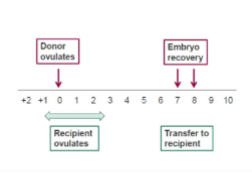
Process: Breed mare, collect embryo, transfer to recipient mare
- Day 0: Ovulation
- Day 7 - 8: Flush
- Transfer
- Mares don’t superovulate very well
- Hormones: Use porcine FSH or use equine specific FSH
- Anatomy: They only ovulate in a single horn
- Mares don’t superovulate very well
Recipient Mare Selection
Enhanced or restricted fetal and postnatal environment effects glucose.insulin metabolism
- Uterine environment affects foal metabolism outcomes
Embryo Transfer
- Recipient mare selection
- Temperament
- Repro conformation
- Age (late teens no older mares)
Recipient Mare Management
Normal cycling by February
- Monitor follicular development
- Receive embryo 4 - 8 days post ovulation
Donor Mare Management
Goal: Recover clean embryo, of size that transfers well
- Uterine status is important!
- Daily ultrasounds
- Follicular development/ovulation
- Condition of the uterus
- SIze of embryo: 7 - 8 day post ovulation
- Too big: start to get too sensitive/fragile
- Too small: wont be able to find it in the fluid
Uterine Flush for Embryo Transfer
- Sterile procedure
- Do give the mare some oxytocin to help relax the cervix
- Will sedate the mare
- Immediately transferred, maintained in media, or frozen
- Evaluate for quality
Transfer of Embryo to Recipient Mare
- Good uterine tone and closed cervix
- Sedate mare, clean perineum, vulva, vestibule
- Load embryo into transfer gun or pippette
Managing Mares Post Transfer
- Risk of bacterial contamination – endometritis
- Recipient mare protocol
- Time of transfer: banamine, antibiotics
- Pregnancy check: days 11, 13, 17, 23, and 29
- Donor mare management
- Biggest risk: becoming pregnant
- Administer PGF2a after flush
- Fluid not completely removed
- Check day after flush
- Monitor signs of estrus
- Biggest risk: becoming pregnant
Embryo Transfer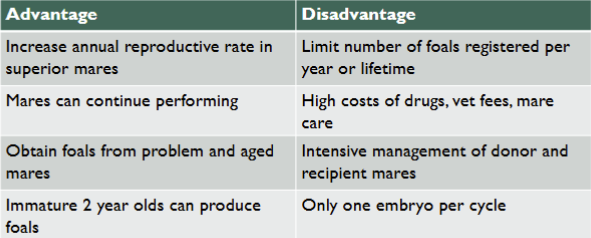
Oocyte Aspiration
Collect oocytes directly from ovarian follicles
- Transvaginal aspiration (TVA)
- Ovum pick - up (OPU)
Collecting immature oocytes – require in vitro maturation
- Mature – lower recovery rate, ready for ICSI
- Sedate mare
- Ultrasound probe placed transvaginally
- Ovary stabilized per rectum
- Needle guided through vaginal wall to follicle
- Follicular fluid aspirated
- Oocyte recovered from fluid in the lab
Oocyte Aspiration and Transfer
Collection of follicles from donor and recipient mares
- Collect oocyte (donor)
- Remove recipient oocyte
- Transfer to oviduct
- Breed recipient
Oocyte Transfer
- Oocyte transferred to recipient
- Trans - abdomina l
- Remove recipient mare oocyte
- Deposit oocyte in oviduct
- AI recipient mare
- Highest success rate of the ARTs
Intracytoplasmic Sperm Injection (ICSI)
What is ICSI?
- One sperm cell injected into oocyte
- Done in vitro
- Requires micromanipulator
Why use ICSI?
- Poor semen quality
- Limited semen
- Preserving genetics
- Multiple oocytes
Options for embryo
- Immediate transfer to oviduct of recipient mare
- Culture 24 - 48 hours then transfer to oviduct
- Culture 7 - 8 days then transfer to uterus
- Success rate: Varies between 20 - 50 %
Gamete Intrafollopian Transfer (GIFT)
Performed via standing laparotomy → done more surgically for the recipient mares
- Advantage:
- Lower quality or lower number of sperm → puts right in the oviduct
- Lower risk of post breeding endometritis
In Vitro Fertilization (IVF)
Standard method of fertilization of isolated oocytes in most species
- More successful with frozen than fresh semen
Nuclear Transfer (Cloning)
First equids cloned (2003): a mule in Idaho Gem, and a Haflinger; Prometea
- Why clone?
- Genetics → gelded colt
- Preserving endangered breeds
- Making a genetic copy of the offspring
- Success Rate? → very low but possible
- More frequently done in polo ponies
- 800 oocytes – 22 embryos – 17 transferred – 4 pregnancies – one full term foal
- Oocyte from mare and denucleated
- Tissue from horse to be cloned is collected and cultured
- Chromosome from donor cell transferred to cytoplasm of oocyte
- Embryo transferred oviduct of recipient or cultured in vitro then transferred to uterus of recipient mare
Health of cloned foals
- Increased risk of maladjustment syndrome, enlarged umbilicus, contracted tendons, angular deformity of front limbs
- After 2 weeks, appear normal
- > 200 polo ponies produced via cloning in Argentina since 2009
- After 2 weeks, appear normal
Basic Genetics
- 4 nucleo tides
- Strands of DNA have different segments that will code for building different structures in the body
- Genes have different alleles that cause a different phenotype
Genome
- “Instructions” for making an organism
- Horses have 64 chromosomes in 32 pairs
- Shvulski horses have 66 chromosomes
Genotype
Phenotype
Epigenetics
- Influence gene activity
- Change how the gene is expressed
Equine genome
Published in 2007
- “Blueprint” or starting point of that horses make up
- Compare between animals
- Identify traits
Importance of genetic testing
- Traits
- DNA and parentage verification
- Genetic diseases
- Color and patterns
- Palamino
- Buckskin
- Appys
- Making wise breeding decisions!
The “Speed Gene”
Early findings: Nucleotide at one part of the myostatin gene associated with speed
- C nucleotide: speed
- T nucleotide: stamina
Myostain gene and race length (hormone depending on muscle growth)
- C/C: Sprint performance (less than 1 mile)
- C/T: middle distance (~1 - 1.5 miles)
- T/T: longer distance (> 1.25 miles)
Important to note that speed is controlled by more than just that one gene
DNA and parentage verification
- Hair, blood, tissue
- DNA testing
- Parentage verification
- Sire and dam must be DNA tested
Breed requirements
- AQHA: embryo transfer, shipped semen, racing, descendant of impressive
- Jockey Club
- APHA
Genetic Diseases
6 panel plus genetic testing → Primarily found in stock horses
- HYPP: hyperkalemic periodic paralysis
- PSSM1: polysaccharide storage myopathy type 1
- MH: malignant hyperthermia
- GBED: glycogen branching enzyme deficiency
- HERDA: hereditary equine regional dermal asthenia
- MYHM: Myosin heavy chain myopathy
Others
- WFFS: Warmblood fragile foal syndrome
- OLWS: Overo letha white syndrome
- Arabian panel” Cerebellar abiotrophy, lavender foal syndrome, SCID
Terminology
Dominant and Recessive Alleles
- Example: E = dominant black coat color, e is recessive red gene
- EE or Ee = black base coat
- ee = red based coat
- Homozygous: two identical alleles
- Heterozygous: two different alleles
Hyperkalemic Periodic Paralysis
Dominant disease
- Causes muscle spasms
- Interrupts flow of sodium in/out of muscle
- Diet management is key!
- Low potassium diet
- Regular exercise/turnout
Polysaccharide Storage Myopathy Type 1 (PSSM Type 1)
Dominant condition
- Abnormal synthesis of glycogen in the muscle
- Muscle pain and cramping
- Breakdown of muscle fiber
- Management
- Low starch/sugar diet
- Cannot break down the glycogen
- Low starch/sugar diet
There is a type 2 but there is not genetic testing for it but they do experience similar symptoms
Hereditary Equine Regional Dermal Asthenia (HERDA)
Recessive Condition → need both copies to be expressed
- Degenerative skin disease
- Stretchy, elastic, sloughing skin
- Severe skin wounds
- AQHA, appaloosas, paints
- No treatment or cure
- Wont know they have herda until they start under saddle
- Seen more in the cutting horses
Glycogen Branching Enzyme Deficiency
Recessive disease
- Usually see in the foal but the foal more than likely doesn't make it
- Signs: have no energy, very weak, cannot stand
- They cannot make glycogen
- No treatment or cure
- These effected foals that are alive and are not still born or aborted are normally euthanized
- AQHA and Paints
- Glycogen synthesis disorder
Malignant Hyperthermia → RARE
Dominant disease
- AQHA and Paints
- Mutation results in excessive Ca release in muscle cells
- Increase metabolic rate
- Can result in death
- Triggered by stress and anesthesia
- Treatment: can give a drug when they are under anesthesia
- Cant test for it, not a death sentence if know that they have it
Myosin Heavy Chain Myopathy
Dominant Disease
- AQHA and other stock breeds
- See muscle stiffness, muscle drops rapidly
Two disease presentations
- Immune mediated myositis
- Non exertional rhabdomyolysis
Treatment/Management
- No strangles vaccine
- Use intranasal vaccines when possible
- Space out vaccinations
Coat color genetics
Over 300 genes control pigmentation
- Base coat colors: CHestnut and Black
- Agouti:
- A: restrict the black at the points
- a: distribute the black all across the body
- Red factor: 3 alleles → E, e, e^a
- Sorrel if they are homozygous with E and a lowercase a
- Agouti:
- Shade
- How light or dark the horse is
- Dilution genes
- 6 dilution genes
- Reduce the amount of pigment expressed
- Champagne
- Cream
- Dun
- Mushroom
- Silver
- Pearl
- White spotting pattern genes (PATN1)
- Gray, roan
- Progressively loose pigment
- At risk for developing melanoma
- Tobiano, overo, sabino
- Can get the lethal white syndrome if not careful when breeding these
- Appaloosa spotting (leopard complex) or pattern
- Gray, roan