Chapter 3: Forensic Science and Evidence
Congress authorized the National Academy of sciences to conduct a study to assess forensic science in the United States as a whole. This resulted in an epic report called Strengthening Forensic Science in the United States
U.S Court System
The U.S. has a dual court system, meaning there are two different types of courts: state courts and federal courts.
state courts take care of breaches of state law
federal courts take care of breaches of federal law
Court’s Jurisdiction → The jurisdiction of a court refers to its legal authority to hear and decide cases, which varies depending on whether the case involves state or federal laws.
Civil Law → Civil law involves disputes between individuals or organizations, typically seeking monetary compensation or specific performance rather than criminal penalties.
Plaintiff → The party who brings a lawsuit into a court, claiming to have been harmed and seeking relief from the defendant.
Defendant → The party being accused in a lawsuit, who is required to respond to the plaintiff's claims and can also present a defense against the allegations.
Criminal Law → Criminal law pertains to offenses against the state or public, where the government prosecutes individuals accused of violating laws that prohibit harmful behaviors, leading to penalties such as imprisonment or fines.
Prosecution → The legal party responsible for presenting the case against the defendant in a criminal trial, charged with the task of proving the defendant's guilt beyond a reasonable doubt.
Defendant → The legal party in a civil trial who is required to defend against claims made by the plaintiff, which may include presenting evidence and arguments to counter the allegations.
In the federal court system the lowest court is the district court, then circuit courts, and finally the U.S. Supreme court.
The state court system is based on the federal court system, so looks quite a bit the same. The lowest level is the trial courts, then the state appellate courts, and finally the state Supreme Courts
Science and the Law
Criteria used to determine whether something was scientific or not:
It is guided by natural law.
It has to be explanatory by reference to natural law.
It is testable against the empirical world.
Its conclusions are tentative, that is are not necessarily the final word.
It is falsifiable
Legality of Scientific Evidence
RULES OF EVIDENCE
The Frye Standard (1923) → a legal standard used to determine the admissibility of an expert witness’s scientific testimony.
To properly enact the Frye Standard, three questions must be answered:
Is the scientific theory generally accepted in the scientific community?
Is the scientific method used generally accepted in the scientific community?
Has the technique been applied correctly?
The Daubert Standard (1993) → a legal precedent used by a trial judge to determine if an expert’s scientific testimony is based on scientifically valid reasoning and/or methodology and if the testimony can, therefore, be applied to the trial at hand.
The judge is considered the “gatekeeper” of scientific evidence presented to the court. He or she must determine these things:
If the theory or technique in question has been properly tested.
If the theory or technique has been subject to peer review22 and subsequent publication.
If the theory has a known or potential error rate.
If there are maintenance of standards controlling its operation.
If the theory or technique is widely accepted within the relevant scientific community.
FEDERAL RULES OF EVIDENCE
The Federal Rules of Evidence (FRE) are Congressional rules which govern the introduction and admissibility of evidence to federal trials within the United States.
Admissibility or inadmissibility of trial information is determined by the Rule of Evidence as interpreted by the Supreme Court.
According to the rules, evidence must be reliable and relevant. Specifically, the evidence must have the ability to make a fact more or less probable than it is without the evidence. It must not violate any parts of the U.S. Constitution, a federal statute, or other rules as put forth by the Supreme Court
A result of a committee of lawyers, judges, and legal scholars
States were free to adopt the federal rules or maintain different state rules
Rule 702 → governs the testimony of expert witnesses, allowing them to provide opinions based on specialized knowledge, skill, experience, training, or education, so long as their methods and principles are generally accepted in their respective fields.
Evidence and the Scientific Method
The scientific method has four steps:
Observation and description of a phenomenon or group of phenomena.
Formulation of a hypothesis to explain the phenomena. In physics, the hypothesis often takes the form of a causal mechanism or a mathematical relation.
Use of the hypothesis to predict the existence of other phenomena, or to predict quantitatively the results of new observations.
The performance of properly performed experimental tests of the predictions by several independent experimenters.
Literature Search → the bare minimum for research and simply means to look up information in credible sources
From Crime to Courtroom
Once a defendant is in jail, one of three things happens:
If the prosecutor (usually the district attorney or the city attorney) does not think there is enough evidence to file charges, then the defendant is released.
The defendant posts bail (also called a bond) and/or is released with the promise to show up in court for arraignment. If this happens, the defendant is given a particular court date for the arraignment. If that date is missed, then the defendant will be arrested once again.
The defendant stays in jail. This happens when the defendant cannot post bail or is considered a flight risk. Law enforcement officers will transport the defendant to the court for arraignment.
BEGINNING OF THE CASE
A case begins with the arrest and the authorship of an arrest report. This report summarizes the events leading up to the arrest of the defendant and provides everything from witnesses names to possible evidence.
The arrest report is given to the prosecutor (often a civil servant working for the city, state, or district) and the prosecutor decides if there is enough evidence to file charges.
Once charges are filed, the defendant appears in court for the arraignment. During the arraignment, the judge outlines the charges against the defendant, reminds the defendant of his or her constitutional rights, and determines if the defendant has adequate legal counsel. If the defendant cannot afford a lawyer, the judge will appoint a lawyer to the defendant.
In the case of a federal crime, a grand jury is created to hear the evidence. This is a right of the defendant and guaranteed by the Fifth Amendment of the U.S. Constitution, which states that a person suspected of a federal crime cannot be tried until a grand jury has determined there is enough reason to charge the person.
PLEAS AND TRIAL
The defendant must respond to the charges by entering a plea.
Usually, the defendant enters a plea of not guilty, guilty, or no contest.
Once a plea has been entered, then the judge will either release the defendant on his or her own recognizance, set bail for the defendant and send the defendant back to jail until bail, is posted, or refuse to set bail and send the defendant back to jail.
If the defendant is set to stand trial, trial preparations begin with the prosecution and the defense analyzing the evidence and finding witnesses. Much of the evidence will likely have been analyzed by forensic scientists in public crime labs before the arrest of the defendant
THE FORENSIC LAB
An accredited laboratory has agreed to operate according to a professional or industry standard and has proven that it can and does operate in a professional manner.
To become accredited it must undergo a variety of inspections, have certain documentation in place, and have a system of checks and balances that ensure high-quality evidence analysis
LAWYERS AND LAW
Adversarial System → Lawyers representing one of two rival positions arguing for acceptances
Voir Dire → the process of questioning prospective jurors to determine their suitability for serving on a jury, ensuring they can be impartial and fair.
THE JURY
If the jury finds the defendant not guilty, they will grant the defendant an acquittal.
The defendant is then released and can never again be tried for the same crime in a criminal court.
A finding of not guilty is not the same as a finding of innocence ... it simply means that the jury was not convinced beyond a reasonable doubt that the defendant was guilty.
CSI and Evidence
Contrite Fallibilism → An awareness of how much we do not know and the humility to acknowledge the possibility of making mistakes
CATEGORIES OF EVIDENCE
Inculpatory → its presence at a scene includes a person as a source
Exculpatory → its presence can exclude a person as a source
Direct Evidence → the type that establishes a fact without the need for further inference
Circumstantial Evidence → requires inference from a fact that is directly proven
Reconstruction Evidence → provides information about the events, preceding, occurring during, and concurring after the commission of a crime.
Associative Evidence. → type of evidence is from an unknown source or origin until a comparison is made to a known standard
Exemplar → a sample that is used for comparison to establish the significance of evidence found at a crime scene.
Class Evidence → consists of class characteristics: class characteristics of evidence do not reference a particular suspect. Instead, they reference a group of objects that all have common attributes.
Identification Evidence → reference a particular suspect
Physical Evidence
physical objects associated with a crime
Physical evidence has some major advantages over things like witness testimony:
It provides a tangible object for the jury to see.
It can be taken into the jury room for further evaluation during deliberations.
The defendant or prosecution cannot distort the physical evidence.
It supports the reconstruction of the crime, and therefore some cases cannot be solved without it.
It is not subject to memory loss.
It can be tested by an independent expert.
The most common types of evidence are:
Trace evidence: This type of evidence is any substance found in small but measurable amounts. It is subject to Locard’s Principle, stating that every contact leaves a trace.
Biological evidence: Typically, human or other animal tissues used for identification and individualization constitute the focus of forensic biology. An expert working with biological evidence will spend much of his or her time working with conventional serology (ABO blood grouping), DNA analysis, and tissue identification.
Chemical evidence: Forensic chemistry primarily deals with drugs, toxicological samples, explosives, and the identification of unknown substances.
Fingerprint evidence: Can you guess what this is? Yep, it’s fingerprints. Two aspects of fingerprinting are generally associated with the lab: latent print development and print identification. Print development involves using various substances to visualize prints made in natural bodily oils. Identification involves comparing the discovered print with a known exemplar to include or exclude a person from the scene.46
Impression evidence: Tires, footwear, and other objects can leave impressions of their patterns and markings at a scene. This is where the forensic scientist comes in. Impression evidence can provide substantial information, including the identification of individuals, based on the quality of the impression.
Firearm and tool mark evidence: This is actually a type of impression evidence, but it is used so extensively it earned its own place in these categories. Firearm and tool mark evidence encompass everything from fired bullets to spent cartridges to striation marks left behind by hammers or other objects. The forensic scientist is responsible for comparing and contrasting these marks in the hopes of individualizing the evidence.
Questioned documents: There are lots of different types of examinations that can be used to analyze documents. Common examination for questioned documents includes handwriting comparisons, alterations of the document itself, obliterations on the document, and chemical analysis of inks and papers.
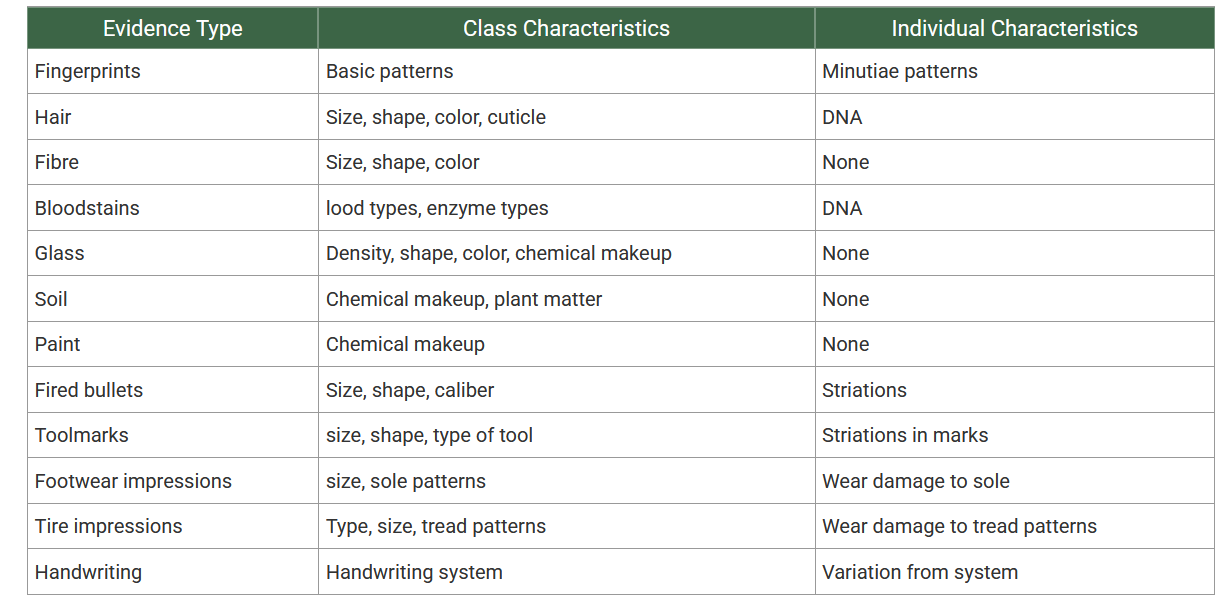
Class Characteristics → those attributes that are shared by an entire group of things (i.e., a class)
Individual Characteristics → unique features that can be linked to a single source or individual, such as specific writing habits or unique markings that occur in handwriting, which can help establish the identity of the person who created the document.
Comparative Analysis Process
Prior to the comparison of the questioned item to a known item, the physical evidence must be completely examined.
The choice of how to accomplish this examination depends upon the physical evidence type
A preliminary exam is performed first to locate any additional evidence (trace evidence and so on) that may be present, and to determine the full nature of the physical evidence in order to make an informed choice of analyses.
Comparative Analysis Process → this stage involves a systematic approach where the questioned item is directly compared to known samples. It includes several techniques such as microscopy, chemical analysis, and instrumental methods to evaluate similarities and differences, ensuring a thorough understanding of the evidence's characteristics and origins.
Compare the class characteristics of the physical evidence to the exemplar
If the class characteristics do not match, then the exemplar may be eliminated as a source of the evidence (Elimination)
If the class characteristics do match, move onto #2
If the physical evidence has individual characteristics, compare them to the exemplar
If the individual characteristics do not match, then the exemplar may not be the source of the physical evidence (Inconsistent)
If there is some agreement between individual characteristics, then the exemplar may be the source of the evidence (Consistent)
If there is a lot of agreement between individual characteristics, then the exemplar is identified as the source of the evidence (Individualization)
KNOWS
Standard → materials from a known source and can either be categorized as a comparison standard or a reference standard.
Comparison → those materials collected from a known source for comparison with an unknown piece of evidence (it’s right in the name!).
Reference → specimens that are kept in a permanent collection and have often been collected from various known sources under various conditions throughout the years.
Exemplar → used to describe either a sample of the known comparison sample that is collected for the specific purpose of comparing it with the physical evidence or the entire comparison standard used for the comparison with an unknown item.
Controls → known items that are tested at the same time as an unknown piece of evidence.
Evidence Collection Requirements
ETHICAL REQUIREMENTS
any evidence collected at the scene has to follow the legal and scientific requirements for collection and analysis.
This includes maintaining a proper chain of custody, ensuring that all evidence is documented thoroughly, and that the collection methods do not contaminate the evidence.
LEGAL REQUIREMENTS
Fourth Amendment → protects individuals from unreasonable searches and seizures, which means law enforcement must have a warrant or probable cause before collecting evidence from a private property.
Fourteenth Amendment → ensures that individuals have the right to due process and equal protection under the law, further impacting how evidence is obtained and utilized in legal proceedings.
Fruit of the Poisonous Tree → doctrine that prohibits the use of evidence obtained through illegal means, thus ensuring that any evidence derived from an unlawful search or seizure cannot be used in court.
Consensual Scope → refers to the limits of consent given by an individual for law enforcement to search their property. This concept is pivotal, as it defines the extent to which officers can rely on a person's permission without infringing on their Fourth Amendment rights. The consent must be voluntary and not coerced, and it should be clear and specific, outlining the areas that may be searched.
The Plain View Doctrine → allows law enforcement officers to seize evidence of a crime without a warrant if the evidence is clearly visible while they are lawfully present in an area. This doctrine plays a critical role in balancing the needs of law enforcement with individuals' rights, as it permits the collection of incriminating evidence that is inadvertently discovered during legitimate police activities, provided that the officer has not violated any reasonable expectation of privacy.
Search Warrant → a legal document authorized by a judge or magistrate, allowing law enforcement to conduct a search of a specified location for evidence of a crime. A search warrant must demonstrate probable cause, supported by oath or affirmation, and must detail the places to be searched and the items to be seized. This process ensures that searches are conducted under judicial oversight, thereby protecting individuals' Fourth Amendment rights against unreasonable searches and seizures.
Affidavit → a written statement made under oath, often used to support the issuance of a search warrant. It contains factual information presented to a judge or magistrate, affirming that there is probable cause to believe that a crime has been committed and that evidence related to that crime can be found at the specified location. The affidavit is an essential part of the legal process, as it helps to ensure accountability and transparency in law enforcement actions.
The probable cause, or the likelihood that the search will result in the discovery of relevant evidence.
The seriousness of the crime.
The importance of the evidence, and the extent to which it is necessary to establish guilt of a suspect.
The practicality of using other, less intrusive means (if any exist) to establish guilt.
The extent to which the search may threaten the suspect’s health and safety or cause psychological harm.
The extent to which the search may intrude on the suspect’s dignity and privacy.
Probable Cause → the legal standard that law enforcement must meet before conducting a search, indicating that there is a reasonable basis for believing that a crime may have been committed.
Extra
Private Laboratories →Are businesses designed to make a profit
Public Laboratories → Are funded by governments
Latent Print Development is dependent on the surface