PUBLIC HEALTH ENGINEERING
Health Definitions
What is Health?
A state of complete physical, mental, and social well-being, not merely the absence of disease.
Defined by the World Health Organization (WHO).
World Health Organization (WHO)
The directing and coordinating authority for health within the United Nations system.
What is Public Health?
Organized measures to prevent disease, promote health, and prolong life among the population.
Focuses on entire populations, not individual patients or diseases.
Aims to provide conditions in which people can be healthy (WHO).
What is Environmental Health?
Branch of Public Health concerned with the natural and built environment that may affect human health.
Focuses on aspects of human health and disease determined by environmental factors.
Involves assessing and controlling environmental factors that can potentially affect health (WHO).
The total relationship of humans to their physical, biological, socio-economic, and socio-cultural environment as it affects well-being.
What is Environmental Sanitation?
Science dealing with the prevention and control of diseases by eliminating or controlling environmental factors in disease transmission.
Control of all factors in man's physical environment that significantly affect physical development, health, and survival.
What is Engineering?
Application of mathematical and natural sciences, gained by study, experience, and practice, with judgment, to economically utilize materials and forces of nature for mankind's benefit. (Defined by the Accreditation Board for Engineering and Technology)
What is Public Health Engineering?
Deals with the control of the environment through modifications, protective, and preventive measures.
Aims at providing optimum conditions for health and well-being.
What is Disease?
A particular abnormal condition negatively affecting the structure or function of an organism, not due to immediate external injury.
According to Dorland's Medical Dictionary, it is any harmful deviation from the normal structural or functional state, associated with signs and symptoms, and differing in nature from physical injury.
Britannica defines it as a disorder of structure or function in a human, animal, or plant, producing specific signs or symptoms, affecting a specific location, and not a direct result of physical injury.
Oxford defines it simply as the opposite of health.
Study of Disease
Pathology
The study of the essential nature of diseases and the structural and functional changes they produce.
Epidemiology
The study of the distribution of a disease or condition in a population.
Science dealing with the inter-relationship of factors and conditions determining the frequencies and distributions of an infectious process, a disease, or a physical state in a human community.
Study of the occurrence of a disease in populations.
Concerned with the series of events that makes a disease possible.
Provides prevention and control measures based on scientific principles and procedures.
Concerned with the disease process and ways of controlling the disease.
Studies the major forces involved in the infectious process: person or host, agent, and environment.
Disease Classification
Congenital
Present at birth.
Acquired
Began at some point during one's lifetime.
Communicable
Can pass from person to person.
Contagious
Can easily pass from person to person by direct contact.
Non-communicable
Not passed from person to person.
Degenerative
Due to malfunctioning of vital body organs over time.
Deficiency (Nutritional)
Due to lack of essential nutrients in diet.
Allergies
Due to hypersensitivity of the body to certain foreign substances.
Cancer
Due to uncontrolled growth of cells/tissues.
Mental
Emotional or psychosomatic.
Acute, Chronic, and Other Disease Descriptions
Acute
Disease in which symptoms develop rapidly and that runs its course quickly.
Chronic
Disease with usually mild symptoms that develop slowly and last a long time.
Subacute
Disease with time course and symptoms between acute and chronic.
Asymptomatic
Disease without symptoms.
Latent
Disease that appears a long time after infection.
Local Infection
Infection confined to a small region of body.
Systematic Infection
Widespread infection in many systems of the body.
Focal Infection
Infection that serves as a source of pathogens for infection at other sites in the body.
Primary Infection
Initial infection within a given patient.
Secondary Infection
Infections that follow a primary infection, often by opportunistic pathogens.
Types of disease transmission
Genetic
Caused by one or more genetic mutations.
Hereditary
Errors in genetic code received from parents.
Hormonal (Endocrine)
Excess or deficiency of hormone.
Immunological
Hyperactive or hypoactive immunity.
Neoplastic
Abnormal cell growth.
Iatrogenic
Caused by medical treatment/procedure.
Idiopathic
Unknown cause or source.
Natural History of Disease
Prepathogenesis Phase
Phase before a disease infects an individual through interaction of the agent, the host, and the environment factors.
Concept of Disease Occurrence
Result of an interaction of three factors: Host, Agent, and Environment.
Infectious agent - is a microorganism capable of producing infectious disease under circumstances of host and environment favoring transmission.
Infectivity - ability of an infectious agent to cause infection
Pathogenicity - ability of an agent to cause disease after infection
Virulence - ability of an infectious agent to cause severe disease
Host - is a person or other living organism that can be infected by an infectious agent under natural conditions.
Opportunities for exposure
Susceptibility and response
Environment - refers to the ecological conditions that favor the interaction of host and agent e.g. swampy areas, bushes within households, sanitation etc.
Physical factor (geology and climate)
Biologic factors (insects)
Socioeconomic factors (crowding, sanitation, and the availability of health services)
Pathogenesis Phase
When the agent becomes established in the host.
Start of the four periods of infectious disease.
Four Periods of Infectious Disease
Incubation period: Time that elapses between arrival of the pathogen and onset of symptoms.
Prodromal period: Time during which the patient feels "out of sorts" but is not yet experiencing actual symptoms of the disease.
Period of Illness: Time during which the patient experiences the typical symptoms associated with that particular disease.
Convalescent period: Time during which the patient recovers.
Chain of Infection
The infection process can be described as a chain composed of links which are clasped securely to one another from beginning to end.
Infectious Agent
Infectious agents: Organisms capable of spreading disease.
Pathogens: Organisms that cause disease.
Examples:
Bacteria
Viruses
Fungi
Protozoa
Helminths
Chemical Contaminants
Incubation Periods for Various Diseases:
Chickenpox: 14-16 days
Cholera: 1-3 days
Diphtheria: 2-6 days
Gas gangrene: 1-5 days
Gonorrhea: 3-5 days
Hepatitis A: 2 weeks-2 months
Hepatitis B: 6 weeks-6 months
Hepatitis C: 2 weeks-6 months
Herpes simplex: 4 days
Influenza: 1-3 days
Leprosy: 3 months-20+ years
Measles: 10-12 days
Meningitis (bacterial): 1-7 days
Mumps: 2-3 weeks
Pertussis: 5 days-3 weeks
Pinworm: 2-6 weeks
Plague: 2-6 days
Polio: 7-14 days
Rabies: 2 weeks-2 months (up to 1 year)
Salmonella food poisoning: 12-72 hours
Staphylococcus food poisoning: 1-8 hours
Syphilis: 10 days-3 months
Tetanus: 3 days-5 weeks
Tuberculosis: 2-10 weeks
Reservoirs of Infection
The habitat in which an infectious agent normally lives, grows and multiplies or merely survives until it is transferred to a host.
Living reservoirs (human and animal reservoirs)
Non-living/Environmental reservoirs (materials and inanimate objects).
Human as Reservoir
Intestine, Mouth, Nose, Throat, Respiratory tract, Skin
Colonization - when bacteria are present in a person's nose, mouth, gut or other site, but do not cause illness.
Normal microbiota or indigenous microbiota
Resident microbiota
Transient microbiota
SKIN
Resident microbes:
Staphylococcus (especially epidermidis)
Proprionibacterium (especially acnes)
Micrococcus
Corynebacterium (diphtheroids)
Transient microbes:
Staphylococcus aureus
Clostridium (especially perfringens)
Bacillus
EYES
Staphylococcus sp. (coagulase-negative)
Streptococcus sp. (-hemolytic)
Neisseria sp.
Haemophilus sp.
EARS
Staphylococcus sp. (coagulase-negative)
Streptococcus pneumonia
Pseudomonas aeruginosa
Enterobacteriaceae
UPPER RESPIRATORY TRACT
Nares
Staphylococcus aureus
Nasopharynx and Oropharynx:
Staphylococcus sp.
Micrococcus sp.
Streptococcus sp. (- and -hemolytic)
Peptostreptococcus
Enterococcus
Neisseria sp.
Haemophilus
Moraxelia
Mycoplasma
Corynebacterium (diptheroids)
Enterobacteriaceae
Pseudomonas aeruginosa
MOUTH
Streptococcus sp. (α- and β-hemolytic)
viridans streptococci (especially Streptococcus mutans)
Neisseria sp.
diphtheroids (Corynebacterium)
Staphylococcus aureus
Staphylococcus epidermidis
Lactobacillus sp.
Mycoplasma
Gums
Bacteroides
Fusobacterium
Clostridium
Peptostreptococcus
LARGE INTESTINE/COLON
Bifidobacterium
Eubacterium
Bacteroides
Fusobacterium
Clostridium
Lactobacillus
Enterococcus
Enterobacteriaceae
Carrier
A person or animal without apparent disease who harbors a specific infectious agent and is capable of transmitting the agent to others.
Types of Carrier
Passive carriers - carry the pathogen without ever having the disease.
Incubatory carrier - is a person who is capable of transmitting a pathogen during the incubatory period of a particular infectious disease.
Convalescent carriers - harbor and can transmit pathogen while recovering from an infectious disease.
Active carriers - have completely recovered from the disease but continue to harbor the pathogen indefinitely.
The carrier state may be of short duration (Transient carrier) or long duration (Chronic carrier).
Animals as Reservoir
Rabies (dogs, bats, skunks, foxes)
Yellow Fever (monkeys)
Plague (rodents)
Lyme Disease (deer)
Brucellosis (cows and pigs)
Anthrax (sheep)
Trichinellosis/Trichinosis (swine)
Tularemia (rabbits)
West Nile Encephalitis (birds)
Zoonotic Diseases (Zoonosis)
An infection or an infectious disease of animals transmissible under natural conditions to man.
Arthropods
Invertebrates (without back bones) with joined legs and commonly associated with human infections, including insects and spiders.
Examples are mosquitoes, biting flies, lice, fleas, and arachnids.
When involved in transmission of diseases, these arthropods are called Vectors.
Asymptomatic infections
Bacillary dysentery
common
Cholera (El Tor)
only 1 in 30-50 infections develops illness
Giardiasis
1 in 2-4 infections develops illness
Polio
only 1 in 1,000 infections develops illness
Typhoid fever
very common
Schistosomiasis
very common
Hookworm
very common
Yellow fever
common
Japanese Encephalitis
common
Filariasis
common during epidemics
Malaria
very common
River blindness
very common
Plague
very common
Environmental/Nonliving Reservoir
Includes air, plants, soil, dust, food milk, water, and fomites.
Fomites are inanimate objects capable of transmitting pathogens.
Healthcare: patient's gowns, bedding, towels, eating and drinking utensils, and hospital equipment.
Telephones, doorknobs, and computer keyboards can serve as fomites.
Portals of Exit
The most frequent portals of exit in man are:
Skin through open lesions or with the aid of insects or hypodermic needles.
Respiratory tract
Gastrointestinal tract
Eyes / Ears
Modes of Transmission
Principal modes
Direct Transmission
Direct Contact. The immediate transfer of an agent from a reservoir to a susceptible host by direct physical contact.
Droplet Transmission. Involves the transfer of pathogens via infectious droplets. Droplets may be generated by coughing, sneezing, and even talking.
Indirect Transmission
The transmission of an agent carried from a reservoir to a susceptible host by suspended air particles, inanimate objects (vehicles or fomites), or animate intermediaries (vectors).
Airborne Transmission - Involves the dispersal of droplet nuclei, which are residue of evaporated droplets.
Vehicleborne Transmission. Indirectly transmit an infectious agent include food, water, biologic products (blood), and fomites.
Fomites - Inanimate objects that have come in contact with a sick person.
Vector
Mosquito
Aedes
Chikungunya, Virus
Dengue, Virus
Lymphatic filariasis, Parasite
Rift Valley fever, Virus
Yellow Fever, Virus
Zika, Virus
Anopheles
Lymphatic filariasis, Parasite
Malaria, Parasite
Culex
Japanese encephalitis, Virus
Lymphatic filariasis, Parasite
West Nile fever, Virus
Aquatic snails
Schistosomiasis (bilharziasis), Parasite
Blackflies
Onchocerciasis (river blindness), Parasite
Fleas
Plague (transmitted from rats to humans), Bacteria
Tungiasis, Ectoparasite
Lice
Typhus, Bacteria
Louse-borne relapsing fever, Bacteria
Sandflies
Leishmaniasis, Parasite
Sandfly fever (phlebotomus fever), Virus
Ticks
Crimean-Congo haemorrhagic fever, Virus
Lyme disease, Bacteria
Relapsing fever (borreliosis), Bacteria
Rickettsial diseases (eg, spotted fever and Q fever), Bacteria
Tick-borne encephalitis, Virus
Tularaemia, Bacteria
Triatome bugs
Chagas disease (American trypanosomiasis), Parasite
Tsetse flies
Sleeping sickness (African trypanosomiasis), Parasite
Vector Transmission
Involves the various types of biting insects and arachnids.
Biological Vector
Mosquitoes
Ticks
Flea
Louse
Bloodsucking flies
Bloodsucking bug
Mite
Mechanical Vector
Housefly
Cockroaches
Portals of Entry
The manner of entry are similar with the mode of exit from the reservoir.
The most important portals of entry are:
Skin
Mucous membranes
Respiratory
Gastrointestinal
Urinary
Reproductive
Conjunctiva
Placenta
Pathogens that cross the placenta
Taxoplasmosis
Syphilis
Listeriosis
AIDS
German measles
Channels of infection are means through which the body becomes infected by disease-producing agents. The channels may be the respiratory tract, the digestive tract, exterior surfaces of the body.
Host Defense Mechanism
Nonspecific
First Line of Defense
Intact skin and mucous membrane
Dryness, acidity, temperature of skin, perspiration
Digestive enzymes
Peristalsis and urination
Indigenous microflora
Second Line of Defense
Cellular and chemical responses
Production of fever, production of interferons, activation of the complement system, inflammation, chemotaxis, and phagocytosis
Specific
Third Line of Defense
Immune system
Level of Disease Transmission
Sporadic
Implies the occurrence of a few scattered cases of the disease without relationship to other cases; a few cases every now and then.
Disease that occurs only occasionally within the population of a particular geographic area.
Endemic
Is the term applied to a specific disease when it normally prevails in a locality and does not fluctuate markedly from the normal expected incidence in the community.
Diseases that are always present within the population of a particular geographic area.
Hyperendemic
Refers to persistent, high levels of disease occurrence
Epidemic
Is the incidence of a communicable disease among a number of people to an extent that is recognized statistically as being well beyond the normal expectancy for the disease in a community in a definite period of time.
Greater than usual number of cases of a disease in a particular region, usually occurring within a relatively short period of time.
Outbreak - carries the same definition of epidemic, but is often used for a more limited geographic area
Pandemic
Affects large number of people at the same time and transcends community boundaries.
Disease that is occurring in epidemic proportions in many countries simultaneously - sometimes worldwide.
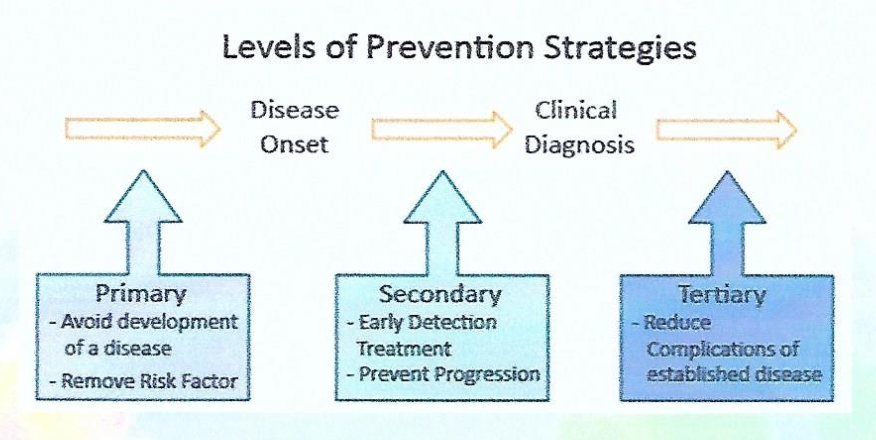
Three Levels of Disease Prevention
Primary prevention
Refers to the measure that may be applied in the prepathogenesis phase of the natural history of disease.
Intervening before health effects occur, through measures such as vaccinations, altering risky behaviors such as poor eating habits, tobacco use, etc., and banning substances known to be associated with a disease or health condition (CDC)
Health Promotion - The process of enabling people to increase control over, and to improve health (WHO)
Specific Protection
Secondary prevention
This is applied in the early pathogenesis phase. This consists of early diagnosis and prompt treatment of the disease in order to arrest the disease and prevent its spread to other people.
screening to identify diseases in the earliest stages, before the onset of signs and symptoms, through measures such as mammography and regular blood pressure testing (CDC)
Tertiary prevention
includes disability limitation and rehabilitation.