4.1 Atomic structure and the periodic table
4.1.1 A simple model of the atom, symbols, relative atomic mass, electronic charge and isotopes
4.1.1.1 Atoms, elements and compounds
All substances are made of atoms
An atom = the smallest part of an element that can exist
Atoms have a radius of about 0.1 nanometres and contain protons, neutrons and electrons:
The nucleus:
Contains protons + nucleus
Has a radius of around 1 X 10^-14m
Has a positive charge (because of the protons)
Nearly all the mass of the atom in concentrated here
The electrons:
Move around the nucleus in electron shells
Negatively charged
Tiny but cover a lot of space
Volume of their orbits determines size of the atom
Electrons have virtually no mass
Atoms are neutral in terms of charge
Because they have the same number of protons and electrons
Ions = charged atoms that don’t have the same number of protons and electrons (therefore an overall charge)
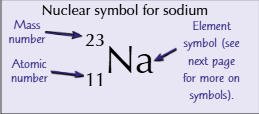
Atomic number = number of protons
Number of protons in the nucleus that decides what type of atom it is
Mass number = protons + neutrons
Elements consist of Atoms with the same atomic number:
Element = a substance that only contains the same type of atoms with the same atomic number
Elements are shown on the periodic table
All atoms of a particular element have the same number of protons
Atoms of different elements have different numbers of protons
Atoms join together to make compounds:
A compound = substances that are formed from 2 or more elements, the atoms are in fixed proportions throughout the compound and are held together by chemical bonds
Making bonds involves atoms giving away, taking or sharing electrons
Usually difficult to separate original elements of a compound
4.1.1.2 Mixtures
A mixture = two or more elements or compounds not chemically bonded together:
E.g:
Crude oil is a mixture of different length hydrocarbon molecules
Air is a mixture of gases
Properties of mixture = mixture of the properties of the separate parts of the mixture
Chemical properties of a substance aren’t affected when it is in a mixture
Mixtures can be separated without a chemical reaction but by a physical process:
Solution = A mixture formed when a solute dissolves in a solvent.
Solute = A solute is the substance that dissolves in a solvent to form a solution
Soluble = A substance is soluble if it can dissolve in a given solvent
Chromatography - separates the dyes in an ink:
1. Draw a line (with pencil as it is insoluble) near the bottom of the sheet of filter paper
2. Add a spot of the ink you want to separate on the pencil line
3. Place the sheet in a beaker of solvent
Solvent used depends on what’s being tested - some compound dissolve better in water some don’t
Make sure the ink isn’t touching the solvent or it will dissolve into it
4. Place a lid on top of the container to stop the solvent evaporating
5. As the solvent seeps up the paper each different dyes in the ink will move up at different rates so the dyes will separate out
Does this as there are two phases of chromatography:
Stationary phase - the paper used
Mobile phase - the solvent travelling up the paper
The different dyes are attracted to the two phases in different proportions
Solvent front = is the furthest point reached by the solvent as it moves up the chromatography paper
If any of the dyes in the ink are insoluble they will stay at the baseline
When solvent has nearly reached the top of the paper you can take the paper out of the beaker and leave it for drying
End result = chromatogram
Filtration and crystallisation - can be used to separate rock salt (mixture of sand and salt)
Salt dissolves in water but sand doesn’t so you use this method:
1. Grind the mixture to make sure the salt crystals are small
So it will dissolve easily
2. put the mixture in water and stir - salt will dissolve but the sand won’t
3. Filter the mixture
Sand stays in the filter paper
Salt water passes through
4. Pour the solution into an evaporation dish and slowly heat the solution using a bunsen burner
The solvent will evaporate and crystals will start to form as the solution gets more concentrated
Stop heating when crystals appear around the edge of the basin
5. After remaining solution has cooled pour the excess liquid away (or filter) and pat dry the crystals
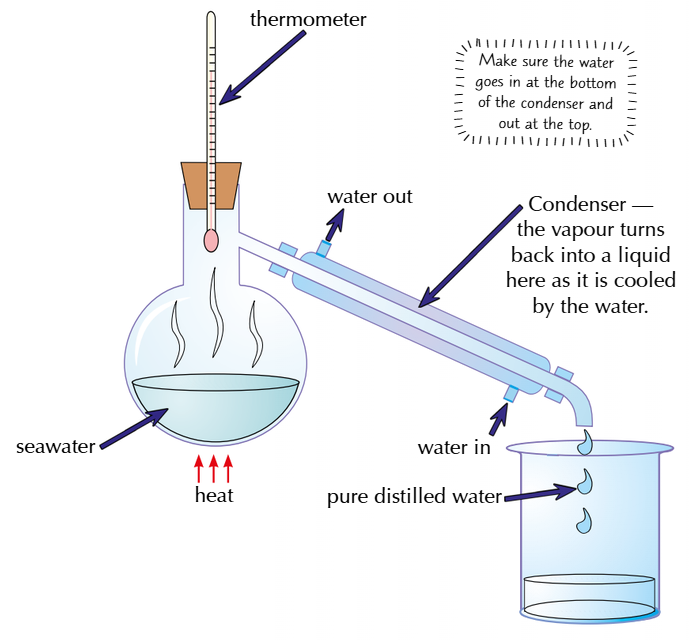
Simple distillation - used to separate out a solvent from a solution
1. Solution is heated - the part of the solution that has the lowest boiling point evaporates first
Problem is that you can only use this to separate things with very different boiling points
2. The vapour is then condensed and is collected
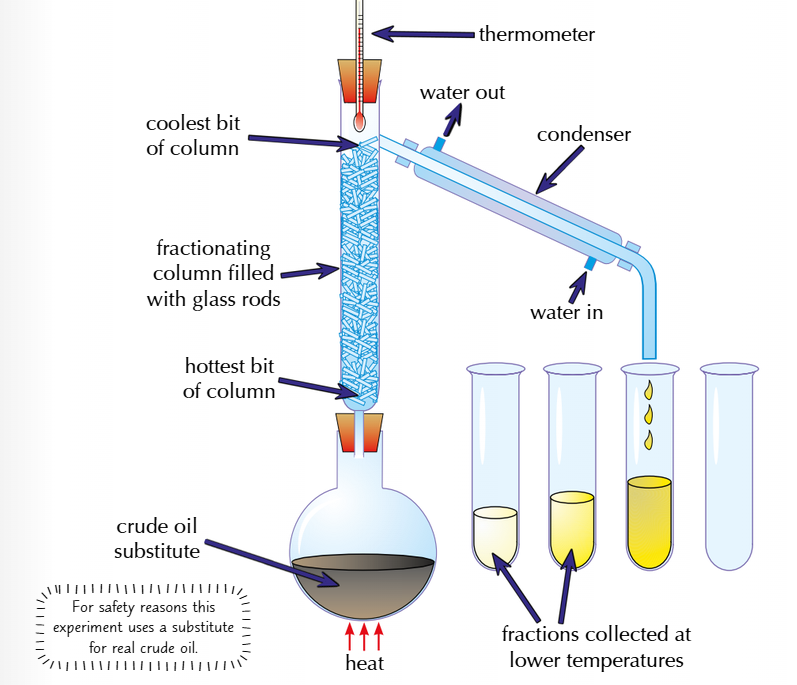
Fractional distillation - used to separate a mixture of liquids:
1. Heat the mixture in a flask
2. The different liquids will evaporate at different temperatures as they have different boiling points (even tho they lowkey similar sometimes)
3. Liquid will the lowest boiling point evaporates first - when the thermometer matches the boiling point of this liquid it will reach the top of the column
4. Liquids with higher boiling points will also start to evaporate but the column is cooler at the top so it will condense and return to the flask
5. When first liquid has been collected - raise the temp until the next liquid reaches the top of the column
6. Repeat
4.1.1.3 The development of the model of the atom
Before electrons were discovered:
John Dalton at the start of the 19th century:
Atoms were thought to be solid spheres as were the smallest unit of matter
Different spheres made up different elements
Discovery of electron:
In 1896 JJ Thomson:
Concluded that atoms weren’t solid spheres
Concluded that an atom must contain smaller, negatively charged particles - electrons
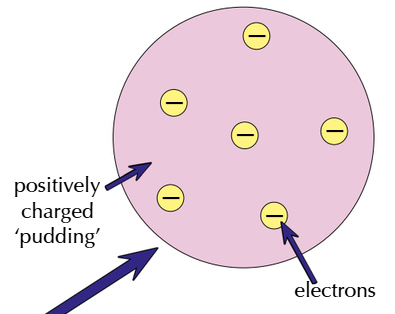
New theory was known as the plum pudding model that showed the atom as a ball of positive charges with electrons stuck in it
After the discovery of electrons:
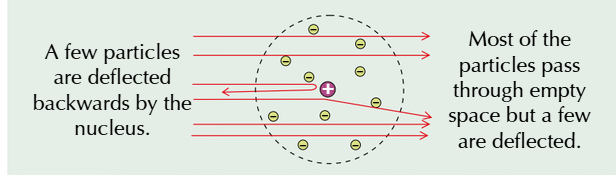
in 1909 Ernest Rutherford and his student Ernest Marsden conducted the alpha particle scattering experiment:
Fired positively charged alpha particles at an extremely thin sheet of gold
Concluded that most of the atom was empty space - a cloud of electrons surrounded the nucleus
Most alpha particles were not deflected
Concluded that the mass of of an atom was concentrated at the centre (nucleus) and that the nucleus was charged
Some alpha particles were deflected and a small number deflected backwards
Therefore plum pudding was wrong
Bohr's Nuclear model:
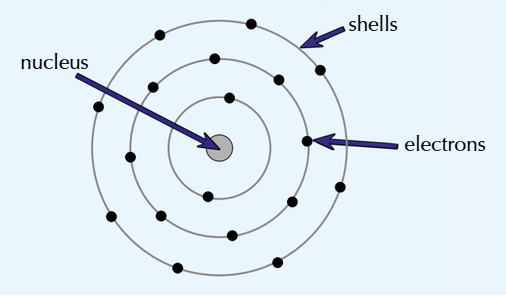
Scientists realise that the electrons in a cloud would be attracted to the nucleus causing the atom to collapse
in 1913 Neil Bohr suggested that the electrons were contained in fixed shells that orbit the nucleus
Each shell is a fixed distance from the nucleus
This was supported by many experiments and helped to explain lots of other scientists’ observations at the time
Existence of protons:
Further experiments by Rutherford and other scientists concluded that the positive charge of the nucleus could be divided into smaller particles - protons
Existence of neutrons:
About 20 yrs after scientist had accepted that atoms have nuclei (1932):
James Chadwick carried out an experiment which provided evidence for neutral particles - neutrons
4.1.1.4 Relative electrical charges of subatomic particles
Name of particle | Relative particle |
Proton | +1 |
Neutron | 0 |
Electron | -1 |
4.1.1.5 Size and mass of atoms
Atoms have a radius of about 0.1 nm (1 x 10⁻¹⁰ m)
The radius of a nucleus is less than 1/10 000 of that of the atom (about 1 x 10-14 m)
Name of particle | Relative mass |
Proton | 1 |
Neutron | 1 |
Electron | Very small |
Isotope = Different forms of the same element, which have the same number of protons but a different number of neutrons
Same atomic number but different mass numbers
4.1.1.6 Relative atomic mass
Relative atomic mass = an average mass taking into account the different masses and abundances of all the isotopes that make up the element

4.1.1.7 Electronic structure
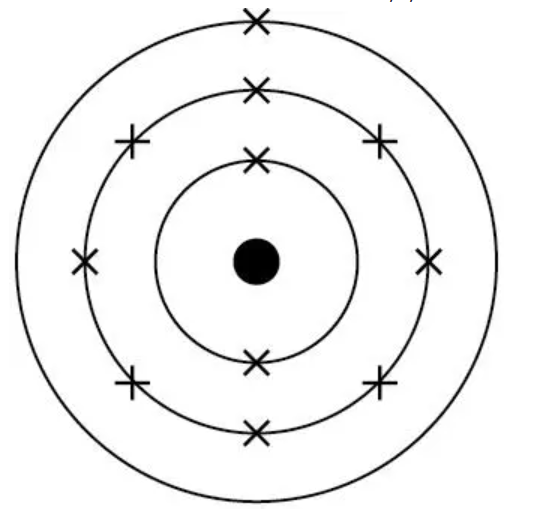
Electrons always occupy shells (called energy levels)
Lowest energy levels are always filled out first (innermost available shell)
Only a certain number of electrons are allowed in each shell
1st Shell - 2
2nd Shell - 8
3rd Shell - 8 etc…
4.1.2 The periodic table
4.1.2.1 The periodic table
Elements in the periodic table are arranged in increasing order of atomic number
Means that elements with similar properties are arranged in columns
These vertical columns are called groups
Properties occur periodically, hence the name periodic table
Can predict the properties of another element in the same group
Rows are called periods - each period represents another full shell of electrons
Group number tells us how many electrons there are in the outer shell
4.1.2.2 Development of the periodic table
Before the discovery of protons, neutrons and electrons (atomic number):
Periodic table was arranged by order of atomic weight and did not take into account their properties
Early periodic tables were incomplete and some elements were placed in the wrong group
In 1869, Dmitri Mendeleev overcame the problems of the early periodic table by taking 50 known and arranging them into his table of elements:
Left gaps to make sure that elements with similar properties stayed in the same groups
Allowed Mendeleev to predict the properties of undiscovered properties
He put the elements mainly in order of atomic weight but did switch that order if the properties meant it should be changed
Elements with properties properties predicted by Dmitri were discovered and filled the gaps
The discovery of isotopes made it possible to explain why the order based on atomic weights was not always correct
Isotopes of the same element have different masses but have the same chemical properties so occupy the same position on the periodic table
4.1.2.3 Metals and non-metals
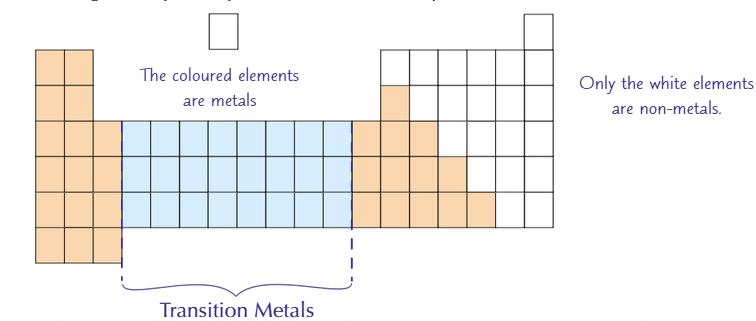
Metals = elements that react to from positive ions
Majority of elements are metals
They are found to the left and towards the bottom of the periodic table
Very easy for them to form positive ions as:
Metals to the left of the periodic table:
Don’t have many electrons to remove
Not much energy needed to remove the electrons to get a full outer shell - feasible to form positive ions
Metals at the bottom of the periodic table:
As there are more shells, there is a weaker attraction between the outer shell and the nucleus
Not much energy required as it is more feasible to lose that electron and form positive ions
Metals have metallic bonding which causes them to have similar physical properties:
They’re strong
Malleable
They’re great at conducting heat and electricity
They have high boiling and melting points
Have high density
Shiny
Non-metals = elements that do not form positive ions when they react
They are found to the right and the top of the periodic table
For non-metals it is more difficult to form positive ions as:
They are at the right of the periodic table where the elements have lots of electrons in their outer shell
They are at the top of the periodic table so there are less shells between the outer shell and the nucleus - meaning a stronger attraction
Therefore, it is easier for them to share or gain electrons to get a full outer shell
Non-metals don’t have metallic bonding so they don’t exhibit the same properties:
Dull
Brittle
Low melting and boiling points
Poor conductor of electricity and heat
Low density
4.1.2.4 Group 0
Group 0 elements = the noble gases
Unreactive and colourless gases
Unreactive as they have 8 electrons in their outer shell so it is electronically stable
Except from helium which has 2 electrons in its outer shell
Exist as monatomic gases - single atoms that are not bonded to each other
As they are inert they are non-flammable
Patterns in properties of the noble gases:
Boiling points of the noble gases increase as you move down the group
greater intermolecular forces as there is an increase in the number of electrons in each atom as you go down the group
Relative atomic mass increases as you go down the group
4.1.2.5 Group 1
The elements of group 1 are known as the alkali metals
Are all soft and have low density
First three are less dense than water
All have one electron in their outer shell
React similarly
Makes them very reactive
Trends of Alkali metals:
Reactivity of the elements increase going down the group
As the attraction between the nucleus and the electron decreases as more shells it can lose that one electron easily
Boiling and boiling points decrease as you go down the group
Metallic bonding means that as the metallic bonds get weaker because the other electrons are further from the nucleus so less energy needed to break these bonds
Relative atomic mass increases as you go down the group
Reactions of alkali metals with non-metals:
Reaction with water:
React vigorously to produce hydrogen gas and metal hydroxides
That is why it is called an alkali metal - it dissolves in water to form an alkaline solution
Amount of energy given out by the reaction increases down the group - reaction with potassium releases enough energy to ignite hydrogen
Reaction with chlorine:
React vigorously when heated in chlorine gas to form white chloride salts
Reaction with oxygen:
Can react with oxygen to form a metal oxide
Lithium reacts to form Lithium oxide (Li2O)
Sodium reacts to form a mixture of sodium oxide (Na2O) and sodium peroxide (Na2O2)
Potassium reacts to form a mixture of potassium peroxide (K2O2) and potassium superoxide (KO2)
4.1.2.6 Group 7
The elements of group 7 are known as the halogens (non-metal)
All have 7 electrons in their outer shell
React similarly
Exist as molecules which are pairs of atoms
Have coloured vapours
Trends of the group 7 elements
Less reactive as you go down the group
Harder to gain an extra electron, because the outer shell’s further from the nucleus to less attraction
Higher melting and boiling points as you go down the group
The molecules get larger as you go down the group.
→ Each halogen molecule (F₂ → Cl₂ → Br₂ → I₂) has more electrons.More electrons = stronger intermolecular forces.
→ The weak intermolecular forces between molecules become stronger because of the increased number of electrons.More energy is needed to overcome these stronger forces.
→ So the melting and boiling points increase down the group
Higher relative atomic masses when you go down the group
Halogens can share electrons via covalent bonding with other non-metals to achieve a full outer shell
Halogens form ionic bonds with metals:
Halogens form 1- ions called halides when they bond with metals
The compound that form have ionic structures
More reactive halogens will displace less reactive ones:
A displacement reaction can occur between a more reactive halogen and a less reactive halogen from an aqueous solution of its salt
4.1.3 Properties of transition metals
4.1.3.1 Comparison with Group 1 element
Group 1 metals are much more reactive than transition metals
They react more vigorously with water, oxygen and Halogens
Group 1 metals are much less dense, strong and hard than transition metals and have lower melting points
Exception to this is the transition metal mercury which is liquid at room temperature
4.1.3.2 Typical properties
Good conductors of heat and electricity and they’re very dense, strong and shiny (typical metal properties)
Transition metals have more than one ion
e.g - copper forms Cu+ and Cu2+
e.g - cobalt forms Co2+ and Co3+
Transition metal ions are often coloured and so compounds that contain them are colourful
e.g - potassium chromate = yellow
e.g - potassium manganate = purple
Transition metal compounds often make good catalysts
e.g - nickel based catalysts are used in the hydrogenation of alkenes
e.g - an iron catalyst is used in the Haber process for making ammonia