Unit 1 Gas Laws MCQ Test Notes
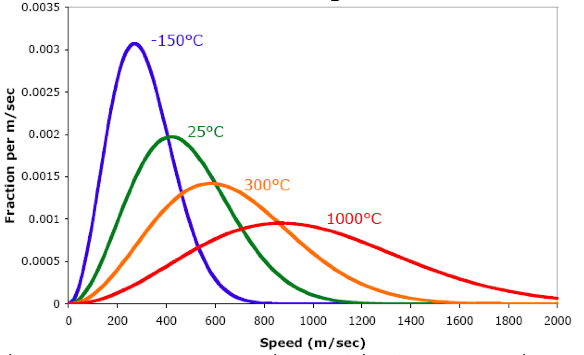
1) Which of the following graphs shows the speed distribution of he same molecules at a lower temperature?
D) Graph that is stretch out
A decrease in temperature results in a decrease in the average speed of the molecules.
T in K directly related to KE=1/2mv²
2) PCl5(g) ←→PCl3(g) + Cl2(g) Which is the most likely cause for the increase in pressure observed in the container as the reaction reaches equilibrium
C) An increase in the number of molecules, which increases the frequency of collisions with the walls of the container
Every time 1 molecule of PCl5(g) decomposes, 2 molecules of gas form
Increased frequency of collisions with the walls and increase pressure because 2 molecules of gas formed
3) What is the change in temperature reported with the correct number of significant figures?
A) 5.5 degrees Celsius
Write one more place than the gradations allow for
Given the ones so we write to the tenths
Performing subtraction so limited to the smallest number of decimals (1) so at least one decimal should be in the answer
28.0-22.5=5.5
4) The behavior of a sample of a real gas more closely approximates that of an ideal as its volume is increased because the…
C) Average distance between molecules become greater
Volume of molecules becomes even more negligible and molecules are less likely to collide with each other, limiting impact of IMFs
5) 1 L of He gas @ 25 degrees C and 1 atm combined with 1 L of neon gas @ 25 degrees C and 1 atm. Which statement about combining gases is correct?
D) The average kinetic energy of the helium atoms and neon atoms do not change when the gases are combined.
Only difference is the density of gases themselves
All gases have the same average kinetic energy @ a given temperature (speeds aren’t going to change)
6) At 8 atm, experimental volume is 2.925 and ideal volume is 3.055 (other data points show that experimental and ideal were very similar at lower pressure). The experimental volumes that were needed to achieve the desire pressures were different from the volumes predicted by the ideal gas law. Which explains the difference between the experimental volumes and the volumes predicted by the ideal gas law?
A) The attraction between the molecules become significant at high pressure
Causes clumping and decreases the number of effective particles and collisions
Volume must be smaller than predicted to account for this/bring collision number back up
7) Container holds 0.50 mol Ar(g) and 0.75 mole O2(g). How will total pressure in container and partial pressure of O2(g) be affected when adding 0.25 mole He(g)?
D) The total pressure will increase, and the partial pressure of O2(g) will remain constant.
8)
9)
10)
11)
12)
13)
14)
15)
16)
17)
18)