Technical Writing
Technical Communication
Practice of conveying complex and specialized information (engineering and scientific terms + details) in a clear, concise and actionable manner to a specific audience.
bali porject proposal of research
since its project proposal it has to help like non engineers/scientists to understand difficult concepts
Key aspects:
Purpose: The purpose lmao
Audience-centered: tailor fit to who will consume the information
Formats: Uses media such as visual and electronic aid (manuals, videos, FAQs)
Adheres to these Core principles:
Clear
Concise
Cohesive
Complete
Correct
Common types of Technical writing
Technical writing: User manuals tutorials installation guides
Technical Editing: Review of documents for accuracy and clarity
Instructional Design: Creating training materials and tutorials.
User Experience (UX) Design: Designing how users interact with technical products.
Report Writing: Research, feasibility studies, and white papers.
Whats the difference from general communication?
focuses on precise language to eliminate ambiguity to ensure that the user succeeds in whatever
general communication is often subjective while technical is strictly functional.
Primary purpose
Technical writings goal is to make complex information easy to understand and actionable. Again, it aims to reduce any confusion in the communication by focusing on efficiency
Audience Centric Approach
Highly targeted towards a specific audience such as engineers and technicians (those who take action on it) and Higher ups (people who fund that might not be familiar with engineering terms etc)
Clear and Concise
Uses direct and straightforward language, it strays away from metaphors and word play. It is mostly written in third person.
Highly structured and Visual
Often organized in a list
Technical Report format
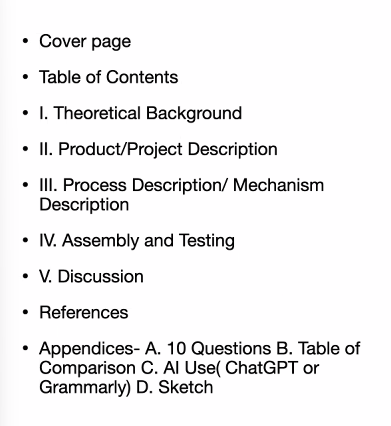
Notes:
Product Innovation is defined as the process of creating new goods and services or significantly improving existing ones.
(WE DONT HAVE TO MAKE A NEW ONE ITS JUST UPGRADING AN OLD THING)
Primary Goals: To meet customer needs, enhance functionality, and gain a competitive edge in the market.
Scope: It covers both tangible improvements (such as materials and physical design) and intangible upgrades (such as software and user experience).
Scale: Enhancements can range from minor, incremental changes to major, market-disrupting breakthroughs.
Should have an original name
Must have an inspiration product
Ensure it can be assembled (avoid business innovation or service innovation)
Anchored in 17 Sustainable Goals
Related to Program
In project descriotion, Set specific objectives and goals as we work toward the project. This alongside what it addresses and the parcitular problem/existing solutions
For our innovation:
Mechanism description
provides the physical aspects of a tool, machine or mechanical device (which is ours)
Definition
Glossary of terms if there are too many technical terms
Assembley and testing
Step by step process on how the innovation can be created and tested (before mass distribution)
Written in steps and procedures instead of paragraphs
Discussion section
- must include the SWOT analysis, technical report, relevant findings challenges, include what was not clearly elaborated and discussed
week 7:
Different genres of writing serve specific purposes and require distinct approaches, each writing type has a specific “setting” it is used in as well as the people the writing is written for (Audience):
Technical Writing: Uses an expository style to explain, inform, and instruct.
Examples: Technical reports, case studies.
Intended Audience: Specialists, managers, technicians, or consumers who need clear, objective information to perform a specific task or make a decision.
Creative Writing: Uses descriptive and narrative styles, relying heavily on figurative language.
Examples: Fiction, poetry, creative non-fiction (essays)
Intended Audience: The general public, literary enthusiasts, or any reader looking for entertainment, emotional connection, or artistic insight.
Academic Writing: Combines descriptive, analytical, and critical (and sometimes reflective) styles. Uses formal citations and research.
Examples: Theses, university papers, research journals, dissertations.
Intended Audience: Scholars, professors, researchers, and fellow students within a specific academic community or discipline.
Business Writing: Uses an expository style designed to inform or give practical instructions.
Examples: E-mails, business letters, memos.
Intended Audience: Colleagues, clients, stakeholders, managers, or business partners who require professional, concise communication to conduct everyday operations.
Journalistic Writing: Uses descriptive and sometimes persuasive styles. It can incorporate reflective, analytical, and critical elements for opinion pieces.
Examples: News, features, opinion columns, editorials.
Intended Audience: The broad general public or specific community readership
5 Types of technical writing:
Medical and Scientific Papers
User Manuals or Assistance Guides
Technical Books and Guides
Assembly Manuals
Technical Reviews and Reports
Recall that Technical Writings are primarily made to convey complex instructions in a clear manner for a directed audience
5 Basic techniques in technical writing
Mechanism Description
Explains the mechanisms physical description such as its arrangement and shape. During this description it also explains any movement involved in the mechanism as long as it is not a complex motion (so if it twists you can put it there but if you want to talk about the gears that move around etc it is better put in the process description)
What is the mechanism?
What is its function?
What does it look like?
Process Description
Similar to mechanism description. However, this focuses more on the specific ordered steps in how the mechanism functions.
Ex: a speaker, in mechanism description we explain its shape, and function (playing music) but in process description we go step by step on how it functions such as “the device uses a sensor to etc.”
This technique is usually used for sequence, instructions, and procedure. This could show them either how it works or show them how to perform a process (Instructions is only applicable to the latter)
Classification
This technique focuses on categorizing similarities or dividing by differences, this ensures that the topic is easily digestible and to ensure that nothing is missed (As technical writings are lengthy and have tons of data)
Partition
Dividing things into component parts, this is similar to classification however, id divides things by its components opposed to classifications data (Ie. classifying gears, springs, sensors etc.)
Definition
Uses words to define “something” essentially giving meaning to a short “phrase” making it faster to interpret/imagine this is essential to technical writing.
For example in Process description we say raspberry pi, so we define it by something like a motherboard. Because of this definition we have a quick idea on what it is already when it is brought up in later parts.
Follows: SPECIES (the thing were introducing) = GENUS (groups this with something the reader already knows) + DIFFERENTIA (what makes it different)
Example Raspberry pi = Controller + Can be programmed
The Writing Process Notes
Pre-Writing: Create a plan or a rough idea of the content to narrow down your topic. Define your intended audience ("for whom am I writing this?") and your chosen purpose ("what do I want to accomplish from this?").
Researching:
List places to find information and conduct research.
Use primary sources (surveys and interviews) and secondary sources (books, journals, articles, and online references).
Evaluate your sources.
Make an outline to organize the research.
Starting Up (Drafting): Put your plan into action and start writing your collected ideas into a "Draft."
The First Draft: This is the paragraph-form product completed after drafting. The writing is not yet finished; corrections, grammar adjustments, paraphrasing, and revisions will occur after finishing this first draft.
Evaluation: Review the big picture and details to see how well you have written and ensure the content meets your standards for grammar, sentence construction, and ideas.
Rhetorical Patterns Notes
Rhetorical Patterns: Also known as methods of development, these help a writer organize and develop ideas and content in an essay. You may combine different patterns within a single essay.
Core Methods of Development
Definition: Explains a concept, idea, or issue. It moves beyond a dictionary definition to deeply examine a word or concept as it is actually used and understood.
Comparison and Contrast: A technique that examines similarities and differences to express contrasting ideas, often combined with parallel construction.
Cause and Effect: Analyzes why something happens by discussing either the reasons for an occurrence or its observed/predicted consequences.
Analogy: Makes connections between concepts using analogical reasoning. This allows writers to make inferences about new experiences, transfer learning across domains, and identify relevant information in a comparison.
Other Types of Rhetorical Patterns
Types | Specifics |
|---|---|
Narration | Tells a story, usually in chronological order, using flashback and foreshadowing if necessary. |
Description | Fully describes a subject to create an obvious dominant impression. Can be subjective (emphasizing emotions) or objective (unbiased and unemotional). |
Examples and Illustrations | Provides examples that illustrate a larger point without distracting from the main point. |
Classification / Division | Sorts things, people, or places into categories based on similarities, or breaks a single thing down into its components. |
Enumeration or Cataloguing | Lists details or mentions words and phrases step-by-step to elucidate a topic, make it understandable, and avoid ambiguity. |