1.1 What is economics? Notes
1.1.1 economics as a social science
What is Economics?
Definition
EconomicsThe study of choices leading to the best possible use of scarce resources in order to best satisfy unlimited human needs and wants.
Economics arises from the scarcity of resources. While human needs and wants are infinite, the world's resources are limited.
Economics is a science that studies the different approaches humans follow to allocate scarce resources in order to best satisfy our unlimited needs and wants.
The Social Nature of Economics
Economicsis asocial sciencebecause it deals with human society and behaviour, especially those aspects concerning how humans organise their activities to satisfy their needs and wants.
Definition
Social scienceAny academic field that examines human society and social relationships, focusing on uncovering general principles that explain how societies operate and are structured.
Tip
Economics, in its essence, is the study of human behaviour in the face of scarcity, about people and the choices they make in face of scarcity.
The Basis of the Study of Economics: Microeconomics and Macroeconomics
Economics is divided into two main branches, breaking down the economy into two levels:microeconomicsandmacroeconomics.
Definition
MicroeconomicsThe branch of economics that studies the behaviour of consumers and firms in making decision regarding the allocation of resources.
Microeconomics focuses on the small scale of the economy: individual markets.
Microeconomics examines the behaviour of individual decision makers: consumers and firms (or businesses).
Microeconomics studies how the interactions between consumers and firms, and how their interactions determine the prices of goods and services in markets.
Definition
MacroeconomicsThe branch of economics that analyzes the economy as a whole by using aggregates.
Macroeconomics looks at the larger scale of the economy: cities, regions, countries... It explores the economy as a whole.
By aggregating (adding up) the impact of all the decision-makers in the economy (consumers, firms, governments...), macroeconomics studies how the collective interactions of all economic participants affect overall economic performance.
Example
Aggregates are collections of individual units such as the total behavior of consumers and firms, the overall income and output of an economy, total employment, and the general price level.
Introduction to the nine central concepts
Over the IB Economics curriculum, you will often encounter the following economics concepts. Understanding the meaning and the application of each concept in the science is essential to its understanding.
Scarcity
Definition
ScarcityThe idea that available resources (land, labour, capital, entrepreneurship) are limited and unable to satisfy unlimited human needs and wants.
Example
The world's fossil fuels are scarce, they are not infinite. From world's natural resources to human working hours, virtually all resources are scarce and not enough to satisfy our unlimited human needs and wants.
Choice
Definition
ChoiceThe act of selecting among alternatives because of the scarcity of resources.
Example
If a friend gifts you $50, you must decide whether to buy new shoes or save for concert tickets. You can't do both with that limited money, so you must make a choice between the options. Consumers, firms, and governments all must make choices to allocate their scarce resources.
Efficiency
Definition
EfficiencyUsing scarce resources in the best possible way to avoid welfare loss.
Analogy
At this point of the course, think of welfare loss as the waste of available resources in a society.
Equity
Definition
EquityThe condition of being fair and just.
Note
Equity should be contrasted with equality. While equality refers to all having an equal amount of resource, equity refers to the idea of allocating resources in a way that is fair and just.
Example
For example, if Rosa works two hours and Tom works one hour:
Equality argues both should be paid the same.
Equity claims that Rosa should be paid double than Tom.
This is a very simplified example. In reality, the lines between equity and equality are very complex and subjective.
Economic well-being
Definition
Economic well-beingThe level of prosperity, economic satisfaction, and standard of living experienced by members of an economy.
Example
The residents of a small town have good jobs, affordable housing, and access to quality healthcare and education. These factors, amongst others, contribute to their economic well-being, which leads to a comfortable standard of living.
Sustainability
Definition
SustainabilityPreserving the capacity of the environment and the economy to continue to produceand satisfy the needs and wants of future generations.
Example
A fishing community sets limits on how many fish can be caught each season to ensure the fish population can reproduce and remain plentiful for future generations. This ensures the sustainability of environment and its resources, so that their and their present and economic livelihood can be satisfied.
Change
Definition
ChangeThe dynamic nature of economic activity, where prices, employment, output, and policies evolve over time in response to internal and external influences.
Note
Change is important in economics because the economic environment is constantly changing.
Example
When video streaming became popular, DVD rental stores had to either adapt their business model or close down, and governments had to develop new systems of control and taxation. This shows how economic conditions constantly evolve with new technology.
Interdependance
Definition
InterdependenceThe concept that economic decision-makers rely on and interact with one another, because no one can be entirely self-sufficient.
Example
A local coffee shop depends on coffee bean farmers for its supply, while the farmers depend on the coffee shop's purchases for their income. Neither could succeed without the other. This type of interdependence can also be seen across countries who trade different resources.
Intervention
Definition
InterventionTypically involving government action, it occurs when the government interacts with the workings of markets.
Example
When housing prices become too expensive for most residents, the government might intervene in the housing market by implementing rent control laws to keep apartments affordable. This shows how governments can step in to influence market outcomes.
1.1.2 the problem of choice
Factors of production: land, labour, capital and entrepreneurship
Definition
Factors of productionAll resources or inputs used to produce goods and services.
There are many different factors of production, but they can be categorised in 4 main groups:
Land: including all the natural resources above or below the ground.
Labour: the work done by people.
Capital: equipment used in producing goods and services.
Entrepreneurship: willingness to take a risk to make a profit.
Land
Definition
LandAll natural resources on Earth, including farmland and non-farmland. All the natural resources found below and above the ground.
Despitelandbeing a vast source of resources, most of the resources that fall into the land category arescarce(non-renewable):
Natural gas, oil, coal, and fossil fuels are limited.
Materials such as wood or mined minerals will eventually run out.
Animals found in the area have to be used at a rate lower than their reproduction rate.
However, there are also somerenewableresources which are virtually unlimited (humans utilising them doesn't lead to their depletion).
Air can be used to obtain energy through windmills without reducing the amount of air available.
Sun energy is a constant source of energy.
Example
The resources contained in a square kilometer of land are many: the trees on it, the minerals underground, the air and sunlight on top of the ground... All of these landresources can be utilised as factors of production.
Labour
Definition
LabourAll the physical work and mental skills that humans put into the production of goods and services.
It is important to understand that only the efforts allocated to producing goods and services count as labour:
The effort of a person working at a factor is labour.
Dedicating time to think of new ideas for sustainable city transportation is labour.
The effort of running to catch the bus or playing video games are not labour: the effort is not allocated to producing goods or services.
Capital
Definition
CapitalHuman-made factors of production used to produce goods and services.
Note
For a factor of production to be considered as capital it must:
Be human-made. Natural resources are not capital resources because they are a product of nature.
Be used to produce goods and services. A basketball is man-made but is not used to produce goods and services (assuming they are not the ones used in the NBA, which in that case are used to produce a service). However, the machines and factories in which used to make the ball are capital resources.
There are 3 different types ofcapital factors of production:
Physical capital: used to produce more goods and services in the future.
Human capital: human skills and resources acquired by people to be more productive.
Financial capital: investments and funds.
Physical Capital
Definition
Physical capitalCapital factors of production used to produce more goods and services in the future.
Example
The factory and machines a car-producing firm owns is an example of physical capital factors of production: the company uses them to produce goods (cars).
Human Capital
Definition
Human capitalSkills, abilities, good health, and knowledge utilized by people to increase their productivity.
Example
A teacher's education and classroom experience are examples of human capital: they use their knowledge and skills to effectively teach students.
A construction worker's strength and good health are examples of human capital: they enable the worker to perform physically demanding tasks safely and efficiently.
Financial Capital
Definition
Financial capitalInvestments in financial instruments, or the funds used to purchase financial instruments. A capital factor of production.
The factors of production considered as financial capital are:
Investments in financial instruments: stocks and bonds.
The funds used to purchase financial instruments (money).
Example
A company's investment in stocks or bonds is an example of financial capital: it uses the funds to raise money for expansion or operations, both leading to higher production of goods and services.
Entrepreneurship
Definition
EntrepreneurshipThe unique human skills held by some individuals, including the ability to innovate, take business risks, and pursue new opportunities for running a business.
Entrepreneurship is a factor of production (resource) possessed by some people: entrepreneurs. It is a factor of production because:
Entrepreneurs establish and manage businesses by utilizing the available factors of production.
The management carried out by the businesses created by entrepreneurs is used to produce goods and services.
Note
Entrepreneurship tends to be a highly-rewarded skill due to the risk entrepreneurs accept. If their businesses fail, they risk losing significant amounts of money; however, if they succeed, the reward for their risk are the profits.
Example
An entrepreneur starts a local coffee shop by combining labor, land, and capital. They take the risk of investing in equipment and a storefront, hire staff, and offer a unique menu. If the business thrives, they earn profits as a reward for their innovation and risk-taking.
Scarcity
Unlimited human needs and wants to be met by limited resources
In the previous section we introduced the idea that scarcity is the foundation of economics.
Because resources are finite, yet human needs and wants are infinite.
This imbalance forces individuals, firms, and governments to make choices about how to allocate resources effectively.
Note
The idea that economics arises due to the fact that the scarcity of the factors of production prevents all our unlimited human needs and wants to be satisfied is crucial to understand.
Needs and wants will be mentioned often throughout this book, so it is important to understand their differences:
Needs are essentials required for survival, such as food, water, and shelter.
Wants are additional desires that go beyond survival, like luxury cars or vacations.
Example
Scarcity of resources being unable to satisfy all needs and wants
A government may need to decide between funding a new hospital (a need) or hosting a major sports event (a want). Limited resources mean it cannot do both without trade-offs. Studying the outcomes of the choice the government must make is part of the study of economics.
Scarcity and Sustainability
Definition
SustainabilityUsing resources in a way that meets current needs without compromising the ability of future generations to meet their own needs.
Because resources are scarce, consuming them at rates faster than their generation will eventually lead to their depletion.
Hence, humans should ensure resources are consumer sustainably.
If resources are used unsustainably, the scarcity of the factors of production of future generations will be higher, and so future generations will have to sacrifice more human needs and wants.
Example
Imagine you own a forest of 100 trees. If every year you cut down 20 trees for wood usage and only plant 10 trees, in 10 years you will run out of tress and will be unable to satisfy your wood-related needs and wants.
However, if every year you cut down 20 tress but also plant 20 trees, you will never run out of trees. By following consuming your factors of production at a sustainable rate, you are not harming your future ability to satisfy your need and wants.
Opportunity Cost
Definition
Opportunity costThe value of the next best option that must be forgone or sacrificed in order to acquire something else.
The trade-off described in the above example illustrates an opportunity cost.
An opportunity cost is what you give up when you choose to allocate your scarce resources to do something else.
Example
If you choose to go to the cinema, your choice has an opportunity cost: sacrificing buying two coffees (each one costs $5). The $10 that you spend on the cinema ticket could have been allocated to buying two coffees. By choosing to go to the cinema, you have traded-off having two coffees.
Opportunity cost is afundamentalconcept in economics that helps achieve a moreefficientuse ofscarce resources.
Consumers apply it when deciding how to spend their money.
Producers consider the profits they miss by not producing a different product.
Governments evaluate the societal value lost from policies they decide not to pursue.
Self Review
Think about a recent decision you made. What was the opportunity cost of your choice? Could a different decision have been better in the long run?
Free goods vs Economic goods
The concept of opportunity costs divides goods and services into two categories:
Free goods: goods that are not scarce and therefore have no opportunity cost.
Economic goods: goods that are scarce and so their opportunity cost is greater than zero.
Example
Seats in an airplane are an economic good: they are scarce and so have an opportunity cost.
Oxygen is a free good: it is so largely available that consuming it doesn't lead to its depletion and so has no opportunity cost.
Note
Free goods can become economic goods over time. Salt used to be a free good, but over time it has become an economic good. This is because with the growing human population, the amount of refined salt available has become scarce to satisfy all salt-related global needs and wants.
The basic economic questions
Scarcity compels every society to answerthree fundamental economic questions:
What to produce?
How to produce?
For whom to produce?
What to produce?
Since resources are scarce, a society needs to answer the following question:
What goods and services should be produced?
Deciding what to produce with the scarce resources available is termedresource allocation.
Definition
Resource allocationAssigning available resources or factors of production to particular uses selected from various possible options.
Since a society has scarce resources, it must decide how to allocate its factors of production.
Resource allocation is a choice. Different societies allocate resources differently based on their social and economic objectives.
How to produce?
Since resources are limited, a society must also determine:
How should goods and services be produced?
This involves deciding the most efficient methods and combinations of factors of production to create goods and services.
Example
Goods and services can be created using various combinations of production factors, such as more labor with fewer machines or more machines with less labor. They can also be produced by employing workers with different skill levels, utilizing different technologies, or choosing between raw materials like plastic or wood.
Deciding how to produce good and services also involvesresource allocation:
Decisions must be made on which factors of production and in what amounts should be used to produce which goods and services.
A society much choose how to allocate its factors of production to produce goods and services.
Example
A government must decide how to allocate its resources between producing food and weapons. If it chooses to use more farmland, labor, and machinery for farming, it can increase food production but will have fewer resources left for manufacturing weapons. Conversely, if it invests heavily in factories, advanced technology, and skilled labor for weapon production, less will be available for agriculture.
This trade-off reflects the need to decide how and in what quantities resources should be used for different goods.
For whom to produce?
Another key decision a society faces due to the scarcity of its resources is:
For whom should goods and services be produced?
This question focuses on how the output is distributed among individuals and groups in the economy.
Societies distribute goods and services differently based on economic systems and social values.
In some economies, markets decide distribution through purchasing power.
In other economies, governments allocate resources to meet social needs.
Example
Healthcare resources are scarce. In a market economy, healthcare may be provided mainly to those who can afford it, while in a welfare system, the government ensures everyone has access. This shows how societies decide for whom to produce goods and services.
Means of answering the economic questions
Market versus government intervention
In order to answer thethree basic economic questions, different economies have different ways allocate scarce resources based on choosing wether to prioritise:
Free market working: let the market work freely and allocate resources on a price basis.
Government intervention approach: the government mediates the economy and the resource allocation.
Note
Free market working
Resources are owned by private individuals or groups.
Economic decisions are made by consumers and firms.
Resource allocation and economic decisions respond to prices set in markets.
Note
Government intervention approach
The government owns the resources and factors of production.
The government makes economic decisions through commands, such as legislation and regulations.
The resource allocation is decided by the government.
Definition
Government interventionWhen a government alters the resource allocation that markets would have achieved working freely on their own.
Economic systems: free market economy, planned economy and mixed economy
The market-based and interventionist economic ideologies have led to three different types of economies:
Free market economy: based on the free market approach.
Planned economy: based on government intervention.
Mixed economy: a combination of both.
Free market economy
In afree market economythe production and distribution of goods and services are determined entirely by market forces. The key features of a free market economy are:
Private ownership: all resources are owned by individuals or private businesses.
Price mechanism: the production and consumption decisions are driven by free market prices, which are determined by supply and demand.
Consumer sovereignty: consumers decide what to produce through their purchasing choices.
Profit-driven resource allocation: businesses aim to maximize profits, driving innovation and efficiency.
No government intervention in the economy: the government only enforces laws, property rights, and national security.
Example
The United States
While the U.S. has regulations and public services, most industries operate freely under market principles.
Planned economy
In aplanned economythe government owns and controls the resources and makes all key economic decisions about what, how, and for whom to produce. The key features of a planned economy are:
Public ownership: the government owns land, factories, and capital.
Centralized decision-making: the state sets production targets, pricing, and distribution of the economy's resources.
Non-price rationing: goods are allocated through planning rather than pricing (e.g., quotas, waiting lists).
Focus on equality: aims to reduce wealth disparities by controlling wages and distributing resources.
Example
North Korea
The government controls nearly all production and distribution, limiting market activity.
Mixed economy
Amixed economycombines elements of both free market and planned economies. The private sector operates freely in most areas, but the government intervenes in key sectors to correct market failures, provide public goods, and ensure social welfare. The key features of a mixed economy are:
Mixed ownership: resources are owned by both private individuals and the government.
Government regulation: the government regulates markets to prevent monopolies, protect consumers, and address externalities.
Provision of public goods: The government provides essential services like healthcare, education, and infrastructure.
Welfare programs: Social welfare policies help redistribute income and reduce poverty.
Note
In reality, all economies are mixed economies: all economies ran a combination of the free market approach with government intervention.
Based on the degree of free market working and government intervention, economies are placed differently on the market-based vs command approach spectrum.
1.1.3 the production possibilities curve model (ppc)
Introduction to the Production Possibilities Curve (PPC)
The Production Possibilities Curve (PPC) is a fundamental economic model that illustrates the maximum possible output combinations of two goods or services that an economy can produce given its available resources and technology.
It helps visualize concepts like scarcity, choice, and opportunity cost.
A graphical representation showing the maximum combinations of two goods or services that can be produced when all resources are fully and efficiently utilized.
Think of the PPC as a menu showing all the possible meal combinations you can make with the ingredients you have at home. You can't make everything at once, so you must choose between different options.
Imagine an economy that can produce only two goods: robots and pizzas. The PPC would show the trade-offs between producing these two goods.
1.1.4 modelling the economy
Circular flow of income model
Definition
Circular flow of incomeAn income flow in an economy where the value of the output produced is equivalent the total income earned from its production, which is also equivalent to the expenditures spent on purchasing that output.
At its core, an economy consists offirmsandhouseholds, which areconnectedthrough the economy:
Firms generate goods and services, collectively forming the national output.
The national output is the value of all the goods and services generated in an economy.
Households provide the factors of production (labor, land, capital, and entrepreneurship) that firms need to produce this output.
The payments households receive by firms for these resources constitute the national income.
Households spend the money received from the national income to purchase the goods and services produced by firms.
The total value of this spending represents the national expenditure.
Note
In other words, the circular flow of income indicates that:
National output = National income = National expenditure.
This flow of income can also be represented by thecircular flow of income model.
Definition
Circular flow of income modelA model illustrating the flow of resources from households to firms, the movement of goods and services from firms to households, and the associated monetary flows, including household income generated from selling resources and firms' revenues from selling their products.
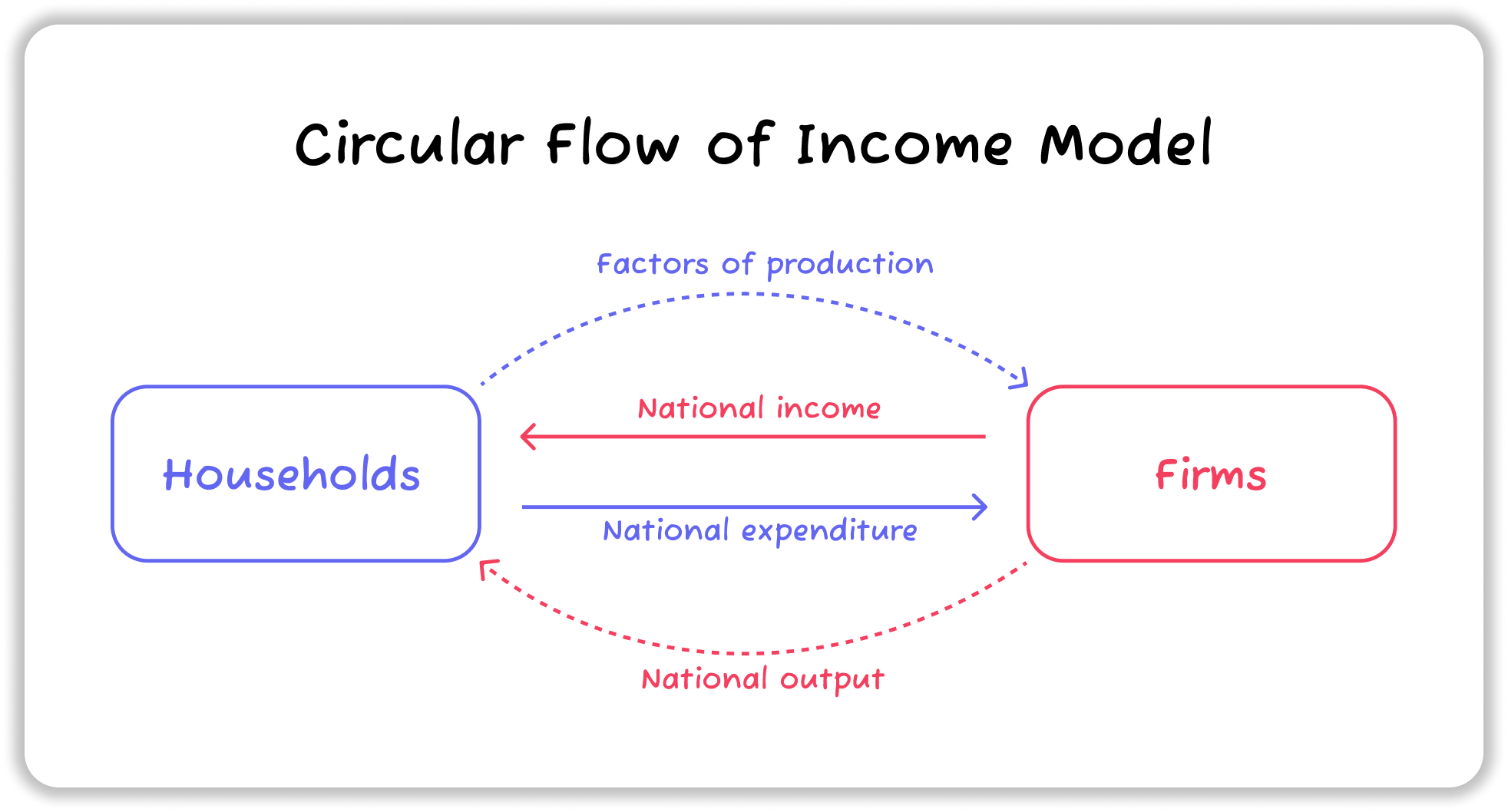
Thecircular flow of income_ _illustrates how:
The factors of production flow from households to firms (upper dashed blue arrow).
Firms pay national income to households in return for these resources (solid pink arrow).
Households use this income to purchase goods and services from firms as national expenditure (solid blue arrow).
Firms supply goods and services to households, forming the national output (dashed pink arrow).
From this, it can be seen how:
The national output (value of the total goods and services produced by firms in an economy)...
Equals the national income (total income received by the households in producing the economy's output)...
Which equals the national expenditure (total spending of households in purchasing the total output of the economy).
Tip
The ideas from this section will be central to the macroeconomics section of the syllabus, so make sure to understand them now!
Interdependence between economic decision-makers interacting and making choices in an economy
Thecircular flow of incomehighlights the relationships and interactions betweenhouseholdsandfirmsin an economy.
Interdependence between households and firms:
Households:
Provide the factors of production (labor, land, capital, and entrepreneurship) to firms.
Receive national income in return (wages, rent, interest, and profits).
Use this income for consumer spending on goods and services.
Firms:
Use the factors of production to create national output (goods and services).
Sell these goods and services to households, generating revenues.
Note
The circular flow of income showcases the interdependence between households and firms in an economy.
Leakages and injections:
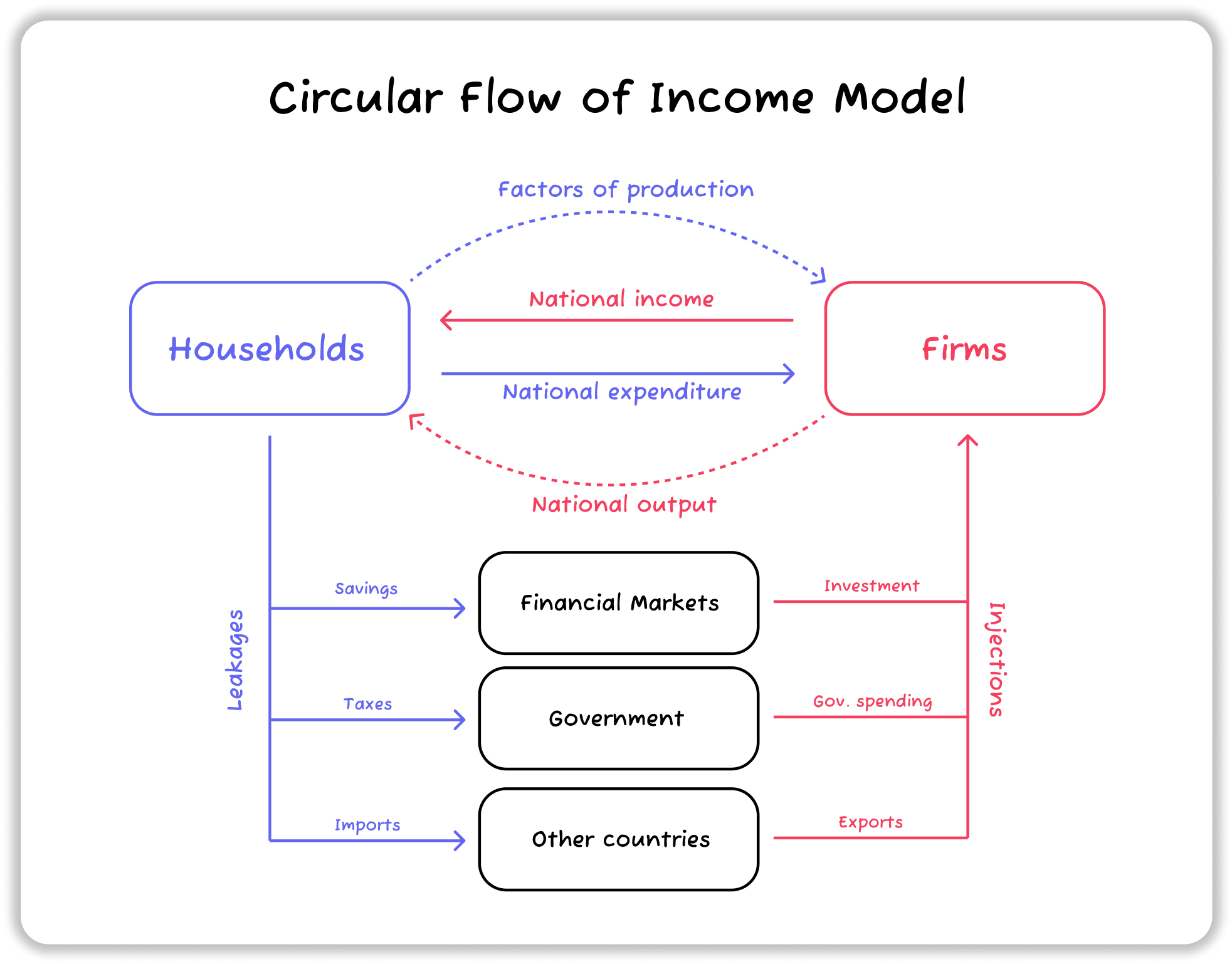
In anopen economy, there are leakages and injections from and into the income flow.
Definition
LeakagesThe removal of funds from the income flow, represented by savings, taxes, or imports.
Leakagesrepresent money leaving the circular flow, reducing the size of the economy. Leakages include:
Savings: income saved in financial markets instead of being spent.
Taxes: paid to the government instead of being used for consumption.
Imports: money spent on foreign goods and services.
Definition
InjectionsThe addition of funds into the income flow through investment, government spending, or exports.
Injectionsrepresent money entering the circular flow, increasing the size of the economy. Injections include:
Investment: funds from financial markets used to produce capital goods.
Government Spending: expenditures by the government on public services.
Exports: foreign spending on domestically produced goods and services.
The figure below showcases thecircular flow of income modelfor an open economy that has leakages and injections:
Note
Impact of Leakages and Injections in the size of an economy
Leakages from the circular flow of income are matched by injections into the circular flow of income. However, leakages and injections do not need to equal each other.
The balance between leakages and injections affects the size of the income circulatingthrough an economy (the "size" of the economy).
When leakages exceed injections, the size of the circular flow shrinks (economic contraction).
When injections exceed leakages, the size of the circular flow expands (economic growth).