Rational Choice Theory and Deterrence
feudalism: social system existing in medieval Europe in which people worked and fought for nodules who gave them protection and land in return
No real law and order → plague → canon law
Demonology: crime comes from possession by evil spirits
During this time demonic possession would negate a persons free will and becomes powerless against evil forces driving them to commit crime
Practice of society having the right to punish the offender
Punishments were haphazard, irritational and arbitrary in nature in the absence of a definite principle of criminal justice
Thomas Hobbes (1588-1679)
1651– wrote “Leviathan”
Man is NOT naturally good BUT naturally selfish and hedonist
Actions maximizes pleasure and minimizes pain
Human motives are guided by self interest and if left unchecked, could be highly destructive
Without any civil state to rule life, it would be…
Solitary, poor, nasty, brutish
A “war of Everyman against every man”
BECAUSE I WANT IT → I WILL COMMIT CRIME
Social Contract — people in their pursuit of their own interest will give up some freedoms to prevent war/disorder…expect to gain by giving (EX. Murder)
Cesare Beccaria (1738-1794)
criminological theory was NOT the goal
Writings were to critique the system
Wanted to guide reforms; desire to make both just and fair
Argued that the goal of punishment was to DETER crime rather than enacting retribution
Punishment is about crime control NOT vengeance
Assumed rationality and free will
Works argued that crime will be deterred if the pain from punishment exceeds the pleasures associated with the crime
Civility MUST OUTWEIGH crime
Writes “An Essay on Crime and Punishments” where he critiques society and their treatment of crime and justice
Laws are the conditions in which mean naturally and independently unite themselves in society
Here they sacrifice the joys of hedonism (or at least parts of it ) for peace and security
Judges have NO RIGHT to interpret penal laws because they are nOT legislators — they are enforces of the law. Dangers in laws lies within the obscurity of them
Punishments must be proportional in such that is free from barbarism however more powerful than the motivation to commit crime
Principles of punishment (severity and certainty)
RATIONAL CHOICE THEORY:
Crime is a function of decision making
Decisions are made based on cost and benefit
Deterrence — the action of discouraging an action or event through instilling doubt or fear of the consequences
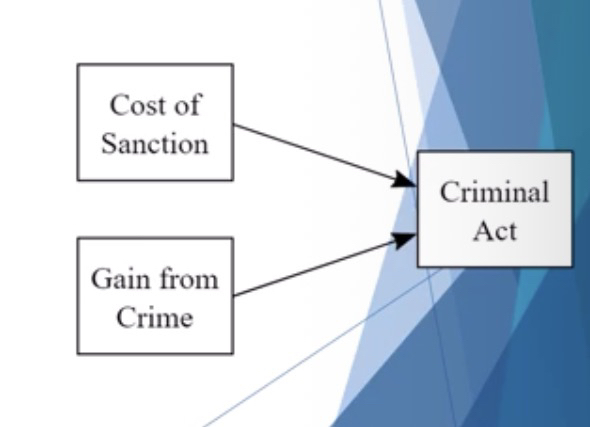
DETERRENCE AND PUNISHMENT:
What makes effective punishment?
Certainty of punishment
Likelihood of punishment
Number of arrest/number of crimes
Severity of punishment
How afflicting will be the punishment be
Certainty, rather than severity, is key to deterring criminal behaviors
Swiftness of Punishment
Punishment being applied immediately to the crime
TYPES OF DETERRENCE:
Marginal deterrence refers to relative effectiveness of punishment to fully stop the crimes form happening → scaling of punishment
Larceny (misdemeanor vs felony)
Restrictive deterrence (partial deterrence) refers to situations in which the threat of punishment can reduce but not eliminate the frequency, severity, and duration of a crime
Tickets for speeding
Specific deterrence
Punishment applied to individual to prevent recidivism
General deterrence
Vicariously preventing recidivism by society perceiving deterrence
3 strike laws
RATIONAL CHOICE AND DETERRENCE TODAY:
Rational Choice and deterrence begin to die down during 1800s but saw a reemergence in 1970s
It was the idea the the removal of environmental explanations focused on the true cause of crimes
Advocates for more punishment — Nixon/Regan Era
Incapacitation Effect:
The idea that keeping offenders in confinement will eliminate the risk of their committing further offenses
Life imprisonment
Death penalty
Solitary confinement
3 strike laws
Sentencing structure in which significantly harsher punishments are imposed on repeated offenders
3 strike laws generally mandate a life sentence for the third violation of violent felonies
Appeals to public sentiments
Routine Acitivities Theory
Because people are rational, crime will generally happen whenever their is…
A motivated offender
A suitable offender
Lack of capable guardianship (ex. CHP not around )
POLICY:
Situational Crime Prevention
Seeks to reduce immediate and particular criminal opportunities
Criminal acts can be prevented if…
Potential targets are carefully guarded
The means to commit crime are controlled
Potential offenders are carefully monitored
Defensible space
Crime Prevention Strategies
Increase effort needed to commit crime
Increase risk of committing crime
Reduce rewards of crime
Induce guilt: increase shame
Remove excuses
Many policies are based on deterrence theory: the premise that increasing the certainty and/or severity of sanctions will deter crime
Another policy flowing from classical and neoclassical models is adding more police officers to deter crime in a given area
Most of these strategies dont seem to work consistently to deter
Research findings suggest that people often carry out behaviors that they know are irrational or without engaging in rational decision making, which criminologists often refer to as bounded rationality
Rationality is limited by our thinking capacity, the information that is available to us, and time. Instead of making the “best” choices we often make choices that are satisfactory
ISSUES:
The view that criminal sanctions should be so powerful that offenders will never repeat their criminal acts however…
Longer incarceration may delay recidivism
Harshest treatment math increase rather than reduce crime
Punishment may breed defiance rather than deterrence
Stigma of harsh punishment labels people
Harshest punishments may cause psychological problems
Effect is negligible in neighborhoods where almost everyone has criminal record
Every crime is NOT rational