Chapter 5 Key Issue 2
Why is English related to other languages?
- English is part of the Indo-European family
- the Indo-European family has 8 branches
Distribution of Indo-European Branches
Germanic Branch
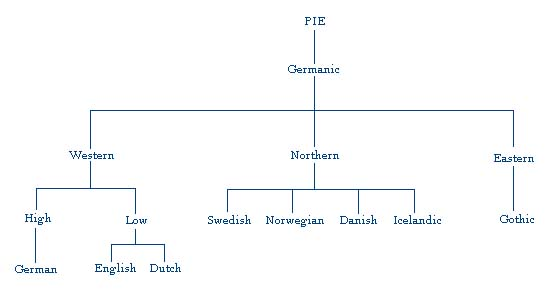
- English and German belong to the West Germanic group of the Germanic branch
- West Germanic is divided into High Germanic and Low Germanic
- high: high elevations
- low: low elevations
- High German
- spoken in the southern mountains of Germany
- basis for the modern standard German language
- Low German
- spoken in the northern lowlands of Germany
- includes English, Flemish, Dutch, Frisian, and Afrikaans
- Afrikaans is similar to Dutch because Dutch settlers migrated to South Africa
- Germanic branch also includes North Germanic languages
- spoken in Scandinavia
- 4 Scandinavian languages
- Swedish
- Danish
- Norwegian
- Icelandic
- all derive from Old Norse
Indo-Iranian Branch
- has the most speakers out of Indo-European branches
Indic (Eastern) Group
- India
- 438 languages
- 29 languages spoken by at least 1 million people
- most widely used languages in India (and Pakistan and Bangladesh) belong to the Indic group
- official language is Hindi
- originally a variety of Hindustani
- grew due to British encouraging its use in government
- English is a secondary official language
- used as a common language
- 22 “scheduled” languages
- government is obligated to encourage use of those languages
- Hindi
- spoken in many different ways
- can be regarded as a collection of many individual languages
- one official way to write
- a script called Devanagari
- Urdu
- spoken very similarly to Hindi
- recognized as a distinct language
- written with Arabic alphabet
- most speakers are Muslims (Quran is written in Arabic)
Iranian (Western) Group
- spoken in Iran and neighboring countries in Central Asia
- major languages
- Persian (Farsi) in Iran
- Pashto in eastern Afghanistan + western Pakistan
- Kurdish used by Kurds of western Iran + northern Iraq + eastern Turkey
- written in Arabic alphabet
Balto-Slavic Branch
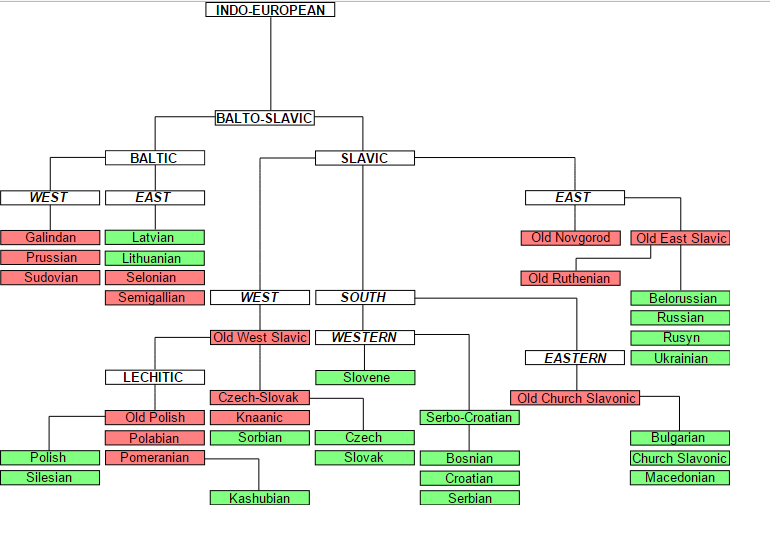
- Slavic was once a single languages
- differences occured when Slavs migrated from Asia to Eastern Europe and lived in isolation
East Slavic and Baltic Groups
- most widely used Slavic languages are eastern ones
- primarily Russian
- spoken by >80% of Russian people
- one of official languages of the UN
- Russian
- Soviet officials forced native speakers of other languages to learn Russian to enforce cultural unity
- Russian was taught as a second language in Eastern European countries dominated by the USSR
- the want to use other languages was a major drive to the break up of the Soviet Union
- newly independent republics adopted other languages once the USSR broke
- Russian still remains the language for communication among officials between past Soviet Union countries
- Ukrainian and Belarusan are most commonly used after Russian
West and South Slavic Groups
- most spoken West Slavic language is Polish, followed by Czech and Slovak
- Czechoslovakia
- government tried to balance the used of Czech and Slovak, though there were twice as many Czechs as Slovaks
- balancing measures were effective in promoting national unity during the Communist era, but afterward, Slovakia split from the Czech Republic
- Slovaks rekindled their long-suppressed resentment of perceived dominance of the national culture by the Czech ethnic group
- most widely used South Slavic language
- spoken in Bosnia & Herzegovina, Croatia, Montenegro, and Serbia
- language was called Serbo-Croatian during Yugoslavia
- offends Bosnians and Croatians because reminds them when they were dominated by Serbs
- Bosnians, Croatians, and Serbians call the languages by different names to demonstrate their uniqueness
- linguists consider them one
- Bosnians and Croats write it in the Roman alphabet
- Montenegrans and Serbs use the Cyrillic alphabet
- South Slavic languages
- Bosnian Muslims introduced Arabic words
- Croats replaced words regarded as having a Serbian origin
- may eventually have enough differences to be considered different languages
- for now, people can understand each other even though they’re considered different languages
Romance Branch
- evolved from the Latin language spoken by Romans
- 4 most widely used languages
- Spanish
- Portuguese
- French
- Italian
- Spanish + French are 2 of the official UN languages
- those languages correspond to the boundaries of the states of Spain, Portugal, France, and Italy
- mountains serve as boundaries
- other Romance languages
- Romanian
- used in Romania and Moldova
- Romansh (dialect of Rhaeto-Romanic)
- one of four official languages of Switzerland
- only spoken by 40,000 people
- Catalan
- official language of Andorra
- also spoken by 6 million people in eastern Spain
- official language of Spain’s Catalonia province
- Sardinian
- a mixture of Italian, Spanish, and Arabic
- was once the official language of Sardinia
- Ladin (dialect of Rhaeto-Romanic)
- spoken by 30,000 people in Italy in South Tyrol
- Friulian (dialect of Rhaeto-Romanic)
- spoken by 800,000 people in northeast Italy
- Ladino
- mixture of Spanish, Greek, Turkish, and Hebrew
- spoken by 100,000 Sephardic Jews, most living in Israel
Origin and Diffusion of Language Families
- languages have existed for a long time, prior to history, so not much is known about the early ones
Origin and Diffusion of English
- British Isles had been inhabited for thousands of years, but nothing is known about early languages before the Celts
- Celts arrived with Celtic
- mainland Europe tribes invaded, pushing Celts to remote northern and western parts of Britain, including Cornwall and highlands of Scotland and Wales
German Invasion
- tribes invading British Isles were called Angles, Jutes, and Saxons
- all Germanic tribes
- northern Denmark → Jutes
- southern Denmark → Angles
- northwestern Germany → Saxons
- England came from Angles’ land
- at that time, all Germanic people spoke a common language
- other invasions to England
- Vikings from Norway
Norman Invasion
- English is different from German because England was conquered by Normans
- Normans
- from Normandy in France
- spoke French
- established as England’s official language
- majority of people didn’t know French in England, so they continued speaking English
- England lost control of Normandy and had a long period of conflict with France
- less people in England wanted to speak French
- official language was eventually changed to English
- while French had been the official language, French and English mixed, helping form modern English
- sky, horse, man, woman → Germanic roots
- celestial, equestrian, masculine, feminine → French roots
- distribution of English speakers worldwide comes from England’s colonies and migration
Diffusion to North America
- first diffused west during English colonies
- after defeating French colonies, English became the principal language
- British took control of Ireland, South Asia, South Pacific, and southern Africa → English became an official language, though only colonial rulers and elite residents could speak it
- US has diffused English to the Philippines, which Spain had ceded to the US in 1899
- after gaining independence, Filipino and English became its official languages
Origin and Diffusion of Romance Languages
- Romance languages developed from Latin (“Roman’s” language)
- as the Roman empire conquered areas, it brought Latin with it
- native languages were extinguished or suppressed
- as the Roman empire grew, Latin used in each province was based on that spoken by the Roman army at the time of occupation
- also integrated words from the original language in the area
Vulgar Latin: a form of Latin used in daily conversation by ancient Romans, as opposed to the standard dialect, which was used for official documents
- introduced to the provinces by soldiers stationed throughout
- after the collapse of the Roman Empire, former provinces stopped communicating together, creating more regional variation
- Latin continued to exist, while others adopted languages of conquering groups of people who spoke Germanic and Slavic
Origin and Diffusion of Indo-European
- if Germanic, Romance, Balto-Slavic, and Indo-Iranian are in the Indo-European family, they must have a common ancestor
- Proto-Indo-European cannot be proven with certainty because it would have existed prior to writing or recorded history
- evidence that it once existed is derived from the physical attributes of words themselves
- words for some animals and trees have common roots
- linguists believe the words must represent things experienced in the daily lives of the original Proto-Indo-European speakers
- words for other features, like elephant, camel, rice, and bamboo, have different roots
- must have been added on later, after the root language split
- languages share common root words for winter and snow but not for ocean
- linguists conclude original speakers lived in a cold climate/one that had a winter, but didn’t come in contact with oceans
- most people accept that Proto-Indo-European had existed, but disagree on when and where it originated and how it diffused
Nomadic Warrior Hypothesis
- created by Marija Gimbutas
- first speakers were the Kurgan people
- homeland was in the steppes near the border between Russia and Kazakhstan
- nomadic herders
- among the first to domesticate horses and cattle
- migrated in search of grasslands for their animals
- westward through Europe
- eastward to Siberia
- southeastward to Iran and South Asia
- warriors used their domesticated horses as weapons and conquered much of Euope and South Asia
Sedentary Farmer Hypothesis
- created by Colin Renfrew
- argued first speakers lived before the Kurgans, in eastern Anatolia
- Russell D. Gray supports but dates back even earlier
- diffused from Anatolia westward to Greece
- and then westward to Italy, Sicily, Corsica, and the Mediterranean coast of France, Spain, and Protugal
- and then northward to central and northern France and on to the British Isles
- also said to have diffused northward from Greece toward the Danube River and westard to central Europe
- then diffused northward to the Baltic Sea and eastward toward the Dnestr River
- from there, speakers migrated to the Dnepr River, the homeland of the Kurgans
- diffused along with agricultural practices rather than by military conquest