The Source of Glycolytic Intermediates in Mammalian Tissue
Cell Metabolism, SPR 2025
1. Why are they dissecting glycogen metabolism from glycolysis?
Glycolysis is the pathway that breaks down glucose to pyruvate for energy (ATP) or building blocks. Its substrate is free glucose.
Glycogen metabolism is about mobilizing stored glucose in the form of glycogen. Its starting point is glycogen, a polymer of glucose residues. The cell must first release glucose units before they can enter glycolysis.
2. Discuss the results of Figure 1C, D & E.
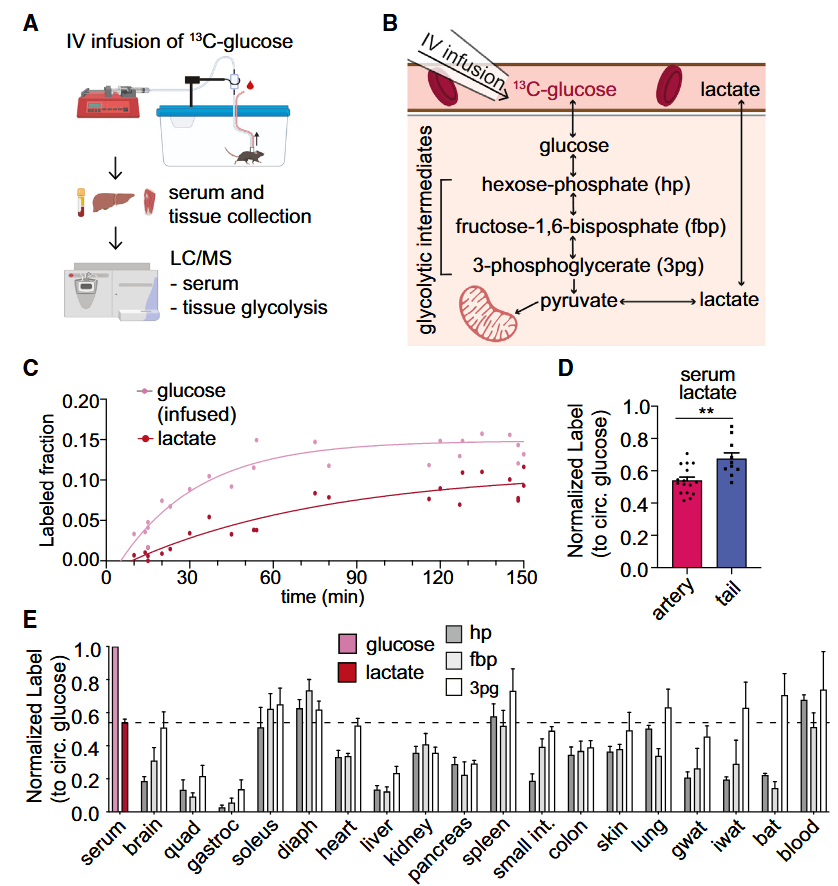
C: lactate production and circulation quickly follows infusion of glucose
D: the tail performs more glycolysis and excretes more lactate than muscle in the neck (?)
E: certain tissues have less glycolytic intermediates from circulating glucose than others
3. Why did certain tissues show very low levels of labeled glycolytic intermediates?
These tissues tended to have large glycogen stores (liver, quads), so the glycolytic intermediates likely came from glycogen and not circulating glucose.
4. Which tissues had high levels of glucose uptake from circulating glucose?
brain, transformed tissues, heart, RBCs (known to be glycolytic), spleen, soleus, diaphragm (latter two muscles have lots of mitochondria → full oxidative phosphorylative metabolism, no glycogen stores)
5. They expected that liver glycolytic intermediate labeling of only 8% relative to liver glycogen. In contrast, what did they find, Figure 3C.
over 50%, implied most of the liver’s glycolysis is done on glucose obtained through glycogenolysis, not circulating glucose (in fasting mice). dynamic
6. After re-feeding experiments what results did they find? Figure 1E & 2B.
circulating lactate increases modestly, as well as glycolytic intermediates in quads and liver
7. Experiments were carried out with normal insulin levels (0.8mU/kg min-1 BW) and super insulin levels (2.5mUmin-1/kg BW). What was their interpretation of this data?
insulin induces glycolysis
8. Propranolol, a beta-adrenergic receptor blocker was given to animals, what did the results show about fasting mice?
the low proportion of glycolytic intermediates from circulating glucose is not due to epinephrine “artificially” promoting glycogenolysis.
9. To see the contribution of Gluconeogenesis to circulating glucose, by giving C13-lactate after refeeding, where was C13 found in intermediates?
in neoglucogenic organs (liver, kidney), but also elsewhere (likely because lactate → TCA cycle → oxaloacetate → PEPCK → glycolytic intermediates)
10. Accordingly, they sought to quantify endogenous glucose production fluxes in the fed and fasted state. While individual tracing experiments reveal the overall contribution from the infused C13-nutrient to downstream metabolites, there may be intervening paths. What were their findings? Fig 5B.
when fasting, gluconeogenesis produces 69% of circulating glucose and glycogenolysis made 28%. while feeding, glycogenolysis stopped, and food became the majority of the circulating glucose, but gluconeogenesis did not seriously reduce.
liver: maintain max glucose in blood (glycogen flux)
kidney: remove excess metabolites inc. glucose (urine)
bicarbonate buffer system in blood - lactic acid, titered by alanine (zwitterion)
muscle cells - alanine transaminase: transfers amino group from glutamine to pyruvate → alanine + ketoalphaglutamate
Key processes in the liver: