Pharmacology
Pharmacology- study of drugs, derived from pharmakon meaning drug
Week 1: History and Basics of Pharmacology
History of Pharmacology
Various diseases were treated by trial and error
Important ones to know
Dioscorides (77 AD)- surgeon with Nero and student of Aristotle
compiled the first Materia medica
6 volumes with over 600 plants
Publius Vegetius (5th century)- compilation of veterinary prescriptions
Paracelsus- clinical use of opium and a number of tinctures
“All substances are poisonous, there is none which is not a poison. Proper dose separates a poison from a remedy.”
William Withering- used foxglove plant extracts to treat “dropsy”- congestive heart failure
methylxanthines from coffee, tea, and other alkaloids were discovered
Merck Pelletier- isolated alkaloids from different plants
Rudolf Buchheim- first lab
published effects of several drugs and actions on living tissue
argued pharmacology was a separate discipline from doctors, pharmacy, and chemistry
John J Abel (1857-1938)- father of pharmacology in the USA
started the department of pharmacology of at UofM and at Johns Hopkins
Drug Discovery, Marketing, and Regulation
preliminary studies
computer models, cell culture studies, testing on bacteria/fungi
preclinical phase
tests on laboratory animals to determine safety and effectiveness of a drug
short term and long term toxicity studies
intermediate drug reactions, organ system damage, reproductive effects, teratogenicity and carcinogenicity
submit INAD (investigational new animal drug) application to FDA
if FDA approves, clinical trials can start on target species
NADA filed (new animal drug application) once satisfactory results are obtained from clinical trials
Drug marketing
purchased by veterinarians from company that manufactures (direct marketing)
from distributors or wholesalers
once expired, other companies can apply to sell equivalent drug

Drug Regulation
USDA and FDA two main agencies responsible for drug regulation
certain drugs not allowed for use in food animal
DEA (drug enforcement agency) oversees use of controlled substances
High abuse potential
Higher scheduling, higher abuse potential
Schedules I-V
Schedule I > Schedule V for abuse potential
Medical Pharmacology
therapeutic goal- drug administered at correct concentration within target area of the body to achieve desired effect
within therapeutic range (concentration that produces desired effect with minimal to no side effects)
Routes of administration
parenterally (other than intestinal)
ex: IM, IV, subq, etc
non-parenterally (intestinally)
oral route
dosage forms: tablets, boluses, lozenges, capsules, powders, solutions, emulsions, and suspensions
solution- drugs dissolved in liquid, and will not settle if left standing
syrups: drugs dissolved in 85% syrup
elixirs: drugs dissolved in sweetened alcohol
tinctures: drugs dissolved in alcohol used for topical application
suspension- finely divided undissolved substance dispersed in water. Must shaken for uniform distribution of drug
emulsion- fine droplets of oil in water or water in oil
separates into layers when left standing and must be shaken before use
injectable drugs
fastest method for drugs into bloodstream is intravenous (IV)
bolus administration
small volume of highly concentrated drug in single injection
intermittent therapy
diluted form of drug over 3-60 minutes through indwelling catheter
frequent for antibiotic administration
infusion of fluid
large volume of fluid containing electrolytes or amino acids over long periods of time
IM injections
aqueous injection
absorbed rapidly and high blood concentrations are reached in 30 minutes
oily suspensions
absorbed more slowly than aqueous injection
injectable pellets
mixed drug with ingredient with limited absorption to delay absorption
tips of injection
drawback plunger so not in blood vessel when giving
needle should be deep in muscle layer and not in subq region
can be painful, especially oily suspensions
Subcutaneous (subq) injections
effect observed faster than oral, but slower than IM
can also deposit pellet subq
recommended dosages- amount of drug administered at one time to achieve desired effect (can be mg, g, ml, or cc)
loading dose
initial dose of drug that is given to get drug concentration up to therapeutic range within short amount of time
maintenance dose
dose of the drug that maintains or keeps drug within therapeutic range
total daily dose
dose of drug delivered in 24 hours
dosage intervals
SID (semel in die or once daily), BID (bis in die, or twice daily), TID, QID
Responsibility of physician/veterinarian
proper dosage selection
age, sex, clinical condition should be considered when selecting dosage
administration of drugs
be aware of proper dosage, frequency, and duration of treatment for each drug prescribed
avoid combination if possible
providing adequate information
testing drugs for allergy when indicated
proper storage and packaging
maintenance of records
maintain patient record carefully, including dose administered
security of controlled substances
knowledge of incompatibilities
welfare of patient/client is paramount
Week 2: Passage of Drugs across Membranes
Basic Terms
Pharmacokinetics- branch of pharmacology that studies fate of pharmacological substances in the body
Absorption, distribution, metabolism, and elimination
what the body does to chemicals
Pharmacodynamics- study of action or effects of drugs on living organisms
what chemicals do to the body
2 systems of circulation that can happen with a drug in the body
protein-bound form
free form in blood vessels
has several fates if free form
1. fraction of drug can reach tissues to produce its effect
2. it can be metabolized
3. free form of the drug or its metabolite can be excreted
4. drug can accumulate in the tissues

Structure and Function of Cell Membranes
Cell membranes are lipid bilayers
phosphate head (polar) groups
cardon-hydrogen tails that are lipid (non-polar) groups
for drugs to dissolve in membranes to pass through them, or be moved by transporters, receptors, channels and enzymes that are embedded
3 important functions of membranes
barrier, protects the cell
transport of chemicals and ions, essential for function of cell
separate various cell organelles
can be in nuclear membrane, mitochondria, etc.
Properties of Chemicals that Enable them to Cross Membranes
movement of chemicals across membranes is facilitated by their inherent properties
inherent properties can include
lipid solubility
charge/polarity
non-ionized state to cross membranes easily
size and shape
smaller the molecules, more readily they pass through the membrane
small pores on the cell
structural similarity to endogenous molecules
when drugs have some structural similarity to endogenous chemicals
can pass through membrane by fooling channel proteins to accept them by looking like other chemicals
Processes by Which Chemicals Cross Membranes
Filtration
process by which transport of large volumes of water across a membrane with ions and chemicals
filtration like in kidneys
pressure gradient through cells by pores or channels
filter from high pressure to low pressure
factors that influence filtration are
size of molecule relative to the size of the pore
number of pores that are present
pressure gradient
passive diffusion
chemical does not go through pores or around membranes, but dissolves in membrane to get across
chemicals have to lipophilic, non-ionized, and have small size
typically processes are dynamic and can go in either direction
net accumulation of chemical on one side of membrane depends on concentration gradient of the chemical
area of higher concentration to lower concentration
surface area of membrane will influence rate of diffusion
factors that affect passive diffusion
lipid solubility
K=amount that dissolves in organic non-polar solvent/amount that dissolves in water
higher K value, more readily absorbed by the body
more readily absorbed drug if lipophilic
measure of lipid solubility by mixing equal volumes of non-polar solvent and water to test where the drug is absorbed more readily
ionization
drugs are more easily absorbed if they are non-ionized
most drugs are weak acid/bases that exist in an “associated form” and “dissociated form” (separated from H+)
lot of math with K, Ka, and conc of acidity based on log equations
if pH is less than pKA, (or Ka of 10^-pH), it will be completely non-ionized, which favors a greater absorption
in weak acids, associated form is non-ionized, dissociated form ionized
weak bases
amino group (R-NH2) that contrasts weak acids
associated form is ionized and dissociated form is non-ionized
Kb is calculated same way
Kb= [associated form][OH-]/[dissociated form]
weak bases remain in non-ionized form in alkaline environment
weak bases better absorbed in intestines
Basic principles governing drug ionization and membranes
1. concentrations of non-ionized and ionized forms of weak acids and bases is dependent on the pKa of the drug and the pH of the environment
2. only non-ionized forms of the drug pass through lipid membranes by passive diffusion
concentration gradient of the non-ionized form determines the rate of movement of the drug across membrane
3. at equilibrium, concentration of non-ionized form will be the same on both sides of a membrane that separates 2 aqueous compartments
concentration of ionized form will depend on pH on each side of the membrane
based on the principles, properties of drug is important to determine the route of administration
will assess if drug will reach required concentration within body compartment to produce desired effect

bottom line
most drugs are either weak acids or weak bases and their rate of diffusion across lipid membranes is determined by
degree of ionization (influenced by pH and pKa of drug)
lipid solubility of nonionized form
concentration gradient of nonionized form
only nonionized can cross membranes, so important to figure out how much ionizes based on environment pH and how that impacts what the drug works in
weakly acidic or basic drugs tend to concentrate on one side of a membrane when pH of fluids on either side are differing
Ion trapping
trap a drug in an area based on the pH of the body system, which is useful for targeting specific areas of the body
ex: stomach ulcers can be treated with weak base that is easily ionized and trapped in high enough concentrations to produce effect
will not “escape” into bloodstream
Facilitated Diffusion
carrier protein that binds to drug and transports it across membrane
moves along concentration gradient
distinct features
substrate-specific
carrier proteins are saturable at large concentrations of the drug
competitive process
Active Transport
very similar to facilitated diffusion
competitive, saturable, substrate-specific
moves against concentration gradient
requires ATP
rate of movement starts fast and slow downs considerably due to carrier proteins saturation with drug
same with facilitated diffusion
opposite for passive diffusion
Pinocytosis
drugs are taken into cell by endocytosis, which requires ATP
slow process
drug is engulfed by invagination of cell membrane and taken into cell
Week 3: Drug Absorption
General Considerations
Drug absorption- transfer of drugs from the site of administration into the systemic circulation (like plasma)
fraction of drug enters system
amount of drug that is bioavailable
rate and extent of absorption depended on factors:
blood flow to site of administration
nature of barriers to absorption
surface area
ionization state of the drug
lipophilicity of drug
carrier systems that are available to transport the drug
metabolism of drug at absorption site
routes of drug administration
oral
sublingual
rectal
IV
SQ/SC (subcutaneous)
IM
inhalation
intraperitoneal (IP)
intrathecal
topical
Absorption of Drugs After Oral Administration
Absorption of drugs from GI tract
GI mucosa acts as semipermeable barrier
differences in characteristics of GI tract lead to differences in drug absorption based on properties
Oral Cavity
highly vascular, lined by stratified squamous epithelium
little to no appreciable absorption
Stomach
large epithelial surface and rich blood supply
rate at which stomach empties determines length of time the drug remains in the stomach
factors influence absorption
properties of drug
degree of ionization
lipophilicity
binding of drug to food particles
surface area
blood flow
gastric emptying time
Small Intestine
Largest GI surface area for absorption
lots of folds and very long area
lined with villi and microvilli
pH is 4-5 in duodenum, and becomes more alkaline further along tract (up to 8)
GI flora may inactivate certain drugs, reducing absorption
drug transport is usually slow compared to stomach
factors that influence absorption
properties of drug
binding of drug to food particles
surface area and motility
blood flow
factors favoring absorption of a weak acid from small intestine
large surface area
high blood flow
pH in blood favors ionized form
Large intestine
no villi
rarely absorbed in large intestine, but technically possible
Fate of Drugs Administered Orally
any drugs absorbed in oral cavity can reach blood circulation
stomach and intestines pass through portal vein and taken to liver
liver organized into hepatic lobules
each lobule has central vein surrounded by radiating cords of hepatocytes
between cords, sinusoids (large veins)
periphery of lobule, there is a branch of portal vein, hepatic artery, and bile duct
hepatocytes in liver can uptake and metabolize some of the drugs
first pass effect
metabolized fraction and free drugs can either be taken into vena cava by sinusoids or run through layers of hepatocytes and back to the GI tract for reabsorption
Absorption of Solid Dosage Forms
oral drugs common for convenience and stability
disintegrate into high surface area of GI tract
dissolution rate impacts drug absorption rate
dissolution rate governed by drug properties
Absorption for Parenteral (non-GI) sites
direct placement of drug into bloodstream ensures highest bioavailability
rate of entry into capillaries is governed by
hydrophobicity of drug
rate of capillary blood flow
blood flow can be changed to area (vasoconstrictor/dilator) to impact length of action of drug
slower absorption rate can be achieved by mixing drug with insoluble material, imbedding drug in matrix, etc.
for IV/IM/SQ: mixing insoluble salts, suspensions in non-aqueous vehicles, etc. can all achieve the same effect to get a slow release for hours/days/weeks
Parenteral Routes of Drug Administration
IV route
100% bioavailability
most preferred route of parenteral drug administration
easy to control dose and duration of action
only practical in clinical setting
Intramuscular and subcutaneous
gain access through peripheral endothelium and lymphatic channels
perfusion important for drug absorption
Inhalation
volatile agents like anesthetics or aerosols
2 steps involved
ventilation to deliver drug to alveoli
amount of chemical in gaseous form in alveoli
absorption of drug into blood from alveoli
solubility
pass a few membranes in cells, such as pneumocytes
drug absorption favored in alveoli due to large surface area and high blood flow
few membranes to cross to reach blood compared to GI tract
impacted by lipophilicity, concentration of chemical in gaseous phase, solubility in plasma
Topical, dermal, or percutaneous route
absorption of drugs in topic application generally happens through passive diffusion
epidermis is good barrier for topically applied agents
outer layer keratinized
only lipid-soluble agents easily absorbed
epidermis has limited blood supply, but can only reach blood supply reliably through a cuts or abrasions
no absorption through hair follicles
Technically, also intra-arterial, intrathecal, and intraperitoneal, but all rarely used and only for specialized procedures
Route | Advantages | Disadvantages
|
Oral
|
• can control rate of drug release
| • GI irritation - nausea • possible destruction of drug by acids or enzymes • "complexes" with substances in GI tract to retard absorption • relatively slow onset- not good for emergency use • cannot use in unconscious or uncooperative patient • possible "first pass"* effect • changes in gut physiology or contents may alter absorption • variable absorption; depends on many factors |
Sublingual | Rapid absorption Eliminates “first pass” effect Chances of drug destruction by acids and enzymes are reduced | Cannot use this route if drug is bad to taste or irritating |
Rectal | • can be used in unconscious patient • can be used in vomiting patient • less GI distress | • inconvenient • lack of compliance by patient • reduces "first pass"* Phenomenon |
Intravenous | • complete dose in blood • rapid action, suitable for emergency use • controllable rate of administration • larger volumes can be injected IV than given SQ | • not easy for client to medicate • can be painful and dangerous • drug must be H2O soluble • dose is not retrievable once given iv or im
|
Subcutaneous | • rapid absorption from aqueous solution • can control rate of absorption a) by altering blood flow using cold, heat, epinephrine b) by altering vehicle c) use of implants (pellets) | • irritating drugs cannot be used (e.g., oil vs. aqueous)
|
Intramuscular | • rapid absorption from aqueous solution • can use depot forms (e.g., oil, suspension) for slow absorption | • irritation a slight problem • possible injection into a blood vessel |
Inhalation | • very rapid absorption • rapid onset of action | • must use aerosol of very fine particle size, if drug is not volatile • often causes irritation • hard to control the size of the dose |
Intraperitoneal | • rapid absorption
| • possibility of infection and adhesions in abdomen |
Intrathecal | • ensure entry of drug into CNS (CSF) as in spinal anesthesia
| difficult technique danger of trauma to nerves danger of leakage of CSF |
Topical | • can produce local effect without systemic effects • controlled-release topical patches can provide
| • possibility of absorption into blood of a large amount of drug if membranes are damaged • drug must be non-irritating sustained delivery of drug (e.g., nitroglycerin or scopolamine) to systemic circulation |
Week 4: Drug Distribution
Drug distribution general concepts
movement of drugs and chemicals away from absorption into circulation and into extracellular space and cells
drug typically reaches tissues with high rate of perfusion first
heart, lungs, brain, liver, kidneys
then moves to lower perfusion rate
muscle and adipose tissue
can move in blood in several ways
dissolved in plasma, bound proteins in plasma, attached to blood components (RBC or WBC)
can also move by intercellular spaces to lymphatic vessels
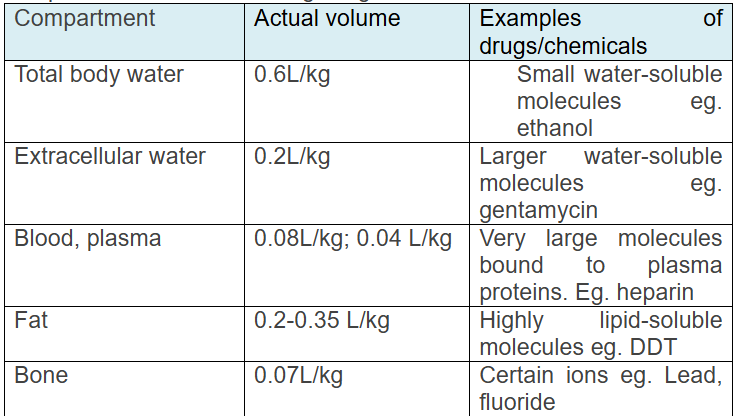
3 compartments of body fluid
plasma
about 4% of total body weight
intercellular space (between cells)
about 16% of total body weight
intracellular space (within cells)
about 40% of total body weight
know how to do the math to calculate the total weight percentage per body fluid
plasma and intercellular fluid together makes extracellular fluid
Factors that influence drug distribution
several factors influence drug distribution from site of administration
blood flow
composition and structure of vascular wall
accumulation of drugs in tissue
extent to which drugs are bound to plasma proteins
availability of membrane transport proteins to transfer drugs between fluid compartments
blood flow
how much of drug is absorbed
how rapidly drug is absorbed
for highly soluble chemicals, blood flow to site of absorption may limit distribution
composition and structure of vascular wall
sinusoids
discontinuous epithelium with holes in walls in which drug easily enters the tissues
incomplete basement membranes and intercellular gap
ex: spleen
density of capillaries in tissue determines how much drug enters tissue
blood brain barrier
formed by astrocytes and glial cells that surround capillaries
prevent most things/drugs from entering nervous tissue
not well developed in young animals
easier for drugs to reach CNS
why a lot of drugs not suitable for young
can be weakened with certain disease states
inflammation, meningitis
can also gain access to brain through active transport through choroid plexus
formation of cerebrospinal fluid
Accumulation of drugs in tissue
accumulation of drugs in tissues influenced by
tissue perfusion
lipophilicity of drug
active transport of drug into tissue
binding of drug to tissue components
either bind reversibly or irreversibly to tissue
works just as well for beneficial or toxic chemicals
effective for storage in body
when drug accumulates, limits amount of drug distribution to other tissue
Plasma protein binding
fraction of drug bound to plasma protein in circulation
amount dependent on affinity and structure of drug
binding to plasma decreases amount free in circulation
decreases drug action
retains drug within blood vessel
plasma binding favors absorption, but limits movement into tissue or extracellular space
limited by transport protein
can bind to several proteins
albumin
most important and most abundant
3 distinct classes of binding sites
high affinity for weak acids
Alpha1-acid glycoprotein for basic chemicals
lipoprotein
metal-binding proteins (transferrin)
transcortin
steroid drugs
reversible binding
involves electrostatic forces, hydrogen bonding, hydrophobic interactions
important distribution mechanism
stores in blood temporarily to release slowly
important to consider for dosage if protein levels are low in body
Availability of membrane transport proteins
transporters can influence distribution of drugs that enter cells by carrier-mediated processes
even if extensively bound to plasma proteins, movement is not reduced if actively transported
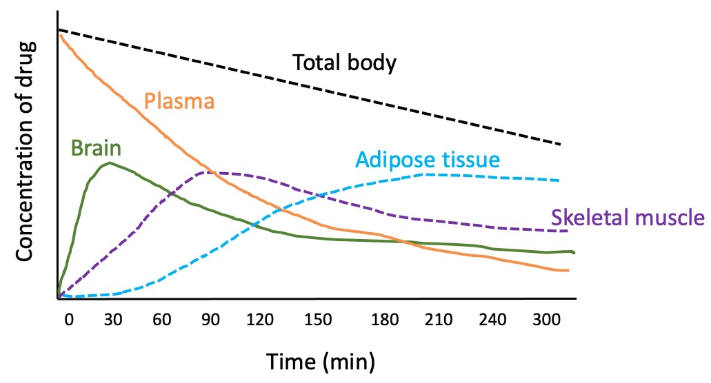
Drug redistribution
drugs can redistribute to other tissues after distributed to initial tissues
Thiopental that first moves to brain (heavily) for sedative affects
moves back into bloodstream and accumulates in adipose tissue so slow releasing after initial affect
Role of placental barrier in drug distribution
placenta not very good barrier between fetus and maternal circulation
placenta slows drug movement, but does not prevent drug distribution to fetus
Apparent volume of distribution
apparent volume of distribution (Vd)
hypothetical volume in which a dose of chemical would have to be placed to yield observed initial plasma concentration after IV injection
how well drug is distributed throughout body
larger the Vd, lower drug concentration in the body
means that most of the drug is in the plasma rather than in the tissue when Vd is high
when Vd is low, means that most of the drug is in tissue rather than in the plasma
Ratio of drug administered IV to maximum plasma concentration extrapolated to time zero (Cp0)
important for calculations of available drug with patients with free floating fluid
physical volumes of body compartments into which drugs might be distributed