Paul and Silas in Galatia & Thessalonica
In his letter to the Galatians, Paul refers to Peter as Cephas. Peter will be used in this lesson to avoid confusion.
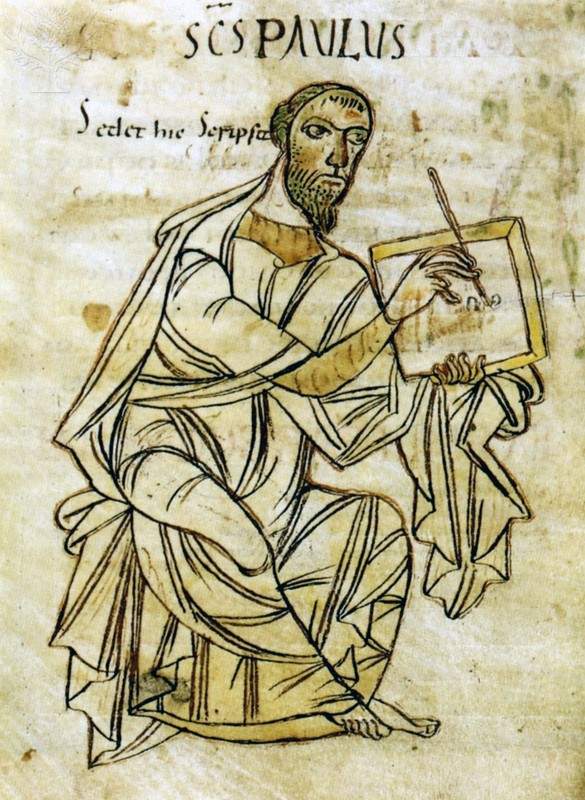
A Letter to the Galatians
The apostle Paul wrote a letter to the churches in Galatia. He was addressing how many of the members of the new churches had been listening to false teachers. He let them know that he had not received the gospel from others but had personally received it from Jesus Christ. While others may try to tell them other ways to be saved, there was no other way than through Jesus Christ.
Paul talked in the letter about his past experience of being a man that persecuted the Christians on behalf of the Jews. He was well known for this persecution. When he received Jesus Christ through a revelation, he was so zealous to spread the gospel that he immediately traveled to Arabia and Damascus. He did not go to Jerusalem for three years. When he went, he only met with Peter and James (the brother of Jesus).
After fourteen years, Paul went to Jerusalem with Barnabas and Titus. Titus, being a Greek, was not forced to be circumcised. James, Peter, and John saw the grace given to Paul, and they accepted Paul and Barnabas. They agreed that Paul and Barnabas should go and continue to preach to the Gentiles, while they preached to the Jews.
Paul opposed Peter because Peter had been eating with Gentiles, but when he was confronted by others, he began fearing the circumcision party. Peter then acted like a hypocrite and stopped associating with Gentiles that had not been circumcised. Paul remarked that the hypocrisy deceived even Barnabas. Paul wrote that this was not in line with the gospel.
Justified by Faith
Paul wrote that Christians were not justified (forgiven) by their good works but only through faith in Jesus Christ. No one would be saved if they had to be justified by the law. Paul explained that it was no longer he who lived but Christ who lived in him. He was now living by faith in Christ. If righteousness could be gained through the law, then Christ's sacrifice was for nothing. Paul asked the Galatians if they had received the Holy Spirit by works of the law or by hearing with faith.
Anyone who relied on works under the law was under a curse. The Scriptures read that anyone who did not abide by all laws was cursed, and any violation of the Law of Moses violated the entire law, which meant that no one could be justified through the law. However, Jesus saved the people from the curse of the law by becoming cursed Himself. The Scriptures stated that anyone who was hanged on a tree was cursed, and since Jesus was crucified, He took this curse onto Himself. If people lived by faith, they would be saved from the curse of the law through Jesus' sacrifice.
The descendants of Abraham were given a covenant, and Christ was a descendant of Abraham. Therefore, by accepting the grace of Christ and having faith in Christ, anyone would become a child of Christ. It did not matter what anyone's ethnicity was—Jew or Gentile. It did not matter if anyone was a man or a woman. It did not matter if anyone was a slave or was free. Paul continued by saying that Christ brought those who believed in Him into His family through His sacrifice and fulfillment of the law. Christ was in those that were saved by His grace.
Since the Galatians had been saved, they no longer needed to be slaves to the world. Paul wanted to know how they could turn back to the principles of the world. He remembered how when he had first come to them to preach the good news, they had not wronged him but had welcomed him despite his physical ailments, and he commended them for that. He was perplexed as to why they were not treating him that way now. He wished he could be with them because he was confused by them.
Paul compared the lives of Sarah and Hagar to two covenants. The child born to Hagar was like those under the slavery of the law. The child born to Sarah was like those born of the promise—salvation through Christ. They were like children not born into slavery but born to a free woman.
Christ had set them free, and Paul noted that they should not give in to slavery. If they accepted circumcision, then Christ was not an advantage to them. If they received circumcision, they were obligated to keep all of the laws. They had fallen away from grace; circumcision did not matter through Christ. Christ had justified them. The only thing that mattered was faith in Christ working through love.
Paul wondered why they had changed their ways when they had been doing so well. He was curious about who had kept them from obeying what was true. He believed that whoever was causing these problems would suffer the penalty. He could not understand why his brothers preached circumcision and why he was still being opposed. The Galatians were called to be free—not for pleasure in the flesh, but to serve one another. The entire law was fulfilled by loving others as they loved themselves. If they went against each other, they would destroy each other.
A Walk in the Spirit
Next, Paul wrote for the Galatians to walk in the Spirit. This would keep them from gratifying their fleshly desires. The Spirit was against the flesh, and the flesh was against the Spirit. The works of the flesh could easily be seen. Many of the sins of the flesh—like sexual sin, idolatry, discord, and envy, among others—were evident. Paul reminded them that these things would not be welcome in heaven. He shared that the fruit of the Spirit included all good things, such as love, patience, and kindness. The crucifixion of Christ had crucified fleshly desires. If they lived by the Spirit, they would walk with the Spirit.
Paul also commented that if one sinned, the other believers had a responsibility to correct the sinner gently. They were to watch out and avoid temptations. Everyone was to be responsible for their work; they were to test their work and not boast to others about it. They would reap whatever they sowed. If someone planted things of the flesh, that person would harvest things of the flesh. They were to do good to everyone, especially other believers.
The ones that were forcing the circumcision issue were doing so to avoid being persecuted for being Christians. The ones desiring to have them circumcised were not keeping the law; rather, they were doing this so they could boast to others.
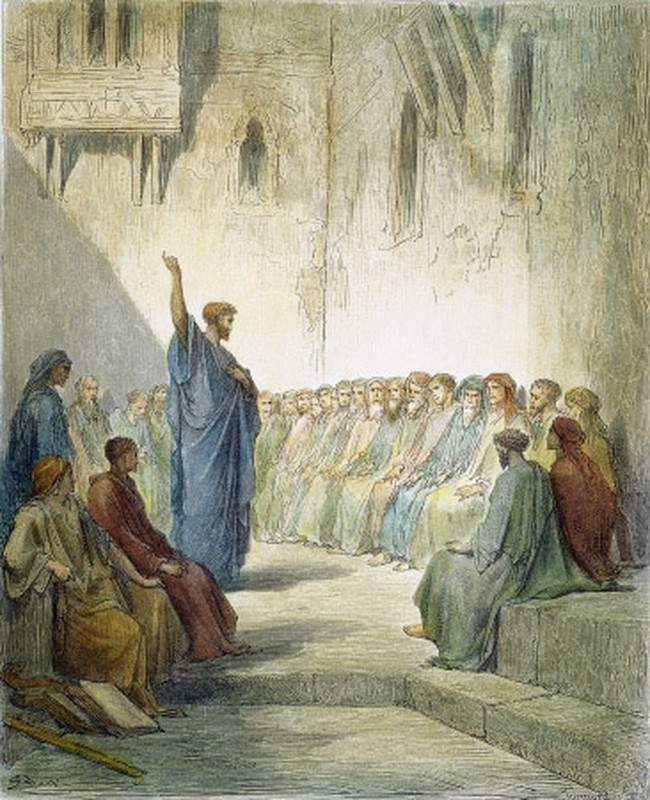
Paul and Silas in Thessalonica
Paul and Silas went to the synagogue in Thessalonica. Paul preached to the people there for three Sabbaths, explaining the gospel of Jesus Christ and how Christ needed to suffer to fulfill the promise of God. Paul persuaded some Jews to join him and Silas, as well as many Greeks and leading women. The Jews became jealous, and they gathered a mob and attacked the house of Jason, who was hosting Paul and Silas. They took Jason to the authorities and complained that Paul and Silas had changed everything and that Jason had received these men. They accused the men of saying that there was another king named Jesus. They took money from Jason and let him go.
Paul and Silas in Berea
Paul and Silas fled to Berea. They arrived at the synagogue and were received eagerly. The people there examined the Scriptures to confirm what Paul was telling them. There were many new believers. The Jews in Thessalonica heard that Paul and Silas were in Berea teaching. They came after them, causing problems and forcing Paul to flee. Silas and Timothy remained in Berea. Paul was taken to Athens and sent word for Silas and Timothy to join him there.
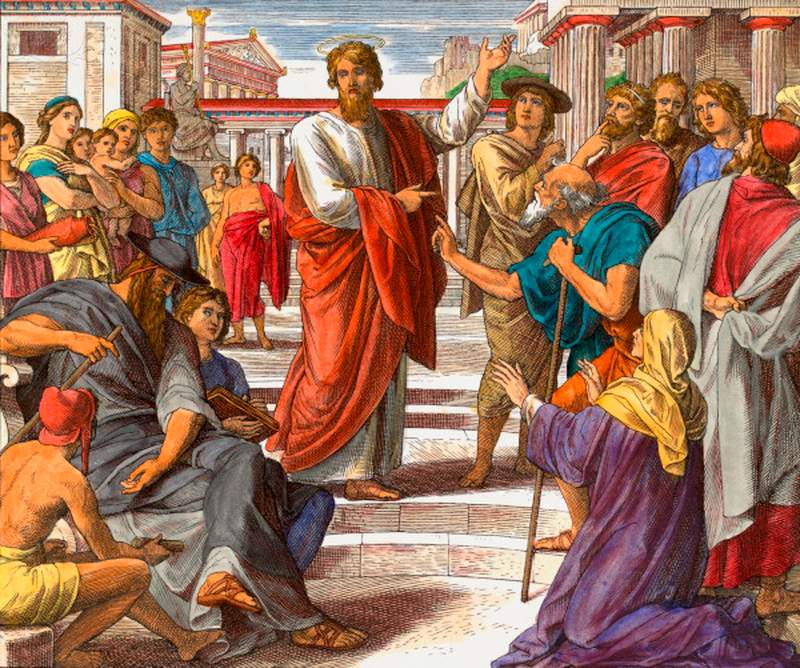
Paul in Athens
Paul was in Athens waiting for Silas and Timothy. The city was full of idols. He talked to the Jews in the synagogue and the people in the marketplace daily. He spoke to Greek philosophers. They brought him to the Areopagus (a popular location used as a forum for discussion), wanting to know what he was teaching. Athenians loved to hear and tell what was new.
Paul was at the Areopagus and mentioned to the men of Athens that they seemed to be religious. He said that he had seen many objects of their worship, including an altar to an unknown god. He shared how he served the God that had made everything. This God did not live in man-made temples. Human hands did not serve Him because He did not need anything from them. They should seek God; He was not far away. Paul proclaimed that the time for ignorance had gone, and now all men must come to God and repent of their sins. God had decided on the day of judgment, and He had given assurance of this by raising Christ from the dead. Some of the people made fun of Paul when he mentioned the resurrection. Others wanted to know more. Some of the people joined him and believed, including a man named Dionysius and a woman named Damaris.
A Letter to the Church in Thessalonica
Paul wrote to the church in Thessalonica. The letter was addressed as being from Paul, Silvanus, and Timothy. Paul noted how thankful they were for their friends in Thessalonica. He added that they were constantly praying for them—for their works of labor and love in the hope of Christ. Paul remarked that they knew that the Thessalonians had received the gospel not only in word but also in power from the Holy Spirit. The people of Thessalonica had imitated the disciples and Christ. They had become examples to other believers in Macedonia and Achaia. The word of God had spread from them. They had turned from idols to serve the true God and to wait for the risen Christ's return.
Paul reassured them that coming to them had not been meaningless. Even though he, Silvanus, and Timothy had suffered in Philippi, the Thessalonians had avowed their faith during this conflict. He and the other apostles did not come with any intent to deceive them, only to spread the gospel. The disciples had been gentle, just like a mother to the Thessalonians. They had shared both the gospel and themselves with the Thessalonians because the Thessalonians had become so special to them.
Paul reminded the Thessalonians of the work he and the other apostles had done so that they would not be a burden to the people there while they preached the gospel. He and the apostles with him had encouraged the Thessalonians to walk in a manner pleasing to God. Paul and the others thanked God for them receiving the gospel of Christ. The Christians in Thessalonica had suffered the same kind of persecution from their neighbors as the Christians in Judea had suffered from the Jews who had killed Jesus Christ and the prophets.
Paul revealed how they longed to see their friends in Thessalonica again, but Satan had prevented them. Thessalonica would be their pride and joy when Jesus returned because the Thessalonians were their glory. The apostles were in Athens and had sent Timothy to establish and boost the faith of those in Thessalonica. Paul confirmed that he had told them that trials would come, just as they had. Timothy had delivered a good report to them about the church in Thessalonica. Paul prayed that God would return him and the apostles to help the Thessalonians.
Paul discussed how they knew that they must continue to abstain from deviant sexual acts because God had called His followers to be pure, unlike the Gentiles who did not control their bodies. Paul urged them to keep up their good work in helping and loving each other. He encouraged them to continue their love for each other and increase these acts. He asked for them to be patient concerning the dead among them. They would be raised into heaven before the living and would meet Jesus when He returned. The day of His return was not known. It would come as a surprise to all. Paul instructed them to pray without stopping and give thanks in all situations.
"But the fruit of the Spirit is love, joy, peace, patience, kindness, goodness, faithfulness, gentleness, self-control; against such things there is no law" (Galatians 5:22-23, ESV®).
Summary
Paul wrote to the churches in Galatia. He told them that they should not be deceived by false teachers. Paul detailed his past persecution of Christians and how he had changed when he had received the gospel. Paul's principal message was that Christians were justified by faith and the grace of Christ and not by works. Christians had a new covenant with God through the sacrifice of Christ, and any requirements that new believers be required to follow the Torah meant that belief in the gospel would be meaningless. Paul wrote to the church in Thessalonica and praised the work of the Thessalonians. He commented how much he and his fellow apostles that had been there missed them and longed to return.

Application and Reflection
Application
Greek and Roman occupiers were persecuting the church in Thessalonica. Paul used this situation to remind the Thessalonians that they were not alone in their persecution since Christ had been persecuted by His own people, and he had been persecuted by his. The Thessalonians not only withstood the persecution but also flourished in their faithfulness to Christ. This shows that being saved does not keep a person from persecution, but persecution allows that person to draw closer to Christ.
Reflection
Paul said that making Gentile converts follow the law of the Torah ignored the truth of the gospel. This does not mean that the law is wrong. It means that we have a new law, and that law is to love God and each other through the Holy Spirit. Do you love God and others and show this through your life?