Biological Approach
Definition (#f7aeae)
Important (#edcae9)
Extra (#fffe9d)
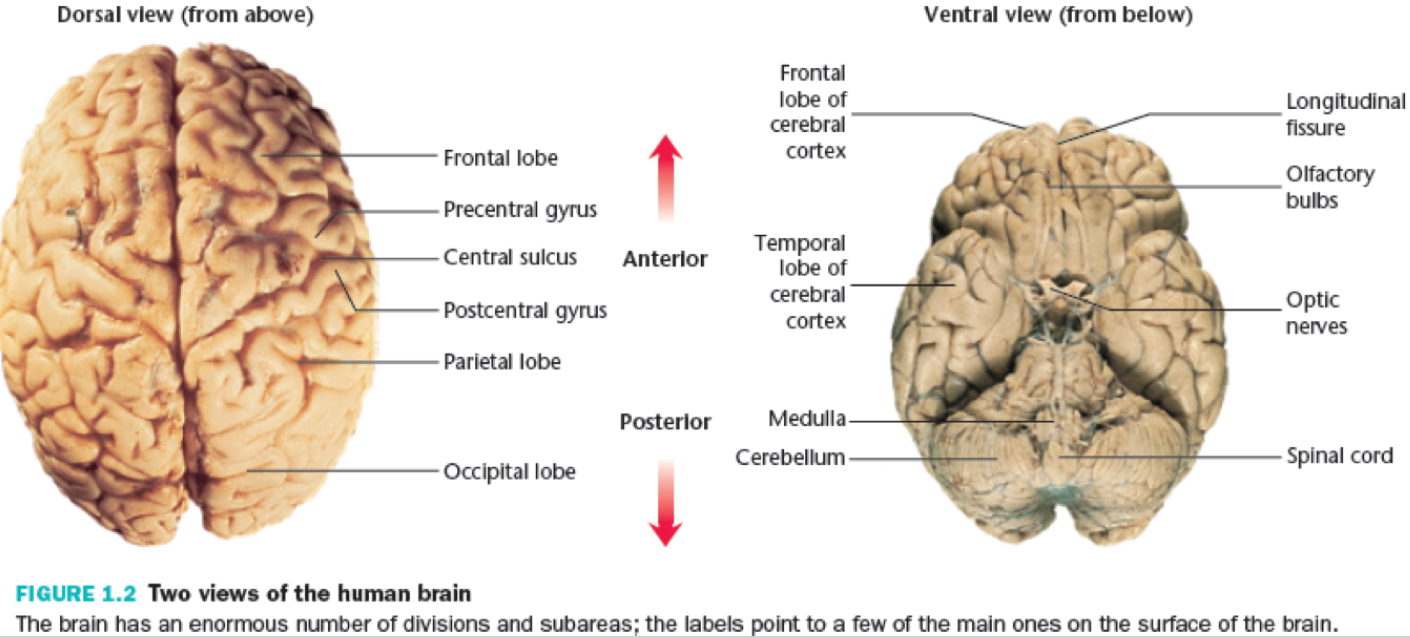
Biological Psychology: Study of the physiological, evolutionary and developmental mechanisms of behavior and experience. Emphasis on brain functioning.
Explanations: Issue of the relationship between mental activity and the brain (mind-body).
Neurons & Glia:
Brain functioning explained at a microscopic level with neurons and glia activity.
Produce large amount of behavior and experience.
Perception occurs in the brain: The brain is responsible for feeling pain despite not being hurt, happy.
Monism: Ideas of mind, body and brain as one.
Dualism: Believing everything works separately (Brain, body, senses).
Explanations:
Physiological: Relates to behavior of brain activity and hormones.
Ontogenetic: Development of a structure of behavior.
Evolutionary: Reconstructs evolutionary history of a behavior.
Functional: Describes why a behavior evolves, evolves to environment.
Biological explanation of behavior:
Physiological: Relates a behavior to the activity of the brain and other organ.
Ontogenetic: Describes the development of a structure or behavior.
Evolutionary: Reconstructs evolutionary history of a behavior or structure.
Functional: Describes why a structure or behavior evolved as it did.
Genetics And Behavior:
Genes and environment both interact to shape human behavior.
Issue is how much a role each factor plays in shaping behaviors.
Ex: Personality, psychological disorder.
Mendelian Genetics:
Gregor Mendel demonstrated that inheritance occurs through genes.
Genes are aligned along chromosomes and are in pairs.
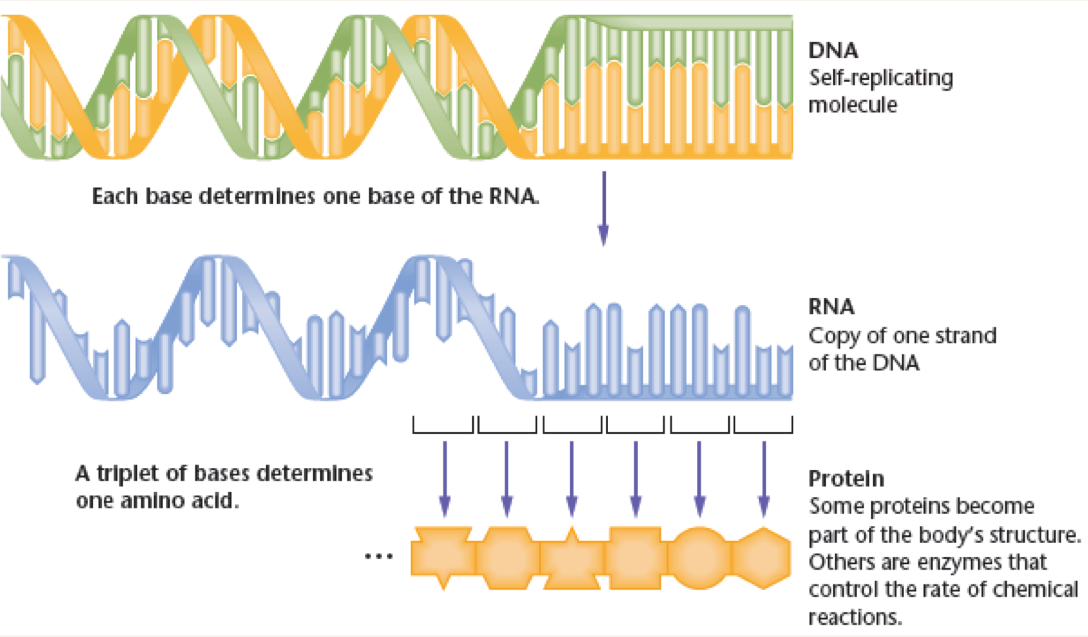
Gene: Portion of a chromosome, composed of DNA.
A strand of DNA serves as a model for the synthesis of RNA molecules.
RNA: Single strand chemical, serves as a model for the synthesis of protein.
Protein determines the body development by:
Forming part of the structure of the body.
Serves as enzymes, biological catalysts regulating chemical reactions.
Types:
Homozygous: Person has an identical pair of genes on the 2 chromosome.
Heterozygous: Person has an unmatched pair of genes on the 2 chromosomes.
Dominant gene: Gene that shows it affect even if there’s only 1 copy.
Recessive gene: Gene that only shows it’s effect if you inherited 2 copies.
Intermediate gene: Not fully dominant, get a mix of both traits.
Autosomal gene: All other genes except sex-linked genes.
Sex-linked genes: Genes located in the sex chromosome (X and Y). Genes present in both genders but are only expressed in one sex.
Human Y chromosome has genes for 27 proteins.
Human X chromosome has genes for 1500 proteins.
Genetic Mutations:
Mutation: Heritable change in a DNA molecule.
Microduplication / Microdeletion: Part of a chromosome that might appear once or twice or not at all.
Epigenetics:
Gene regulation: Involves chemical changes that affect how genes are expressed.
Some genes can be active or inactive based on these changes.
Environmental influence: Factors like diet, stress can affect these chemicals changes.
Inheritance: Epigenetic changes can be passed through generations.
Histone Proteins:
Histone proteins are special proteins that help package and organize DNA in the cell.
Basic proteins that bind to negatively charged DNA, wrapping around them to form nucleosomes.
This compaction allows the DNA to fit inside the nucleus and is crucial for gene regulation and controlling gene activity.
Structure: Histones are small proteins that DNA wraps around to form a structure called chromatin.
Function: They help condense long strands of DNA so they fit inside the cell nucleus.
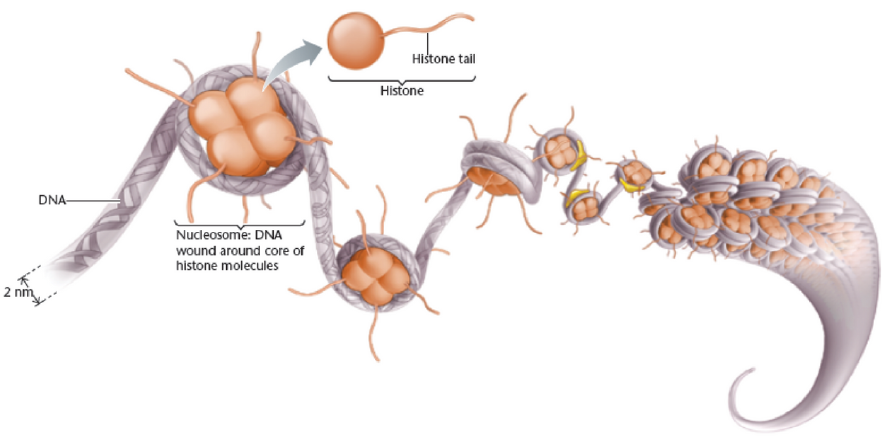
DNA Packaging: DNA wraps around histone proteins, forming a structure similar to beads on a string. Each "bead" is called a nucleosome
Gene Regulation: The way DNA is wrapped can affect whether a gene is turned on or off. If tightly wrapped, the gene is usually inactive, if loosely wrapped the gene can be active and expressed.
Chemical Modification: Histones can undergo chemical changes ( adding or removing small molecules), which further influence how tightly or loosely DNA is wrapped around them, affecting gene activity.
Types:
Acetylation:
Addition of Acetyl groups to the histones.
This loosens the DNA-histone interaction, making the DNA more accessible for gene expression (turning genes on).
Methylation:
Addition of methyl groups to specific amino acids in the histones.
Depending on where the methylation occurs, it can either activate or silence gene expression.
Phosphorylation:
Addition of phosphate groups to histones.
This can influence the structure of chromatin and play a role in gene expression and DNA repair.
Ubiquitination:
Ubiquitin proteins can be attached to histones.
This modification is involved in regulating gene expression and DNA repair.
These changes help control how tightly DNA is wrapped, affecting whether genes are turned on or off. Specific modifications can either promote or inhibit gene expression.
Hereditary And Environment:
Almost all behaviors have both genetic and environmental components.
Researchers study:
Monozygotic twins: Same genes.
Fraternal twins: Different genes.
Purpose: To infer contributions of heredity and environment.
Studies of adopted children help identify hereditary influences by comparing them with their biological parents.
Heritability: Extent to which characteristics depend on genetic differences.
Heritability of a trait is population-specific.
Strong environmental influences can reduce the effect of genetic factors.
Environmental Modification:
Traits with strong hereditary influence can be modified by environmental intervention.
Ex: PKU (Phenylketonuria):
Genetic inability to metabolize amino acid phenylalanine.
Environmental intervention (special diet) can prevent harmful effects.
Environment can modify genetic expression.
Genes don’t directly produce behaviors.
Genes produce proteins that increase the probability that a behavior will develop under certain circumstances.
Genes have an indirect effect:
Can alter your environment by producing behaviors or traits that alter how people in your environment react to you.
Evolution:
Evolution: A change in the frequency of various genes in a population over generations.
Changes in genes, like mutations and duplications, create new traits that can help or hurt an individual’s chances of surviving.
Artificial Selection: Choosing individuals with desired traits and making them parents of the next generation. According to Darwin, successful individuals’ genes will be prevalent in later generations.
Common Misunderstandings:
Lamarckian Evolution: The use or disuse of some structure or behavior causes an increase or decrease in that behavior. Ex: Humans have stopped evolving.
Evolutionary Psychology: Study of how our behaviors have changed over time through evolution.
Focuses upon functional and evolutionary explanations of how behaviors evolved.
Assumes that behaviors characteristic of a species have arisen through natural selection and provide a survival advantage.
Evolutionary psychology suggests that our genes are similar to those of our ancestors.
Natural selection:
The idea is that behaviors that were beneficial in the past helped our ancestors survive.
These behaviors were then passed down through generations because they made it easier for our ancestors to thrive.
Advantages:
It is assumed that any behavior we see in a species today likely evolved because it provided some kind of advantage to our ancestors.
For ex: Helping each other in groups might have made it easier for our ancestors to find food and stay safe.
Evolution of Behavior:
Some behaviors are more debatable regarding the influence of natural selection.
Altruistic behavior: A behavior that benefits someone other than the actor. Altruistic behavior is when someone helps others without expecting anything in return.
Group selection: States that altruistic groups survive better than less cooperative ones.
Kin selection: Selection for a gene that benefit’s the individual’s relatives.
Reciprocal altruism: Idea that individuals help those that will return the favor.
Animals In Research:
Animal research varies on the amount of stress or pain that is caused to the animal.
Reasons:
The underlying mechanisms of behavior are similar across species and easier to study in nonhuman species.
We’re interested in animals for their own sake.
What we learn about animals sheds light on human evolution.
Some experiments cannot use humans because of legal or ethical reasons.
Ethical Debate:
Opposition:
Minimalists: Favor firm regulation on research and place consideration upon the type of animal used and the amount of stress induced.
Abolitionists: Maintain that all animals have the same rights as humans and any use of animals is unethical.
Justification:
Considers the amount of benefit gained compared to the amount of distress caused to the animal.
Research institutions are required to have an Institutional Animal Care and Use Committee; oversees and determine acceptable procedures.
3 R’s:
Replacement
Reduction
Refinement