Midterm Review
Cultural Relativism
Everyone is correct; who are you to disagree
We all do things differently depending on our culture
However, cultural relativism can cause us to accept too much, when we become too tolerant bad things can happen (ex: genocide).
The Three Questions
What human problem is cultural relativism trying to solve?
Solves the persistent problem about things that matter
Risk of material conflict (killing each other)
Fear of domination through judging
Fact: societies do differ, and there is disagreement
What kind of human being does this political order assume to produce?
Reflective, tolerant, self-aware, bound
You should be able to see your own beliefs as a function of contingency, that things could be radically otherwise, that your beliefs about right and wrong are just as right and wrong as anyone else’s.
You should be tolerant of every other way that human beings live, simply because they live that way.
Can you be bound by beliefs that you believe are completely contingent? No
This is the core fundamental way you go about the world, so you would literally be nothing
What must politics do to make the world livable?
Cultural relativism must lower the stakes, deflate conflict, and “keep things moving.”
Conflicts are reframed as differences, and this is just a matter of taste, and then if you insist on something “making a fuss”, you’re the problem.
Keep your beliefs to yourself
You aren’t supposed to ask the question, do philosophy, that’s a “waste of time.”
Cultural relativism creates a surface where it is totalizing; there is nothing but the surface, so ignore the cracks
John Locke
Central Problem: How we can live together if we are all naturally free and equal
• Human Nature: Free, Equal, reason-capable—property- owner
• Goal of Politics: secure property, create standing known laws, impartial judges, constitutional power
• Signature Claim: People enter society to protect property—limited government
Key Concepts
Property
Consent
State of nature
Locke Chapter 2
Chapter 2: Human beings are naturally free and equal; no one is born with political authority over anyone else
“Constitutional liberalism”
The virtues of Lockean virtues, human beings are tolerant, against violence, rational (cultural relativism)
State of perfect freedom: we can act and do things as we see fit, insofar as it doesn’t conflict with the Law of Nature
State of perfect equality: no one has the clear decree from the divine to rule, and everyone can act as they want, therefore, we are equal
Law of nature: The only thing that stops us from doing literally anything with our power
Divine sanction: authority to rule requires a clear, public declaration—even from God
What does the Law of Nature teach us?
Do no harm: you cannot take someone’s life, liberty, health, or possessions (“Property”)
The sole aim is preservation
Self-preservation is primary
Preservation of others is secondary
Justice is the sole exception to doing harm
Everyone has universal executive power
Restrain others, protect the innocent
Everyone gets to be the judge
The violator has rejected the rule of reason, so they cannot be a part of the community.
You can’t punish people for breaking your “English laws” if they’re not from England.
The only way you can punish somebody is by the law of nature.
Locke Chapter 5 On Property
Chapter 5: The state of nature is transformed by the invention of money where value becomes abstract, inequality is present, and conflict is structural
Labor Theory of Value
The human being is the one who puts their energy into the thing that controls it, and that is what gives it value
Locke says that a king of a large territory in America has it much worse than a day laborer in England.
The land is already cultivated in England
Thus, at the beginning, the entire world is America
The creation of money naturally makes inequality
Money is not just seen as “gold” here; it is just seen as something that we deem valuable
Money freezes the here and now; it is futural.
In the state of nature, the labor you do is what makes it yours.
Nature is worthless if it does not have labor acting on it
Locke Chapter 8
Chapter 8: People begin free; authority arises through use (early monarchies and family dynamics); consent stabilizes obligation; government stores decisions in the future; the social world hardens into law
By joining into a community, creating a body politic, you are under:
Obligation (to be bound to/ward
something)
Incorporate (lit. make into a body)
Engagement (into + pledge/stake)
Consent
The only lawful government in the world derives from consent
The consent by the governed is in the coming together as one, uniting, into a community
This consent to the rule of the majority is far more substantial than initially thought
Political society beings only when individuals consent to unite into one body politic
This is not real history—this is logic: what must be true for political authority to be legitimate?
Some claim that it is natural—”we are just born into it; that’s just how the world is.”
No—political authority is made, we enter into it; and we engage it
What feels inevitable (government), given (authority), and natural (obedience) is actually due to our consent, our act in self-binding
Consent comes in two forms:
Express: you literally say that you are going to join the society, binding yourself to the body politic, the majority
Tacit: you use your property, which is designated and secured by the laws of a particular territory
Locke Chapter 9
Problem: Why leave the State of Nature at all?
Enjoyment—to fittingly have, to be in a state of joy—a dwelling, securely
The state of nature provides a freedom you cannot live in
“First, There wants an established, settled, known law, received and allowed by common consent to be the standard of right and wrong”
Established: independent of mood
Settled: doesn’t change between disputes
Known: it is common, not privately held
The state of nature is a battle of meanings, interpretations.
Even if there were a law of nature and everyone could understand it— there is still no impartial judge. People are horrible judges in their own cases: partial, vindictive, and lazy.
We submit to authority because we are afraid of freedom exposing us to dear, danger, and death
People aren’t evil but the state of nature is unstable, so we agree to give up our power and transfer it to an agent according to laws.
To join society we give up:
Legislative (power to direct ourselves)
Executive (power to punish)
Equality, liberty, and executive power is transferred
This does not created an unlimited government, it sets the groundwork for what will be called liberal constitutionalism
Locke 3 Problems
What human problem is politics trying to solve?
Chapter 2: equal freedom created insecurity because everyone can interpret and enforce right for themselves
Chapter 5: labor and need created a problem in a common world; then money transforms the problem by making accumulation and inequality possible (value becomes storable over time)
Chapter 8: with stable possessions, the core problem is how a “we” can act, how collective agency can exist without destroying the individual
Chapter 9: our original condition has no settled law, no impartial judge, and no reliable enforcement
Overall: human beings are free and equal, but when everyone is free to judge and act for themselves, life becomes insecure, unpredictable, and dangerous.
What kind of human being does political order assume and/or produce?
Assumes:
self-owning, future oriented, reason capable (though not always reasonable), motivated by preservation of property
Produces:
A person who is a “rights-bearer” and “property owner”, someone habituated to follow standing public rules; someone who treats the world as secure, stable, improved and improvable, someone split between public and private life.
What must politics do to make the world livable?
Politics must stabilize a shared world across time by converting fragile individual powers into durable public structures. These are still bound by a particular end: preserving private property
Secure property broadly understood, it is about enjoyment not just wealth
Create standing known laws, indifferent judges, and public policing
Reduce fear, anxiety, and conflict
Hobbes
Central Problem: Radical insecurity produced by natural equality.
Human Nature: Free, Equal, driven by fear of violent death
Goal of Politics: create an absolute common power that defines laws, enforces contracts, eliminates competition
Signature Claim: State of nature is a state of war, so we must give up effectively all our power to a sovereign to rule absolutely
Hobbes Chapter 13
Hobbes like Locke starts with the fundamental equality of everyone
We are equal because we are all vulnerable, we all have the ability to kill someone
Fundamental equality also extends to our intellectual abilities
Most people are smart today because they can follow rules, but that’s super hard to come by naturally
Most people learn by doing and experiences (in the state of nature)
Most people think they’re smarter than the average person
Equality + scarcity in the state of nature produces enmity (feeling hostile or opposed to something)
Diffidence (mistrust) leads to war
Three causes to the state of war
Scarcity and competition
Diffidence or mistrust
For some, glory
So, there’s not “law of nature” like Locke believes, there is only power to do what you must to survive
No private property in the state of nature
Justice requires law, and law requires a common power
What brings us together is
Fear of violent death
Desire for the necessities of civilization
Hope that our labor is actually secured
Hobbes is all about preventing a violent death, not really enjoying property
Hobbes Chapters 14 and 15
First two laws of nature
Liberty - absence of external impediments to your actions (right)
Law - a constraint that binds your actions (obligation)
First “fundamental law of nature”
Seek peace and follow it (where there is hope of obtaining it)
When peace can not be obtained, use every advantage of war in your self-defense
Second law
You have to be willing to lay down your natural rights to all things, keeping only as much liberty against others as you would allow them to have (golden rule)
If others will not reciprocate, then you have no obligation to do the same
Lay down: right to deprive yourself of your liberty to hinder someone else from using theirs
Hobbes is saying there is no such thing as good or bad, there is no place of Hobbes, we were never able to just dwell in the state of nature
Not all rights are alienable though, someone who tries to kill you you still have the right to resist them
Contract: something that is a mutual transfer of rights
Covenant (pact): where a performance is delayed, one party is trusted
Faith: performing what is promised
Violation: breaking that promise
You can’t just have contracts in the state of nature because words alone are not enough
Obligation comes from externally stabilized expectations (of violence)
Hobbes builds his system on fear
Third law
Justice - you must perform your covenants
Actual covenants coercive power, punishment has to be greater than any gain from breaking the covenant
Justice is not a virtue of the soul, it’s about creating stability in the world around us
Justice emerges after you reason or reckon towards peace
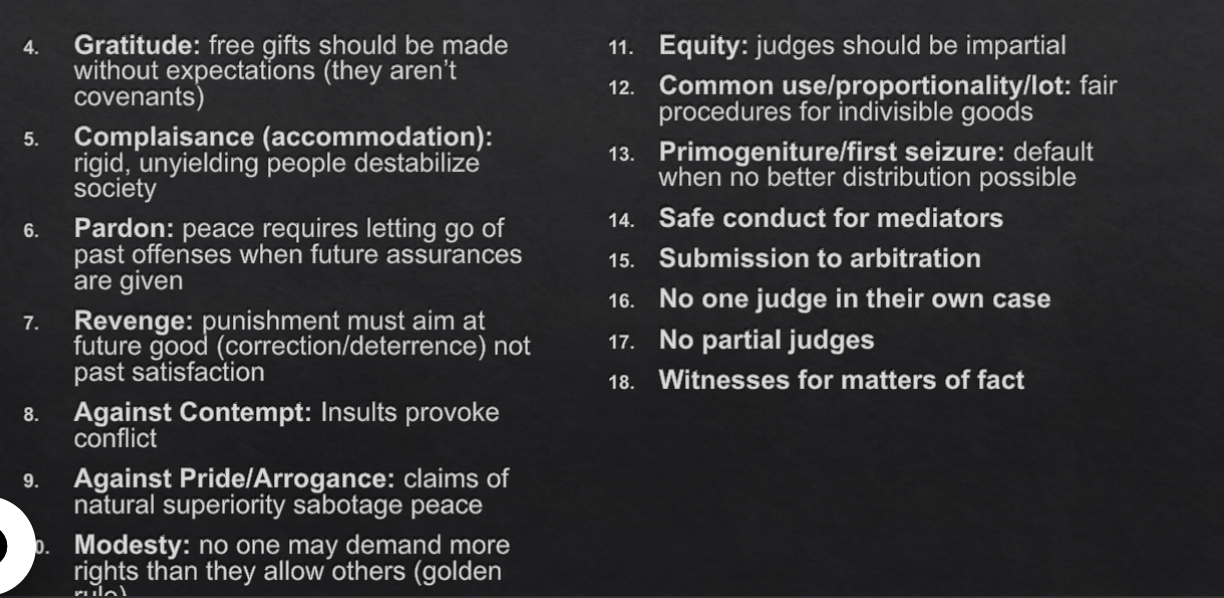
These laws of nature are about conflict resolution
Laws of nature are eternal and immutable
Hobbes Chapters 17 and 18
The goal of politics is to stabilize the natural inclination of people’s love of liberty and dominon over others
Awe: dread, fear, reverence
Must create “invisible power” to keep people in awe and provide sufficient fear of punishment for breaking the law
Since the law of nature, small numbers of people, large numbers of people, and covenants alone are insufficient, we must confer all power upon one man, or upon one assembly of men
Individuals give up their power to one person who does not give up their power
Sovereign power comes from
Nature
Politics
So far: the only solution to the state of war is to confer all power into one person, this person is called the sovereign who rules through fear
Consequences of this system
You cannot change sovereigns/forms of government
Because you agreed and obliged yourself, you would be breaking that covenant
You also can’t claim you had an original covenant with God that’s above this one
Sovereign power cannot be forfeited
Unable to be breached, the group is just the sovereign and then all the subjects
Covenant cannot have been between each individual
No protesting the decision to make a sovereign
Majority rule = you gotta follow
The sovereign cannot injure you
Sovereign cannot be punished by a subject
Then the subject would be punishing himself too
The sovereign is the sole judge over what is necessary for peace and defense
Sovereign decides the rules by which you have “property”
Sovereign decides what the law means
sovereign is head of military
chooses all officials
Has the right to reward and punish
Designation of honorability and order is established by sovereign
Hobbes Three Questions
What human problem is politics trying to solve?
Radical insecurity produced by natural inequality
What kind of human being does political order assume/produce?
Assumes: Self-interested, calculated, fearful, glory-seeking, suspicious (not virtious)
Produces: subjects who authorize a sovereign, individuals who obey out of rational self-preservation
What must politics do to make the world livable?
Create a common power, centralize force, define property, control doctrines, enforce contracts, eliminate competing centers of power
Machiavelli
Central Problem: Radical instability in the world
Human Nature: ambitious, unreliable, self-interested— some want to dominate others just want to be alone
Goal of Politics: found a new political order, institute order over chaos
Signature Claim: Life is about survival, ends justify the means, and virtue is really just being able to be effective—cruelty well-used
M Chapter 15
This is about guidance
He intends to write something useful to those who understand it
The Effectual Truth
Looking at the actual causes and effects of decisions, without thinking of how things could be.
Sometimes, you have to do the “not good” for the better.
Truth vs. Imagination
This is not about ideals, about what ought to be done; it is about what actually works
The Aim of Ruling
The distance between is/ought
What a ruler should do is whatever is needed to avoid ruin
The best regime is one that preserves itself
Hence, a prince must learn to be able to be not good.
The end goal for a prince is to maintain power
He must be so prudent that he knows how to contain the infamy of his vices, which keeps his state.
It is necessary for him to be so prudent…
Circumstances
We all want to be virtuous or seem virtuous, but we cannot be. Makes it impossible for us to always “do the right thing”.
The Effectual Truth
But that means we need to rethink what “the right thing” means; it cannot be the case that the right thing is against my aims.
Prudence is about knowing when to do good or bad.
The Aim of Ruling
Conceded the ideal of full virtue
Denied its practicability because of “human conditions.”
Elevated prudence over moral consistency
Redefined vice as necessary
Good comes into the equation when there is no necessity
M Chapter 6 and 9
Virtu is not virtue
Virtu is your ability to do
Capacity, strength, initiative and force
Political strength through self-sufficency
You cannot simply copy others, you have to follow your own path because circumstances have changed
The effectual truth
Fortuna is unstable, virtu is self-generated
Who is safer for the prince?
The people: the prince can make and unmake the nobles; the people just want to be righteous.
Far fewer nobles than people
He says that the prince must keep the people friendly; otherwise he has no security in adversity.
The people themselves often cause disorder
It’s important to have people depend on you so that they will not betray you.
Machiavelli is a “teacher of evil”
He says it’s good that people don’t want to dominate
The nobles can be controlled
You secure power by your own virtue and arms when the occasion arises (conflict), or by being elevated by the divided city by the people or the nobles.
M 7 and 25
Those who become Princes solely by good fortune may not have problems rising to the top, but once you’re there it’s exceptionally hard to stay there.
Those that become unexpectedly princes, and have the virtu, might be able to succeed.
You cannot rely on chance or luck
You need to be honest with yourself and everyone around you, what you think is so great about yourself could just be circumstance.
Virtu here means lay the foundation, lay a foundation that keeps you in power.
Virtu is just being prepared
Virtu means foundation
Two examples:
Francesco Sforza
Had virtu and laid proper foundation to rise to power
Cesare Borgia
His father became Pope (Alexander VI)
Through this position he was put into power
At the decisive moment in his time in power he got sick.
THIS is the example of “The Prince”
The Rise of Cesare Borgia
Disrupt Order
Alexander VI pitted the Italian nobles against one another
Invited foreign powers to invade Italy
Romagna
Cesare set up as ruler of Romagna
His troops were not loyal to him
Won over nobles
Gave put ranks and money to make people dependent on him
Killed the nobles who didn’t assimilate
Cesare Borgia went to kill the governor he put into office (Ramiro) who was known for being swift and cruel, so that the people would like him again.
It was a spectacle and very gory, but caused the people to be satisfied and stupefied.
Cesare recognized that stability required swift action against the nobles
D’Orco was extremely efficient
Now he’s doing everything possible to stay in power, because he knows he’s a nepo baby
He had a fear a new successor of the Church would not be friendly towards him.
So,
He exterminated all the families of those lords whom he had despoiled
Won himself to the gentlemen of Rome
Converted the college more to himself
People hurt or injure you out of fear or hatred.
Power acquired by/through someone else is unstable
Virtu is an effort to escape fortune
Cruelty must be “well-used”
Eliminate rivals completely
Anticipate the worst
One error of Borgia: he allowed Pope Julius II to become Pope
Machiavelli
The Prince, Chapters 18 & 17
Agenda
Recap of Prior Content
Discuss Chapter 18
Discuss Chapter 17
Recap of Main Concepts
Machiavelli's Reputation: Is he a "teacher of evil"?
Key Philosophical Concepts:
Effectual Truth
Virtù vs. Fortuna
Chapter 18: Concerning the Way in which Princes Should Keep Faith
General Consensus: It is praiseworthy for a prince to keep faith and live with integrity rather than craftiness.
Historical Insight:
Notable princes who achieved great things often disregarded the importance of keeping faith.
They utilized craftiness to circumvent others’ intellect and overcame those who relied on their word.
Methods of Contesting:
By Law: Appropriate for humans.
By Force: Appropriate for beasts.
Importance of employing both methods in governance.
Ancient Wisdom on Leadership
Exemplified through the figure of Chiron, the Centaur:
Known for nurturing kings like Achilles.
Symbolizes the necessity of blending human intelligence with brute force.
Important qualities for a prince include craftiness (fox) and strength (lion).
The Dual Nature of a Prince
Choosing Attributes:
Fox (Cunning): Essential for detecting traps.
Lion (Strength): Essential for intimidating rivals.
A wise ruler must understand when to embody each.
Ethical Implications
Prudence in Governance:
A wise lord may justly deviate from keeping faith when it serves to protect him from harm.
The inherent bad nature of humans necessitates this approach; thus, one is not bound to keep faith with those who do not.
Frequent contemporary examples illustrate this point.
Example of Effective Deception
Alexander VI: A historical figure known for using deception effectively, securing his goals through cunning and craftiness.
The Nature of Virtue and Perception
It is not necessary for a prince to possess all virtuous qualities but rather to appear to have them.
Concept of Perception: People judge based on appearances rather than reality.
Practicing Appearance: A prince should outwardly embody traits such as mercy, faith, humanity, uprightness, and piety.
Language and Image
Importance of Language: A prince's language shapes how others perceive him.
Control Over Image: The ability to maintain a perfect image leads to less opposition.
Consequences of Kingship
Public Judgment: Means are deemed honest if a prince successfully retains control of the state, reinforcing the idea that outcomes are viewed through a lens of appearance rather than reality.
Machiavelli as Chiron: Teaches the importance of embodying both the human (moral) and animal (forceful) aspects in leadership.
Chapter 17: Concerning Cruelty and Clemency, and Whether it is Better to be Loved than Feared
Desirable Qualities for a Prince: Should strive to be perceived as merciful rather than cruel but must not misapply clemency.
Case of Cesare Borgia: Despite being labeled cruel, his actions provided unity and order in a disordered state.
Realpolitik and Governance
A prince's cruelty can be justified when it stabilizes his realm more effectively than excessive mercy, which may allow disorder.
Concept of Utility: Swift punishment can be justified if it achieves a greater common good.
Calculated Cruelty
Historical Context: New princes may need to deploy measures seen as cruel to maintain order and unite factions.
Virgil’s Perspective: Dido's inhumane decisions resonate with Machiavelli's advice that cruelty may be essential for maintaining control over new territories.
The Dilemma of Love vs. Fear
Preference for Fear: It is safer for a prince to be feared than loved, as love can be easily lost while fear remains more constant.
Human nature is characterized by envy and self-interest.
Relationships based on fear are more stable but must be managed carefully to avoid hatred.
Impact of Property and Honoring Citizens: To mitigate hatred, a prince should avoid imposing on the property of citizens, which fosters resentment.
The Dynamics of Fear
Controlled Fear: Although a prince can foster fear, he must strive to avoid becoming hated since hatred can lead to instability.
Examples in Military Leadership: Military leaders, such as Hannibal, utilized fear to maintain loyalty among their troops and could execute swift, harsh measures when necessary without losing authority.
Final Thoughts on Governance
Necessity for Cruelty: Cruel measures may be essential to ensure stability in a fragile new political landscape.
Foundational Understanding of Politics:
Politics exists primarily as a method to manage human instability, ambition, and unreliability.
A successful political order must navigate complex human interactions while achieving stability.
Aquinas: Life and Context
Birth and Background
Aquinas was born between Rome and Naples in Italy to a minor noble family.
Studied in Naples and joined the Dominican Order (Order of Preachers).
Aimed to be a professor, a choice that faced disapproval from his family.
Studied under Albertus Magnus (Albert the Great) in France.
Became a Master at the University of Paris, a leading theological center in Latin Christendom.
Intellectual Impact
The “Aristotle Shock”
Aquinas experienced the influx of Aristotle's texts, preserved by Arabic and Jewish scholars, into Christendom during the 12th-13th centuries.
Aristotle's works introduced new models of knowledge in various fields:
Logic
Natural philosophy
Psychology
Metaphysics
Ethics
Aquinas dubbed the great synthesizer for his goal to integrate these “pagan” teachings instead of dismissing them.
The Synthesis of Thought
Aquinas's Intellectual Focus
Engaged in synthesizing ideas amidst a backdrop of changing intellectual landscapes in universities like Paris.
Addressed key themes:
Reason vs. Revelation
Advocated a “fusion model” of faith and reason, suggesting that both Athenian (philosophical) and Jerusalem (theological) traditions could coexist.
Proposed "Natural Law" as an anthropological component rather than merely a set of rules.
Developed the method of argumentation known as the Scholastic method, characterized by structured questioning:
Presentation of a question
Objections
Counterstatements
Main body of the argument
Replies to objections.
Systematic Accounts of Reality
Aquinas's Systematic Approach
His work aims to provide a systematic account of reality, beginning with God's existence and flowing through:
Creation
Human action
Law and virtue (specifically examined in Q90 and Q91 of the Summa Theologica).
Transition to Modernity
Machiavelli's Challenge
Introduced the idea of politics focused on survival rather than the common good, starkly contrasting with Aquinas and his predecessors.
Presented concerns about acquiring and maintaining power amid instability, emphasizing the need for order over moral considerations.
Key concepts introduced by Machiavelli:
Fortuna: the notion that the world is inherently unstable, requiring human efforts to impose order.
Hobbes further systematizes these ideas, asserting that human beings are fundamentally equal in vulnerability and motivated by self-preservation.
Modern Political Assumptions
Foundational Ideas of Modernity
Over the last 500 years, Western political theory has been characterized by several assumptions:
Individuals are ontologically prior to communities; we come together to create political entities, emphasizing separation and consent among beings.
The inherent instability of the world leaves individuals exposed; order must be artificial.
Norms and laws serve primarily as risk management tools in an uncertain world.
Rights are primarily defensive; laws are protective, and government should be limited.
Suspicion of power is pervasive, reflecting a Machiavellian realism.
Achievements of Modernity
Key Developments
Modernity has led to significant political innovations:
Constitutionalism
Separation of Powers
Individual Rights
Religious Tolerance
Skepticism towards absolute power
Realism regarding corruption.
These developments were responses to historical experiences of conflict, including:
Religious wars
Partisan civil wars
Failed states and hypocrisy among rulers.
The Nature of Human Experience
Thownness in Modernity
Modernity encapsulates the notion of thrownness: the sense of existing in a pre-established world.
This recognition underlines the inherent disorder masked by apparent order, leading us to contemplate the nature of stability.
Politics becomes the domain of management, negotiation, and balance of power, raising ethical questions about the costs of such an approach.
Foundational Political Models
Admirable Models from Machiavelli
Machiavelli highlights the importance of founders in establishing political stability.
Historical figures such as Moses, Theseus, Romulus, and Cyrus exemplify leaders whose exceptional virtues led to the formation of lasting political orders.
Founding is portrayed not merely as survival but as:
Establishing laws
Creating lasting institutions
Shaping civic character
Building shared identities
Stabilizing political time.
Machiavelli on Law and Force
Philosophical Dilemma
Discusses the two methods of fighting:
By law (the proper method of men)
By force (the method of beasts).
Machiavelli contends that while law should guide, force may be necessary when law fails.
Examining Law
Aquinas’s Definition of Law
Aquinas defines law as a rule and measure of acts that induces or restrains human behavior, emphasizing that it is not merely a command but encompasses reason.
Measure of Law
Measure signifies not mathematical quantification but involves setting limits and establishing proportionate relations among human actions.
The measure is guided by reason, which serves as a fundamental capacity to understand order and ethical ends.
Aquinas's Arguments on Law
Responses to Objections
Objection 1: Law as desire is rejected; it is a function of reason, the highest faculty of humans.
Objection 2: Law is not just the act of reasoning but is produced through reason; it is universal and rational measure.
Objection 3: Will does drive action, yet it must be guided by reason to be lawful.
Common Good as the End of Law
Common Good in Aquinas’s Philosophy
Law is fundamentally aimed at achieving the common good rather than individual benefits;
Happiness requires community, thus law’s binding force extends beyond individual desires.
Authority in Legislation
Who Makes the Law?
Aquinas argues that law must align with the good of the community and belong either to the whole community or a representative.
Responses to Community-Based Objections
Affirmation of universal participation in rational order is essential.
Promulgation as Fundamental to Law
Promulgation’s Role
The act of promulgating laws makes reason explicit and intends to bind the community.
Aquinas asserts that without public promulgation, laws remain ineffective and may not guide actions appropriately.
Conclusion on Law**
Aquinas's View on Politics
Contrasts with views that consider power as foundational. Instead, politics should promote common good and community flourishing.
Acknowledges that our desires for order and stability align with living authentically according to nature.
Notes on Aquinas II
Page 1
Reference to serene King Charles II.
Page 2
Recap of Aquinas.
Mention of Question 91 (Q91).
Page 3
Classical Literature: Modernity is viewed as an attempt to conquer nature.
Human beings are identified as natural entities governed by reason.
Recap of Q90: Law is framed as the means through which humans attain happiness in the world.
Page 4
Discussions referencing Summa Theologica.
Focus on Question 91 titled "Of the Various Kinds of Law."
Page 5
Viewpoint of Aquinas:
Humans are intrinsically social and political.
Community is essential not merely for survival but to live a good life, aiming at happiness (which is the ultimate goal, linked to the common good).
Happiness is found within societal constructs through the law.
Humans are guided by reason, which understands the fundamental stability that is nature.
Page 6
Modernity's Rejection:
Modern perspectives discard the notion of unchanging elements in nature, seeking stability through alternative means.
Challenges the idea of whether nature can indeed serve as a standard for providing order in life.
Page 7
Structure of Question 91: This question contains six key parts outlining Aquinas' argument:
Existence of governance in the universe implies an eternal law.
Rational beings must possess their governance through natural law.
Necessity of human law arises from the particular nature of human life against the background of general natural law.
Acknowledgment of divine law stems from a higher human end than mere nature, given the limits of human judgment.
Historical immaturity of humanity leads to the concept of a twofold divine law (Old and New).
Internal disarray within humans manifests as a law-like principle of sin.
Page 8
Article 1: Discussion focuses on Eternal Law.
Page 9
Definition from Q90:
Law is deemed an ordinance or dictate of practical reason from a ruler aimed at the common good within a community and must be promulgated.
Key Question: Is there a law that transcends the human order entirely?
Objections Raised:
Law is typically imposed on subjects; therefore, without creatures, the existence of eternal law is questionable.
Promulgation is necessary for law, yet there's no audience in eternity for such law to be promulgated to.
Laws are aimed at an end, suggesting eternal law is impractical as it lacks a purpose beyond eternal existence.
Each objection emphasizes that law is generally contained within creaturely and temporal contexts.
Page 10
Aquinas' Response:
Cites Augustine, positing that "Supreme Reason" is both unchangeable and eternal, equating supreme reason with law; therefore, eternal law exists.
As law is a revelation through reason, it must stem from a divine being who is eternally responsible for the community.
Eternal law represents God's governance and the ordering of all existence in His intellect.
Since God exists outside of time, eternal law must inevitably exist outside the confines of time itself.
Page 11
Rebuttal to Objections:
Claims of eternal law are valid as creatures exist alongside God; thus, they are subject to eternal law influenced by God.
Divine revelation is delivered in the act of Creation, signifying promulgation of law during the temporal creation process.
Laws can imply order towards an end, establishing that existence does not hinder divine law's eternal purpose.
Emphasis on intelligibility of the natural world as it reflects eternal divine reason.
Page 12
Aquinas' Critique of Modernity:
Rebuts the view that reality is chaotic and necessitates political constructs to impose order.
Proposes that the world embodies stability and intelligibility independent of our perception or regulation of it.
Key Distinction: Between the world being comprehensible prior to human will versus the will shaping the understanding of chaotic existence.
Asserts that true existence offers preordained meaning beyond subjective human existence being merely interpretative.
Page 13
Article 2: Title: Natural Law.
Page 14
Natural Law Discussion:
Asserts participation in eternal law through natural law.
Objections Raised:
If eternal law exists, additional laws seem redundant.
Distinction made suggesting natural law merely reflects instinctive behavior, clashing with rational human nature.
Human free will is at odds with adherence to natural law if law mandates conditions.
Page 15
Aquinas' Argument:
Introduces the participation doctrine establishing that natural law is human reflection of eternal law.
All entities participate in God's universal order, though varying in nature and manner:
Plants grow naturally.
Animals follow instinct.
Rational creatures exercise understanding and direction.
Page 16
Unique Position of Humans:
Humans partially govern themselves through their faculty of reason, allowing awareness of orders toward ends.
This structured action directs human behaviors towards aims in accordance with natural law.
Natural law signifies the rational understanding of the inherent order of existence.
Page 17
Integration of Reason and Religion:
Aquinas aligns Aristotelian understanding of virtue with Christian teachings emphasizing that the ultimate good derives from God.
Rebuttals to Objections Revisited:
Natural law isn't a separate classification but a realization of eternal law through reason.
Rational participation eclipses simple instinct.
Freedom in human terms correlates with the innate orientation towards goodness.
Aquinas connects human nature’s ability to comprehend the divine supernatural referencing the natural order.
Page 18
Article 3: Title: Human Law.
Page 19
Necessity of Politics:
Questions why human law is necessary amidst eternal and natural law perspectives.
Objections Addressed:
If natural law suffices for moral guidance, the rationale for human law is debated.
Aristotle's premise suggests that human intellect cannot intrinsically generate laws as it is measured by existing reality.
Human law’s instability is questioned due to subjective judgments being inherently flawed.
Page 20
Aquinas’ Resolution:
The concept of determination in law serves the purpose of boundary positioning of moral norms derived from general principles.
Human law assists specifically in applying natural law to societal experiences, aiding clarity amidst abstract principles.
Page 21
Reiteration of Human Law's Purpose:
Further objections emphasizing the redundancy of human law are countered by clarifying that human law makes natural law applicable to community contexts.
Page 22
Article 4: Title: Divine Law.
Page 23
Need for Divine Law:
Challenge regarding the necessity for divine law when human law aligns with natural law.
Objections Elicited:
The argument of existing law sufficiency meets resistance from the proposed divine law's higher aspirations.
Divine law’s universal application debated against individual claims to moral governance.
Irreducibility of divine law juxtaposed with human sufficiency is questioned.
Page 24
Explicit Arguments for Divine Law:
Human ends surpass natural reasoning as law directs toward a transcended aim—eternal happiness—requiring divine revelation.
Page 25
Second Argument for Divine Law:
Human judgment is inherently unreliable, necessitating divine law's authoritative and infallible function to stabilize moral understanding.
Page 26
Third Argument for Divine Law:
Human legal systems lack insight into the internal moral dimensions such as thoughts and intentions; divine law embodies moral completeness encompassed within legal structure.
Page 27
Fourth Argument for Divine Law:
Political law is limited as it cannot eradicate all evils; divine law is positioned to address moral accountability beyond earthly life.
Page 28
Consolidation of Arguments:
Concludes divine law’s necessity reflects humanity's orientation toward a higher, eternal aim beyond temporal existence.
Page 29
Further Responses to Objections Against Divine Law:
Clarification that human limitations prompt the need for divine guidance beyond temporal laws.
Page 30
Article 5: Title: Single Divine Law.
Page 31
Query on Divine Diversity in Law:
Examination of dual covenants present in the Bible leads to confusion about they might suggest about divine law.
Objections Presented:
With one divine king, questions arise on the reasoning for two differentiating laws.
Shared ends demand unified directing laws—debunking any notion of bifurcation.
Establishes that divine law ought to reflect unity since eternal law remains singular.
Page 32
Aquinas' Response to the Difference Between Testaments:
Differentiates law due to species, acknowledging maturity levels among humanity necessitating distinct directives.
Old Law caters to initial development for societal stability focusing on external behavior and simple moral instructions.
New Law addresses advanced moral education emphasizing inner virtue through love and spiritual obedience.
Page 33
Continued Argument Regarding Testaments:
Responses reassure that law adaptation reflects the progressive essence of human understanding throughout time.
Page 34
Article 6: Title: Inclination Toward Sin.
Page 35
Definition of ‘Fomes Peccati’:
Refers to "tinder of sin": the disorderly inclination persisting through sensual appetite post-Fall, not inherently sinful but a departure from rational order—a question of legal designation arises.
Page 36
Further Discourse on Sin as Law:
Investigates if tendencies toward sin can align with law from two critical objections regarding law's rational nature.
Page 37
Conceptual Definitions by Aquinas:
Laws can be classified through essence and participation. Distinct methods include:
Direct inclination via explicit commands.
Indirect inclination through systemic status transition affecting behavioral regulation.
Page 38
Analysis of Pre-Fall and Post-Fall Human Nature:
Reflects on loss of harmony between reason and passion due to original sin, leading to moral disorder manifesting in behavior.
Page 39
Readdressing Sin in Light of Law:
Clarifies that fomes itself does not constitute law but is symptomatic of divine law’s participation framework influencing moral action.
Augustine of Hippo
Key Figure in Early Christian Philosophy
Born in 354 in modern-day Algeria
Educated at Carthage
Worked as a teacher of rhetoric
Influenced by classical thinkers such as Plato and Cicero
Converted to Christianity in 386
Became the bishop of Hippo Regius (in Algeria)
Died in 430 during the siege of the city by the Vandals
Importance in Political Thought
Augustine is recognized as a crucial political thinker bridging antiquity and the Middle Ages
His political philosophy significantly informs future thinkers like Aquinas
In theology, he elucidated key concepts of Western Christian doctrine:
Sin: Human inclination away from God
Grace: Divine assistance for humans to achieve salvation
The Fall: Humanity's initial disobedience resulting in a ruptured relationship with God
Salvation: The process of being saved from sin and its consequences
Influential in proposing a linear understanding of history:
Contrast with the cyclical historical views prevalent in ancient historiography
Sees history as a progression: Creation → Fall → Redemption → Final Judgment
The City of God
Written in response to the sacking of Rome by the Visigoths in 410
The event caused panic and disbelief among Romans regarding their own divine protection
Romans blamed Christianity for the disaster claiming its abandonment of old gods resulted in divine neglect
The City of God has a straightforward thesis:
There are two cities:
City of God: Founded on the love of God
City of Man (Earthly City): Founded on love of self
The term “city” represents a community defined by its core commitments, not merely a geographical location
Book XIX: Philosophical Chaos Regarding Happiness
Philosophical discourse has led to diverse opinions on the nature of good and evil, particularly concerning happiness
Philosophers have endlessly debated what constitutes happiness
Observed philosophical sects possess no consensus on the nature of the ultimate good
Various ancient views on happiness include:
Aristotelian View: Happiness equated with virtuous activity
Stoicism: Happiness rests in virtue
Epicureanism: Defined by pleasure
Skeptics: Believe in suspension of judgment
Happiness is envisioned as a combination of living well and the associated goods, with goods of the soul being prioritized over those of the body
Raises questions about the durability of physical well-being compared to spiritual integrity
Nature of Happiness and Virtue
Sec. 4 Commentary on Virtue and the Body
Virtue achieves its highest rank among human good only after engaging in a perpetual struggle against vices
These vices are internal, not external, requiring personal self-examination and correction
A significant aspect of virtue (Greek: σωφροσύνη - sofrosyni), or temperance, is to control bodily desires and maintain moral integrity
Pursuit of the supreme good involves rejecting the bodily lusts that conflict with spiritual aspirations
True happiness cannot be fully accomplished in earthly life; thus, it necessitates divine intervention to steer the soul away from succumbing to fleshly desires
Criticism of the notion that happiness can be found solely in earthly existence, even in the face of suffering and calamitous conditions
Refutes the idea that a wise or virtuous person can remain happy while enduring severe physical and emotional pain
Ultimate Happiness and Salvation
Consequences of a misguided understanding of happiness among philosophers who ignore the premise of salvation
Philosophers fail to acknowledge that true happiness is only attainable in the eternal life beyond mortality
Ancient thought deemed happiness possible in this life—yet it remains transient and fraught with misery
The pursuit of virtue alone without referencing God leads to a flawed framework for understanding true happiness
Conflict Between Earthly and Heavenly Cities
Existence of two competing cities reflected in social and political structures:
Earthly City: Aiming for happiness and stability in the temporal realm
Heavenly City: Seeking enlightenment and eternal happiness beyond earthly sufferings
This duality manifests as a tension between the material and the spiritual
The Earthly City actively endeavors for material benefits often at the expense of spiritual well-being
Emphasizes civic concord and material provisions as essential goals
Conversely, the Heavenly City utilizes earthly peace as a mere necessity during its pilgrimage through life, drawing attention to the fact that their true allegiance lies beyond the material realm
Virtues and their Relations to God
Sec. 24 Definition of Commonwealth
A political community defined fundamentally by collective love and shared values
Augustine rebuts modern notions of community formed out of fear or self-interest, emphasizing the role of faith-based shared objectives
Sec. 25 Categorization of Virtues
Identifying authentic virtues: moderation, justice, courage, prudence
These virtues gain significance only through their orientation towards God, highlighting the relationship between divine acknowledgment and true virtuous living
The Role of Christians in Earthly Cities
Christians can thrive within earthly cities and benefit from societal peace
While they appreciate philosophical teachings, this engagement does not equate to belonging to the earthly community
Their ultimate hope rests on salvation beyond life, affirming that worldly happiness is illusory and temporary
Political Philosophy and Human Condition
Three Questions for Consideration:
What problem is politics trying to solve?
According to Augustine, the issue is primarily sin. Political institutions can only temper chaos; true happiness lies outside their scope.
What type of human beings does political order assume?
Politics presupposes fallen, yet rational, beings with disordered affections.
What can politics do for livability?
Politics functions to sustain limited earthly peace, allowing Christians to await redemption.
Augustine Compared to Other Thinkers
Augustine vs. Aquinas
Aquinas sought to harmonize Christian thought with ancient philosophy, positing that humans can achieve political good through reason and moral integrity
Augustine countered that the Fall irrevocably altered human condition, resulting in an inherently flawed political realm, where justice is unattainable.
Augustine vs. Modern Political Philosophy
Contrasts with figures like Machiavelli who separated morality from politics, suggesting power and survival as primary concerns
Augustine acknowledges the darker aspects of political life (deceit, conflict) as reflections of a Fallen world, not as an ideal to strive for
Critiques modernity's focus on earthly vitality at the expense of spiritual fulfillment beyond physical existence