lecture 8 Baroque Architecture Overview & Key Figures
`Giacomo Barozzi da Vignola & Giacomo della Porta
Church of Il Gesù (Consecrated 1584)
Ceiling fresco: The Triumph of the Name of Jesus, by Il Baciccio (Giovanni Battista Gaulli, 1672-1685)
Overview of Baroque Architecture
Examines the architectural transition from the Middle Ages through the Renaissance and into the Baroque period.
Discusses the Reformation and Counter-Reformation’s influence on architecture.
Key Topics:
Introduction:
New Epoch: Transition to Baroque from earlier periods. an emphasis on emotional engagement and sensory experiences.
Reformation and Counter-Reformation: Key historical contexts.
The Church
Persuasion and Participation: Architecture used as a means to encourage engagement with the church, particularly evident in Il Gesù.
Il Gesù: Example of a Counter-Reformation church with Baroque style elements.
Baroque Architecture
Articulation: Features and decorative aspects of Baroque style.
Intention: The motive behind the designs, often to evoke emotion and participation.
Characteristics: Dynamic forms, elaborate detailing, and dramatic spaces.
Giovanni Lorenzo Bernini (1598-1680)
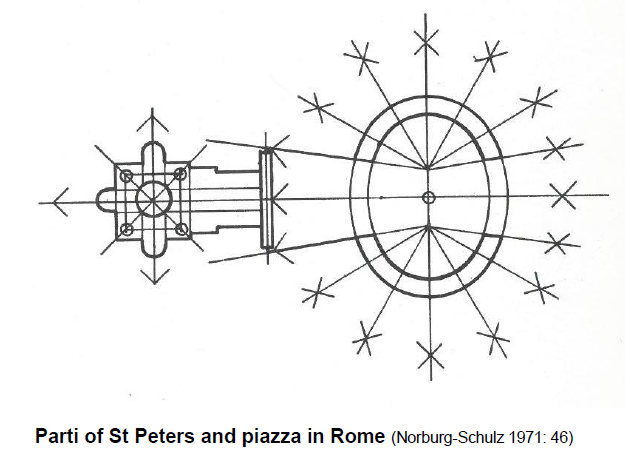
Key works include the Piazza at St. Peter’s Basilica in Rome.
Known for persuasion through dramatic architecture.
St. Peter's Basilica Timeline
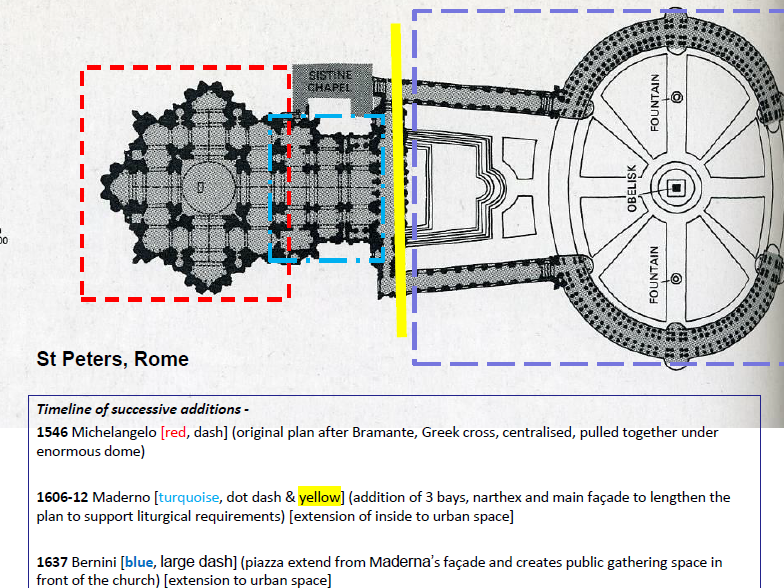
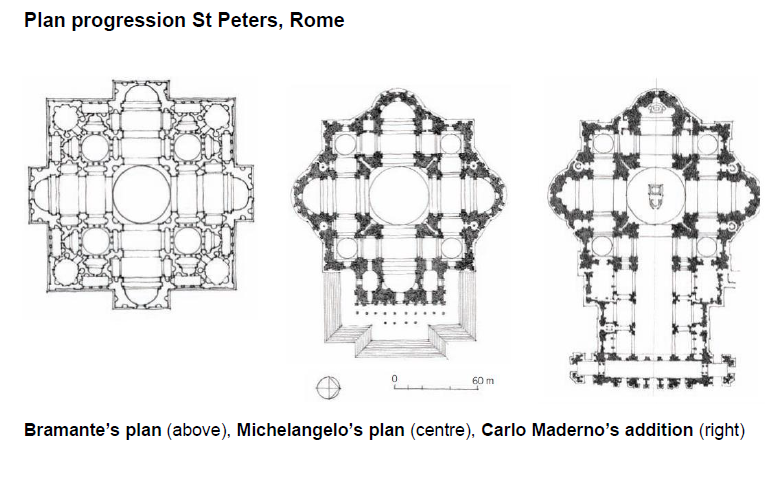
1546: Michelangelo’s original plan based on Bramante’s designs—Greek cross layout under a large dome.
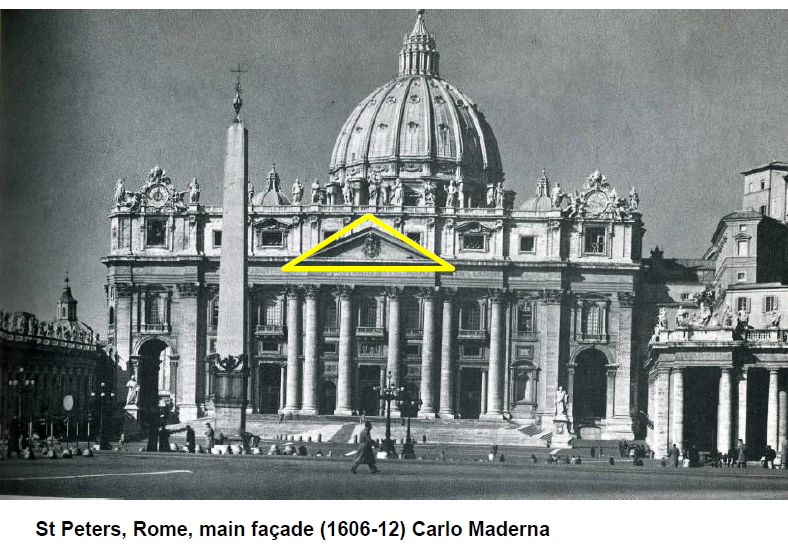
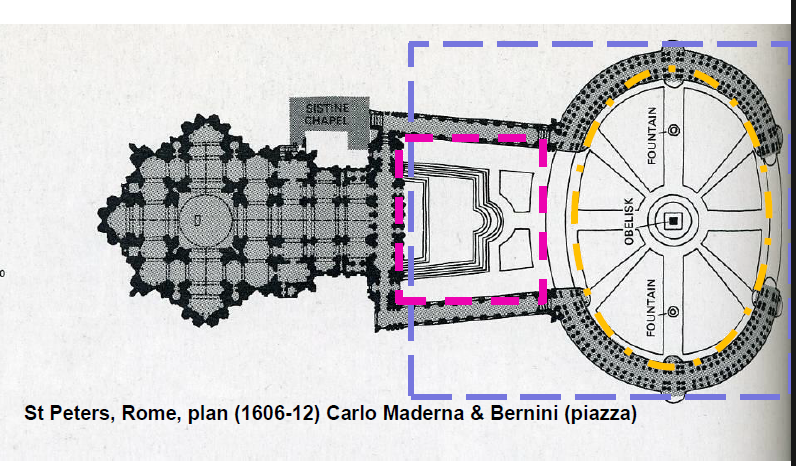
1606-12: Modifications by Maderno added three bays and an extended façade to accommodate liturgical needs.
1637: Bernini’s design of the piazza creates a public gathering space in front of the church.
Notable Works and Concepts
Gian Lorenzo Bernini
St. Peter’s Basilica:
Major contributions include the central layout and grand piazza.
Engagement: Known for utilizing architecture to create interaction and emotional responses.
/
Francesco Borromini (1599-1667)
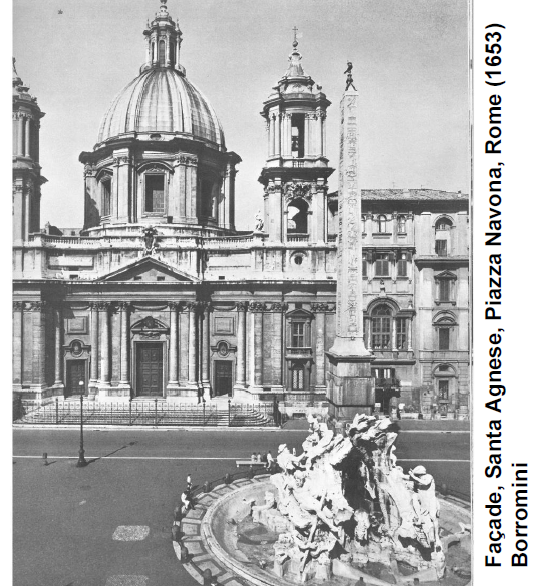
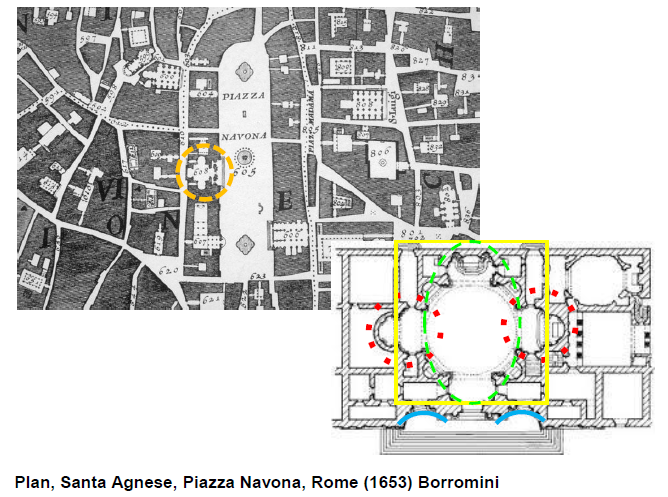
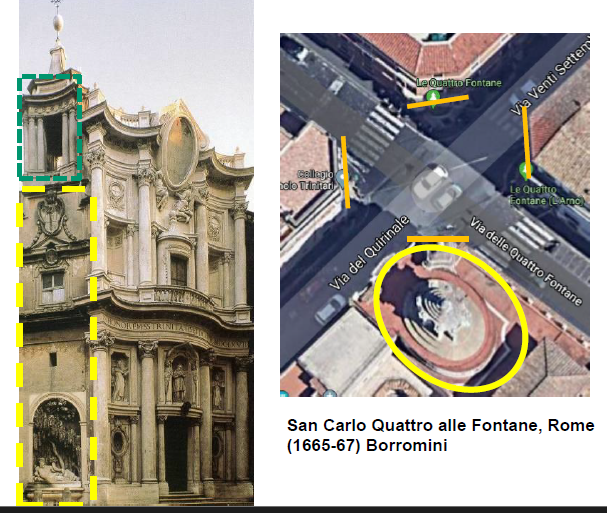
Worked on St Agnese in Piazza Navona and San Carlo alle Quattro Fontane in Rome.
Introduced innovative forms and expressive content in architecture.
Notable Works and Concepts
Francesco Borromini
Santa Agnese, Piazza Navona:
Facade and interior demonstrate dynamic forms and innovative design elements.
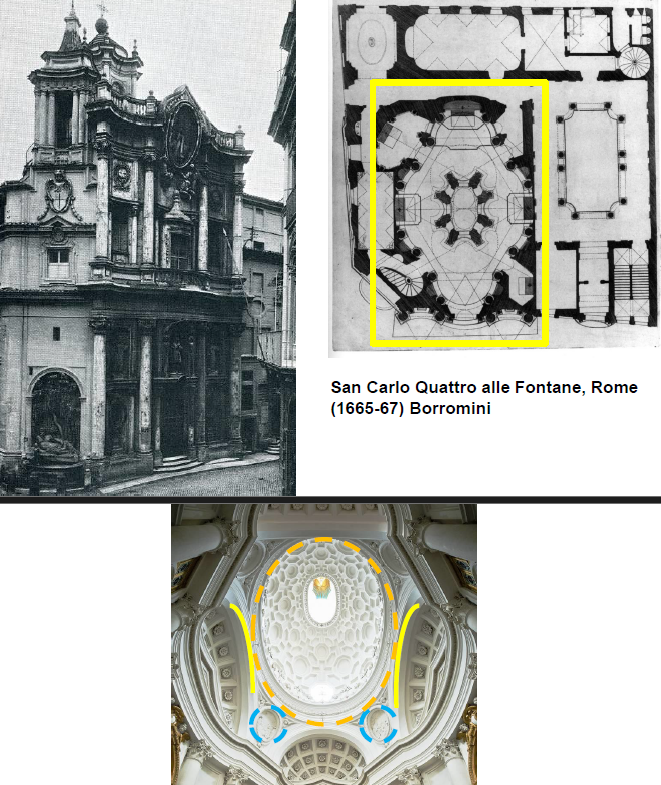
San Carlo alle Quattro Fontane:
Project showcases curved lines and complex spatial arrangements.
Conclusion
Detailed Components of Baroque Architecture
Layout:
Churches organized around a central axis to integrate with urban environments while maintaining an authoritarian vision.
Dynamic, extending spaces that invite participation.
Conclusion on Baroque Churches
Longitudinal Plan:
Emphasizes both longitudinal and vertical axes, with facades serving as gateways into interiors.
Open Axis:
Connects church spaces with the urban environment, highlighting the church's focal role.
Spatial Integration:
Secondary spaces are less independent and become part of a broader architectural narrative.
Spatial Continuity:
Elements of architecture combine to form cohesive designs, merging arts and architecture.
Bernini
= persuasive dynamism create by fusion of
Borromini
= made architectural form itself the carrier of expressive content, space as constitutive
element.
Vocabulary of Baroque Architecture
Centralization: Focusing elements towards a single point or axis.
Extension: Expanding designs beyond conventional limits.
Principle of quadratura: Combining actual and implied movement within designs.
Sotto in su & chiaroscuro: Techniques giving the illusion of depth and infinity.
Plasticity: The expressive qualities of forms that project dynamism.
Juxtaposition: Placing contrasting elements side by side for visual impact.
Giant order: Use of large classical columns for emphasis.
This comprehensive breakdown covers the major aspects of Baroque architecture, emphasizing how these elements serve the narrative of the Counter-Reformation and the persuasive role architecture played in congregational participation.
Giacomo Barozzi da Vignola & Giacomo della Porta
Church of Il Gesù (Consecrated 1584)
Ceiling fresco: The Triumph of the Name of Jesus, by Il Baciccio (Giovanni Battista Gaulli, 1672-1685)
Overview of Baroque Architecture
Baroque architecture marks a significant evolution in architectural design, characterized by its bold and dynamic forms, elaborate ornamentation, and the use of light and shadow to create dramatic effects. This architectural style emerged in the late 16th century, primarily in Italy, before spreading throughout Europe. It examined the transition from the Gothic structures of the Middle Ages through the Renaissance ideals of symmetry and proportion, culminating in the exuberance of the Baroque period.
The Reformation and Counter-Reformation played a crucial role in shaping the Baroque movement. The Catholic Church's response to the Protestant Reformation sought to reaffirm its power and appeal to the populace, which significantly influenced architectural styles and methodologies.
Key Topics:
Introduction:
New Epoch: The Baroque period represents a new epoch in architecture, distinguished by an emphasis on emotional engagement and sensory experiences.
Reformation and Counter-Reformation: The historical contexts of the Reformation led to a reevaluation of architecture as a tool for conveying religious messages and engaging the faithful.
The Church
Persuasion and Participation: The architecture of Baroque churches was designed to foster participation and emotional responses, turning worship into an immersive experience. This is particularly evident in the design and decoration of Il Gesù, which uses architectural elements to invite congregation interaction and enhance spiritual engagement.
Il Gesù: Recognized as the mother church of the Jesuit order, Il Gesù exemplifies the Counter-Reformation's architectural style, characterized by its stark yet dramatic façades and richly decorated interiors that guide the worshiper's experience.
Baroque Architecture
Articulation: The features of Baroque architecture are marked by intricate detailing, a sense of movement in the forms, and lavish decorations that include stucco, gilding, and frescoes.
Intention: Architects aimed to invoke emotion, spirituality, and a sense of community through their designs, often employing grandiose scale and ornamentation to overwhelm and inspire.
Characteristics: Prominent characteristics of Baroque architecture include dynamic forms, elaborate detailing, dramatic spaces, and a focus on integrating light and color to create vibrant atmospheres.
Gian Lorenzo Bernini (1598-1680)
Key works include the Piazza at St. Peter’s Basilica in Rome, which reflects his masterful ability to blend architecture with sculpture, creating a lively public space that draws visitors in.
Known for persuasion through dramatic architecture, Bernini’s works often embody theatricality, inviting viewers to engage with the space emotionally and spiritually.
Francesco Borromini (1599-1667)
Worked on St Agnese in Piazza Navona and San Carlo alle Quattro Fontane in Rome, showcasing his innovative approach to spatial configuration and form.
Introduced innovative forms and expressive content in architecture, employing complex geometries and a fluidity of space that broke away from traditional rectilinear forms.
Conclusion
The impact of Baroque architecture can be seen in its intricate integration of various design elements, storytelling, and the evocation of movement through space, ultimately serving the narrative of the Counter-Reformation and enhancing congregational participation.
Detailed Components of Baroque Architecture
Layout:
Churches were organized around a central axis, which allowed them to integrate seamlessly with the urban landscape while upholding a vision of hierarchical authority.
Dynamic, extending spaces encouraged congregation participation, enhancing the experiential aspect of worship.
St. Peter's Basilica Timeline
1546: Michelangelo’s original plan based on Bramante’s designs called for a Greek cross layout dominated by a massive central dome, symbolizing the celestial and the divine.
1606-12: Modifications by Maderno introduced three additional bays and an extended façade to better accommodate the burgeoning liturgical requirements, effectively transforming the church’s silhouette.
1637: Bernini’s design of the overarching piazza creates a vast public gathering space that emphasizes the church's grandeur and invites social interaction and reflection.
Notable Works and Concepts
Gian Lorenzo Bernini
St. Peter’s Basilica:
Major contributions include the harmonious central layout and the grand piazza, which reflects the intersection of architectural form and public space.
Engagement: His work is known for utilizing architecture to create interaction and emotional responses, often leading to a deeper connection among congregants and their faith.
Francesco Borromini
Santa Agnese, Piazza Navona:
The facade and interior demonstrate dynamic forms and innovative design elements that challenge conventional architectural perspectives.
San Carlo alle Quattro Fontane:This project showcases curved lines and complex spatial arrangements, epitomizing the Baroque's fluidity in design and its break from rigid classical traditions.
Conclusion on Baroque Churches
Longitudinal Plan:
Emphasizes both longitudinal and vertical axes, with façades serving as gateways into richly detailed interiors, often creating a grand sense of arrival.
Open Axis:
Connects church spaces with the urban environment, highlighting the church’s role as a central focal point within the community.
Spatial Integration:
Secondary spaces are designed to be less independent and integrate smoothly into the overall architectural narrative, creating a unified experience.
Continuity:
Elements of architecture combine cohesively to form designs that harmoniously merge different art forms, reflecting the philosophical and theological ideals of the Baroque movement.
Vocabulary of Baroque Architecture
Centralization: Focusing all elements towards a single point or axis which becomes a focal point within the space.
Extension: Expanding architectural designs beyond conventional limits to create a sense of boundlessness.
Principle of quadratura: Involves combining actual and implied movement within designs, often creating an illusion that guides the eye.
Sotto in su & chiaroscuro: Techniques that produce the illusion of depth and spatial infinity, enhancing the viewer's experience of the architecture.
Plasticity: The expressive qualities of architectural forms that project dynamism and vitality within the design.
Juxtaposition: Placing contrasting elements side by side to create visual impact and highlight artistic intent.
Giant order: The use of large classical columns for emphatic structural support while also serving aesthetic purposes.
This comprehensive breakdown covers the major aspects of Baroque architecture, emphasizing how these elements serve the narrative of the Counter-Reformation and the persuasive role architecture played in congregational participation, fundamentally reshaping the architectural landscape of its time.