Groups
The Nature and Purpose of Group Living
A group has been described as “a collection of individuals who have relations to one another that make them interdependent to some significant degree.”
Social Facilitation
What effect does the presence of other people have on human performance?
Does the presence of others typically help or hinder performance, or does it have no effect at all?
Social facilitation
initially a term for enhanced performance in the presence of others; now a broader term for the effect, positive or negative, of the presence of others on performance
Initial Research
The first social psychology experiment:
Triplett (1898) observed that cyclists recorded faster times when competing against others than when racing alone.
He designed an experiment to test whether the presence of others facilitates human performance
Triplett assigned groups of children to reel in fishing lines alone and beside another child and found faster times when the child was co-acting with another person.
He concluded that the presence of others facilitates performance.
He coined the term social facilitation becuase of this experiment
However, subsequent studies showed that often the presence of others can impair performance.
EX: Math, memory, complex cognition proves this idea!
Resolving the Contradictions
Zajonc’s theory of mere presence
The presence of others increases arousal, and arousal increases an individual’s dominant responses.
Nervous system arousal
Difference between Zajonc’s theory and Triplett is Zajonc focuses on arousal!
This theory is well supported!
Dominant Response
Dominant response
in a person’s hierarchy of possible responses in any context, the response she is most likely to make
For an easy or well-practiced task, the dominant response is often correct.
Like reeling a fishing line.
For a difficult or novel task, the dominant response is often incorrect
If it is new or hard, the higherarchy is not built for you becuase you don’t do this behavior often. Therefore, the dominant response is wrong
Two Pathways that occur!
Zajonc’s Model of Social Facilitation

Testing the Theory
Thus, the presence of others can facilitate performance of easy tasks but may impair performance of difficult tasks.
Zajonc et al. examined the effects of social facilitation using cockroaches running mazes in the presence or absence of other roaches.
In the presence of spectator roaches, the test roaches ran faster through a simple maze but slower through a complex maze
Social Facilitation in Other Species

Mere Presence or Evaluation Apprehension?
Evaluation apprehension
people’s concern about how they might appear to others, or be evaluated by them
A study found participants made more dominant responses in front of an audience that could evaluate their performance than when in front of an audience that could not see them or when they performed alone
Evaluation Apprehension and Social Facilitation

Testing for Evaluation Apprehension
A study examined how fast people changed their shoes when they were alone (unaware of being observed) compared to when other people were present.
Even though participants had no sense of being evaluated while changing their shoes, they did so faster in the presence of another person even if that person wasn’t watching them.
Social Facilitation and the Effect of an Audience
Alone | Merely Present Audience | Attentive Audience | |
Well Learned Tasks (Own Shoes) | 16.5 Seconds | 13.5 Seconds | 11.7 Seconds |
Novel Tasks (lab shoes, socks and coat) | 28.8 Seconds | 32.7 Seconds | 33.9 Seconds |
Novel tasks increase in time when people are paying attention!
Beyond Social Facilitation
People are complex stimuli, and their presence can have a variety of effects that overlay the influence of mere presence examined here.
People are often very concerned about making a good impression, and their evaluation apprehension can intensify arousal and lead to more pronounced social facilitation effects.
Social Loafing
The tendency to exert less effort when working on a group task in which individual contributions cannot be monitored
Reasons:
Assumption that someone else will do the work
People assume that their contribution will not be useful or helpful
I’m worried that the group with think my part of the project is bad!
Group Decision Making
When people come together in groups, one of the most important things they do is make decisions.
Much of the research on group decision making has been guided by the assumption that decisions made by groups are typically better than those made by individuals. Many heads are better than one.
Yet, in many contexts, group decisions are no better than those rendered by individuals
Group Think
Groups that are highly cohesive can produce poor group decisions because maintaining group harmony may be emphasized over making an accurate judgment.
People hate dissenting!
Historic examples of groupthink:
the Kennedy administration’s invasion of Cuba’s Bay of Pigs without providing proper air cover
the Johnson administration’s decision to increase the number of American soldiers fighting in Vietnam
the conclusion by U.S. naval high command that extra precautions were not needed at Pearl Harbor despite warnings of an imminent attack by the Japanese
Symptoms and Sources of Groupthink
Groupthink
faulty thinking by members of highly cohesive groups in which the critical scrutiny that should be devoted to the issues at hand is subverted by social pressures to reach consensus
Self-censorship
withholding information or opinions in group discussions
Elements of Janis’s Groupthink Hypothesis

Conditions that must be met for groupthink to occur
High cohesion in the group, insolation of the group, directive leadership, lack of standardized proceedures, high stress
Beore any gorup think occurs, these must happen
Concurrence seeking
Groups are motivated to come to a unainous decision
Group think will now happen
the belief that our decision is the best, thinking that the group is invulnerable
People won’t look for alternatives, not look at things objectively
The Dangers of Group Think
In many group decision-making scenarios, group decisions tend to be more extreme.→ Group Polarization
Group discussions may encourage a favorable view of extreme viewpoints, and so the group decision becomes more extreme.
Preventing Groupthink
Group leaders should refrain from making their opinions known at first.
People will otherwise fall in line to appease the leader
Group leaders should discuss important decisions with each member individually. Individuals then feel free to express their opinions during the group discussion.
Prevents a group from forming
Bring in outside opinions.
Assign a “devil’s advocate.”
Develop an alternate plan
Group Polarization
The tendency for group decisions to be more extreme than those made by individuals; whatever way the individuals are leaning, group discussion tends to make them lean further in that direction
This happens because of two differnet reasons:
The “Persuasive Arguments” Account
Persuasive arguments
Exposure to additional arguments in favor of one’s preexisting opinion strengthens that opinion.
If you hold an opinion, and the group provides more evidence for your opinion, then you will support that opinion even more!
Example: We have a group of people who are talking about the idea of strict puishments for criminals. Everyone in the group supports the idea of strict punishments. Durring the discussion, the group memebrs come up with reasons for strict punishments are a good idea. Since the group members already held the idea of supporting punishmnent. Just by virtue of people listing and arguing for it, people are persuaded to support it even more!
The “Social Comparison” Interpretation
Social comparison
compares self to others, with the drive to be “better” than others
If others express similar opinions, we may take a more extreme position to differentiate ourselves.
Example: If everyone in the group is way more extreme in their beliefs than you, then you will think ‘i’m not firm enough in my beliefs” and your throught process becomes even stronger!
Power and Social Hierarchy
Power
the ability to control one’s own outcomes and those of others; the freedom to act
Power is relational: an individual’s power varies from one relationship to another.
Social Hierarchy
The relational nature of power manifests in a social hierarchy, or an arrangement of individuals within a group in terms of their relative power.
Characteristics of Leaders
How do people become leaders within social hierarchies?
Leadership is not based on expertise, knowledge, and technical skill alone.
Alongside expertise and social skills, someone who can provide rewards to the group is more likely to rise to a leadership role.
There will be people who will have connections, and bring in things… does this make a person a good leader?
The Elements of Power
Status
the outcome of an evaluation of attributes that produces differences in respect and prominence, and which contributes to determining a person’s power within a group
Can influence power and leadership
When people function as leaders, part of it is because they are exerts, give rewards, or can build respect.
Gaining Power

Understand the four virtues and three vices
These four are also based on philosophy
These vices are also called the Dark Triad
A super bad combination for a leader to have
Power and Intimidation
Clear and inaproprate crossing of boundreis/personal space
When people gain power, you run the risk of people acting socially inapropreate because they can get away with it
How Power Shapes Thought and Action
Approach/inhibition theory
This theory maintains that high- power individuals are inclined to go after their goals and make quick (and sometimes rash) judgments, whereas low-power people are more likely to constrain their behavior and pay careful attention to others.
The people who have power feel like they can make quick, rash judgements. People who don’t have power cannot make quick decisions because they have to think the decision through
Example: You are a CEO of a company, and are super powerful. Some of the things that you can do as the CEO is to make decisions without consulting people, take major risks with the company, treat your employees poorly. If you are now a newly hired employee at the bottom of the higherarchy, you cannot make decisions all by yourself with impulsivity. You hesitate more, get approval, and you cannot challange leaders.
The Influence of Power on Behavior
The approach/inhibition theory of power has two core predictions:
The first element concerns the influence of power on how people perceive others.
do leaders have empathy towards others
The second element is the prediction that power should make people behave in less constrained and at times more inappropriate ways
If you have power, you have a green light. Do whatever you want
If you don’t have power, you have a yellow light. Slow down and be careful
Power and Empathy Failures

Participants were induced to think of a time they felt very powerful or a time they felt powerless. The researches then had people draw an E on their forhead. If you could take the perspective of a person accross from you, then you should be able to draw the E so that the person across from you could read it (empathy)
Those in power were shown to have low empathy
Those low in power to shown to have high empath
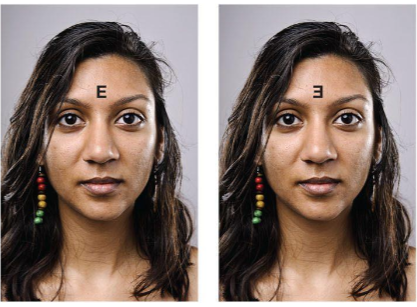
Power and Unethical Behavior
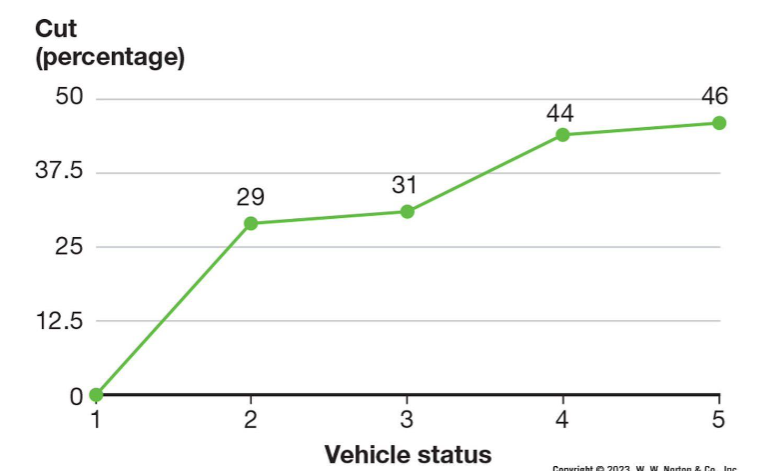
1 are old cars, 5 are super fancy luxury cars. The percentages shown are how often each type of car would cut padestrians off from corssing the sreeet. If you had an old car, they would not cut people off. If you had a fancy car, you would do it 46% of the time.
Deindividuation and the Psychology of Mobs
Why would people in group settings deindividualize?
Deindividuation and the Group Mind
Many aspects of human behavior only arise when people are in groups.
Deindividuation
a reduced sense of individual identity accompanied by diminished self-regulation that can come over people when they are in a large group
People do behaviors that they normally would not do
Decrease in self-awareness resulting in decreased self- regulation and greater conformity to surrounding group norms
Deindividuation results from feelings of anonymity, lack of accountability, and the energizing effects (increase in arousal) of being lost in a crowd
A Model of Deindividuation
Philip Zimbardo (1970) proposed a theoretical model of deindividuation that specifies how certain conditions create the kind of psychological state that promotes the impulsive and often destructive behaviors observed in mobs.
A Theoretical Model of Deindividuation

In order for deindividuation for occur: there must be 3 parts
The first part is most important because it sets the stage for deindividualization to occur
First: Anticedent Conditions
Anonymity
Diffusion of responsibility
Energizing effect of other
Stimulus Overload
Second: Internal State (Deindividuation)
Lesseded self-observation and self-evaluation
Lesseded conserns with the evaluations of others
Weakening of internal controls
Lessens concern with shame, guilt, fear, committment
Third: Behavioral Effects
Impulsivity
Irrationality
Emotionality
Antisocial activity (Causes Problematic, criminal activity)
Effects of Deindividuation
Deindividuation often results in more impulsive, emotional, irrational, and antisocial behaviors.
Historic examples of deindividuation include lynch mobs, riots, and military atrocities.
mercyhurst beats Ohio State at Football, we all strom the field. While it is deindividuation, it is not criminal
Testing the Model:
The Conduct of War
The conduct of war
Deindividuation may encourage greater levels of brutality directed at groups that are seen as enemies or rivals.
Increase of brutality happens when we deindividualize ourselves
Halloween Mayhem
In America, many forms of uninhibited and impulsive behaviors occur on Halloween.
The disguised identities of Halloween costumes may lead to deindividuated states.
Halloween study (Seattle, 1976)
Experimenters placed bowls of candy at 27 homes.
Children arrived alone or in groups and were told to take one piece of candy.
After the adult left, 57 percent of children in groups took extra candy, but only 21 percent of children who were alone did so.
If the adult asked for names before going inside the house, there is a dramatic change in data.
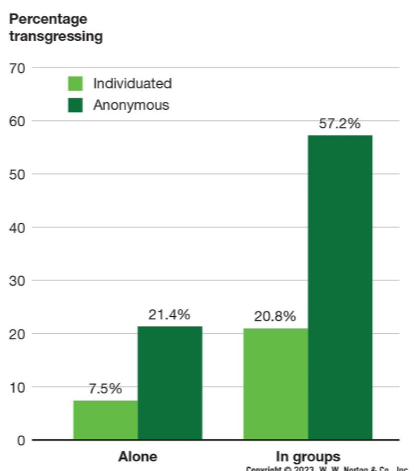
Kids who are anonymous had higher rates then kids who were named.
Self-Awareness and Individuation
Individuation
an enhanced sense of individual identity produced by focusing attention on the self, which generally leads people to act carefully and deliberately and in accordance with their sense of propriety and values
Studies of Self-Awareness
Self-awareness theory
a theory maintaining that when people focus their attention inward on themselves, they become concerned with self- evaluation and how their current behavior conforms to their internal standards and values

In the study there was a coffee cart. If you used any of the milk/creamer, you were supposed to put money in the jar to pay for it. In the study, they changed the conditions. Near the cart, there was a picture of flowers or a man staring at you. One issue with the study is because different people came up to the coffee cart, it is not standard
Self-Consciousness and the Spotlight Effect
Spotlight effect
individuals’ conviction that other people are paying attention to them (to their appearance and behavior) more than they actually are
We as humans are over confident/over critical about how often people are paying attention to us