Ch. 21 - Accounting Changes and Error Analysis
Categories and Foundations of Accounting Changes
Financial accounting recognizes three distinct types of accounting changes: changes in accounting principle, changes in accounting estimate, and changes in the reporting entity. A change in accounting principle involves shifting from one generally accepted accounting method to another generally accepted accounting method, exemplified by transitioning inventory valuation from the Last-In, First-Out (LIFO) method to the First-In, First-Out (FIFO) method. A change in accounting estimate constitutes an adjustment to a previously estimated figure necessitated by new information, subsequent experience, or subsequent developments, such as revising the useful life or salvage value of a depreciable asset. A change in the reporting entity occurs when an organization prepares financial statements that represent, in substance, a different reporting structure or economic entity from the one reported in previous periods, such as presenting consolidated statements in lieu of individual company reports.
The conceptual framework establishes that financial information must possess the fundamental qualitative characteristics of relevance and faithful representation, enhanced by comparability and consistency. Comparability enables financial statement users to identify similarities and differences between economic phenomena across different entities or timeframes. Consistency denotes the uniform application of identical accounting methods to similar economic events across successive reporting periods. Any accounting change inherently disrupts consistency and impairs the comparability of financial data across accounting intervals, creating tension with the conceptual framework. Consequently, accounting standards permit changes in accounting principles and estimates only when accompanied by rigorous disclosures that enable statement users to reconstruct comparative relationships and understand the economic substance behind the variance.
Two general approaches govern the reporting of accounting changes: the retrospective method and the prospective method. Under the retrospective approach, an entity restates prior-period financial statements presented in the annual report as if the newly adopted principle or reporting entity had always been in use. This method requires adjusting the opening balances of assets and liabilities for the earliest period presented to reflect cumulative effects from earlier intervals, recording an offsetting cumulative adjustment to opening retained earnings (or other appropriate equity components) for the earliest period presented, and restating the individual line items of all comparative statements presented. In contrast, the prospective approach implements the change exclusively within the current operating period and applicable future periods. The prospective method treats all prior-period reports as closed and definitive, prohibiting retroactive modifications to historical accounts or opening balances.
Accounting for Changes in Accounting Principle
Changes in accounting principle arise under two distinct classifications: mandatory changes and voluntary changes. Mandatory changes occur when standard-setting bodies issue new accounting standards that obligate reporting entities to adopt revised policies. Voluntary changes take place when enterprise management elects to change existing principles on its own initiative, such as shifting from FIFO to average-cost inventory valuation. Voluntary modifications are permissible solely when management demonstrates that the newly adopted principle is preferable because it more accurately portrays the financial position and operating results of the entity. The initial adoption of an accounting principle to record events or transactions occurring for the first time, or that were previously immaterial, does not constitute an accounting change.
Entities must account for all changes in accounting principle using the retrospective method, subject to two specific exceptions. The first exception occurs when a newly issued standard mandating a change prescribes explicit transitional requirements that override standard retrospective treatment. The second exception arises when retrospective application is deemed impractical. Impracticality is established if any of three statutory conditions exist: the financial statement effects of retrospective application cannot be determined after reasonable effort; retrospective application requires assumptions regarding management intent in a prior historical period; or retrospective application necessitates significant estimates for a prior period whose underlying information cannot be objectively verified.
Principles changes generate both direct and indirect economic effects. Direct effects represent the balance sheet and income statement adjustments strictly necessary to execute the change in principle, such as altering inventory carrying values, related cost of goods sold, and deferred income taxes. Direct effects are applied retrospectively unless impracticality is demonstrated. Indirect effects represent modifications to current or future cash flows resulting secondarily from implementing the new principle, such as contractual adjustments to executive profit-sharing bonuses or royalty agreements tied to reported net income. Indirect effects are accounted for strictly on a prospective basis; retrospective application of indirect effects is explicitly prohibited.
Comprehensive Retrospective Principle Change: Topeka Tile Company Case Study
Topeka Tile Company commenced operations on January 1, , and elected at the beginning of to change its inventory valuation method from FIFO to the average-cost method for financial reporting purposes while maintaining FIFO for income tax calculations. The company is subject to an income tax rate of , has declared zero dividends, and maintains historical accounting records sufficient to execute retrospective application. In its December 31, annual report, Topeka Tile Company presents comparative income statements and statements of retained earnings for , , and , along with comparative balance sheets as of December 31, and December 31, .
The inventory valuation model adheres to the fundamental equation where the sum of beginning inventory and purchases defines the cost of goods available for sale, which in turn equals cost of goods sold plus ending inventory:
Over the company operating history, recorded purchases were in , in , in , in , and in . Operating revenues were in , in , in , in , and in . Operating expenses were recorded at in , in , in , in , and in . Cost of goods sold under the original FIFO method was in , in , in , in , and in . Under the newly adopted average-cost method, cost of goods sold is in , in , in , in , and in .
Evaluating the general ledger inventory accounts reveals the comparative ending inventory balances across each year of operations. In , beginning with an inventory of and purchases of , the cost of goods available for sale was ; subtracting FIFO cost of goods sold of produced ending inventory of , whereas subtracting average-cost cost of goods sold of produced ending inventory of . In , additions of in purchases yielded available goods of under FIFO and under average-cost; subtracting cost of goods sold of (FIFO) and (average-cost) left ending inventory balances of and , respectively. In , purchases of produced available goods of (FIFO) and (average-cost); deducting cost of goods sold of and resulted in ending inventories of and . In , purchases of created available goods of (FIFO) and (average-cost); subtracting cost of goods sold of and yielded ending inventories of and . In , purchases of expanded available goods to (FIFO) and (average-cost); deducting cost of goods sold of and settled final ending inventories at under FIFO and under average-cost.
Because the company retained FIFO for income tax purposes, the tax basis of inventory exceeded the financial reporting carrying value, creating temporary timing differences that generated deferred tax assets. As of December 31, , the tax inventory of exceeded book inventory of by , establishing a deferred tax asset of:
0.40 \times (\"\$23,000\" - \"\$16,400\") = \"\$2,640\"
As of December 31, , the tax inventory of exceeded book inventory of by , establishing a deferred tax asset of:
0.40 \times (\"\$36,000\" - \"\$26,700\") = \"\$3,720\"
The schedule of income statement and retained earnings adjustments requires tracking the net-of-tax differential between FIFO and average-cost cost of goods sold. In , the pretax net income decreased by , generating a net-of-tax reduction (") of , and an identical cumulative reduction of . In , pretax income decreased by , reducing net income by and yielding a cumulative retained earnings decrease of . In , pretax income declined by , reducing net income by and pushing cumulative retained earnings down by . In , pretax income declined by , reducing net income by and creating a cumulative retained earnings decrease of . In , pretax income fell by , generating a net income decrease of and bringing the cumulative net-of-tax reduction to .
The restated comparative income statement for the three-year reporting period reports all figures using the average-cost method:
\begin{array}{lrrr}\n\textbf{Income Statement} & \mathbf{2023} & \mathbf{2022\text{ (as adjusted)}} & \mathbf{2021\text{ (as adjusted)}} \\\n\hline\n\text{Revenues} & \"\$20,000\" & \"\$32,000\" & \"\31,000\" \\\n\text{Cost of Goods Sold} & (4,700) & (6,200) & (7,400) \\\n\text{Operating Expenses} & (7,000) & (11,000) & (9,000) \\\n\hline\n\text{Net Income before Tax} & \"\8,300\" & \"\$14,800\" & \"\$14,600\" \\\n\text{Income Tax Expense } (40\%) & (3,320) & (5,920) & (5,840) \\\n\hline\n\text{Net Income} & \"\$4,980\" & \"\$8,880\" & \"\$8,760\"\n\end{array}
The statement of retained earnings initiates adjustments on the opening balance of the earliest period presented, which is December 31, . Beginning with the previously reported balance of , deducting the cumulative effect of the accounting change of yields an adjusted balance of . Adding adjusted net income of establishes the adjusted December 31, balance of . Adding adjusted net income of produces the adjusted December 31, balance of . Incorporating net income of results in an ending balance of on December 31, .
The comparative balance sheets reflect restated balances for December 31, and current balances for December 31, . Cash remains unchanged at original figures ( in ; given as in "), liabilities remain constant at , and common stock remains constant at . Adjusted inventory sits at for and for . Deferred tax assets are reported at for and for . Total assets equal for and for . Total liabilities and stockholders equity balance exactly at () for and () for .
Because books for prior periods are formally closed, Topeka Tile Company records the cumulative transition entry on January 1, . The entry debits Retained Earnings by (the after-tax cumulative reduction through December 31, ), debits Deferred Tax Assets by (the tax timing benefit through December 31, ), and credits Inventory by (the pretax difference between FIFO inventory of and average-cost inventory of ):
\begin{array}{lrr}\n\textbf{Date: January 1, 2023} & \textbf{Debit} & \textbf{Credit} \\\n\hline\n\text{Retained Earnings} & 3,960 & \\\n\text{Deferred Tax Assets} & 2,640 & \\\n\quad \text{Inventory} & & 6,600\n\end{array}
Prospective Application for Principle Changes and Impracticality
When an entity faces conditions rendering retrospective calculation impractical, standard-setting guidelines require prospective reporting. In such instances, historical financial statements remain unmodified. If Topeka Tile Company lacks sufficient accounting records to determine historical inventory costs retrospectively, it adopts the average-cost method prospectively beginning in . The inventory balance determined under the prior FIFO method at the end of the preceding year (December 31, ), amounting to , serves as the opening inventory balance for .
Under prospective implementation, the cost of goods sold calculation combines the legacy FIFO beginning inventory of with purchases of to establish available goods of . Deducting the average-cost ending inventory balance of yields a cost of goods sold of :
\begin{array}{lr}\n\text{Beginning Inventory (FIFO)} & \"\23,000\" \\\n\text{Plus: Purchases} & 15,000 \\\n\hline\n\text{Cost of Goods Available for Sale} & \"\38,000\" \\\n\text{Less: Ending Inventory (Average-Cost)} & (26,700) \\\n\hline\n\text{Cost of Goods Sold} & \"\$11,300\"\n\end{array}
The resulting income statement for reports revenues of , cost of goods sold of , and operating expenses of , producing pretax income of . Applying the " tax rate produces income tax expense of and net income of . Comparative income statements for and remain exactly as originally reported under FIFO: net income is (revenues of , COGS of , expenses of , pretax income of , tax of ") and net income is (revenues of , COGS of , expenses of , pretax income of , tax of ").
The prospective statement of retained earnings incorporates zero adjustments to opening equity. The retained earnings balance at December 31, is maintained at its original . Adding original net income of establishes a December 31, balance of . Incorporating original net income of brings the December 31, balance to . Adding the prospective net income of yields an ending retained earnings balance of as of December 31, , which corresponds to the identical ending retained earnings reached under retrospective application.
The balance sheet under prospective treatment leaves the December 31, statement as originally issued: cash of , inventory of , deferred tax assets of , total assets of , liabilities of , common stock of , and retained earnings of . For December 31, , the balance sheet is identical to the retrospective report: cash of , average-cost inventory of , deferred tax assets of (40\% \times (\"\$36,000\" - \"\$26,700\")""), total assets of , liabilities of , common stock of , and retained earnings of .
Entities enacting any change in accounting principle must include six required disclosures in the footnotes during the period of adoption: a comprehensive description of the nature of the change; management formal justification establishing why the newly adopted principle is preferable; specification of the implementation method utilized (retrospective or prospective); a detailed description of all prior-period information restated; the quantitative effect of the change on income from continuing operations, net income, applicable per-share amounts, and any other affected financial line item across all periods presented; and the cumulative effect of the change on retained earnings reported on the earliest balance sheet presented.
Accounting for Changes in Accounting Estimates
Revisions to accounting estimates represent adjustments to carrying amounts of existing assets or liabilities resulting from ongoing reassessments, improved operational experience, or the emergence of new information. Accounting estimates are pervasive and unavoidable across standard business operations, frequently governing areas such as the allowance for doubtful accounts, depreciation and amortization schedules, provisions for obsolete inventory, and actuarial assumptions underlying pension liabilities. Because revisions of estimates are a natural consequence of the passage of time and operational learning, entities must account for all changes in estimate using the prospective method. Under this treatment, revised estimates apply exclusively to the current period and applicable future periods, without modifying prior financial statements or opening equity balances.
The operational mechanics of a change in estimate are demonstrated by Adelaide Manufacturing Company, which acquired an industrial plant asset for on January 1, . The company depreciated the asset using the straight-line method based on an estimated useful life of years with zero salvage value, recording annual depreciation expense of:
\frac{\"\1,000\"}{10\text{ years}} = \"\100\text{ per year}\"
On January 1, , after utilizing the equipment for full fiscal years, accumulated depreciation stood at , leaving a net book value of (). Management assessed that an intensive maintenance program instituted years prior had extended the machine operational longevity, projecting an additional years of productive service rather than the years remaining under the initial estimate. The revised annual depreciation expense from onward is calculated by dividing the carrying value by the extended remaining useful life:
\frac{\"\400\"}{8\text{ years}} = \"\50\text{ per year}\"
Adelaide Manufacturing Company recognizes in depreciation expense annually starting in through the eventual retirement of the machine. The company makes zero adjustments to depreciation recognized from through .
A specific variant occurs when an entity executes a change in accounting estimate effected by a change in accounting principle, wherein the policy change is inseparable from revised estimates of future economic utility. A standard instance involves altering a depreciation method, such as moving from accelerated depreciation to straight-line based on updated patterns of economic asset consumption. Even though changes in principle normally demand retrospective application, changes in principle inseparable from changes in estimate must be accounted for prospectively as changes in estimate. Nevertheless, footnote disclosures for such transactions must comply with the expanded disclosure standards governing changes in accounting principle.
Disclosures for standard changes in accounting estimate require firms to report the quantitative impact on income from continuing operations, net income, and corresponding per-share metrics for the current period whenever the revision alters multiple operating periods. Footnotes must document the operational justification validating the revised estimate. Entities are exempt from disclosing revisions to recurring operational estimates, such as routine adjustments to bad debt reserves or inventory obsolescence, unless those revisions are materially significant.
Accounting for Changes in the Reporting Entity
A change in the reporting entity arises when an enterprise issues financial statements that represent an entity structure substantively different from that presented in preceding periods. Standard corporate situations triggering a change in reporting entity encompass three primary circumstances: presenting consolidated or combined financial statements in place of separate individual statements of affiliated enterprises; changing the specific corporate subsidiaries that comprise the consolidated economic group; and modifying the corporate entities incorporated within combined financial statements.
Entities must account for any change in the reporting entity using the retrospective method. This requires restating the financial statements of all prior comparative periods presented to depict the financial condition and operating results as if the current organizational configuration had been operative throughout those timeframes. Retrospective realignment restores comparative utility and rectifies the discontinuity that would otherwise impair long-term longitudinal analysis.
Disclosures accompanying a change in the reporting entity must outline the operational nature of the corporate reorganization alongside management explicit reasons for the restructuring. Furthermore, the notes must quantify the specific impact of the structural change on income from continuing operations, net income, other comprehensive income, and relevant per-share measurements across every reporting period presented in the comparative statements.
Error Analysis and Corrections: Theoretical Foundations and Balance Sheet Errors
An accounting error is defined as an unintentional mistake occurring within the financial statements, typically originating from mathematical miscalculations, oversight, or the erroneous application of accounting standards. Accounting errors are distinguished from financial fraud by the absence of intentional misrepresentation. When an entity detects an error of material magnitude, standard accounting guidelines mandate correction through the retrospective restatement method. Adjustments affecting historical earnings are recognized as prior-period adjustments charged or credited directly against opening retained earnings.
Under the conceptual framework, faithful representation requires reported information to be complete, neutral, and free from error. Freedom from error does not demand absolute, impossible mathematical perfection across every enterprise transaction; rather, it requires that the reporting processes selected are applied without procedural flaws and that line-item narrative descriptions faithfully depict the underlying economic phenomena. If an error is deemed immaterial, standard restatement procedures are not required. Materiality is determined through professional accounting judgment rather than universal numerical thresholds, evaluated by assessing whether an omission or misstatement could plausibly influence the capital allocation decisions of reasonable financial statement users.
Balance sheet errors involve the misclassification of accounts restricted entirely to asset, liability, and equity classifications, exerting zero direct effect on income statement accounts or aggregate net income. A typical example involves recording a long-term note receivable incorrectly as a short-term trade receivable. Upon discovery, correcting a balance sheet error requires three procedural actions: reclassifying the incorrectly stated balances into their appropriate accounts via a journal entry, recording any necessary adjustments to balance sheet accounts, and retrospectively restating any comparative balance sheets presented in subsequent annual reports.
The mechanics of correcting a balance sheet error are illustrated by Douglas Designs, Incorporated. In , the company received a bank note from Phillips Bank, NA, carrying a maturity of years with principal payable in full at maturity. Douglas Designs correctly debited Cash for , but erroneously credited Accounts Payable rather than Long-term Notes Payable. Interest accruals throughout the period were recorded correctly. Auditors detected the classification error in . Because the mistake is confined to balance sheet accounts, the correcting entry executes a direct reclassification between liability accounts:
\begin{array}{lrr}\n\textbf{Date: 2022 Correcting Entry} & \textbf{Debit} & \textbf{Credit} \\\n\hline\n\text{Accounts Payable—Phillips Bank} & 450,000 & \\\n\quad \text{Long-term Notes Payable—Phillips Bank} & & 450,000\n\end{array}
Following the journal entry, Douglas Designs retrospectively restates its comparative balance sheet for to present the obligation correctly within long-term liabilities.
Income Statement Errors and Corrections
Income statement errors entail classification errors restricted strictly to revenues, gains, expenses, and losses. These errors do not impact balance sheet accounts and frequently leave net income completely unaltered, such as recording administrative rent expense mistakenly under selling expenses, or recording an operating gain inside revenue. The procedural response to an income statement error depends entirely on whether discovery happens before or after the closing of the enterprise accounting books.
If an income statement error is identified during the fiscal period of occurrence prior to closing the general ledger, the accountant records a correcting entry reclassifying the balances to their proper revenue or expense lines. If discovery occurs in a subsequent fiscal year after the books have been closed, no correcting journal entry is made. Because nominal accounts close into retained earnings at fiscal year-end, compensating errors within revenues and expenses leave retained earnings correctly stated. However, any historical income statements presented for comparative purposes must be restated to report each revenue and expense line accurately.
This principle is demonstrated by Begg Incorporated, which sold an item of machinery during for a realized gain of . The company erroneously credited Sales Revenue instead of Gain on Sale of Equipment. If Begg Incorporated discovers the error prior to closing the books for , it records a journal entry transferring the balance out of revenue into the dedicated gain account:
\begin{array}{lrr}\n\textbf{Date: 2022 Correcting Entry (Books Open)} & \textbf{Debit} & \textbf{Credit} \\\n\hline\n\text{Sales Revenue} & 35,000 & \\\n\quad \text{Gain on Sale of Equipment} & & 35,000\n\end{array}
If Begg Incorporated uncovers the error in after the ledger accounts are closed, no formal correcting journal entry is permitted or required because Sales Revenue and the unrecorded gain closed out to Retained Earnings with a net zero impact. To satisfy reporting standards, Begg Incorporated restates the comparative income statement when issued alongside the annual report, reducing Sales Revenue by and reporting a Gain on Sale of Equipment of .
Errors Affecting Both Balance Sheet and Income Statement: Self-Correcting Errors
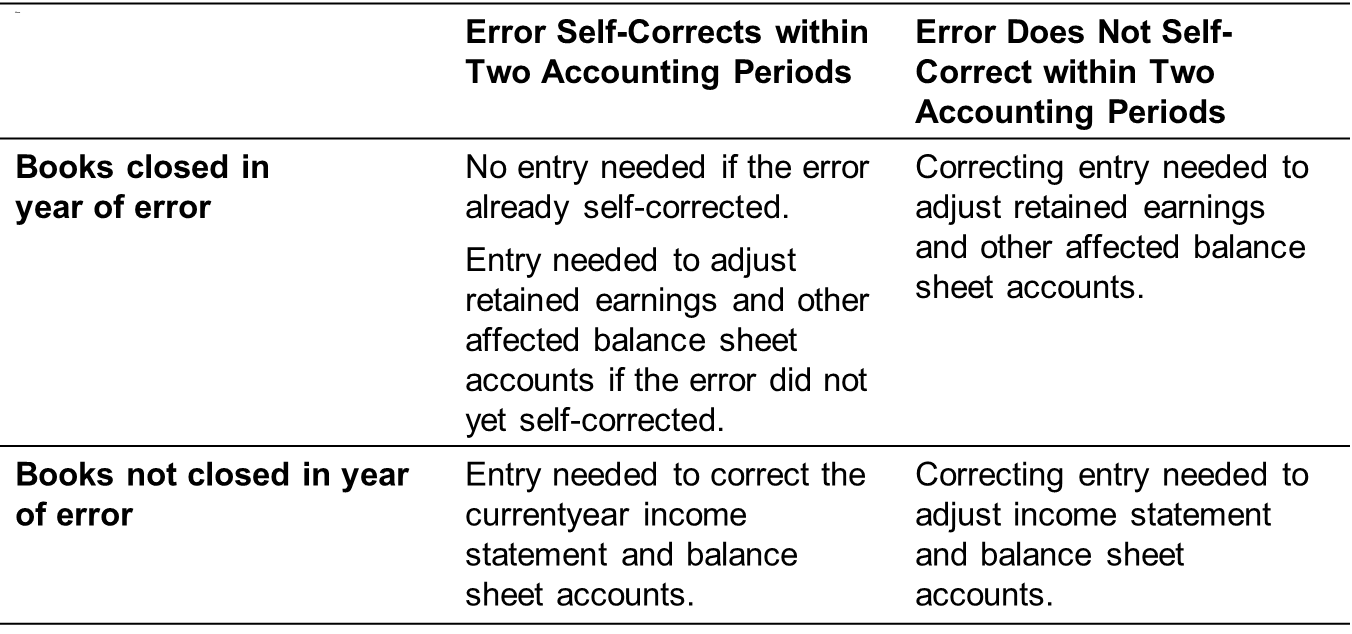
Errors affecting both balance sheet and income statement accounts distort nominal performance and financial position simultaneously. These errors are divided into self-correcting errors and non-self-correcting errors. Self-correcting (or counterbalancing) errors are those that automatically offset and resolve within two consecutive accounting intervals through the standard progression of closing entries.

An ending inventory misstatement represents the quintessential counterbalancing error. If ending inventory is understated in Year 1, cost of goods sold is overstated, causing Year 1 net income and ending retained earnings to be understated, while inventory on the Year 1 balance sheet is understated. In Year 2, the understated ending inventory of Year 1 becomes the understated beginning inventory of Year 2. Assuming purchases and Year 2 ending inventory are recorded accurately, cost of goods available for sale in Year 2 is understated, driving Year 2 cost of goods sold to be understated and Year 2 net income to be overstated by the exact counterbalancing amount. Upon closing Year 2 nominal accounts, the overstatement of Year 2 income offsets the understatement of Year 1 income within retained earnings, bringing the cumulative retained earnings and ending inventory on the Year 2 balance sheet to their correct balances.
The accounting response to a counterbalancing error is governed by two factors: the year in which the error is uncovered and whether the books for that period have been closed. If the error is detected after the books for the second year have closed, the accounts have self-corrected and no journal entry is recorded, though comparative prior-period financial statements must be restated. If the error is discovered after closing the first year but before closing the second year, an adjusting entry is required to adjust opening retained earnings and the affected balance sheet or income statement accounts for the second year. If the error is detected before closing the first year, an adjusting entry corrects the first-year accounts directly.
The counterbalancing process is illustrated by Fazon Associates, which overstated its ending inventory on December 31, , recording instead of the verified balance of , creating an overstatement of . For , beginning inventory was and purchases were , establishing cost of goods available for sale of . Under the erroneous ending inventory of , reported cost of goods sold was , whereas the correct cost of goods sold using the true ending inventory was . Consequently, reported net income was overstated by , closing into an ending retained earnings balance overstated by , while ending inventory was overstated by .
In , the erroneous ending inventory carried forward as a reported beginning inventory of , which alongside purchases of inflated cost of goods available for sale to (compared to the correct based on true beginning inventory of "). Ending inventory for was correctly established at . Subtracting this ending inventory produced reported cost of goods sold of , compared to correct cost of goods sold of . The resulting net income was understated by . When the understated net income closed into retained earnings, it counterbalanced the overstatement from , restoring retained earnings and inventory to their proper balances at the end of .
Corrective action depends on the timing of discovery: if Fazon Associates discovers the error after the books for have closed, the error has fully counterbalanced and requires zero correcting entries, though comparative financial statements for and must be restated. If the error is detected in after the books are closed but before the books close, the company records a debit to Retained Earnings (Prior-period Adjustment) of and credits Inventory by (or adjusts Beginning Inventory/Cost of Goods Sold), while restating comparative cost of goods sold to and reporting cost of goods sold as :
\begin{array}{lrr}\n\textbf{Date: 2022 Correcting Entry (Books Open in 2022)} & \textbf{Debit} & \textbf{Credit} \\\n\hline\n\text{Retained Earnings—Prior-period Adjustment} & 30,000 & \\\n\quad \text{Inventory} & & 30,000\n\end{array}
If the error is identified during prior to closing the books, the correction requires a direct debit to Cost of Goods Sold of and a credit to Inventory of :
\begin{array}{lrr}\n\textbf{Date: 2021 Correcting Entry (Books Open in 2021)} & \textbf{Debit} & \textbf{Credit} \\\n\hline\n\text{Cost of Goods Sold} & 30,000 & \\\n\quad \text{Inventory} & & 30,000\n\end{array}
Non-Self-Correcting Errors and Multi-Period Analysis
Non-self-correcting errors do not offset within a standard two-year accounting horizon. Such errors perpetuate misstatements across balance sheet and income statement accounts indefinitely until explicit correcting entries are entered into the general ledger. Consequently, non-self-correcting errors mandate correcting entries whenever discovered, regardless of whether the books are open or closed, followed by the retrospective restatement of all comparative prior-period financial statements.
The progression of non-self-correcting errors is demonstrated by Underwood Computer Company, which purchased a circuit board stamping machine for on December 31, . The general accountant incorrectly expensed the purchase invoice as Repair Expense. The machinery had a projected useful life of years with zero salvage value, depreciated under the straight-line method at an annual rate of:
\frac{\"\700,000\"}{10\text{ years}} = \"\70,000\text{ per year}\"
If Underwood Computer Company discovers the error on December 31, , prior to closing the books, no depreciation expense is required because the asset was acquired on the final day of the operating cycle. The accountant executes a reclassification entry debiting Machinery for and crediting Repair Expense for :
\begin{array}{lrr}\n\textbf{Date: December 31, 2022 (Books Open)} & \textbf{Debit} & \textbf{Credit} \\\n\hline\n\text{Machinery} & 700,000 & \\\n\quad \text{Repair Expense} & & 700,000\n\end{array}
If the error is discovered in after closing the books, the erroneous repair expense has already closed into Retained Earnings, causing net income and ending retained earnings to be understated by . To correct the ledger in , the company debits Machinery for and credits Retained Earnings (Prior-period Adjustment) for :
\begin{array}{lrr}\n\textbf{Date: 2023 Correcting Entry} & \textbf{Debit} & \textbf{Credit} \\\n\hline\n\text{Machinery} & 700,000 & \\\n\quad \text{Retained Earnings—Prior-period Adjustment} & & 700,000\n\end{array}
At the close of , the company records the standard annual depreciation expense for the current operating cycle:
\begin{array}{lrr}\n\textbf{Date: December 31, 2023} & \textbf{Debit} & \textbf{Credit} \\\n\hline\n\text{Depreciation Expense—Machinery} & 70,000 & \\\n\quad \text{Accumulated Depreciation—Machinery} & & 70,000\n\end{array}
Underwood Computer Company must also retrospectively restate its comparative statements in the annual report, capitalizing the asset and reversing the repair expense.
A more complex multi-period scenario occurs if Underwood Computer Company acquired the stamping machine for on December 31, , erroneously expensed the invoice as Repair Expense, and discovered the error on December 31, , prior to closing the books. Because the asset was acquired on the final day of , zero depreciation was allocable to . However, annual depreciation of was omitted throughout , , and .
Analyzing the cumulative impact on equity reveals that the repair expense overstated expenses by , understating opening retained earnings by . Conversely, omitting depreciation for and ("\70,000" \times 2 = "\) understated expenses, overstating retained earnings by . Consequently, as of January 1, , the net cumulative misstatement in Retained Earnings is an understatement of:
\"\$700,000\" - \"\$140,000\" = \"\$560,000\"
Because the books are currently open, current-year depreciation expense of is recognized in nominal accounts. Accumulated depreciation reflects full years of service (, , and ), totaling (). Underwood Computer Company records a compound correcting entry on December 31, :
\begin{array}{lrr}\n\textbf{Date: December 31, 2022 Correcting Entry} & \textbf{Debit} & \textbf{Credit} \\\n\hline\n\text{Machinery} & 700,000 & \\\n\text{Depreciation Expense—Machinery} & 70,000 & \\\n\quad \text{Accumulated Depreciation—Machinery} & & 210,000 \\\n\quad \text{Retained Earnings—Prior-period Adjustment} & & 560,000\n\end{array}
Alternatively, this adjustment can be separated into two distinct entries: one entry correcting historical balance sheet carrying amounts and prior-period retained earnings (debiting Machinery for , crediting Accumulated Depreciation for , and crediting Retained Earnings for "), followed by the standard entry recognizing current-year depreciation expense (debiting Depreciation Expense for and crediting Accumulated Depreciation for "). The company then retrospectively restates all comparative statements presented for fiscal years , , and .
Correct Answer: A. use the prospective approach
Explanation
The General Rule (Retrospective Method): Under GAAP, a voluntary change in accounting principle normally requires retrospective application. This means prior-period financial statements presented for comparative purposes must be restated, and the opening balance of retained earnings for the earliest period shown is adjusted to reflect the cumulative effect of the change.
The Impracticality Exception: When a company lacks sufficient historical accounting records or information to determine the cumulative effects of the change after making every reasonable effort, retrospective application is considered impractical.
Accounting Treatment when Impractical: When retrospective application is impractical, accounting standards dictate that the entity must apply the change prospectively. Under the prospective approach:
The new principle is applied starting in the current year and carried into all future periods.
The ending carrying value of affected assets and liabilities from the prior period (such as ending inventory) serves as the beginning balance for the year of adoption.
No prior-period financial statements or opening equity balances are restated.
Why the Other Options Are Incorrect
B. estimate the numbers to do so: If retrospective application requires significant estimates that cannot be objectively verified, standard rules consider the method impractical rather than permitting management to guess or approximate past figures.
C. declare the change to be impractical: While the firm identifies the condition as impractical, "declaring impracticality" is merely the rationale, not the accounting method used to record and present the change.
D. be forced to abandon the change: Standard-setting guidelines do not require a firm to abandon an accounting change; instead, they provide the prospective method as an explicit transition path.
Yes, your reasoning is on the right track! Here is the complete explanation of why B (As of January 1 of the current year) is correct under U.S. GAAP:
The Retrospective Requirement Covers the Full Fiscal Year:
Under U.S. GAAP, when a company voluntarily changes an accounting principle (such as switching from FIFO to weighted-average inventory), it must account for the change using the retrospective method. Even though Harvey Co. made the decision on August 31, the newly adopted method must be applied to the entire current calendar year (January 1 through December 31), not just from August 31 onward.Definition of Cumulative Effect:
The cumulative effect represents the net difference in income, inventory, and retained earnings for all prior closed accounting periods before the start of the earliest period presented. Because Harvey Co. does not present comparative statements for prior years, the earliest period presented is the current calendar year. Therefore, all cumulative adjustments to beginning inventory and opening retained earnings are measured as of January 1 of the current year.Why Other Options Are Incorrect:
A and C (As of August 31 / During the 8 months ending August 31): August 31 is merely the date the decision was made. Accounting changes cannot be implemented midway through the year leaving the prior eight months on FIFO; the whole year must be on the new principle.
D (During the current year): The cumulative effect isolates the impact of prior closed years on beginning balances, whereas activity occurring during the current year is recognized in current-year operations under the new weighted-average method.
Explanation of Requirement c
Requirement c asks for the Cost of Goods Sold under the Average-Cost Method to be reported on the comparative income statements for each year from through .
1. The Accounting Rule (Retrospective Application)
Under U.S. GAAP, when a company voluntarily changes an accounting principle (such as switching from FIFO to the average-cost method effective January 1, ), the change must be reported using the retrospective method:
Prior-period financial statements presented for comparative purposes must be restated as if the newly adopted method had always been in use.
Therefore, the income statements for all comparative prior years (, , and ), as well as the current year (), must reflect Cost of Goods Sold computed under the new principle (the Average-Cost Method).
2. The Values to Enter
Because each year's income statement must report Cost of Goods Sold under the newly adopted average-cost method, you take the numbers directly from the Average Cost Method column in the provided Income Information popup:
2021:
2022:
2023:
2024:
Why You Do Not Use the FIFO Figures
A common point of confusion is whether prior years should retain their original FIFO figures. Under the retrospective approach, prior-period figures are restated to ensure comparability across all reporting periods. The cumulative timing difference for years prior to was already adjusted directly to opening Retained Earnings, Deferred Tax Assets, and Inventory in Requirement b (the January 1, journal entry), allowing the income statements for all years to be presented uniformly under the average-cost method.
HW 22
Yes, you are correct! The correct answer choice is Option B.
Explanation
Nature of the Change (Change in Accounting Estimate)
Adjusting the estimated percentage of uncollectible accounts is classified as a change in accounting estimate under U.S. GAAP.
Changes in estimates occur naturally as new information becomes available or as operational experience improves.
Prospective Treatment
Standard accounting rules mandate that all changes in accounting estimates must be handled using the prospective method.
Under prospective application, the new estimate affects only the current year () and future periods. Prior-period financial statements (such as ) are never restated or modified retroactively.
Calculation for Each Year
For 2024: Because prior periods remain closed and cannot be restated retrospectively, bad debt expense remains at the original estimate:
For 2025: The revised estimate of is applied to current sales:
Why the Other Options Are Incorrect
Options C and D (showing for 2024): These options incorrectly apply the retrospective method by restating the income statement with the new rate (). Retrospective restatement is explicitly prohibited for changes in accounting estimates.
Options A and D (showing for 2025): These options incorrectly attempt a cumulative catch-up by adding 's adjusted amount to , which is not permitted under prospective reporting.
Q. 10
Yes, your selected answer choice (Option A) is correct! Here is why: 1. Why an entry is not necessary: An income statement error that does not affect the balance sheet is typically a classification error among revenues, gains, expenses, or losses (as detailed in Source 1, Section 5-4 and Example 21.6). Once the books are closed for the fiscal year, all nominal income statement accounts close out into Retained Earnings. Because the classification errors offset each other, Retained Earnings is already correctly stated. Consequently, recording a formal correcting journal entry in the general ledger is neither required nor appropriate. 2. Why the income statement must be corrected before issue: Even though the general ledger accounts and balance sheet are already correct, financial statements must provide a faithful representation. When comparative financial statements are prepared and presented to users, the historical income statement must be corrected or restated so that individual revenue, gain, expense, and loss line items are properly classified. 3. Why the other options are incorrect: Option B is incorrect because classification errors do not require an immediate recall of issued financial statements; they are simply corrected in comparative statements. Option C is incorrect because no entry is made in the next year since the nominal accounts have already closed. Option D is incorrect because closed accounting books are not reopened to make retrospective adjustments.
Q. 13
Yes, you are completely correct! Option A (no entry is necessary because all permanent accounts are correctly stated) is the correct choice.
Explanation
The Nature of Self-Correcting Errors: Self-correcting (counterbalancing) errors naturally offset each other over two consecutive operating intervals through the standard sequence of closing entries. For example, an error that understates net income in Year 1 causes an equal overstatement of net income in Year 2.
State of the Permanent Accounts: By the time the books are closed at the end of the second year, the offsetting income effects have both closed out into Retained Earnings. Because the overstatement and understatement counterbalance exactly, ending Retained Earnings and all other permanent balance sheet accounts (such as inventory or accrued liabilities) reflect their proper, true balances.
Why No Journal Entry is Recorded: Because all general ledger account balances are already accurate as of the end of Year 2, making a formal journal entry would actually introduce an error. While no journal entry is recorded, any comparative prior-period financial statements presented for Year 1 and Year 2 must still be restated to report each individual line item correctly.
Why the Other Options Are Incorrect:
Option B is incorrect because permanent accounts are already properly stated after closing entries for the second year are posted.
Options C and D are incorrect because nominal income statement accounts from prior periods are already closed and cannot have retroactive entries posted to them, and the balance sheet accounts do not require adjustment.
Q. 14
Yes, your selected answer choice, Option D (should correct beginning retained earnings and any remaining accounts needed to correct the error for both years), is correct!
Explanation:
1. Adjustment to Beginning Retained Earnings: Because the error occurred in Year 1 and the books for Year 1 are already closed, the nominal income statement accounts from that year have already closed into Retained Earnings. Therefore, the opening balance of Retained Earnings for Year 2 is misstated and must be corrected as a prior-period adjustment.
2. Adjustment to Year 2 Accounts: Because the books for Year 2 are still open, the counterbalancing effect has not yet occurred through closing entries. Leaving the error untouched would cause Year 2 accounts (such as beginning inventory and cost of goods sold) and Year 2 net income to be misstated. An entry is required to adjust these current-year accounts alongside beginning Retained Earnings.
3. Comparative Statements: Any comparative financial statements presented for Year 1 and Year 2 must also be restated retrospectively.
Why the Other Options Are Incorrect:
- Option A is incorrect because firms do not recall and reissue previously published financial statements for self-correcting errors; instead, prior-period figures are restated retrospectively in future comparative reports.
- Option B is incorrect because beginning Retained Earnings must be adjusted to correct the carried-over equity misstatement from Year 1.
- Option C is incorrect because, even though self-correcting errors eventually counterbalance after Year 2 closing entries are completed, failing to correct the accounts while Year 2 books are open produces misstated financial statements
Yes, this is a capitalized asset.
1. What the Asset Is
The asset is the circuit board stamping machine, which is recorded on the balance sheet under the long-term asset account Machinery (or Equipment) at its acquisition cost of .
In financial accounting, capitalizing an asset means recording the expenditure as an asset on the balance sheet rather than immediately expensing the full cost on the income statement in the year of purchase. Because the machine was incorrectly expensed as "Repair Expense," the correcting journal entry debits Machinery for to place the asset where it belongs on the balance sheet.
2. How to Tell if an Asset Should Be Capitalized Moving Forward
When evaluating transactions in accounting problems, you can identify that a purchase must be capitalized by looking for these key indicators:
Useful Life Beyond One Year (Multi-Period Benefit)
If the item provides economic utility for more than one operating period or accounting cycle, it cannot be expensed immediately. Here, the problem specifies a useful life of years.
Mention of Depreciation or Amortization
Ordinary period expenses (like repairs or utilities) are never depreciated. If a problem states that an item is depreciated (e.g., "depreciated straight-line over years with no salvage value"), that is an explicit instruction that the item is a capital expenditure.
Nature of the Item (Property, Plant, and Equipment)
Purchases of major tangible operating assets—such as machines, equipment, buildings, land, and vehicles—belong to Property, Plant, and Equipment (PP&E) and must be capitalized.
Wording of the Accounting Error
The problem explicitly states that the accountant "incorrectly coded the invoice as repair expense." This wording signals that expensing was the error, and the proper treatment was capital expenditure recognition.
Materiality and Enduring Value vs. Routine Maintenance
Routine maintenance merely keeps an asset in normal operating condition and is expensed as incurred. A major equipment acquisition of creates entirely new, long-term productive capacity, requiring capitalization.
Going beyond what the note covers (as the note focuses on accounting changes and error analysis rather than the statement of cash flows), here is an analysis of what statements options B and D correspond to:
Option D: "disclose changes in working capital over a period of time"
Why it is not the Statement of Stockholders' Equity: The Statement of Stockholders' Equity focuses exclusively on changes in equity items (such as common stock, preferred stock, additional paid-in capital, and retained earnings). It does not measure or report working capital.
What statement it actually describes: This describes the historical Statement of Changes in Financial Position (often referred to as the Funds Statement or Working Capital Statement). Before standard-setting bodies issued SFAS 95 in 1987 establishing the modern Statement of Cash Flows, companies were required to present a Statement of Changes in Financial Position, which evaluated sources and uses of "funds" defined primarily as working capital (). Option D is a classic distractor referencing this predecessor statement.
Option B: "disclose changes in asset and equity accounts over a period of time"
What statement it relates to:
Changes specifically in equity accounts over a period of time are reported on the Statement of Stockholders' Equity (or Statement of Retained Earnings).
Changes and comparisons across asset, liability, and equity account balances from one balance sheet date to the next are displayed via a Comparative Balance Sheet (or Comparative Statement of Financial Position).
Context in this question: In standard accounting multiple-choice questions, Option B serves as an incomplete distractor combining balance sheet elements (assets and equity) without referencing liabilities, designed to contrast with the actual cash-inflow and cash-outflow focus of the Statement of Cash Flows (Option C).