Supplementary M.H: The study of introvert and extrovert characters
A We are often labelled as introverts or extroverts, and humans do seem to have biological
propensities to behave in certain ways; some of us are naturally more talkative and sociable
while others prefer more time alone. But, according to Canadian-born research psychologist
Professor Brian Little, our traits are by no means fixed. In his book Me, Myself and Us: The
Science of Personality and the Art of Well/-Being, Little suggests that we are often able to
override our biological make-up through the adoption of what he calls "free-traits', which allow
us to behave in a manner which contrasts with our natural selves. According to Little, we
adopt these free-traits only when we need them, in order to meet the demands of different
situations and reach targets and goals that are important to us - our 'persona projects' These
projects might be big (such as career ambitions) or small (like cleaning the car) and pursuing
them shapes our day-to-day behavior and our relationships with friends, family and
workmates.
B Little recommends that we might usefully think of ourselves as amateur scientists. We are
continually exploring and testing the world around us to discover what works and what
doesn't. We do things, say things, and then we observe the reactions and unconsciously store
the results. We apply the knowledge gained from our 'experiments' to the advancement of our
personal projects. Sometimes our personal project pursuit requires us to engage in free traits;
at other times, we can just be ourselves. Little proposes that the successful pursuit of
personal projects which are meaningful, manageable, supported by others and generate
positive feelings can greatly impact our happiness and the quality of our lives.
C Professor Little and one of his graduate students, Sanna Balsari-Palsule, have looked into
the experiences of employees in a range of organizations. The reason for basing the research
on this environment, as Balsari-Palsule explains, is that ‘in an ideal world, one's job would fit
one's traits perfectly, but that's very rarely the case. As so much can hinge on how we behave
with others while at work, I wanted to discover what happens when people push the limits of
their ability to act out of character. Do employees experience detriments in their well-being or
work performance and does this increase their chances of burnout?"
D Their findings suggest that extroverts initially experience advantages over introverts at
work, in terms of getting noticed and promoted more rapidly. However, when introvert
employees higher up in the organization act out of character and take on extrovert traits, they
have equal performance ratings to those extroverts, and do not report any negative effects of
this use of free traits. Balsari Palsule offers an explanation: introvert employees make
frequent use of 'restorative resources ‘These are spaces designed to allow employees to read
quietly or simply relax in order to recover their equilibrium after a strenuous session of acting
out of character that would otherwise leave them feeling drained. However, if the same
employees were expected to act out of character for more prolonged periods, without the
chance to recover, the benefits could quickly turn into costs.
E In the same study, however, extroverts report strikingly different, and much less rewarding,
experiences of acting out of character. It appears that more outwardly confident personality
types find it extremely hard-and stressful-to rein back their personalities and act as if they
were introverted. We found this difference was most common among younger employees. It
may be that introverts are generally so used to acting extrovertly in situations outside of the
workplace that it becomes a relatively easy force of habit, particularly in Western cultures
where extroversion is often highly valued. On the other hand, extrovert employees at the beginning
of their careers are much less used to being isolated in an office for long periods of
time, so may feel like caged animals, needing to feed off the energy of others in order to
thrive, ‘says Balsari-Palsule.
F In the second stage of research, Balsari-Palsule is looking into the idiosyncrasies of
people's work projects and how the work environment plays a vital role in supporting or, in
some cases, constraining them. For example, highly competitive environments, which place
demands on employees to conform to certain types of behavior, may leave little time for
employees to pursue projects which are important to them on a personal level. This could
eventually be detrimental to their well-being. She expects that a closer look at the influences
of different factors in the work environment, in conjunction with how people behave, will shed
more light on what acting out of character may lead to.
G The implications of Little and Balsari Palsule's research are numerous and need to be taken
into account by businesses. Balsari-Palsule suggests that it would serve companies well not
to dismiss the costs of free-trait acting. She points out that compromised psychological and
physical well-being can quickly result in more frequent occurrences of absenteeism. She also
believes that management should rely less on handing out personality surveys that
pigeonhole employees into introvert and extrovert categories. instead, organizations should
adopt policies and build work environments that are supportive of free-trait expression, and
also provide the spaces for people to be themselves. Furthermore, making these changes is
also likely to lead to increases in productivity in the long run.
Questions 14–20
Reading Passage 2 has seven paragraphs.
Choose the correct heading for each paragraph from the list of headings below.
Choose the correct number, i-x, in boxes 14-20.
List of Headings
i | How company culture can have a negative impact |
|---|---|
ii | Recommendations for employers |
iii | The pressure of restraining an outgoing nature |
iv | Why researchers decided to focus on the workplace |
v | How does personality influence your choice of career? |
vi | Examples of various contexts in which we might need to act out of character |
vii | How workplace facilities aid the success of one personality type |
viii | Learning by trial and error |
14 A ………………….
15 B…………………..
16 C…………………..
17 D…………………..
18 E…………………..
19 F…………………..
20 G………………….
Answer Key:
Color code:
Beige: Lexical meaning 1
Blue: Lexical meaning 2
Green: Grammar meaning
Purple: Lead-in information/Topic sentence for better comprehension (understanding the flow of the paragraph)
Tips: khi đối chiếu paraphrase giữa nội dung của HEADING và PARAGRAPH, cần đảm bảo 2 yếu tố:
Khớp về mặt nghĩa từ vựng
Khớp về mặt nghĩa ngữ pháp
14 A - vi
Heading: Examples of various contexts in which we might need to act out of character
Paragraph:
We are often labelled as introverts or extroverts, and humans do seem to have biological
propensities to behave in certain ways; some of us are naturally more talkative and sociable
while others prefer more time alone. But, according to Canadian-born research psychologist
Professor Brian Little, our traits are by no means fixed. In his book Me, Myself and Us: The
Science of Personality and the Art of Well/-Being, Little suggests that we are often able to
override our biological make-up through the adoption of what he calls "free-traits', which allow
us to behave in a manner which contrasts with our natural selves. According to Little, we
adopt these free-traits only when we need them, in order to meet the demands of different
situations and reach targets and goals that are important to us - our 'persona projects'. These
projects might be big (such as career ambitions) or small (like cleaning the car) and pursuing
them shapes our day-to-day behavior and our relationships with friends, family and
workmates.
15 B - viii
Heading: Learning by trial and error
Paragraph:
Little recommends that we might usefully think of ourselves as amateur scientists. We are
continually exploring and testing the world around us to discover what works and what
doesn't. We do things, say things, and then we observe the reactions and unconsciously store
the results. We apply the knowledge gained from our 'experiments' to the advancement of our
personal projects. Sometimes our personal project pursuit requires us to engage in free traits;
at other times, we can just be ourselves. Little proposes that the successful pursuit of
personal projects which are meaningful, manageable, supported by others and generate
positive feelings can greatly impact our happiness and the quality of our lives.
16 C - iv
Heading: Why researchers decided to focus on the workplace
→ Trong nghiên cứu khoa học (scientific research), đây là bước Rationale - giải thích lý do chọn
đối tượng/phạm vi nghiên cứu đó.
Paragraph:
Professor Little and one of his graduate students, Sanna Balsari-Palsule, have looked into
the experiences of employees in a range of organizations. The reason for basing the research
on this environment, as Balsari-Palsule explains, is that ‘in an ideal world, one's job would fit
one's traits perfectly, but that's very rarely the case. As so much can hinge on how we behave
with others while at work, I wanted to discover what happens when people push the limits of
their ability to act out of character. Do employees experience detriments in their well-being or
work performance and does this increase their chances of burnout?"
→ KEY TAKEAWAYS: Tại sao ta có thể loại trừ heading iv cho các đoạn văn D, E, F, G mà chưa cần đọc kĩ nội dung, chưa cần so chặt chẽ paraphrase?
Câu trả lời: Hãy nhìn vào sự tuần tự trong cấu trúc thông thường của một bài SCIENTIFIC RESEARCH hay STUDY:
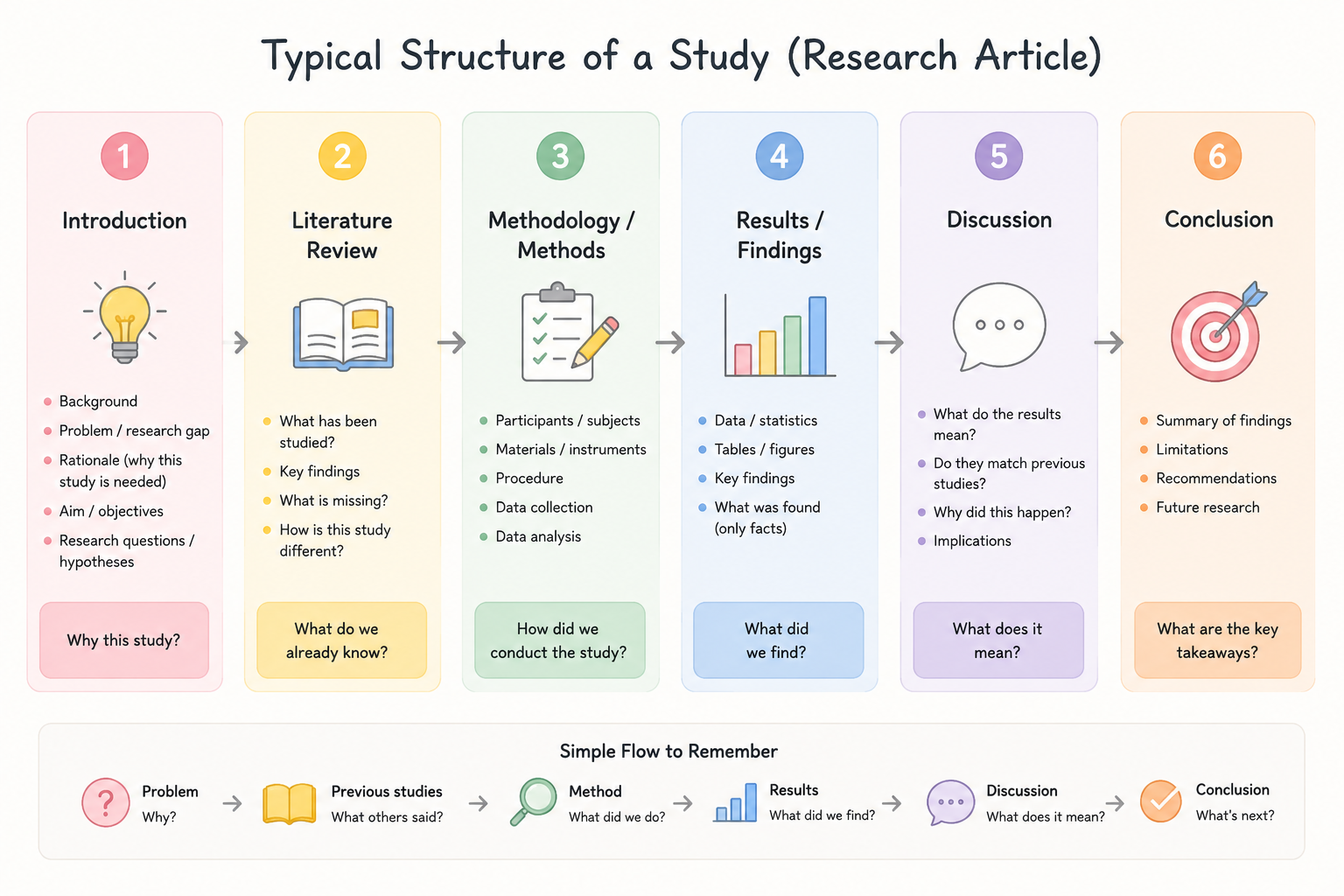
→ Đối chiếu:
iv: Why researchers decided to focus on the workplace = Rationale
→ Xác định được bước đưa lí do nghiên cứu phải nằm ở những đoạn đầu, ko thể ở đi sau phần Results/Findings, Discussion hay Conclusion được!
D: Their findings suggest..
E: In the same study… we found
F: In the second stage….
G: The implications
Lưu ý:
- Key takeaways này cần được áp dụng một cách có chọn lọc, chỉ là bước lọc đáp án nhiễu, tiết kiệm thời gian, củng cố sự tự tin cho 1 dạng điển hình là STUDY/ SCIENTIFIC RESEARCH có tuần tự như trên.
Một ví dụ khác:
PRESERVING ANTARCTIC HISTORY
Protecting early buildings in Antarctica
A. Few people conjuring up the ‘most comfortable dwelling place imaginable’ are likely to picture a wooden shelter on an island off the coldest continent on Earth. But that’s how Antarctic explorer Robert Falcon Scott described the hut at Cape Evans on Ross Island that was the base for his 1910-13 expedition. The hut is nestled below a small hill on a long stretch of black sand. In 2011, it looked like a building site, but now, seals lie on the ice in front of the newly restored structure and sun reflects off the cliffs of the nearby glacier.
B. The New Zealand Antarctic Heritage Trust (NZAHT) and its team of conservation workers recently announced the completion of 10 years of intensive work to save three historic buildings on Ross Island. As well as the hut at Cape Evans, it has worked on the Discovery Hut from Scott’s 1901-04 expedition at Hut Point, and the hut at Cape Royds, built for Ernest Shackleton’s 1907-09 expedition. When work began, many of the artefacts were temporarily removed while carpenters from the team of conservation workers repaired the walls, floors and roof. In Scott’s ‘zone of command’ was the table where team member Edward Wilson made his enduring biological and botanical illustrations. In a dark corner nearby, Edward Atkinson had once incubated his moulds and parasites. Of particular interest is the small workbench and array of test tubes, sample jars and Bunsen burner stands of biologist Edward Nelson, lit by sunshine through a dusty window. This was where the young scientist preserved marine specimens as part of his search for new species and an understanding of the Antarctic food chain.
the reason to make conversation project in ross island
C. The NZAHT executive director Nigel Watson describes the three restored huts as ‘fantastic remnants of humans’ first contact with the continent’. The idea for the birth of the conservation project, he says, ‘was the fact that we were in great danger of losing them’. When the on-site work began in 2004, snow and ice were building up around, under and sometimes inside the huts, damaging the structures and threatening their contents. ‘We now have three buildings that are structurally sound and watertight with a very different feel - they are drier and lighter and the humidity is reduced. It’s a much better environment for the collection.’
D. As well as heritage carpenters, the NZAHT team on Ross Island has included experts in textile, paper and metal conservation: in total, 62 experts from 11 countries have visited Antarctica to work on the project, often spending a whole summer on-site, sleeping in tents and popping 25km back to Scott Base for the occasional shower. ‘It became known as the most exciting conservation project in the world,’ says Watson, ‘so it attracted top heritage conservation talent.’
E. Some of the most exciting discoveries were three intact crates of ‘Mackinlay’s Rare Old Highland Malt Whisky’ found encased in ice beneath Shackleton's hut, a paper notebook that belonged to surgeon, zoologist and photographer George Murray Levick found buried in dirt at Cape Evans and a small box of 22 cellulose nitrate negatives waiting to be developed into photographs found in Herbert Ponting’s darkroom. But most of the 18,202 items catalogued and conserved are more mundane: food, tools, clothing and other personal items that were not precious enough to be taken home on the return voyages.
F. The NZAHT team’s conservation treatments involved thorough cleaning, followed by chemical treatment to help slow, or even reverse, the deterioration. Metal items would go through corrosion removal, followed by a chemical stabilization treatment, then application of an oxygen and moisture barrier to prevent further corrosion. Treatment of paper items often involved washing to remove harmful acids and salts and to help reinforce the fibers so that in some cases the paper was even stronger than before.
G. As a result of the project, the NZAHT has become the world leader in cold-climate heritage conservation and its members have been interviewed for numerous television documentaries and radio reports. The Ross Island huts are ‘the jewels in the crown’, says Watson, but there are other historic buildings needing attention. With logistics support from Antarctica New Zealand, program managers Al Fastier and Lizzie Meek will be part of a small team heading to Cape Adare, an exposed site more than 700 km north of Scott Base. The two Cape Adare huts, remnants of an 1898-1900 British expedition, ‘are not only the first buildings on the continent’, says Watson, but also ‘the only example of humanity’s first buildings on any continent on Earth.’
H. The three-year restoration effort will involve construction repairs and the removal, conservation and return of about 1100 objects. Compared with the hut sites on Ross Island, which are relatively sheltered, Cape Adare is ‘a very the remote and challenging place to work in,’ says Watson. It’s set among world's biggest colony of Adélie penguins on an exposed spit of land, and it is important that they don’t interrupt the functioning of the colony in any way while they are there. Lizzie Meek looks forward to the challenge. ‘But I’m also looking forward to going back to the Ross Island huts and seeing them with fresh eyes. After so many years of working on them, to be able to step inside and look around to see what we have accomplished will be amazing.’
I. If you can find your way to Antarctica, you’ll need a permit to visit any of these huts, which are each in an Antarctic Specially Protected Area. But there’s an easier way to see them without making the long journey: the trust has partnered with Google to offer Street View walkthroughs of each of the dwellings, available via Google Earth or through the NZAHT’s website.
Questions 14–19
Reading Passage 2 has nine paragraphs, A-I Which paragraph contains the following information? Choose the correct letter, A-I, in boxes 14-19.
14 a reason the early explorers left some objects behind
15 an explanation of how to see the huts without travelling to Antarctica
16 reference to the fact that Robert Falcon Scott enjoyed the time he spent living in the hut
17 reference to how the Ross Island project has received attention from the media
18 the reason the decision to begin conservation work at Ross Island was made
19 a description of the process for preserving paper
Câu hỏi:
Trong số những headings trên, chúng ta nên ‘đâm đầu’ vào cái nào trước?
Hint: based on

- Ngoài ra, ta có thể nghĩ tới những kiểu cấu trúc bài theo tuần tự logic khác:
Đi từ lịch sử tới hiện tại:
(sẽ gặp ở 1 bài khác)
Đi từ khái niệm rồi mới diễn giải biểu hiện, phân tích, mở rộng,…:
Seeing the color of sounds, hearing the color of numbers
When the senses mix together
A What is the color of five? What is the sound of blue? To most of us such questions are either meaningless or suitable only for poetry. But for some people these are questions to which very precise answers can be given. Five, for example, for some people is green, while others say the sound of a guitar is like someone blowing on their ankles. People who 'see' color in numbers or letters of the alphabet and 'feel' sensation in sound have synesthesia – meaning literally 'joined sensation' – an extraordinary condition that causes certain senses to leak' into one another.
B People whose senses behave in this way are called 'synesthetes'. Some synesthetes take pleasure in it. To me it's like other people see the world in black and white, says one, who sees every letter, number, sound and pain in color. Others learn to keep it a secret for fear of people laughing at them. But to neurologists investigating the brain it is of great interest. 'When scientists study normal perception,' says Daniel Smilek of the University of Waterloo in Ontario, Canada, there are lots of things we don't question because most of us perceive in the same way. Synesthesia, because it's abnormal, can give us new insights into normal perception.
C Seventeenth-century English philosopher John Locke was the first westerner to describe synesthesia. He wrote about a man who experienced bright red as the sound of the trumpet. Later, the condition excited the imagination of nineteenth-century European painters, such as the non-synesthete Wassily Kandinsky, who believed synesthetes were like good, much-played violins, which vibrate in all their parts and fibers. But it proved impossible to research and people lost interest. Recently, however, advances in brain imaging have sparked renewed interest.
D Early claims that the multi-sensory experiences of synesthesia were linked with the hallucinations of mental illness have long been disproved. Until 1993, many researchers dismissed it as another name for a vivid imagination, but then an experiment by Simon Baron-Cohen of Cambridge University in the UK showed that synesthetes who, when tested, had linked particular colors or shapes to letters, gave the same answers in 92 per cent of instances when tested again a week later. Non-synesthetes, given similar examples to imagine, returned the same answers in only 37 per cent of instances.
E Although there is some overlap between synesthetes as to what color is linked to what – 56 per cent see the letter 'o' as white – most of the responses are individual. There are 30 possible sensory combinations, but links between sounds and colors are the most common. Women are between two and eight times more likely than men to have the condition.
F As yet there is no explanation for any of this, but small pieces of the jigsaw are emerging. A brain scanning experiment by Baron-Cohen in 1995 found that when synesthetes were listening to words, areas of the brain lit up that are normally only active in response to vision and color. From this comes the notion that we may all have synesthesia at birth, when many parts of the brain are linked, but, as we develop, connections are pruned, so our senses become separated and the synesthetic mechanism is no longer intact. Somehow, synesthetes have kept their synaptic connections intact. It's an idea that has been challenged, however, on the grounds that if you give people certain drugs they will have synesthetic experiences, which suggests the mechanism is intact in adults but repressed.
G There are many more unanswered questions about synesthesia. For example, is the synesthete's color response to a number five triggered by actually seeing the number five written on a page, or does the synesthete 'see' the color just by thinking of the number five? The neurologist Vilyanur Ramachandran came up with a test for synesthesia which seemed to suggest it was the sight of the number that was important. He asked people to look at a page made up of specially drawn twos and fives that were a mirror image of each other. The fives were placed at random on the page but the twos were placed to form shapes such as circles or triangles. To most people the numbers just looked like a jumble without order, but to synesthetes the patterns made by the twos were very obvious as a different color from the fives. 'This shows they were really sensing color in the numbers they saw,' says Ramachandran 'Ideas don't form these kinds of patterns.'
H However, Smilek subsequently came up with evidence that what really matters is the idea of a number rather than the sight of it on a page. He asked a synesthete to do some simple mental arithmetic while looking at different colored papers, The subject did not write her answers, but only thought of them and said them aloud. Smilek found that when the color of the paper clashed with the color of the answer, the subject's response was slower than when the colors were the same. An actual color (the color of the paper) could interfere with the colour of a number that existed only in her head (the answer to the mental arithmetic question). 'My research suggests that color experiences coincide with the processing of meaning,' says Smilek. 'It's the concept of a number that's colored.'
I So which is it? At present, we don't know, but in the future neurologists may be able to explain what's going on in the brains of people like the novelist Nabokov, who perceived the English 'a' as dark brown and the French 'e' as black.
Questions 31–35
Reading Passage 3 has nine paragraphs, A-I.
Which paragraph contains the following information?
Choose the correct letter, A-I, in boxes 31-35.
NB You may use any letter more than once.
31. an investigation into synesthesia using modern medical technology
32. a mention of a writer who was a synesthete
33. a definition of synesthesia
34. two different explanations of why synesthesia is uncommon in adults
35. a reason why some synesthetes do not tell people about their experiences
Câu hỏi:
Trong số 5 câu thông tin này, câu nào “hấp dẫn” nhất, có thể đem lại lợi thế ngay cả khi chưa đọc bài? Tại sao?
Học viên tự chữa phần còn lại, GV đã mệt… 😩
17 D - vii
How workplace facilities aid the success of one personality type
18 E - iii
The pressure of restraining an outgoing nature
19 F - i
How company culture can have a negative impact
20 G - ii
Recommendations for employers