Introduction to Psychology: Cognitive Psychology
Learning
- The relatively permanent change in knowledge or behavior that is the result of experience. Although you might think of learning in terms of what you need to do before an upcoming exam, the knowledge that you take away from your classes, or new skills that you acquire through practice, these changes represent only one component of learning
Memory
- Psychologists conceptualize memory in terms of types, in terms of stages, and in terms of processes
Biological Psychology vs Cognitive Psychology
- Biological Psychology
- Reductionist
- Simple is the source of complex
- Explanations of a behavior at its simplest level can be deemed reductionist. The experimental and laboratory approach in various areas of psychology reflects a reductionist approach
- This approach inevitably must reduce a complex behavior to a simple set of variables that offer the possibility of identifying a cause and an effect
- The biological approach suggests that psychological problems can be treated like a disease and are therefore often treatable with drugs
- Cognitive Psychology
- Functionalist
- Functionalism considers mental life and behavior in terms of active adaptation to the person’s environment
- In functionalism, the brain is believed to have evolved for the purpose of bettering the survival of its carrier by acting as an information processor in processing information the brain is considered to execute functions similar to those executed by a computer
- Cognitive psychologists rely on the functionalist insights in discussing how affect or emotion and environment or events interact and result in specific perceptions
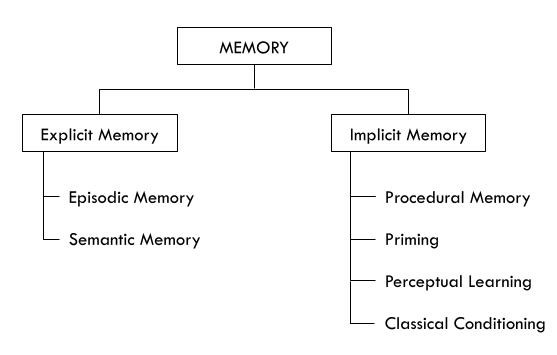
Types of Memory
- Explicit Memory: conscious
- Episodic Memory: memory of specific events
- Semantic Memory: general knowledge, not tied to any time or place
- Implicit Memory: revealed by indirect tests
- Procedural Memory: knowing how (memory for skills)
- Priming: changes in perception and belief caused by previous experiences
- Perceptual Learning: recalibration of perceptual systems as a result of experiences
- Classical Conditioning: learning about associations among stimuli
Aspects of the Memory Process
- Acquisition
- Memory acquisition is not just a matter of “copying” an event or a fact into memory, the way a camera copies an image onto him
- Requires some intellectual engagement with the material and it’s then the product of this engagement that’s stored in memory
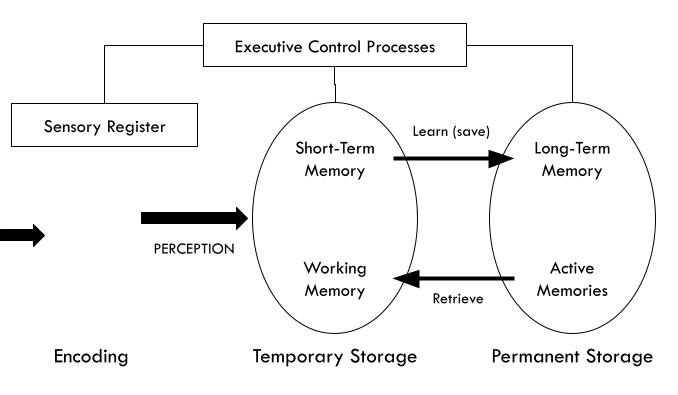
- When information first arrived, it is stored briefly in sensory memory, which held onto the input in “raw” sensory from
- Iconic memory for visual inputs
- Echoic memory for auditory inputs
- A process of selection and interpretation then moved the information into:
- Short-Term Memory: the place you hold information while you’re working on it
- Long-Term Memory: a much larger and more permanent storage place
- Information is held in sensory memory where perception and attention determine what will be held in working memory for further use.
- In working memory, new information connects with knowledge from long-term memory. Thoroughly processed and connected information becomes part of long-term memory, and can be activated to return to working memory
- Implicit memories are formed without conscious effort
- Working Memory
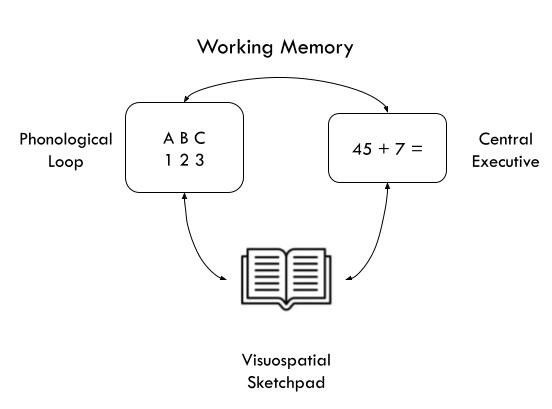
- Workbench of the memory system
- Interface where new information is held temporarily and combined with knowledge from long-term memory
- Involves temporary storage and active processing
- Short term = temporary storage
- Central Executive
- Initiate control and decision processes
- Reasoning, language comprehension
- Transfer information to long-term memory via rehearsal recording
- Phonological Loop
- Short-term buffer
- System for rehearsing words and sounds for short-term memory
- Recycling items for immediate recall
- Articulatory processes
- Executive’s resources are drained if articulation is difficult
- Visuospatial Sketchpad
- Visual imagery tasks
- Spatial, visual search tasks
- Executive resources are drained if imagery or spatial task is difficult
- Maintenance Rehearsal
- Keeping information in working memory by repeating it to yourself
- Elaborative Rehearsal
- Keeping information in working memory by associating it with something you already know
Contents of Long-Term Memory
- Declarative Knowledge
- Knowledge that can be declared through words and symbol systems of all kinds
- Ex. verbal information, facts
- Procedural Knowledge
- Knowledge that is demonstrated when we perform a task
- “Knowing how”
- Ex. how to use a word processor
- Conditional Knowledge
- Knowing when and why to use declarative and procedural knowledge
- Ex. when to give up and try another approach
- Ex. when to skim and when to read carefully
Storage
- Evidence suggests that the trace for a particular past experience is not recorded in a single location within the brain
- Different aspects of an event are likely to be stored in distinct brain regions
- Visual elements of the episode
- Emotional reaction
- Conceptual understanding of the event and so on
- Memory traces aren’t created instantly. Instead, a period of time is needed, after each new experience for the record of that experience to become established in memory
- During that time, memory consolidation is taking place; this is a process, spread over several hours, in which memories are transformed from a transient and fragile status to a more permanent and robust state
- Evidence suggests that this time period allows adjustments in neural connections, so that a new pattern of communication among neurons can be created to represent the newly acquired memory. This process seems to require the creation of new proteins, so it is disrupted by chemical manipulations that block protein synthesis
Retrieval
- The step of locating and activating information in memory – is crucial. Moreover, the success of retrieval is far from guaranteed, and many cases of apparent “forgetting” can be understood as retrieval failures – cases in which the information is in your memory, but you fail to locate it.
- Partial Retrieval
- People in the TOP (tip-of-the-tongue phenomenon [lethologica]) state cannot recall the target word, but the word is certainly in their memory. If it weren’t, they wouldn’t be able to remember the word's sound, or its starting letter and syllable count. What’s more, people often recognize the word when it’s offered to them
- A case of retrieval failure – the information preserved in storage, but for various reasons it is inaccessible
- Effective Retrieval Cues
- One important factor is whether the cure recreates the context in which the original learning occurred
- Ex. If an individual focused on the sounds of words while learning them, then she would be well served by reminders that focus on sound
- In case after case, then it’s helpful, at the time of memory retrieval, to return to the context of learning
- Context Reinstatement
- Benefit of recreating the state of mind during learning
- Evidence suggests that the physical setting matters only indirectly: a return to the physical circumstances of learning does improve recollection, but only because this return helps recreate the mental context that matters
- Apparently, then, what matters for retrieval is your mental perspective, not the room you’re sitting in. if you change the physical context without changing your mental perspective, the physical relocation has no effect.
- Encoding Specificity
- Based on the idea that what’s recorded in memory is not just “copy” of the original (in other words, it’s translated into some other form) and is also quite specific (and so represents the material plus your thoughts and understanding of the material)
Learning Styles
Style Matching Technique
Critique
- Fail to explain the developmental processes and causal mechanisms
- Lack validity and reliability
Failure to Explain Underlying Mechanisms
- Consists of list of preferences
- No conclusive evidences on the developmental processes whether an individual becomes one type of learner or the relationship between two dimensions
- No explanation about what produces these differences
- A blend of borrowed constonets from better-developed theories
- Include styles that reflect differences in personality or self-regulatory skills
Ignorance of Research Contradicting the Theories
- Ignore research that directly contradicts learning style theories
Problem of Measurement
- Use of Less Valid Measures
- Rank ordering produces negative correlations between the constructs that are being measured so that the construct validity is inflated
- False dichotomy created by rank ordering is not supported by measures that independently assess each construct
- Poor Validity
- Failure to link to achievement
- Learning styles do not correlate with preference of instructional materials nor does achievement correlate with learning styles