Electromagnetic Spectrum
The electromagnetic spectrum is the range of all types of electromagnetic radiation.
Electromagnetic radiation travels in waves and includes the following types:
Radio Waves:
Used in communication (like radios and TVs).
Have the longest wavelength within the spectrum.
Microwaves:
Used in microwave ovens and for some types of communication.
Wavelengths are shorter than radio waves but longer than infrared light.
Infrared Rays:
Can be felt as heat (like from the sun).
Used in remote controls and thermal imaging.
Visible Light:
The only part of the spectrum we can see.
Made up of colors: red, orange, yellow, green, blue, indigo, and violet (ROYGBIV).
Ultraviolet Light (UV):
Can cause sunburn and is used in blacklights.
Shorter wavelengths than visible light.
X-rays:
Used in medicine to see inside the body.
Have shorter wavelengths than UV light.
Gamma Rays:
Emitted by radioactive materials and certain types of stars.
Have the shortest wavelength and carry the most energy.
All parts of the electromagnetic spectrum travel at the speed of light, but they have different wavelengths and frequencies.
Structure of Electromagnetic Waves:
Electromagnetic waves consist of oscillating electric and magnetic fields, which are perpendicular to each other and to the direction of the wave's travel. The waves move through space and can travel through a vacuum. The distance between two successive peaks of the wave is called the wavelength, while the number of waves that pass a point in one second is the frequency. Higher frequency waves have shorter wavelengths and carry more energy, while lower frequency waves have longer wavelengths and carry less energy.
Understanding the electromagnetic spectrum is important for various scientific and practical applications in daily life, including medicine, communication, and safety.
Diagram of Electromagnetic Waves:
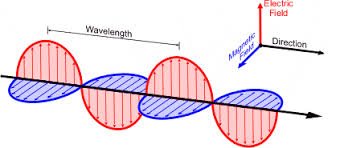
This diagram illustrates the structure of electromagnetic waves, showing the oscillating electric and magnetic fields and the distance between the waves, which represents the wavelength.