79 – 70 BC Up and coming generation
CRASSUS — POMPEY — CAESAR
Overview
Early 100s BC: Marius and Roman military reforms – poorest citizens can join the Roman army
90 BC: Social War – Rome vs Italian allies
88–82 BC: Sulla’s proscriptions
79–70 BC: Pompey and Crassus: early careers and military victories
73 BC: Defeat of Sertorius in Spain by Pompey
71 BC: Defeat of Spartacus in Italy by Crassus and Pompey
70 BC: Joint consulship of Pompey and Crassus
Amicitia and Inimicitia; Patronage
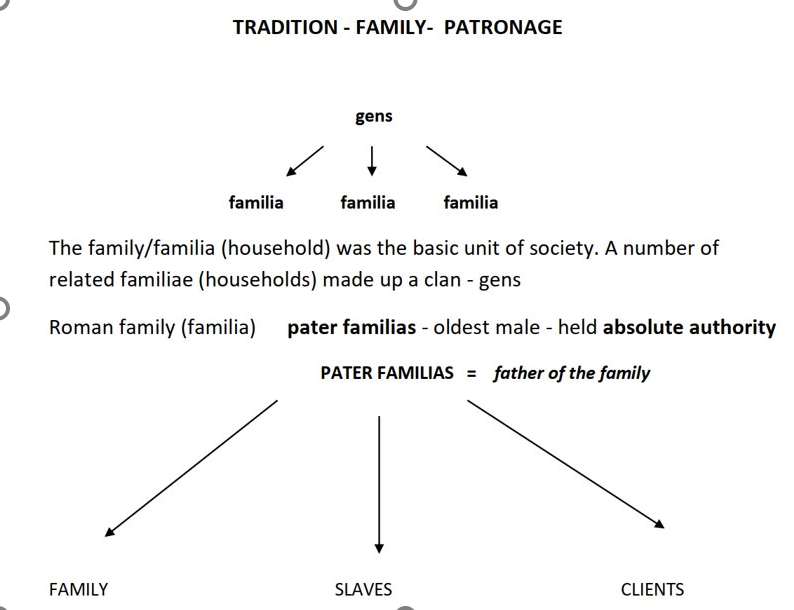
An amicitia (pl. amicitiae) was a relationship of friendship or alliance between people of generally equal status.
Inimicitia was the opposite: a feud or hostility.
Patronage – a social system in which a wealthier and more powerful patron provided protection, resources and support to clients in exchange for their respect, services and political allegiance.
Patronage: Patrons and Clients
patron | cliens |
protected, sponsored and granted favours to those of lower status. advanced their career, secured them business, argued for them in the law courts. |
honoured, supported and performed tasks for their patron: supported patron’s cause in elections, ran errands, carried messages, performed labour for the patron. T |
Rome in the 70s (79 BC – 70 BC)
“The 70s were the decade where greed, luxury and personal desire ran rampant through the now unchecked senatorial classes, pirates ravaged the coastline and economic problems, and slave uprising became the norm. It was the decade when senators passed luxury laws but entertained themselves at banquets; a decade when the rights of the people had been destroyed by the ineffective tribunate….”
POMPEY
Gnaeus Pompeius Magnus
106–48 BC
From equestrian class
Pompey’s Rise to Power
In 83 BC, the 23-year-old Pompey raised a private army on his own initiative to aid Sulla.
Sulla was impressed and hailed him as imperator, even though Pompey was not entitled to be addressed in this fashion.
Later Sulla gave him his stepdaughter in marriage – AMICITIA.
Pompey continued to hold the imperium of a propraetor for 2 more years while he waged a successful campaign against the Marians in Sicily and Africa.*
Problems in Spain – Campaign Against Sertorius
Sertorius was a popularis, chosen as governor of Hither Spain during the civil war.
Plutarch says he “took control of their affairs as general with absolute powers” and “brought the neighbouring parts of Spain under their control” – he disobeyed and worked independently.
Sertorius triumphed repeatedly over senatorial generals such as Metellus because he made extensive preparations, transformed undisciplined Spanish tribesmen into an army, and employed guerrilla tactics.
Campaign Against Sertorius (76–71 BC)
As more Roman troops joined his cause, Sertorius organised an alternative Roman government with a ‘senate’, praetors and quaestors.
Pompey, with proconsular imperium, arrived in Spain in 76 BC to help Metellus.
Pompey remained from 76–71; he was unable to end the war quickly due to Sertorius’ guerrilla tactics.
By early 71, Hispania was subdued. Pompey showed efficiency and fairness in the province, extending his patronage through Hispania.
In 71 he set off for Italy with his army.
CRASSUS
Marcus Licinius Crassus
115–53 BC
From equestrian class
Slave Uprising 73–71 BC: Crassus in Charge
In 73 BC, while Pompey was in Spain, a serious uprising of gladiators and slaves occurred in Italy. It was led by Spartacus, a Thracian gladiator.
After several early successes, both consuls were defeated and a more efficient commander was sought.
Crassus, praetor of 73, was given propraetorian or proconsular imperium in 72 BC to take supreme command.
Crassus defeated Spartacus’ divided forces. Spartacus fought until the very end; afterwards about 6000 supporters were crucified along the Appian Way.
Pompey vs Crassus
Pompey arrived from Spain in 71 and was officially associated with Crassus in command.
Although Crassus had done the work, “fortune somehow managed to give Pompey a share” when he prevented 5000 fugitives from escaping north.
Pompey wrote to the Senate that **Crassus had won the battle, but he himself had finished the war “utterly and entirely’’*.
Crassus was upset and jealous, especially as he received only an ovation, while Pompey was awarded his second triumph.
The Roman Triumph
Early triumphs were simple victory parades, celebrating a victorious general and his army, ending with a dedication to the gods.
Only the Senate could grant a triumph (the greatest military award).
A triumph was a civil ceremony and religious rite honouring a commander who had led Roman forces to victory.
Triumph and Ovation
A general awarded a triumph was acclaimed IMPERATOR and waited behind the Pomerium to enter Rome.
Order of the procession: captives, spoils, senators and magistrates, the general’s lictors with fasces, then the general in a four-horse chariot.
A lesser triumph was called an ovation.
Pompey & Crassus – Joint Consulship
A Joint Campaign for Consulship
Although not friends, both wanted the consulship for 70 BC, and in 71 they agreed to campaign together.
Crassus: next step in normal career – praetorship (73) and proprietorship (72–71).
Pompey: 7 years too young, had never held magistracy, and was not even a senator.
Both men waited with their armies outside Rome.*
Actions as Consuls
Though Sulla’s lieutenants, once elected they destroyed what was left of his constitution.
Sulla had made the cursus honorum rigid (lex Annalis), deprived tribunes of legislative powers, and debarred them from further office.
The restriction on tribunes was removed in 75 BC by lex Aurelia (C. Aurelius Cotta).
Restoration and Legislation
During their consulship, three key laws passed:
Restored the tribunate: returned legislative powers and the right of veto.
Revived the censorship: censors revised the senatorial list, removing 64 senators and enrolling new ones (future supporters of Pompey).
Reformed law courts: previously only senators; now equal numbers of senators, equites and tribuni aerarii.
CAESAR
Gaius Iulius Caesar
100–44 BC
Family lineage: patrician
Pirates and Caesar
Throughout the decade, pirates caused serious problems.
Pirates kidnapped Roman citizens; in 75 BC, Caesar was captured.
When pirates demanded 20 talents ransom, “he laughed at them for not knowing who their captive was and of his own accord agreed to give them 50…”
Problems continued:
73 BC: Pirates attacked the coast of Sicily; governor Verres attempted temporary relief.
The public would soon demand stronger action from the Senate.
War in the East – Mithridates
In 74 BC, Mithridates VI, king of Pontus, allied with Sertorius, intruded on nearby territory, clashing with Roman interests.
The Senate appointed Lucullus to command in the East.
Roman forces captured towns in Pontus; war dragged on.
Lucullus’ soldiers grew weary; no resolution appeared.
Mithridates and the East would continue to dominate Roman foreign policy for another decade.
The Up-and-Coming Generation
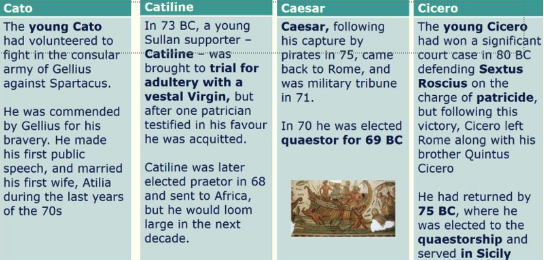
73 BC: Young Sullan supporter Catiline was tried for adultery with a Vestal Virgin; one patrician testified in his favour and he was acquitted.*
Catiline later became praetor in 68 and went to Africa; he would be important in the next decade.
Caesar returned from pirate capture, became military tribune in 71, and quaestor in 70 (for 69).
CICERO
Marcus Tullius Cicero
100–43 BC
From equestrian family – novus homo
Little known early in the decade; in 80 BC he won a major case defending Sextus Roscius (charged with parricide).
After the case, Cicero left Rome with his brother Quintus.
He returned by 75 BC, was elected quaestor, and served in Sicily.
His honesty led Sicilians to later request him to prosecute Verres for corruption.
In the 70s, “Rome was perhaps finally living up to Sulla’s vision. The senate was still in control, but as the decade ended, things would abruptly change. Sulla’s reforms from the beginning of the decade were about to be revisited.”