Perception
perception
the process of interpreting sensory information to understand our environment
Influences on perception
bottom up processing
relies on external sensory information from the environment
sensory receptors detect stimuli and send signals to the brain for interpretation
focuses on the detailed and individual elements of a stimulus
starts with sensory input
details first → big picture
ex. reading unfamiliar handwriting, hearing a new language
top down processing
uses internal prior expectations, knowledge, and experiences to interpret sensory information
influenced by schemas, memories, and context
focus on the bigger picture and overall meaning of a stimulus
brain first → details second
~guessing
ex. reading messy text, seeing a blurry picture
schemas
mental frameworks that organize and interpret information based on prior knowledge and experiences
help simplify and categorize complex information (person schemas, event schemas)
can lead to biases and stereotypes when applied too rigidly
how we understand how the world works
ex. Restaurant schema: you expect to sit, look at menu, order food, eat, pay
perceptual sets
mental predispositions or expectations that influence perception
cause individuals to perceive stimuli in a certain way based on what they expect or want to see
can lead to selective attention and misinterpretation of ambiguous stimuli
External factors in perception
context, such as physical setting or social situation
the same behavior may be interpreted differently in different contexts (laughing at a funeral vs. a comedy show)
personal experiences, including upbringing, education, and past events
a child raised in a loving home may perceive others as trustworthy; while a child from an abusive background may be more suspicious
cultural experiences and expectations provide a lens through which individuals perceive the world
different cultures may have varying norms, values, and beliefs that affect perception (personal space, eye contact)
Gestalt principles of perception
Gestalt psychology emphasizes that the whole is different from the sum of its parts
Explain how we visually organize information into meaningful patterns and structures
help us make sense of complex visual stimuli and understand the world in a coherent and efficient manner
form perception
Figure and ground
the tendency to perceive objects as either the focus of attention (figure) or the background
the figure stands out from the background and i smore easily recognized (a tree against a sky background)
allows us to recognize objects as distinct from their surrounding environment
applies to our hearing
fundamental to our visual perception
enabling us to identify and focus on specific elements in a complex scene
aiding in tasks like reading text on a page or recognizing faces in a crowd

Cocktail party effect
same idea as figure and ground
at a crowded party, you listen to one voice as the figure and teh rest of sound becomes the ground
Grouping
organize the world into a meaningful form
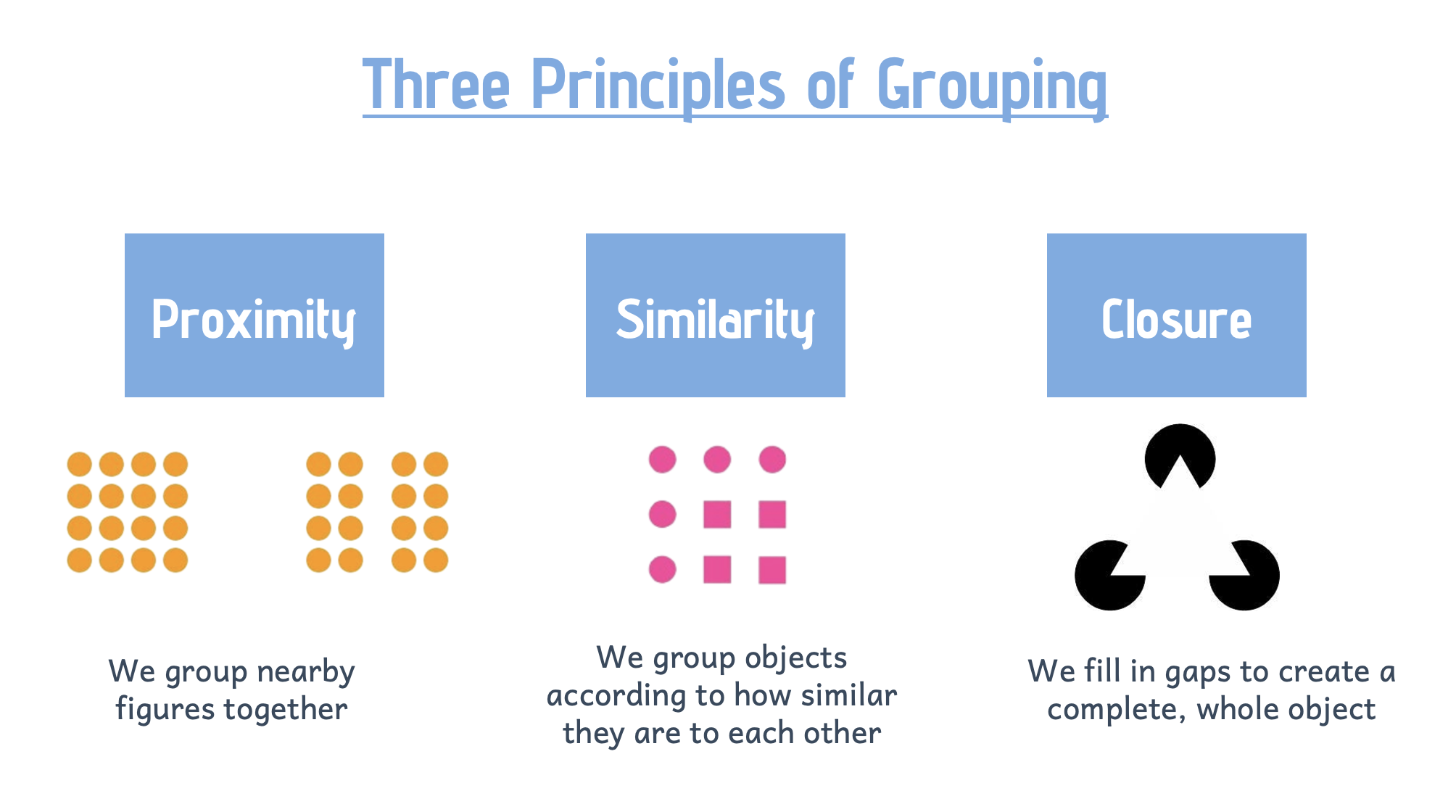
three principles of grouping
proximity
we group nearby figures together
the tendency to perceive objects that are close together as part of the same gruup
items arranged close together are seen as related or belonging together
ex. a row of dots is perceived as a line
similarity
we group objects according to how similar they are to each other
tendency to perceive objects that share similar characteristics as part of the same group
items that look alike are grouped together
a collection of red squares among blue circles is seen as a distinct group
closure
we fill in gaps to create complete, whole object
the tendency to perceive incomplete or partial objects as complete and whole
the brain fills in missing information to create a complete image
ex. a partially drawn circle is perceived as a whole circle
depth perception
ability to perceive the world in three dimensions and to judge the distance of objects
is depth perception learned or innate?
Eleanor Gibson and Richard Walk
infants are placed on a platform with a “visual cliff”
an apparent drop-off created by a sheet of glass covering a patterned surface
studies revealed that most infants hesitate to crawl over the cliff
indicating that an inherent ability to perceive depth to avoid potential and danger
findings highlight how depth perception is an essential and early-developing aspect of human vision
binocular cue
depend on the use of two eyes
convergence
retinal images are combined by the brain
the inward turning of the eyes to focus on a nearby object
the brain uses the degree of convergence to estimate the distance of the object
closer objects require more convergence, while distant objects require less
rental disparity
the slight difference in the images projected onto the left and right retinas due to the eyes’ different positions
the brain compare these differences to create a perception of depth and three dimensionally
the brain can judge how close an object is to you
the greater the disparity (difference) between the two retinal images, the closer the object
monocular cues
can be perceived with just one eye
helpful when we only have one eye open
complement binocular cues to provide a richer and more accurate perception of depth and distance
helping us better understand and navigate our three-dimensional environment
relative clarity
objects that appear clearer and more detailed are perceived as closer than those that appear blurry or less detailed
more light passes through objects that are farther away, we perceive these objects as blurry, whereas nearby objects by contrast appear clear
relative size
objects that appear larger are perceived as closer than those that appear smaller
ex. a person standing next to a building appears smaller than a person standing closer to the viewer
texture gradient
the gradual change in the appearance of a surface’s texture from coarse (near) to fine (far)
moving toward or far away from an object changes our perception of its smoothness or texture
we see more texture when things are closer
ex. a grassy field appears more detailed and distinct in the foreground and becomes smoother and less detailed in the distance
linear perspective
parallel lines appear to meet in the distance
the sharper the angle of convergence, the greater the perceived distance is
interposition
if one object partially blocks our view of another
we perceive as closer
ex. a tree branch in front of a house is seen as closer than the house itself
attention in perception
attention is the process of selectively focusing on specific aspects of the environment while ignoring others
allows individuals to prioritize and process important information
can be influenced by both internal factors (goals, interests) and external factors (salience, novelty)
selective attention, such as the cocktail party effect
involves focusing on specific stimuli while filtering out irrelevant information
people can attend to their name or a topic of interest even in a noisy, distracting environments
inattention can lead to perceptual “blindness" or failure to notice changes in the environment
change blindness occurs when individuals fail to detect changes in a visual scene due to lack of attention
demonstrates the importance of attention in accurately perceiving and processing information
motion perception
normally, your brain calculates motion based on the assumption that shrinking objects are moving away and enlarging objects are getting closer
however, our brains can sometimes be deceived by visual illusions
for instance, when large and small objects move at the same speed
the larger objets appear to move more slowly than the smaller ones
stroboscopic movement
a series of still images presented in rapid succession creates the illusion of continuous motion
movies and animations rely on this principle, presenting a series of slightly different frames to create the perception of movement
Phi phenomenon
the perception of movement created by rapidly presenting two or more stationary stimuli in succession
a blinking light that alternates between two positions can create the illusion of a single light moving back and forth
perceptual constancy
the brain’s ability to recognize objects as having consistent shape, size, color, and brightness despite changes in perspective, distance, or lighting conditions
important because it allows us to maintain a stable and consistent view of thw world
enabling us to recognize objects and people reliably despite varying conditions and changes in our environment
size constancy
to recognize that an object maintains a consistent size despite changes in its distance from us
which affects the size of the image projected on our retinas
ex. when a person walks away from us
they appear smaller in our visual field
but we understand that their actual size hasn’t changed
shape constancy
to recognize that an object’s shape as remaining the same despite changes in the angle or perspective from which it is viewed
ex. a door is perceived as rectangular whether it is open, closed, or partially ajar
even though its retinal image changes
brightness constancy
to perceive the brightness of an object as constant
even when the lighting conditions change
means that an object will appear to have the same level of brightness whether it is in shadow or in direct sunlight
because our brain adjusts for the varying amounts of light
ex. a white sheet of paper appears white whether viewed in bright sunlight or in shade
color constancy
perceive the colors of objects as relativey constant
even under varying lighting conditions
ex. a white shirt will still look white whether you see it under the yellow light of a lamp or blue light of the sky
Müller-Lyer Illusion
where two lines that are actually the same length look different because of the arrow shapes at the ends
Poggendorf Illusion
diagonal line looks misaligned or shifted when it passes behind another shape (usually a rectangle or bars), even though the line is actually straight
Stroop effect
when it is harder and slower to say the color of a word when the word itself names a different color
perceptual adaptation
brains remarkable ability to adjust to changes in the sensory environment
ensuring that we can maintain consistent perception even under altered conditions
allows us to become accustomed to new visual, auditory, or other sensory inputs over time
highlights the brain’s flexibility and its capacity to recalibrate sensory processing to accommodate new or unusual situations, maintaining a coherent and stable experience of the world
ex. when people wear inversion goggles that flip the visual field upside down, they initially experience disorientation
however with continued exposure, the brain gradually adapts and they can function relatively normal, interpreting the inverted visual information correctly