NUR 3029 Week 2
Clinical Judgment Process:
Steps of the Nursing Process: delivers holistic, client-centered care
Developed by Ida Jean Orlando in 1958
Req use of critical thinking & make clinical decisions from exp + evidence-based practice
Takes in account 3 things for pt wellbeing:
Spiritual: let pt observe/do religious practice
Mental: helps maintain/promote mental health
Relaxation techniques, walking, helping with relationships
Physical: providing nutritious diet, physically active, health screening
Assessment:
Nursing knowledge → collection, organization, validation, documentation of data of health status
Focusing on pt response to a health problem (their health beliefs & practices) → comprehensive assessment (sub + obj)
Excellent comms & assessment needed to plan pt care
Obtains pt history (interview) → physical assessment → reviews pt medical record
Interview part:
ask ab pt past medical history, meds, herbs used, substance abuse, sexual history, & support systems
holistic: sociocultural, economic, spiritual needs
Analysis:
Analyze assessment data → find health problems/risks & need for health intervention & formulate PoC
Patterns/trends, comparing data with expected ranges → draws conclusion
If more info needed → reassess pt
Need to repeat 1st 2 steps when triaging pt
Planning:
Make decisions & problem solving
Use of assessment data/evidenced-based practice → goals & find RN interventions
Short/Long-term goals: few days/weeks or months
Interventions: individualized actions to use in pt PoC → attain goals
RN plans them as holistic as possible
should meet physical, spiritual, emotional, social needs
PoC: able to be accessed/utilized/modified by interprofessional HCT; reviewed & updated following pt condition change/ new assessment
Implementation:
Apply knowledge → implement interventions
Sometimes the best action is no action → monitor pt
Use of problem-solving skills, clinical judgment & critical thinking when providing interpersonal & technical skills → pt care
Delegate & supervise & document care & check pt’s response
Evaluation:
Evaluate pt response to interventions & reach RN judgment → report/document to medical record & PoC
Assess pt/staff understanding of instructions
Identify need of further intervention/ change the care plan
Process may go back to any step, even assessment again
Identify if pt adhered to PoC
If not, why?
Clinical Judgment: assessing & drawing conclusions of pt’s health/reqs/concerns → deciding whether to act/adhere/adjust/create new strategies based on pt reaction
RN must consider both environmental & individual factors:
Environmental:
setting, situation, safety considerations, equipment, surroundings, staffing, supplies, health records, time psi, culture, task complexity, risk assessment
Individual: RN knowledge, skills, attitude, prior exp, exp lvl, cognitive load (demands, stress, problem solving, memory)
Steps of it
Recognizing Cues (Assessment):
filter info from diff sources like s/s & environment & health history
Analyze Cues (Analysis)
link recognized cues → pt presentation → establish needs, concerns, problems
Prioritize Hypotheses (Analysis)
establish priority of care from pt’s health problems
Generate Solutions (Planning)
Identify expected outcomes & interventions
Take Action (Implementation)
Implement interventions from knowledge
Evaluate Outcomes (Evaluation)
evaluate pt response → reach clinical judgment
Critical thinking: use of logic + reasoning → client need areas whilst considering alt approaches & solutions
Clinical Reasoning: mental process used when analyzing all clinical data
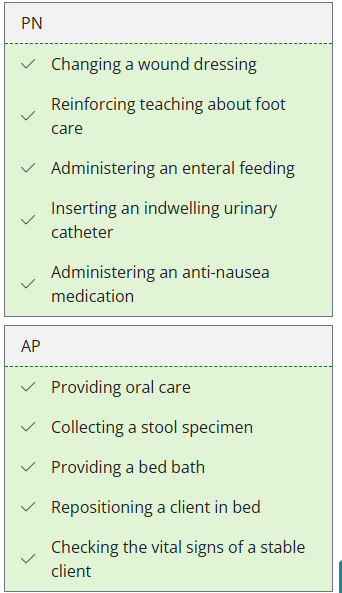
Practical Nurses (PN):
Steps of their process;
Data Collection
Collects data but CANNOT assess pt
Check for vital signs & sub & obj data → report to RN
Planning: Planning w/RN
Implementation:
Different scopes of practice in each state
Med administration, dressing changes, IV fluid hydration
Records in pt’s medical record
Evaluation:
Evaluates care w/RN supervision
records data → medical record
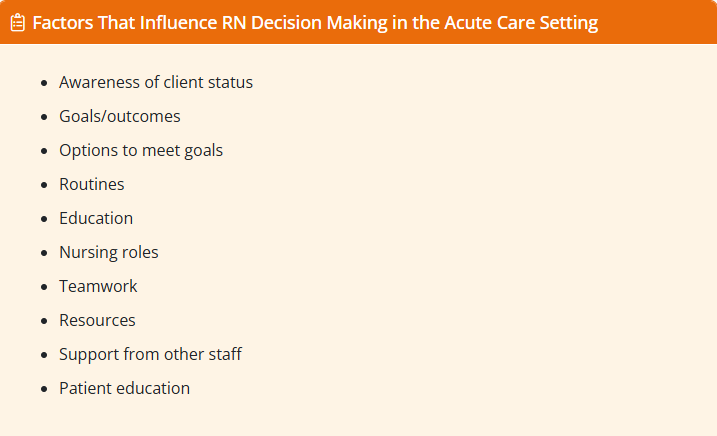
Delegation: assigning nursing activity/procedure to another person
Must be appropriate to the level of the person delegated
Managing Client Care:
Time Management:
Req organizational skills → what/how must be done
RN becomes ^ efficient & v stressed; ^ pt outcome
Proper nursing unit orientation, planning for unexpected, when to delegate & saying “no”
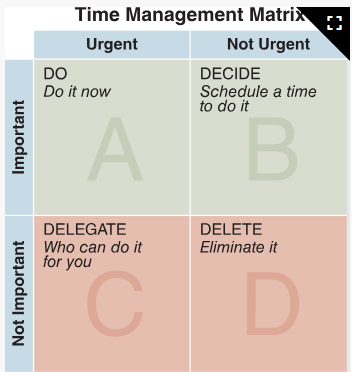
Use the time management matrix: Tool divided into 4 quadrants; & also time log
Important
Not Important
Urgent
Not urgent
Organizational Skills: skills allowing RN to be efficient & accurate in delivering pt care
Bad management skills may lead to mistakes, job dissatisfaction, and job turnover
Online sims can help this in a clinical setting
SMART goals: effective plan to complete tasks/goals
Specific
Measurable
Attainable
Realistic
Timely
Organized communication tools
SBAR: comms tool → relay relevant client info to other hcp
SOAP: documentation tool
SBAR:
S (situational): “Client in room 2 has nausea following surgery.”
B (background): “Client has a history of nausea/vomiting with anesthetic agents. Intravenous fluids are infusing at 50 mL/hr. The client has not had anything by mouth.”
A (assessment): “Client vomited up 100 mL of yellow liquid twice and bowel sounds are absent.”
R (recommendation): “Client was given an antiemetic medication as prescribed. Recommend the client remain NPO and insert a nasogastric tube.”
SOAP:
S (subjective): Chief complaint: “Client states nausea and vomiting after surgery.”
O (objective): Physical assessment: “Heart rate (HR) 85 beats/min, respiration rate (RR) 16 breaths/min, blood pressure (BP) 140/70 mm Hg. Vomited 100 mL of yellow liquid twice. Absent bowel sounds in all 4 abdominal quadrants.”
A (assessment): Problem: “Experiencing postoperative nausea/vomiting.”
P (plan): Consultation: “Provider called to request different prescription for an antiemetic medication, NPO status, and insert a nasogastric tube.”
Client Assignments: process of dividing responsibility for care of multiple clients among staff
Consider unit census, pt acuity lv/ classification score (complexity of condition)
Acuity lv: high-risk meds, isolation precautions, multiple med conditions
Acuity calculation tool → fair client assignments
stable-high risk
moderate-high risk pt have issues that fall into low-high acuity lv
Direct care activities: require pt contact
Indirect care activities: take up lots of time; charting, transit time, unit-related needs; do not determine client acuity
Takes type & physical layout of unit into consideration
Proper patient distances assigned for nurse
RN needs to be prepared for revisions from pt condition deteriorating or pt’s transfers
3 Standard processes for making Client Assignments:
Direct Assignments: RN assigned to only 1 pt (1:1)
Area Assignments: pt has shorter length of stay (LOS); nurses assigned to zones
ER. intraoperative unit, obstetric unit
Group Assignments: sorting pt to groups first → assigning RN to each group
Useful in large units/larger client census
Charge nurse:
Maintains care continuity & proper RN assigning to pt lv of acuity
Discharge Planning: Ongoing event determining what additional support pt needs to be transferred/sent home
admission → leaving/end
Efficient pt/family edu & interprofessional cooperation needed for effective discharge outcome
Case manager utilized for medical supply & home health needs coordination
IDEAL planning discharge:
helps RN organize info & pt understand
Encouraged for hcp to teach info one bit at a time, plain language, & use of teach back
Proper edu → importance of taking meds, its timing, dosage, & any adverse effects → prevent complications that would lead to readmission
Teach-back method: req pt to explain to RN what the RN taught
I: Include the client and caregivers.
D: Discuss the five key areas—medications, home life, warning signs, test results, and follow-up.
E: Educate the client on the condition, the discharge process, and next steps.
A: Assess the effectiveness of the education.
L: Listen to the client’s goals and preferences.
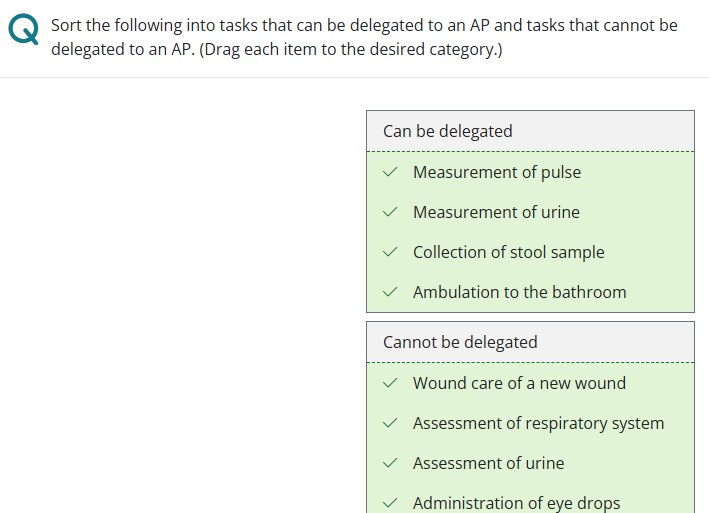
Delegation:
Minor tasks → AP → ^ quality of care & safety
Delegatee: person to whom task is entrusted (AP, PN) by RN; there are 5 “rights” to this:
The right task: delegated activity is part of the delegatee’s role and competency.
Does not require critical thinking skills/decision making based on experience, as those items cannot be delegated.
The right circumstance: appropriateness of the delegated task
pt is stable and the medical condition has not changed.
The right person should be paired with the right task.
The right person: competent to safely complete it.
Special edu needed
Clear instructions & open communication must occur between the delegator & delegatee.
For delegation to be successful, there must be a culture of safety and effective communication of client information to the licensed nurse who delegated the task, skill, or procedure, for the best interest of the client.
Care Supervision: pt supervision by another RN (nurse leader)
Mostly elder care & novice nurses
Direct/indirect supervision, self- and reflective supervision, and supervision using technology
RN work better under supervision
Experienced RN precepting a new nurse → direct supervision.
Charge nurse for a unit of less senior nurses → group supervision.
Self- and reflective supervision: helpful when learning a new skill.
nursing student may demonstrate how to insert a urinary catheter on a simulation mannequin → describe how it went + any improvement
Managing a client group: process of organizing pt care delivery → staff group
Charge nurses prioritize what/when task should be received → appointed to appropriate RNs
Use of primary nursing practice: time-managing/organization for each pt
Involves teamwork w/hcps
Team nursing: nurse group working together to achieve client care tasks
Utilization of RN’s previous exp & lv of skills whilst sharing responsibilities
Client Care Challenges:
Use of Electronic medical record (EMR) → unable to extract complete picture of pt condition when receiving the medical record
Abuse:
¼ nurses assaulted by pt
Causes ^ stress & v work morale
Protection: yell loudly, try to escape, barrier, defending themselves, RN self-care
Zero-tolerance policy & de-escalation info provided: calm, clear commands, nonthreatening body posture, v loud noises & bright lights
Tools to identify aggressive pt:
STAMP: Staring, Tone and volume of voice, Anxiety, Mumbling, and Pacing
Overt Aggression Scale (OAS)
Broset Violence Checklist (BVC)
Brief Rating of Aggression by Children and Adolescents (BRACHA)
Chemical Impairment: opioid use disorder (OUD)
Preventing, identifying, treatment, recovery are framework ← OUD
Educating too is important
Engagement in care, medication initiation such as buprenorphine/methadone, retention, and readmission.
To avoid relapse, treatment last 2 years
Cease all opioid
Parent-child teaching & healthy interactions → v Opioid pandemic
Complications occur w/children usage of OUD
Consent
Risk of med interactions
Pt can become violent
If violent isolate them & call for assistance
Reschedule treatments if pt is stable for their safety
Nonadherence: v pt outcome
To prescribed meds
Effective comms like open-ended question & active listening → ^ adherence with PoC of pt
Stressing importance of meds needed
RN & pt can develop a care → treat nonadherence
Case manager will aid w/pt’s w/lack of support issues
Documentation of all comms attempts req
Inteprofessional collab: 2+ hcp gather to communicate ab pt assessment, data, PoC development, w/addition of family in decision-making process
misscomm, distrust, lack of respect, diff lv of perceived importance, missunderstanding of other’s roles
X of this → resign/burnout due to stress of working alone
Strats to ^ interprofessional comms:
Comms, relationship building, culture of safety & accountability
Standardized comm methods for handoffs & changing shifts last 12 hours instead of 8
HC facility administration must establish culture of professionalism & mutual respect; ensuring each staff knows their place
Job shadowing: RN works in diff area → understand challenges of other hcp
RN needs to be autonomous & be involved in clinical rounding
Governance councils (professional practice groups)
Ensuring Continuity of Care
Gaps may occur: shift changes, transfer of pt, care provider change
Quality assessment skills & consistent pt monitoring are useful methods to ensure continuity of care
Priority-Setting Frameworks:
Priority Setting: Organization of pt care → most critical intervention/action done first
Lack of this → v effect on pt well-being & health care outcomes
Single pt = pt deteriorating
Multiple pt = Organization of care after change-of-shift report
Maslow’s Hierarchy of Needs: Theory suggesting 5 categories of needs that motivate human beings
Needs of lower pyramid must be met first
Physiological needs → Safety needs → Love needs → Esteem needs → Self-Actualization (growth need)
1st 4 are considered deficiency needs → unmet → discomfort → individual makes needs met
Physiological Needs:
Essential needs for survival
Food, water, air, shelter, sleep, clothing, reproduction
Maintains homeostasis
Must meet need before moving on to another lv
Safety & Security:
Environment, personal, employment, health, & property security
Children react with fear & anxiety when threatened their safety
Individuals like order, certainty, & having control in their lives. need for safety → predictable & stable world
Love and Belonging:
Behavior motivated by need for social relationships, friendships, family, intimacy, trust, love, affection, sense of connection
Connections provide sense of belonging
Self-Esteem Needs:
Desire to feel good for oneself & having respect for others
Confidence in one’s abilities/achievements, gaining recognition, appreciation, respect from others
if not → uselessness + feelings of inferiority
Self-Actualization:
Reaching one’s greatest potential
restless & unhappiness if not met
Fluidish state
ABCDE approach: stabilize critical issues first
Consider which physical assessments to perform first
A: Airway
B: Breathing
C: Circulation
D: Disability
E: Exposure
Airway:
Airway obstruction can be partial/complete
Factors: depression of CNS, blood/vomit blockage, edema, inflammation in upper airway, facial trauma, foreign objects
Listen to breath sounds:
gurgling/ wheezing sounds → partially obstructed airway
client can speak → unobstructed
unable to speak/absent breath sounds → obstructed
Opened via head title-chin lift or jaw-thrust maneuver or artificial airway or suctioning secretions that are blocking
Pt with no history of chronic obstructive pulmonary disease (COPD) → O2 saturation would be 94-96%
Pt with history of COPD → 88%-92%
Breathing:
Auscultate lungs, obtain RR w/depth & pattern, monitor central & peripheral cyanosis, thoracic wall symmetry & use of accessory muscles
Thoracic wall symmetry: equal movement of both sides of the chest
Accessory muscles: work of breathing
Ability to speak → pt fatigued from effort of breathing
Pneumothorax (lung collapses from air entering pleural space)
Bronchospasms: airways tighten → v airflow
Pt difficulty breathing → monitor O2 → maintain O2 lvs.
Respiratory Distress: RN places pt in upright position → ^ lung expansion
Circulation:
Evaluating BP; capillary refill time, pulse rate, ^ Volume & character, urine output, lv of consciousness, looking for changes in pt skin tone
v circulation/perfusion = skin tone & temp changes, v consciousness, v capillary refill time
Impaired circulation = acute & chronic cardiovascular conditions, blood volume alterations.
Altered circulation treatment depends on cause: fluid replacement, controlling bleeding, restoring tissue perfusion
Disability:
Determining pt neurologic status; lv of consciousness, response to verbal/painful stimulation, lv of orientation.
ABC can cause neurological status change (D)
Exposure:
Check pt head-toe, maintaining privacy & body temp
Observing any unexpected findings:
Check for internal/external bleeding, rashes, allergic reaction, edema
Check for DVT (warmth, pain, edema in calf);
Checking temp → infections/inflammatory processes
Review of pt records → cues of pt status → deteriorate → seek other hcp help
Safety and Risk reduction: Given to whatever finding poses most risk
Least Restrictive/Invasive: RN ensures pt & those in immediate surrounding are not at risk for harm/injury
Mitten better than wrist restraints
toileting schedule & Kegel exercises > urinary catheter
Survival Potential: Priority given to pt who can survive w/immediate intevention
Mass-casualty incidents, major road accidents, acts of terrorism
Use of triage: rank treatment of pt according to urgency of their need for care
Triage:
Use of 4 injury severity categories:
emergent (red), urgent/delayed (yellow), nonurgent/minimal (green), expectant (black)
Considerations include:
survival, quality of life, resource allocation
Emergent/Immediate:
pt must be transported away immediately
life-threatening injuries w/^ survival probability w/treatment
Urgent/Delayed:
Serious injury but no pose to death
Nonurgent/Minimal:
Minor injuries
Must be able to wait for treatment until all others receive
“walking wounded”
Expectant:
Deceased or not expected to survive
Not transported → comfort measures & allowed to die
blue tag: if they are still alive
Critical client care: Intervene immediately → prevent the pt from deteriorating
respiratory difficulty, chest pain, or a change in neurologic status
Urgent client care: pt could suffer mild harm/discomfort if there is a delay in addressing the client’s needs
postoperative pain
Routine client care: Administering routine meds and performing required shift tasks
routine vital signs, daily physical assessment
Extra client care: activities not essential to pt care but can promote pt comfort
Acute gets more priority > Chronic:
Less opportunity to physically adapt
asthma > emphysema
Urgent vs Nonurgent
respiratory difficulty, chest pain, or a change in neurologic status
Unstable vs Stable