Chapter 9: Covalent Bonding and Molecules
Covalent Molecules
Covalent bonds
Sharing of electrons, two atoms share electrons
Occurs between nonmetal and metalloids
Octet rule - Atoms are stabilized by having 8 electrons in the valence shell
Lewis structure - Shows the arrangement of covalently bonded atoms.
Dashes are used to represent shared electrons.
Lone pairs are two dots beside each other.
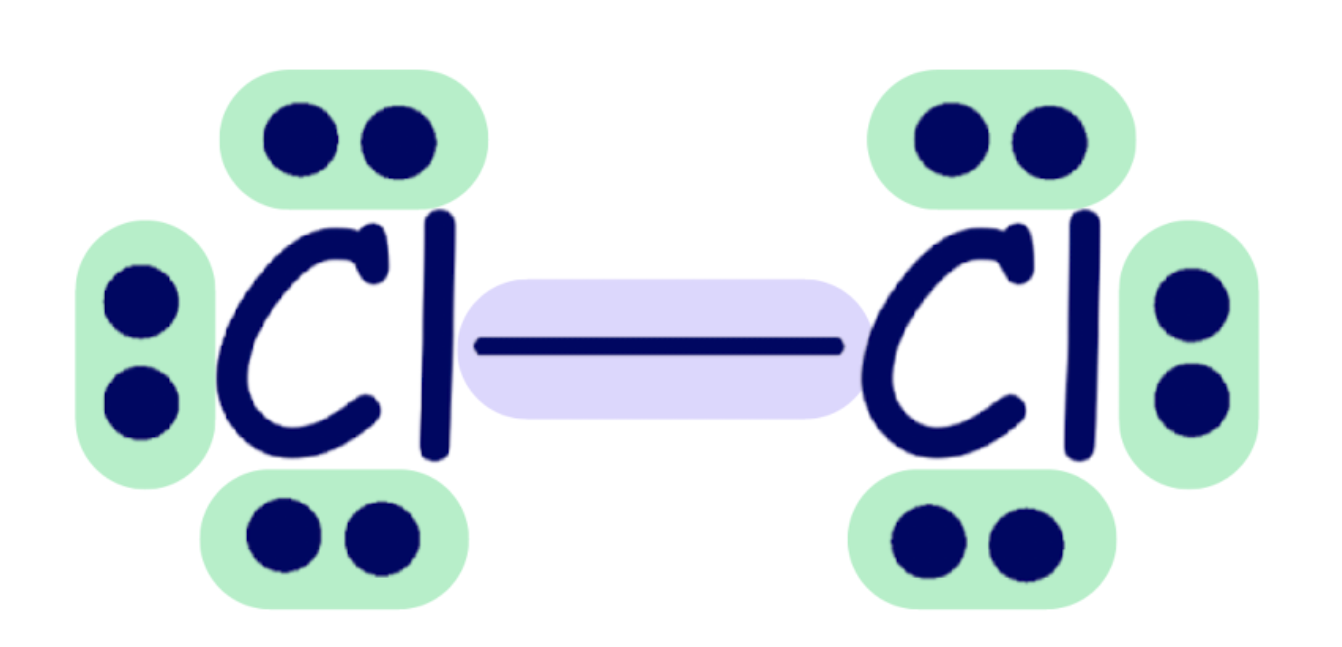
In this image:
Nonbonding pairs = 6 pairs, 12 total electrons
Aka lone pairs
Bonding pairs = 1 pair, 2 total electrons
Covalent Double and Triple Bonds
Double bonds - two dashes represent 4 shared electrons.
Triple bonds - three dashes represent 6 shared electrons.
Octet Rule Exceptions
Incomplete octets have incomplete valence levels.
Expanded octets often contain 5 or 6 valence.
Over 8 electrons.
Complete octets have 8 electrons.
Drawing Lewis Structures
Step 1: Find the total amount of electrons.
Step 2: Draw the base.
Step 3: Fill the octets of the outer atoms.
Step 4: Fill the octet of the central atom.
Molecules and Charge
Polyatomic ions - groups of atoms with an overall charge.
Formal charges - the atom with a specific charge.
Formal charge is an estimate of the total electron charge around bonded atoms.
Formal charge assumes that two atoms share electrons.
Calculating formal charges:

Drawing Lewis Structures for Polyatomic Ions
For polyatomic lewis structures, consider the charges when finding the number of valence electrons.
If an ion has a negative charge it means that there are extra electrons present.
Resonance Structures
A set of structures that show how electrons are distributed around a molecule or ion.
Used when a single Lewis structure is insufficient.
Electronic and Molecular Geometry
Electronic geometry - arrangement of electrons around the central atom.
Look at the groups/bonds.
Bonds = dashes. Double and triple bonds count as one set.
Molecular geometry - shape caused by the arrangement of atoms.
Considers nonbonding and bonding pairs.
Three electronic geometry shapes:
Linear
Trigonal Planar
Tetrahedral
Five molecular geometry shapes:
Linear
Trigonal Planar
Tetrahedral
Bent
Trigonal Pyramidal
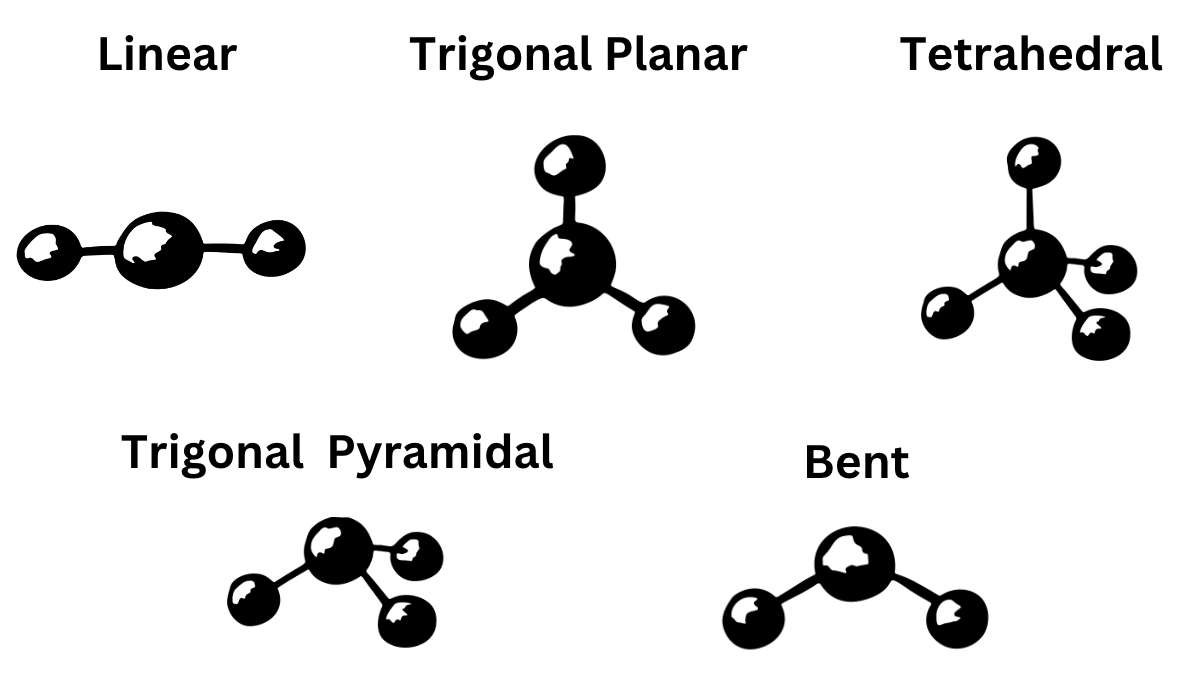
Lineae
Two Electron “Groups”: Linear
Electronic Geometry = Linear
Angle: 180 degrees
Molecular Geometry = Linear
2 electron groups, 2 bonding groups, 0 lone pairs
Electron Groups | Electronic Geometry | Bonding Groups | Lone Pairs | Molecular Geometry |
|---|---|---|---|---|
2 | Linear | 2 | 0 | Linear |
Trigonal Planar
Three Electron “Groups”: Trigonal Planar
Electronic geometry = Trigonal Planar
Angle: 120 degrees
Molecular geometry = Trigonal Planar
3 electron groups, 3 bonding groups, 0 lone pairs
Three Electron “Groups” and One Lone Pair: Trigonal Planar
Electronic geometry = Trigonal Planar
Angle: 120 degrees
Molecular geometry = Ben
If there are lone pairs, the MG will be bent.
3 electron groups, 2 bonding groups, 1 lone pair
Electron Groups | Electronic Geometry | Bonding Groups | Lone Pairs | Molecular Geometry |
|---|---|---|---|---|
3 | Trigonal Planar | 3 | 0 | Trigonal Planar |
3 | Trigonal Planar | 2 | 1 | Bent |
Tetrahedral
Four Electron “Groups”: Tetrahedral
Electronic geometry = Tetrahedral
Angle: 109.5 degrees
Molecular geometry = Tetrahedral
4 electron groups, 4 bonding groups, 0 lone pairs
Four Electron “Groups”: Tetrahedral
Electronic geometry = Tetrahedral
Angle: 109.5 degrees
Molecular geometry = Trigonal Pyramidal
4 electron groups, 3 bonding groups, 1 lone pairs
Four Electron “Groups”: Tetrahedral
Electronic geometry = Tetrahedral
Angle: 109.5 degrees
Molecular geometry = Bent
4 electron groups, 2 bonding groups, 2 lone pairs
Electron Groups | Electronic Geometry | Bonding Groups | Lone Pairs | Molecular Geometry |
|---|---|---|---|---|
4 | Tetrahedral | 4 | 0 | Tetrahedral |
4 | Tetrahedral | 3 | 1 | Trigonal Pyramidal |
4 | Tetrahedral | 2 | 2 | Bent |
Polar Bonds and Molecules
Polar covalent bond - atoms do not share electrons evenly.
Electronegativity
Electronegativity (EN) - How strong electrons in bonded systems are “pulled”.
Electronegativity increases from left to right.
Electronegativity decreased from top to bottom.
Fluorine has the strongest electronegativity = 4.0
Does not include noble gases
Comparing Covalent, Polar Covalent, and Ionic Bonds
Calculating difference in atom electronegativity:
higher value - smaller value
Spectrum of polarity
non-polar =======> polar
Non-polar Covalent < 0.5
Polar Covalent 0.5 - 2.0
Ionic (not polar) > 2.0
Molecules with Dipoles
Molecular dipole - an overall polarity in a molecule.
AKA net dipole
The molecule as a whole is polar => it has a net dipole.
Must consider the shape.
A molecule with a dipole has one side with a slight positive charge, while the other side has a slight negative charge.
Polar bonds
If net dipole is present, the molecule is polar.
If there is no net dipole, the molecule is non-polar.
The dipole in opposite directions will have an equal force.
The dipoles cancel out and the molecule is non-polar.