Overview of Important Receptor Types
Information Processing by the Sensory Division
Stimulus Processing Usually Conscious | |
Special Senses | Somatic Senses |
Vision | Touch |
Hearing | Temperature |
Taste | Pain |
Smell | Itch |
Equilibirum | Proprioception |
Stimulus Processing Usually Subconscious | |
Somatic Stimuli | Visceral Stimuli |
Muscle length and tension | Blood pressure |
Proprioception | Distension of gastrointestinal tract |
Blood glucose concentration | |
Internal body temperature | |
Osmolarity of body fluids | |
Lung inflation | |
pH of cerebrospinal fluid | |
pH and oxygen content of blood |
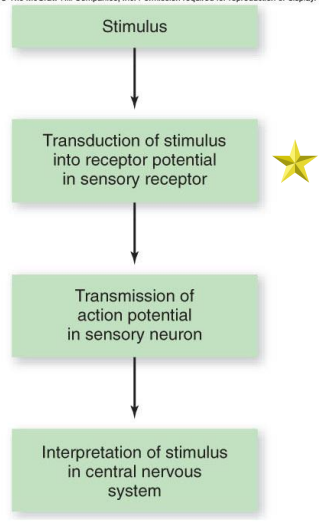
Sensory transduction mechanism -
Reception (stimulus)
Sensory receptor encoutners stimulus - receptors are highly specific (ex. thermoreceptor responds only to temp changes)
Ion channel gating
Bc. of stimulus the ion channels open/close. Can happen in two ways:
Direct (Ionotropic) - physical stimulus (like stretching the skin), physically pulls the ion channel open
Indirect (metabotropic) - stimulus triggers a complex chemical chain reaction (often involves G-proteins) inside the cell that eventually opens the channel
Ion flow (the current)
Once ions are open → ions flow across the cell membrane
Overview of Sensory Receptors
Sensory cells use ion channels in their membranes to respond to stimuli
open or close depends on the sensory system involved
Receptor potential (influx of ions in the intracellular space of the cell)
Analogous to the excitatory postsynaptic potential (EPSP)
For regulation and moderation: Hyperpolarizations are very important (IPSP - inhibitory postsynaptic potential)
They’re like graded potentials
larger sensory stimulus → greater the degree of depolarization → higher the frequency of action potentials
Sensory neurons have different type of receptors
3 Classes of Receptors
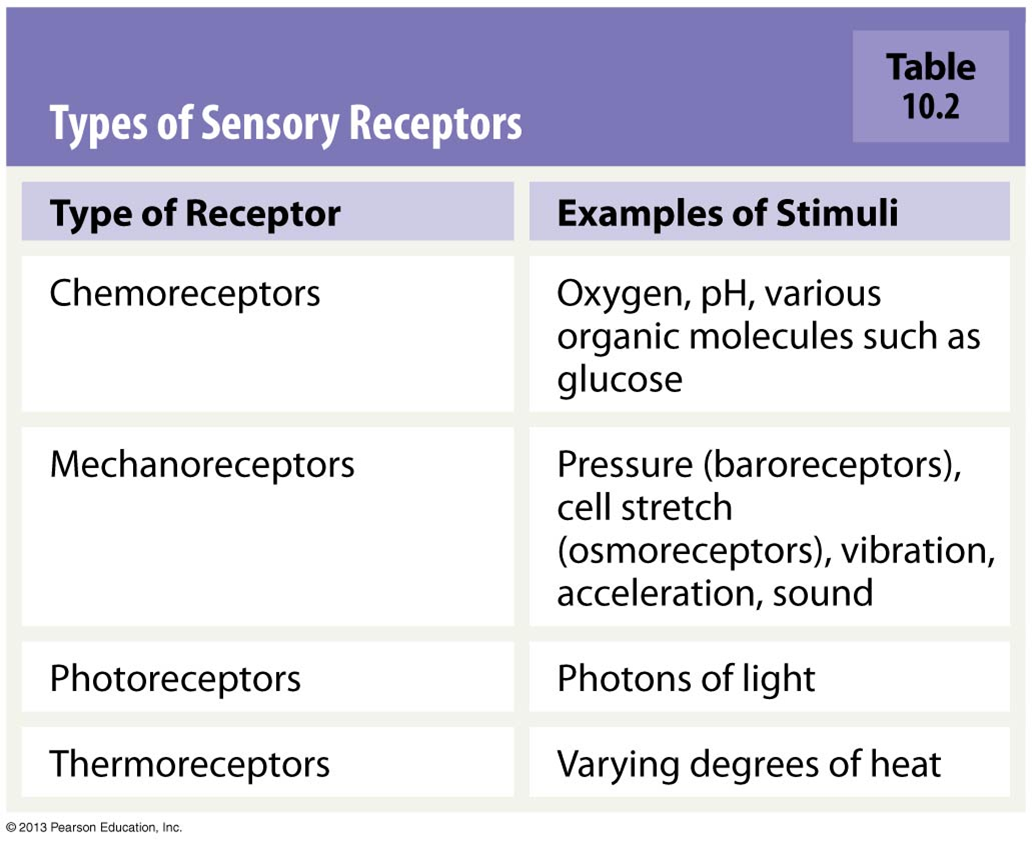
Mechanoreceptors
Stimulated by mechanical forces (like pressure)
Cutaneous receptors
Receptors in the skin - for pain, heat, cold, touch, and pressure
Responds to stimuli at the border between internal and external environments
Nociceptors
Transmits impulses perceived as pain
Sensitive to noxious substances + tissue damage
Most have free endings located thru the body (especially near surfaces)
Transient receptor potential (TRP) ion channel
Nociceptor Pathways:
Reflexive protective response
Integrated in spinal cord
Withdrawal reflex
Ascending pathway to cerebral cortex
Becomes conscious sensation (pain or itch)
Nociceptors: Pain and Itch
Itch
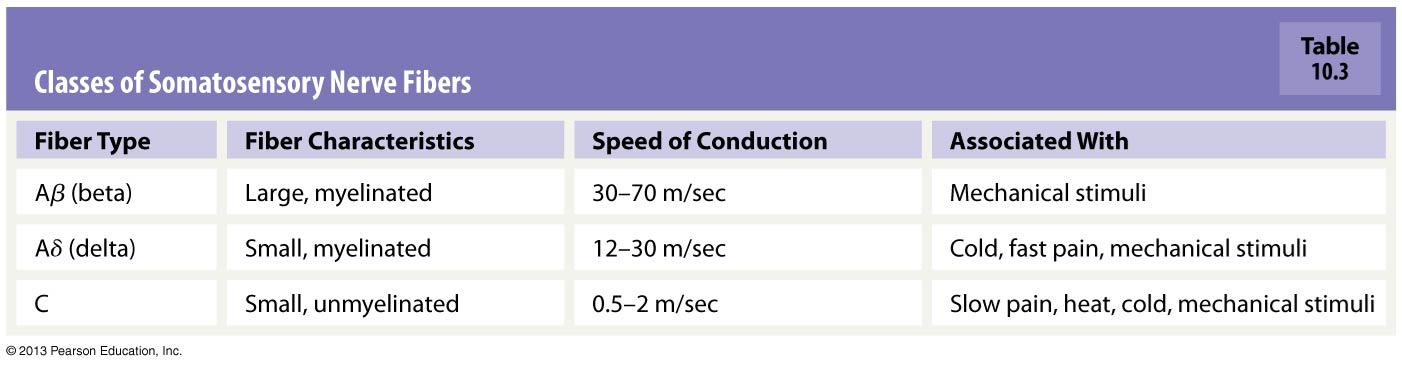
Histamine activates C fibers → causes itch
From skin nociceptors
Pain
Subjective perception
Fast pain (sharp + localized):
by A delta fibers
Slow pain (duller + more diffuse):
by C fibers
Strong pain - C fiber stops inhibition of the pathway → allows strogn signal to be sent to the brain
In abscence of input from C fibers (no stimuli), a tonically active inhibitory interneuron suppresses pain pathway
Pain can be modulated by simultaneous somatosensory input
Proprioceptors
Monitor mucle length and tension
Provide info ab the relative position or movement of body parts
Examples:
Muscle spindles - monitor stretch on muscle. Knee jerk reflex
Golgi tendon organs - monitor tension on tendons → Reflex inhibits motor neurons + prevents damage to tendons
Baroreceptors
Monitor blood pressure
Located at carotic sinus and aortic arch
Detects tension or stretch in the walls of these blood vessels
Blood pressure decreases → frequency of impulses produced by baroreceptors decreases
results in increased heart rate and vasoconstriction
Chemoreceptors
Detect chemicals or chemical changes
Binds to particular chemicals in the extracellular fluid
Membrane of sensory neuron becomes depolarized → produces action potentials
Used in senses of taste and smell
Important in monitoring the chemical composition of blood
pH —
Peripheral chemoreceptors
found in aortic and carotic bodies
sensitive to the pH of plasma
Central chemoreceptors
Found in the medulla oblongata of the brain
Sensitive to the pH of cerebrospinal fluid
Increased CO2 in blood → Lowers pH
Stimulates respiratory control center
Electromagnetic receptors
React to heat and light energy
Integration by CNS
Sensory information:
spinal cord → brain (by ascendingg pathways)
Directly to brain stem (by cranial nerves)
Visceral reflex integrated in brain stem/spinal cord - usually dont reach conscious perception
Perceptual threshold
Each major division of the brain processes 1+ types of sensory information
See image:
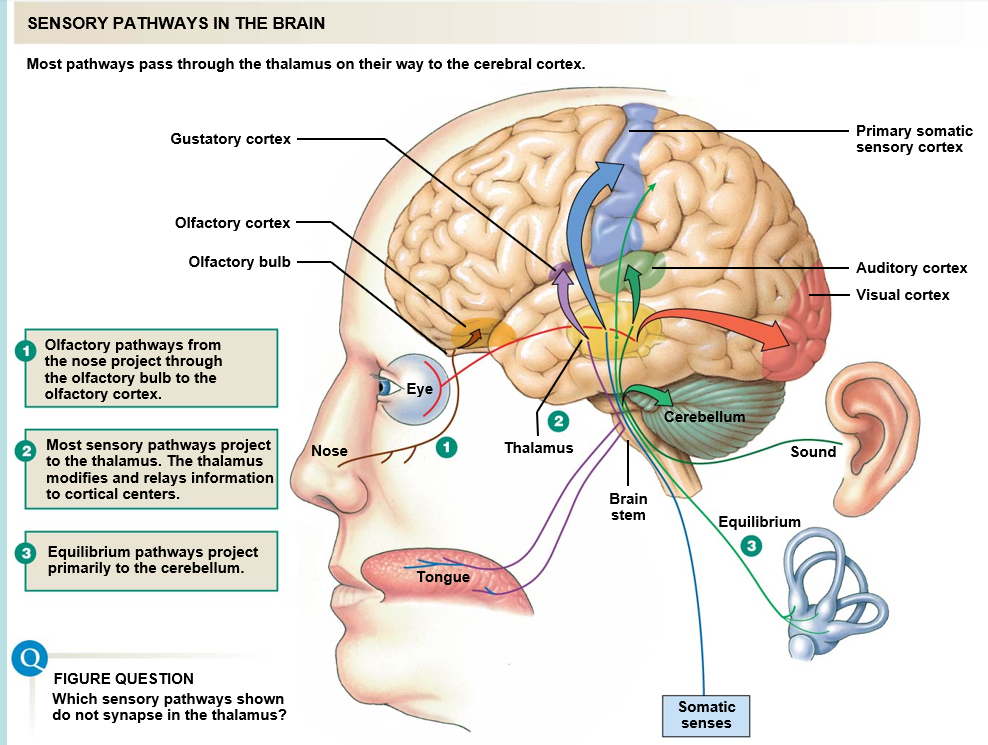
Key points:
Most sensory pathways project to the thalamus
Thalamus modifies + relays info to cortical centers
Equilibrium pathways → project to cerebellum
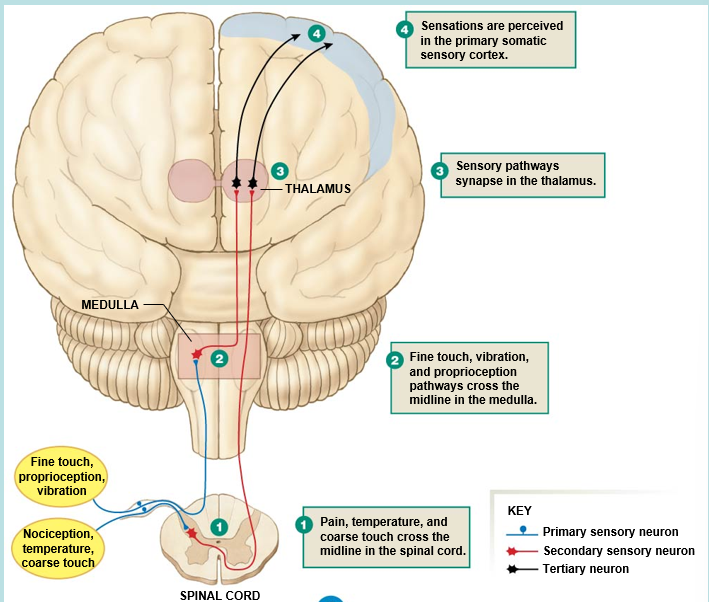
Key points:
Sensory pathways synapse in the thalamus
Sensations are perceived in the primary somatic sensory cortex
Class Notes 1/12/2026
Recitation: Focus on identifiying types of neurons
Homework: Due next week (Monday - 1/19)
(In this lecture we’ll focus on) Receptor types we’re using over and over again when it comes to regulation and moderation → mostly mechanoreceptors, chemoreceptors, etc.