the different types of seismic waves
seismic waves- resultant waves of an earthquake
body waves- they travel through the earth’ surface
primary waves - incident waves compress the rock in the earths surface causing as band of high density compression to move in the direction of the wave. they can travel through all states of matter
secondary waves- incident wave compresses rock sideways, causing deformation in one direction and adjacent layers to move in the opposite direction. Transverse waves, where propagation is perpendicular to the direction of travel. these waves move in a side-to-side motion and can only travel through solids because they have no rigidity to support the side ways motion.
P-waves occur first, followed by S-waves at 60% of the speed. S-waves can only travel through solids due to the elastic properties of needed for a transverse wave. P-waves can cause liquefaction.
Raleigh waves - similar motion to water waves – the ground ‘rolls’ but particles rotate away from the direction of travel
love waves- faster than Raleigh waves, propagate across Earth’s surface, particles move side to side, perpendicular to the path of the wave’s energy.
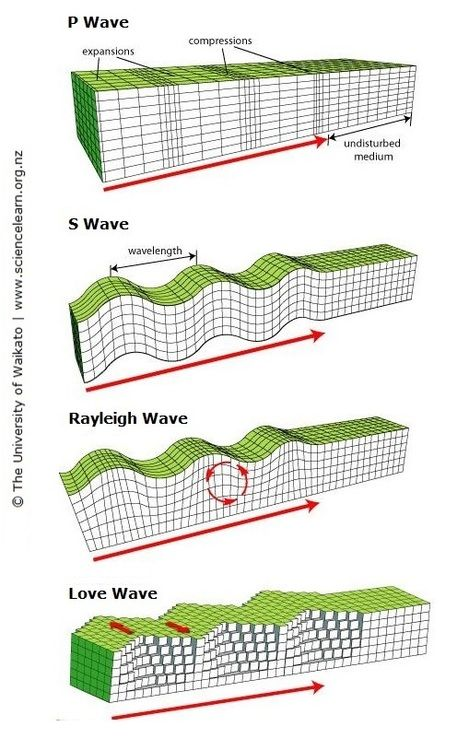
Mohorovičić’s theory of seismic wave movement
in 1990 she studied 4 types of waves and two of them were pressure and the other two were shear waves.
using a seismograph near the epicentre which showed slower moving P waves than S waves. But in contrast further away from the shock showed that the s waves were faster moving.
EARTHQUAKE HAZARDS AND IMPACTS
primary hazards | impacts |
|
|
secondary hazards |
|
|
|