Chapter 4 - Classical Conditioning
Vocabulary:
Classical conditioning (Pavlovian conditioning): A form of learning in which an animal acquired the expectation that a given stimulus predicts a specific upcoming important event. Demonstrated by all organisms. Evolutionarily, allows for prediction about an environment when there is no control over it, foreknowledge is exploited for benefit
Unconditioned stimulus (US): A stimulus that naturally and without learning/conditioning evokes a response, innate (food)
Unconditioned response (UR): A natural behavior in response to an unconditioned stimulus, not dependent on learning/conditioning (salivation)
Neutral stimulus (NS): Doesn’t evoke a natural response, will become a conditioned stimulus (bell)
Conditioned stimulus (CS): A cue that is paired with a US and comes to elicit a conditioned response, starts off as a neutral stimulus. Can be any environmental cue (bell)
Conditioned response (CR): The trained response to a conditioned stimulus in anticipation of the unconditioned stimulus that the conditioned stimulus predicts (salivation)
Appetitive conditioning: Consists of learning/conditioning to predict something that satisfies a desire or an appetite, the US is desirable. Examples include food/sex
Aversive conditioning: Conditioning in which the US is a disagreeable event (such as a shock or air puff to the eye)
Conditioned emotional response (CER): A technique for studying learned fear. Rats were in a cage with a level that when pressed dispensed food and a metal grid floor which could administer shocks. If conditioned to freeze due to fear at a tone from a shock, they would hesitate to press the lever
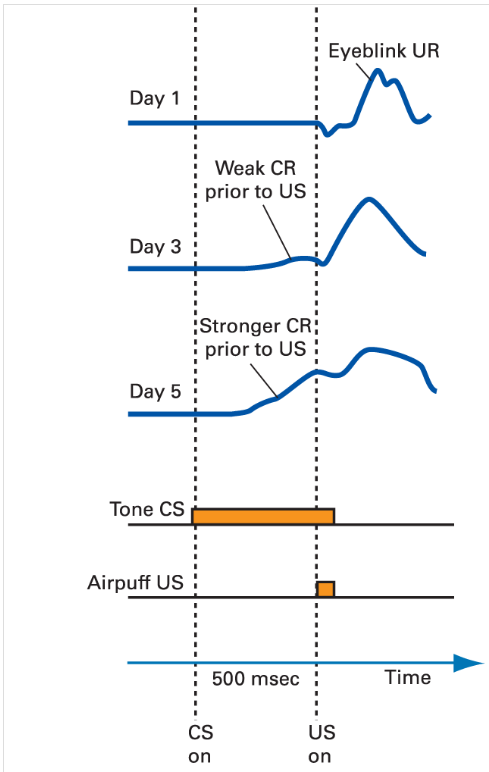
Eyeblink conditioning: A classical conditioning procedure in which the US in an air puff to the eye and the CR and UR are eyeblinks, present across species
Electromyography (EMG): Can measure eyeblink conditioning, has detectors of electrical activity of muscles above and below the eyes
Tolerance: A decrease in reaction to a drug such that larger doses are required to achieve the same effect
Homeostasis: The tendency of the body and brain to gravitate toward a state of equilibrium or balance. This is demonstrated with classical conditioning where in anticipation of a response that will deviate from mean, the brain/body naturally change to counteract the potential change
Timing: A property that impacts classical conditioning, if the US is before the CS there is no learning, demonstrates how the CS must occur prior to the US, but not with too long of a delay
Informational value: How much new evidence and predictive value something gives us relative to what we already know or believe
Extinction: The process of reducing a learned response to a stimulus by ceasing to pair that stimulus with another previously associated stimulus, the CS is presented without the US and it is learned to not associate and predict the US. Not unlearning, rather learning of the opposite response to the CS, meaning there are two learned associations and one is suppressed/unexpressed with context determining which expression is retrieved
Spontaneous recovery: Happens when a CS and US aren’t paired for a long duration of time, when suddenly presented the behavior can present itself again, displays dormant association
Rapid reacquisition: Evidence that extinction doesn’t involve total loss of previous learned associations, as a previously extinguished CS is learned more quickly that a new association between CS and US
Compound conditioning: Conditioning in which two or more cues are present together, usually simultaneously, forming a compound CS. Individually, the cues are less potent than when together, suggesting interference
Overshadowing: Can occur in compound conditioning when one stimulus is stronger than the other(s) and gains more attention. This stronger cue will gain a larger association to the US, though individually will show less response than when compounded
Blocking: A two-phase training paradigm in which prior conditioning with one cue (CS1→US) block later learning of a second cue when the two are paired together in the second phase of the training (CS1+CS2→US). Demonstrates that classical conditioning occurs only when a cue is both a useful and a nonredundant predictor of the future, noticed by Kamin and later studied separately by Rescorla and Wagner
Rescorla-Wagner Model of Conditioning: States that for a CS to be associated with a US, it must be impart reliable, useful, and nonredundant information. Cues appear to compete with one another for associative strength. Changes in CS-US associations on a trial are driven by prediction error, when there is none there is no new learning, as the expected outcome occurs, assumes things have associative weight. Doesn’t account for attention to stimuli modulation during learning or latent learning
Prediction error: Used in the Rescorla-Wagner model of conditioning, the difference between what was predicted and what actually occurred. Can be positive is there is more US than expected, causing CS→US association to increase. Negative is when a CS predicts a US that never occurs, which is followed by a decrease in CS→US association. Encoded within the inferior olive
Error-correction learning: Learning through trial and error to reduce the discrepancy between what is predicted and what actually occurs, used in both motor skill learning and classical conditioning
Associative weight: A value representing the strength of an association between a cue and a US, cue specific. Starts at 0.0, and increases as training continues
Latent inhibition: A conditioning paradigm in which prior exposure to a CS retards later learning of the CS-US association during acquisition training. Cannot be explained by the Rescorla-Wagner model, essentially the boy who cried wolf, teaches us that the CS must be attended to for an association to be made
US modulation theory: Any theory of conditioning that says the stimulus that enters into an association is determined by a change in how the US is processed, for example the Rescorla-Wagner model
CS modulation theories: Any theories of conditioning that say the stimulus that enters into an association is determined by a change in how the CS is processed
Mackintosh Model of Classical Conditioning: A form of CS modulation, operates on the idea that people have limited capacity for processing incoming information, or limited neural resources. Explains blocking due to a lack of resources available to dedicate to the second CS. Differs from the Rescorla-Wagner model in that it says a stimulus must be paid attention to. Says that with trace conditioning, the hippocampus is used to “remember” the CS over the delay
Trial-level model: Any theory of learning in which all the cues that occur during a trial and all the changes that result are considered a single event, applies to the Rescorla-Wagner model and the Mackintosh model, limited as it doesn’t explain when the CR occurs and only explains the aggregate effect
Delay conditioning: A conditioning procedure in which there is no temporal gap between the end of the CS and the beginning of the US and in which the CS co-terminates with the US, CS is continuous, makes things easier to learn
Delay: The time between the onset of the CS to the onset of the US (as opposed to simultaneous occurrence). If this gap is tiny, learning is poor
Trace conditioning: A conditioning procedure in which there is a temporal gap between the end of the CS and the beginning of the US, named because there is a ‘trace’ of the CS that has to be remembered to be associated with the US, harder to make an association than with delay conditioning, requires a hippocampus
Interstimulus interval (ISI): The temporal gap between the onset of the CS and the onset of the US
Associative bias: When some clues are more likely to be associated with some outcomes, typically within the same relevant area of cause (food and a stomach ache as opposed to the movie watched that night)
Conditioned taste aversion: A conditioning preparation in which a subject learns to avoid a taste that has been paired with an aversive outcome, usually nausea
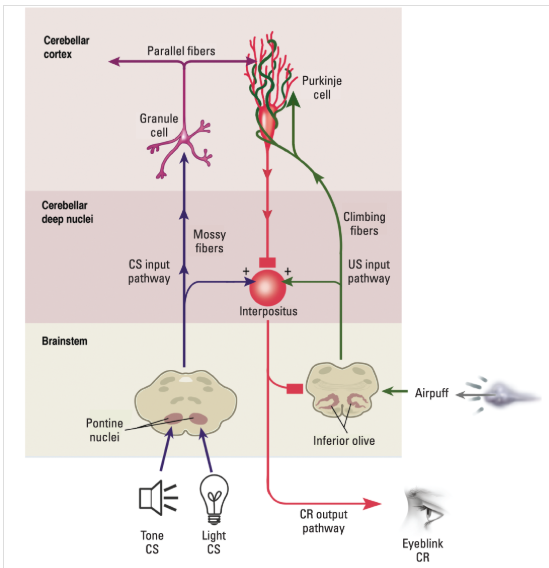
Cerebellum: A brain region that lies below the cerebral cortex in the back of the head, responsible for the regulation and coordination of complex voluntary muscular movement, including classical conditioning of motor-reflexes, lesions can lead to inability to form classical conditioning responses and elimination of previous associations. Gets information from the CS directly and information about the US from the reflex pathway, CS and US together and it has the circuitry to produce a CR
Reflex pathways: Hard wired into our brains developmentally, pathways that are responsible for automatic outputs in response to physical stimulations
Cerebellar cortex: Part of the cerebellum that has Purkinje cells, lesions cause issues with CR timing
Purkinje cells: Large, drop-shaped, densely branching neurons in the cerebellar cortex. Spontaneously fire even when nothing is happening. In trained animals, will decrease firing response to a CS, increased CS-US pairing may cause synaptic depression in the parallel fiber synapses of these cells, inhibit the interpositus nucleus. May have modulating but nonessential influence on learning the CR. When this stops firing, the interpositus fires more (producing a CR). Lesions cause issues in timing of CR learning
Long Term Depression (LTD): Plays a role in classical conditioning, as repeated Purkinje cell firing from parallel fiber synapses is decreased in animals with many well trained CS-US pairings
Long Term Potentiation (LTP): An increase in synaptic efficacy, basis for Hebbian learning between two neurons
Cerebellar deep nuclei: A collection of cells beneath the cerebellar cortex, include the interpositus nucleus, essential for learning the CR
Interpositus nucleus: One of the cerebellar deep nuclei, where conditioned response output is generated in classically conditioned motor responses, if there is no CR there is no activity here (in rabbits). Inhibited by Purkinje cells. CS and US come together here
CS input pathway: A sensory input pathway to the cerebellum, initially projections from parts of the brain → the pontine nuclei → innervates the cerebral deep nuclei via mossy fibers → branches to the (1) interpositus nucleus and (2) cerebellar cortex via granule cells → (2) across parallel fibers and → (2) dendrites of Purkinje cells
Pontine nuclei: Part of the CS input pathway, takes inputs from various parts of the brain about the CS and US, has different subregions for each kind of sensory stimuli, projects to the cerebellar deep nuclei via mossy fibers, in the brain stem. Location of CS storage
Mossy fibers: Carry information from the pontine nuclei to to the cerebellar deep nuclei, branch two directions to the interpositus nucleus and granule cells
US input pathway: A sensory input pathway to the cerebellum, starts with activation of the inferior olive which activates → (1) interpositus nucleus and (2) cerebellar cortex via climbing fibers → (2) wrap around Purkinje cells and cause large complex sets of activation spikes in them
Climbing fibers: Connect the inferior olive to the cerebellar cortex, extend to wrap around Purkinje cells to have strong excitatory effects
Inferior olive: Located in the brainstem, a nucleus of cells that conveys information about aversive stimuli (like an airpuff US) up to both the interpositus nucleus and cerebellar cortex. Location of the US. Activity reflects actual US minus expected US (due to inhibition), meaning this is where the brain codes prediction error (from the Rescorla-Wagner model). This means that activity here decreases as the CS-US association strengthens. Sends climbing fibers to wrap around Purkinje cells
CR output pathway: Purkinje cells project from the cerebellar cortex into the cerebellar deep nuclei and make inhibitory synapses with the interpositus nucleus, the inferior olive is inhibited from sending US information to the Purkinje cells
Hippocampus: Not necessary for classical conditioning, but shown to be very active during training, particularly early on. Park of the Mackintosh model states that this is used. May play a role in latent inhibition and determining stimulus salience. Removal shows elimination of latent inhibition, issues with trace conditioning and contextual conditioning.
Contextual conditioning: Uses the hippocampus to take many inputs to form an idea of a place (context), conditioning that occurs when in a certain place/context
People:
Ivan Pavlov (1849-1936): “Father” of classical conditioning, did work with dogs and a bell to condition them to salivate at the response of the bell due to the conditioning with food. Discovered it by accident. In his experiments with the salivation of dogs, the US was the food, the UR was salivation, the NS was the bell. BY ringing a bell every time he fed them, the NS became the CS
B.F. Skinner: Founder of the behaviorist approach, helped develop CER with Estes
W.K. Estes: Founder of mathematical psychology and learning theory, studied under B.F. Skinner and helped him develop CER
Clark Hull: Early mathematical psychologist, taught graduate students to blink in anticipation of a slap, a CS tone would play prior to the US slap, causing the student to CR blink
Sometimes the UR and CR are the same, but sometimes they are different. For example, when someone takes adrenaline (US) in a given room (CS) often, the UR is behaviors that occur when adrenaline are taken, but the CR is the person’s body naturally lowering adrenaline levels in anticipation of the injection
Due to a CS’s nature of being a naturally occurring cue, what is used as a CS in one experiment might be the US in another
Competition between cues in classical conditioning can be either based on saliency (notability) or temporal presence. Cues compete for associative strength
Cerebellar involvement in eyeblink conditioning is lateralized, damage to the left cerebellum damages conditioning with only the left eye and vice versa, seen in rabbits and humans
One way drug tolerance is created is through classical conditioning. Environmental cues (CS) that accompany a drug (US) classically condition the used to expect to receive the drug, creating an intense craving (CR) felt is response to cues, telling the body to prepare and compensate for the body’s response in anticipation of the drug offsetting homeostasis. This is why doing the same amount of a given drug in a new space has a larger effect, and more easily leads to overdose.
Classical conditioning can help reduce the need for large medication doses, by pairing a neutral stimulus with initial administration of a medication, a CS-US association can be formed between the stimulus and the medication, leading the body to feel as if it has been medicated when just the CS is presented, having therapeutic effects without the negative side effects of large doses.
If the Rescorla-Wagner model was mapped onto the brain, weights are located within the strength of the synaptic connections from the pontine nuclei to the interpositus nuclei. In the interpositus nucleus, the sum of the weights are added. This then sends a signal to the body to carry out the CR (proportional with the expected US). The inhibitory branch from the interpositus nucleus to the inferior olive sends a signal with expected US, and the inferior olive gets actual input about the actual US, meaning the inferior olive is where actual-expected (prediction error) is calculated. This prediction error signal is then carried to both the Purkinje cells and the interpositus nucleus, increasing/decreasing the weights of the CS that are active in the interpositus nucleus. Blocking is in the inhibitory pathway from the interpositus nucleus to the inferior olive